Why Am I So Bad at Sports and What Can I Do About It
Feeling bad at sports is not a talent verdict. It is a structural diagnosis, and once you name the real causes, every single one of them is fixable.
Most people carry a quiet, fixed belief about themselves: “I’m bad at sports because I’m not naturally athletic, some people have it and I just don’t.” It is one of the most common experiences in recreational fitness, and one of the most misread. The conclusion most people land on is personal: “I’m just not built for this.” The reality is almost always structural. Something in the environment, the feedback loop, or the plan itself is broken, and that broken system produces feelings that look exactly like a talent deficit. See our AI fitness app for how this works in practice.
That gap between the real cause and the felt cause is where confidence goes to die. And once you name the actual mechanisms, the whole story changes. The majority of young people drop out of organised sport before their teenage years end, and the pattern continues into adulthood.
Research presented at the 2023 AAP National Conference and Exhibition found that body-image pressure driven by social media comparisons, not missing talent, is a primary structural reason people abandon sport altogether. The quitting is real. The cause is misidentified.
Being bad at sports is almost always traceable to one of four structural causes: underdeveloped foundational motor skills, poor coordination from limited early movement exposure, performance anxiety that tightens muscles and slows reactions, or a simple mismatch between your body’s mechanical profile and the sport you chose. None of these is talent. All of them are addressable.
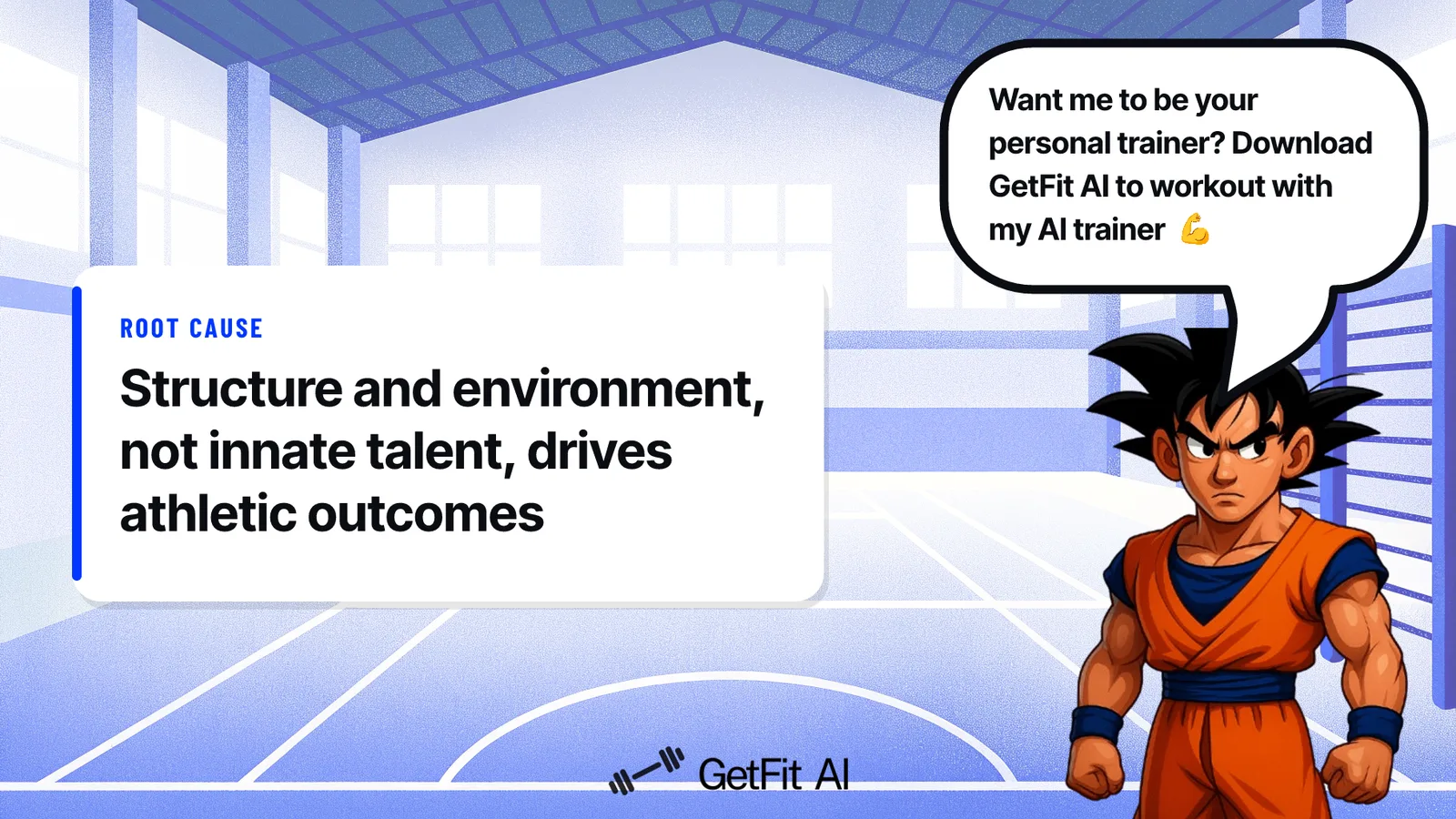
Motor skill competency in a new sport takes consistent, structured repetition over months, not sessions. A study of 11,235 children aged 9-13 found that the structure and environment of sport, not innate talent, is the key driver of athletic outcomes. Most beginners never get that structure.
Anxiety compounds everything. Worrying about being judged tightens muscles, shortens breathing, and slows reaction time.
That physical tension is then read as proof of incompetence, which deepens the anxiety, which worsens the performance. The loop is self-sealing.
Unstructured repetition is not practice. Research by Anders Ericsson on deliberate practice consistently shows that skill acquisition requires structured feedback and targeted correction, not accumulated hours of the same movements. Showing up without a plan means repeating the same patterns, including the errors, with no cue telling you what to fix.
That silence, the moment you don’t know your next move and have no one to ask, is exactly where the “I’m just not athletic” story gets written and reinforced. The problem was never effort. It was the absence of a feedback structure that could catch errors before they calcified into habit.
That’s the gap GetFit AI’s AI Trainer Chat is built for: a trainer you can message the second you’re lost, mid-set or at midnight, so confusion doesn’t get misread as personal failure. Once you stop treating “I feel bad at sports” as a character verdict and start treating it as a diagnostic signal, the real causes become visible and fixable.
Key takeaways
- Feeling bad at sports is almost never a talent problem, it's a structural one: no plan, no feedback loop, and a training environment designed to make you plateau and blame yourself.
- Poor body awareness is a sensory gap, not a genetic sentence, proprioception is trainable, and most beginners have simply never trained it.
- Childhood movement exposure wires motor patterns into the brain early; adults who missed that window aren't broken, they're just starting from a different baseline that requires deliberate catch-up work.
- Performance anxiety isn't mental weakness, cortisol spikes before a ball leaves the pitcher's hand, physically degrading coordination in real time, which means managing stress is a sports skill, not a personality fix.
- Genetics matter at the margins, limb length, muscle fiber ratios, center of gravity, but most beginners are failing at one sport that punishes their exact movement profile, not at sports in general.
- Unstructured repetition is the most expensive habit in amateur sport; isolating one mechanic at a time closes skill gaps faster than full-game reps ever will.
- GetFit AI's AI Trainer Chat puts a real trainer in your pocket for exactly the moments structure breaks down, form checks, exercise swaps, plan questions, or a what-do-I-do-now when you're mid-workout and lost.
What Causes Poor Body Awareness and How Does It Affect Athletic Performance
Poor body awareness is a sensory gap rooted in how well your nervous system maps your own movement, and that gap directly shapes how fast and accurately you respond when sport demands it.
Proprioception - Your Body’s Internal GPS
Poor body awareness in sports is a sensory gap. According to the Journal of Modern Rehabilitation (April 2023), proprioception is the sensory system that feeds your brain real-time information about the position and movement of your limbs in space, forming the body’s internal map of where it is and how it is moving.
The same research confirms that proprioceptive ability directly influences how quickly and accurately a person responds to movement demands, so it functions as a core driver of athletic reaction time. Consider someone attempting their first squat: they struggle to feel whether their knees are caving inward because their nervous system has no reference point for that position yet.
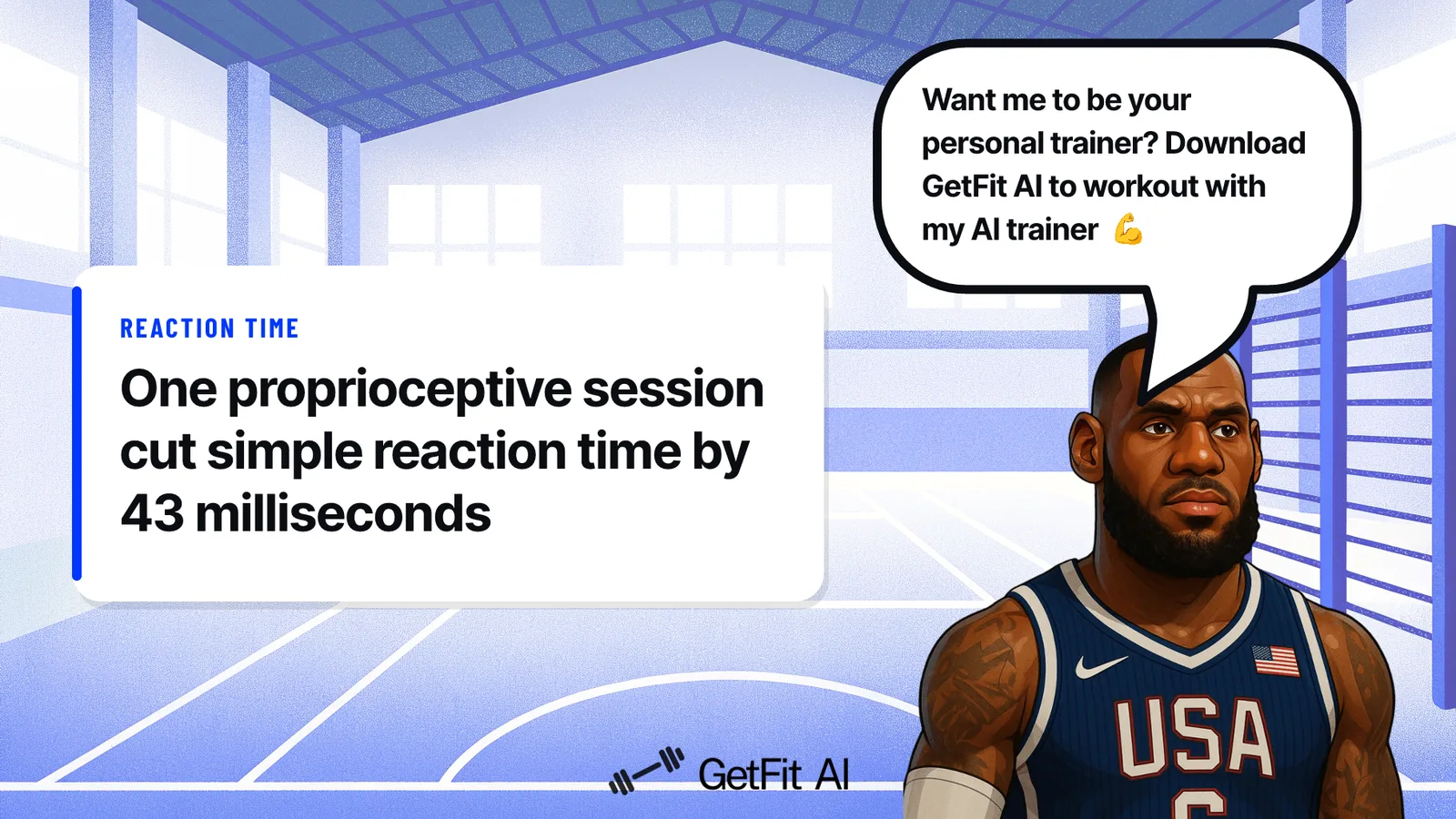
Key takeaway: Participants in the Journal of Modern Rehabilitation study showed a mean decrease in simple reaction time of 43 milliseconds after a single proprioceptive training session, and gains persisted beyond the session itself.
Flexibility, Balance, and Core Stability as Coordination Foundations
Low flexibility, poor balance, and weak core stability make foundational motor skills feel awkward because each one removes a layer of the body’s ability to control position in real time. Tight hips limit the range your proprioceptors can sample, so the brain receives incomplete position data mid-movement. A weak core means the body’s central anchor shifts unpredictably, forcing your limbs to compensate rather than move with intention.
These deficits compound each other in practice: a person with low core stability cannot transfer force from their legs through their trunk cleanly, so throws feel weak and footwork feels lurching.
The Uncorrected-Pattern Trap - Why Practicing Without Cues Deepens Bad Movement Instead of Fixing It
Repetition alone does not fix a flawed movement pattern; it builds habit, and a bad habit practiced a thousand times is harder to unlearn than one caught on day one. Motor learning research consistently shows that practicing a movement pattern without external cues reinforces whatever mechanics the nervous system defaults to, accurate or not.
Related Reading
- Why Am I Not Getting Faster at Running
- Does Masturbation Affect Athletic Performance
- Biomechanics in Sports
- Why is Protein Important for Athletes
- What is Speed and Agility Training
- How to Be a Better Athlete
- How Does Sports Psychology Help Athletes
- Why is Hydration Important for Athletes
- Why Do Athletes Train at High Altitudes
- Why Do Athletes Stretch Before a Game?
- IV Therapy for Athletic Performance and Recovery
- Yoga and Athletic Performance
- Red Light Therapy for Athletic Performance
Why Lack of Childhood Movement Exposure Creates Athletic Struggles in Adults
The movement patterns your brain was supposed to wire during early childhood simply never got built, and that missing foundation is what shows up every time you try to learn a new athletic skill as an adult.
Your Brain Wired Movement Habits During Childhood Play and Skipped Steps Show Up Now
That wiring happened earlier than most people realize. By age six, the window for effortless motor learning has largely closed.
The Special Needs Resource Foundation of San Diego identifies the zero-to-six span as the period of critical developmental windows that directly shape healthy movement foundations, and the Center on the Developing Child at Harvard University confirms that the brain is most receptive to movement-based experiences during early childhood. When those experiences are absent, the relevant neural circuits simply don’t develop as efficiently, making the skills harder to acquire later in life. If athletic movement feels foreign to you now, there is a straightforward reason: you missed the developmental window where your brain was doing its most efficient movement wiring.
Athletic movements feel unnatural to adults who weren’t active as kids because the brain never built the neural pathways those movements run on. The Center on the Developing Child at Harvard University is clear that young children are biologically more sensitive to these learning experiences than adolescents, who are in turn more sensitive than adults. The result is that what feels like clumsiness is actually something more structural.
It's not clumsiness. It's a brain reaching for a file that was never saved.
Layered on top of that neurological reality is a pattern we see consistently: adults who recognize the gap often don’t know where to start, which means the gap widens through inaction rather than closing through practice.
Here is the reframe that changes everything: adults can close the movement gap. Neuroplasticity research confirms the adult brain retains the capacity to build new motor patterns, but doing so requires structured, well-guided repetition rather than trial and error. That is precisely where GetFit AI’s AI Trainer Chat closes that feedback loop instantly, so structured practice produces the neural repetitions it’s supposed to.
GetFit AI delivers Athlete-Style Custom Workout Plans from your very first session, and continues guiding you through each individual workout and across the overall training program arc, so there is always a clear next step rather than a blank page that invites avoidance.
The structured program is also what keeps users training past the early weeks, the point where unstructured approaches most commonly collapse, because the plan itself removes the daily decision fatigue that stalls beginners who are already working against an underdeveloped movement foundation.
How Sports Performance Anxiety Physically Manifests and Wrecks Your Game
Cortisol spikes before a ball even leaves the pitcher’s hand. The common assumption that follows is the same one this post opened with: that you are just not naturally athletic.
The Cortisol-to-Clumsy Pipeline - What Anxiety Actually Does to Your Muscles Mid-Game
Performance anxiety physically impairs sports performance by flooding the body with cortisol, which increases muscle co-contraction and slows motor response time before you have a single conscious thought about the play. According to a study in the Journal of Population Therapeutics and Clinical Pharmacology, baseline cortisol levels were measurably higher during real competitions than in training conditions, confirming that competitive settings trigger a distinct physiological stress response.
-
Muscles that need to be loose to catch, kick, or throw instead tighten against each other.
-
Peripheral vision narrows.
-
Breathing becomes shallow, cutting oxygen delivery to the muscles that need it most.
The recreational basketball player who drains shots alone in the driveway and then airballs in front of teammates has not lost a skill; their body chemistry has simply changed the conditions of execution.
The Yerkes-Dodson Tipping Point - Why Trying Harder in the Moment Makes You Perform Worse
The Yerkes-Dodson law describes an inverted-U relationship between arousal and performance: a moderate level of activation sharpens focus and speed, but past that peak, additional arousal degrades execution. Your conscious mind attempts to override motor patterns that work best when they run automatically, a phenomenon sport psychologists call “paralysis by analysis.”
GetFit AI’s Athlete-Style Custom Workout Plans are built around this principle.
How Repeated Anxious Failures Calcify Into an “I’m Just Not Athletic” Identity
Research in sport science on athletic self-concept shows that repeated performance failures in evaluative social settings compound into fixed beliefs about personal ability that persist long after the anxiety trigger is removed.
The cruel part is that the belief becomes self-fulfilling. Expecting to fail raises pre-performance cortisol. Elevated cortisol tightens muscles and narrows attention, which produces another poor performance, which deepens the belief.
Key takeaway: The Journal of Population Therapeutics and Clinical Pharmacology research found that structured training with adequate recovery produces significant decreases in baseline cortisol levels across athletic groups, so anxiety is a trainable variable.
GetFit AI’s structured training begins working on that problem from the first workout session, and the social layer, friends, challenges, and leaderboards, functions as the retention engine that keeps users training past week three, when most unstructured routines collapse. After connecting with at least one friend in the app, that accountability layer activates continuously across the overall training program arc, with monthly and yearly options available for those committed to the longer arc the research says is necessary to move baseline cortisol in a meaningful direction.
What Role Do Genetics and Body Mechanics Actually Play in Athletic Ability
Most people accept early on that certain genetic and physical variables are working against them. But the question most people never think to ask is whether those variables are working against them in general, or just in the specific sport they happened to try first.
“It’s frustrating to see elite genetic potential, size, speed, natural athleticism, go to waste because of poor discipline, drug and alcohol abuse, and mental health struggles. Genetics alone just aren’t enough without the lifestyle to back them up.”
— what we hear from sports performance coaches
Genetics, Center of Gravity, and Limb Length Do Matter
Center of gravity, fast-twitch versus slow-twitch muscle fiber ratios, and height do give natural advantages in specific sports, and those advantages are real.
-
Fast-twitch fibers, which are largely genetically determined, favor explosive and power-based sports.
-
A higher proportion of slow-twitch fibers suits endurance activities.
-
Greater height benefits basketball and volleyball.
-
A lower center of gravity aids agility and balance in contact or precision sports.
One pattern we see often: parents who are tall or naturally large expect to see those traits reflected in their child early, and when the child doesn’t perform the way the genetic profile seems to promise, they read it as a failure of athleticism rather than a timing and development question. That reading leaves out context, maturation rate, sport fit, and training history. It is an incomplete picture.
Genetics Sets Your Ceiling, Not Your Starting Line
Genetic potential defines an upper boundary, not a guaranteed outcome. Most recreational athletes never approach their genetic ceiling because structural gaps, no plan, no feedback, no movement foundation, stop them far earlier. The ceiling is rarely the limiting factor; the path to it is.
This is not a theoretical observation. Athletes with modest genetic profiles who train with structure consistently outperform genetically gifted athletes who don’t.
Your Body Type Is a Sport-Matching Signal, Not a Global Athletic Verdict
Many athletes who felt athletically limited were not limited overall. It was sport-fit mismatch. Body mechanics in sports are specific, not universal, and the body type you read as a liability in one movement pattern is often exactly what another discipline rewards.
Knowing your body’s mechanical profile is only useful if you then train in a way that actually develops the movement patterns it favors and fuels the adaptations those patterns require. Nutrition is part of that equation. GetFit AI addresses this directly: tell the platform what you’re trying to build, and it tells you what to eat to actually put on size or lean out to support the specific athletic output your body type is suited for.
The question then shifts from “why am I built this way?” to “how do I practice and fuel myself so my body actually learns?”, and that is exactly what the next section addresses.
Related Reading
- Athletic Performance Analysis
- Does Vaping Affect Athletic Performance
- How to Avoid Feeling Sleepy After Workout
- How Does Sleep Affect Athletic Performance
- How to Measure Athleticism
- Velocity Based Training
- Building Stamina and Endurance
- Endurance vs Strength Training
- Why Am I So Tired After Working Out
- How to Create a Personalized Workout Plan
How to Improve at Sports Through Skill Isolation and Deliberate Practice
What’s actually wrong is the structure of the session, not the person running it.
Isolate One Mechanic Before You Ever Touch a Full Game Rep
Skill isolation works because full-game reps bury the one thing you’re failing at inside a flood of competing demands. Your brain cannot fix a broken hip hinge while simultaneously tracking a defender, calling a position, and managing your breath. Worse, you repeat it at game speed, and Donald Clark Plan B (summarising Anders Ericsson’s research) shows that unplanned repetition of the same movements entrenches existing habits rather than building new skills. The nervous system encodes what you repeat, not what you intend.
The fix is blunt: pull one mechanic out of the game entirely and drill it alone. Spend 15 minutes on just the hip hinge before attempting a deadlift. Spend a session on nothing but your ball-contact point before you scrimmage. Ericsson’s framework is clear that expert performers break their domain into component skills and practice each in isolation before integrating them, so the sequence matters as much as the repetition itself.
It is also worth holding one uncomfortable truth without flinching: even research-backed, constraint-based coaching methods do not guarantee improvement for every athlete who follows them faithfully. A meaningful portion of beginners who engage in structured practice still fail to progress, which means methodology alone is insufficient. The missing variable is almost always specificity, isolating the right mechanic at the right moment in the right sequence for your movement profile, not a generic template.
Mobility and Balance Drills as the Foundation of Skill Learning
Proprioception research consistently shows that body-awareness training is a direct performance input. Build 10 minutes of balance and mobility work into every session before you isolate any sport-specific mechanic, and treat it as load-bearing preparation rather than warm-up ritual.
Give Yourself a Beginner’s Scoreboard
A meta-analysis on positive self-talk and motor skill learning confirms that internal dialogue during practice measurably affects skill acquisition rate, not just mood. Reframe the measure entirely: track what improved in each session rather than wins or losses at this stage.
GetFit AI addresses this directly through its friends, challenges, and leaderboard layer.
This is the retention mechanism that keeps users training past week three, when most beginners quietly quit.
When a session stalls, GetFit AI closes the feedback gap mid-session: message your AI trainer the second you’re stuck instead of defaulting back to full-game reps that groove the broken pattern all over again.
The next section shows you how to match your body type and natural skill tendencies to the sport most likely to reward your reps.
What Types of Sports Actually Match Your Body Type and Skill Profile
Matching sport to body type matters because most beginners who feel hopelessly unathletic are not failing at sports in general. They are failing at one sport, in one environment, that happens to punish their exact movement profile. As The Speed Project’s biomechanics research makes clear, certain proportions create natural affordances in specific sport categories, but training and movement development remain the decisive factors, so “not athletic” is rarely the full explanation.
How Limb Proportions Point You Toward Specific Sports
Limb proportions create measurable mechanical advantages before a single rep of deliberate practice happens. According to The Speed Project, longer distal limb segments, such as a longer lower leg relative to the upper leg, increase stride length mechanics in sprinting, giving athletes with that proportion a structural edge in speed-based sports. A compact, heavier torso and shorter limbs shift the advantage toward power-based movements: weightlifting, wrestling, gymnastics. A high leg-to-torso ratio and slow-twitch fiber dominance point toward cycling, rowing, and distance running, where sustained output beats explosive bursts.
Sport-Shopping Is a Strategic Decision, Not a Retreat
The signals that a sport environment is working are specific: you leave sessions with a clear sense of what improved, the demands of the sport reward your natural movement tendencies, and the skill curve feels steep but not humiliating. Finding that environment sooner rather than later is where real-time guidance helps: GetFit AI’s AI Trainer Chat lets you message mid-session to ask what to work on next, swap a movement when equipment is unavailable, or get a form cue in real time.
Related Reading
- How to Deal With Performance Anxiety in Sports
- Hydration Tips for Athletes
- How to Build Mental Toughness in Athletes
- Food for Athletes During Competition
- Strength Training Workout for Runners
- Best Plyometric Exercises for Speed
- Exercises That Improve Muscular Endurance
- Conditioning Workouts for Athletes
- Speed Training for Athletes
- Balance Exercises for Athletes
- Best Core Exercises for Athletes
How Training Like the Athletes You Admire Closes the Gap Faster Than Generic Drills
Admiration is a training asset most beginners never use. That unused asset matters because learning is neurological, and it changes how fast skill sticks.
Why Copying an Athlete’s Training Style Beats Copying Their Highlight Reel
Watching what an elite athlete can do gives you a highlight reel, but watching how they train gives you a repeatable process. According to Learning and Skill Acquisition Applications for Physical Education and Sport (a well-established principle in motor learning research), observational learning works because the learner internalises movement patterns through identity-driven imitation, a process that is neurologically distinct from abstract drill repetition. The brain encodes the pattern by watching, which means a beginner who models a specific athlete’s training style is building motor skill and closing the motivational gap simultaneously.
That identity layer is what makes the difference. A 26-year-old who idolises LeBron James and trains in his movement style is not just doing footwork drills; they are doing LeBron’s footwork drills, and that distinction sustains effort far longer than generic programming.
The Three Friction Points That Kill Progress Before It Starts
-
The first friction point is arriving with no plan, an information gap that feels like personal failure.
-
The second is getting stuck with no one to ask, so bad form goes uncorrected and compounds.
-
The third is ignoring nutrition, so training effort never shows up in visible results, reinforcing the belief that effort is pointless.
Spittle’s 2021 research establishes that structured, individualised practice plans outperform unguided repetition precisely because they align task demands with the learner’s current motor learning stage, reducing confusion and preventing poor technique from being grooved into muscle memory. A structured custom fitness plan addresses all three friction points at once: it tells you what to do before you walk in, sequences the session so you are never stranded mid-set, and pairs training load with nutrition targets so the effort compounds instead of evaporating.
How an AI Trainer Eliminates Mid-Workout Guesswork
The moment you are mid-workout and the machine you need is taken, or your form feels wrong and nobody is watching, the default outcome is a guess, and repeated guessing is how bad habits get built.
Spittle (2021) identifies augmented feedback as a critical variable in skill learning for beginners, specifically because beginners cannot yet self-detect and correct errors in their own movement. Without an external source of correction, errors compound silently until they become the movement pattern. An always-available AI fitness app like GetFit AI closes that gap the moment you download it.
Next steps
If you keep showing up to practice and still feel like the worst person out there, the path forward starts with naming what is actually broken: the structure, not you. Unstructured repetition does not build skill, it cements whatever errors your nervous system is already defaulting to, which means more sessions without feedback produce more of the same ceiling. Start with our AI fitness app.
The proprioception research established that the coordination deficit most adults read as missing talent is a trainable sensory gap that produces measurable gains inside a single focused session. The structural failure research confirmed that no plan, no nutrition guidance, and no one to ask when you are stuck compound into a plateau that gets misread as a talent ceiling, and that removing those gaps changes the biological conditions under which your body can actually perform. Together, they point to one obvious next step: get a structured program with a feedback layer built in before your next session, not after.
Start with the AI fitness app to get a custom athlete-style plan, a macro calculator tied to your actual goal, and an AI trainer you can message mid-set when form feels wrong or you do not know what to do next. The structure handles what willpower never could.
Frequently Asked Questions
Does the Yerkes-Dodson law actually explain why I play worse when I’m trying my hardest?
Yes. The Yerkes-Dodson law describes an inverted-U relationship between arousal and performance: a moderate level of activation sharpens focus and speed, but once you cross that peak, additional arousal degrades execution. Trying harder when you are already over that threshold adds arousal on top of arousal, causing your conscious mind to override motor patterns that work best automatically, a phenomenon sport psychologists call paralysis by analysis, resulting in slower, jerkier movement rather than sharper performance.
If I missed out on active play as a kid, is it too late to get coordinated as an adult?
No. Neuroplasticity research confirms the adult brain retains the capacity to build new motor patterns. The mechanism shifts from passive absorption to conscious, cued practice, but the destination is the same, the catch is that without real-time feedback, bad form goes uncorrected and confusion gets misread as personal failure rather than a solvable gap.
Why do I shoot well alone in the driveway but fall apart the moment other people are watching?
That gap is biological, not a talent verdict. Competitive settings trigger a measurable cortisol spike, confirmed by a study in the Journal of Population Therapeutics and Clinical Pharmacology, that tightens muscles, narrows peripheral vision, and shortens breathing, temporarily overriding the motor pattern that works fine under no-pressure conditions. The skill is still there; the stress hormone event is what disrupts it.
What actually causes poor body awareness, is it something I’m born with?
Poor body awareness is a sensory gap, not an inherited trait. According to the Journal of Modern Rehabilitation, proprioception, the sensory system that feeds your brain real-time information about limb position and movement, can be underdeveloped due to limited early movement exposure, and it is directly trainable. Participants in that study showed a mean decrease in simple reaction time of 43 milliseconds after a single proprioceptive training session, with gains persisting beyond the session itself.
Why does just putting in more practice hours not seem to make me better?
Unstructured repetition builds habit, not skill. Research by Anders Ericsson on deliberate practice shows that skill acquisition requires structured feedback and targeted correction, not accumulated hours of the same movements. Without external cues catching errors in real time, the nervous system treats repetition as confirmation that whatever mechanics you default to are correct, calcifying bad patterns rather than replacing them.