13 Best Exercises That Improve Muscular Endurance Fast

Lifting consistently but still gassing out? Strength and endurance are built through entirely different routes, and most beginner programs are quietly training the wrong one.
Sixty percent of gym beginners train primarily for strength without realizing it, defaulting to heavier loads and longer rests because that’s what looks serious on the gym floor. The common assumption is that if they just keep showing up and doing the exercises they found online, their endurance will eventually improve on its own. The problem is that stamina and strength are built through completely different physiological routes, and your body is ruthlessly specific about which one it develops. If you’ve been lifting consistently but still gas out on a flight of stairs or a long hike, your custom workout plan may be solving the wrong problem entirely. See our AI fitness app for how this works in practice.
Muscular endurance is the capacity of a muscle to repeatedly contract against a submaximal load over an extended period without fatiguing. That definition comes directly from Exercise Science via Wolters Kluwer’s LWW Health Library, and the key word is “repeatedly.” This is about how many times a muscle can produce force before it quits. Endurance adaptation requires 15 to 25-plus repetitions per set, loads below 60 to 70 percent of your one-rep max, and rest periods of only 30 to 60 seconds. Those numbers aren’t arbitrary.
These parameters keep slow-twitch muscle fibers under sustained tension long enough to force mitochondrial density improvements and fatigue resistance, the actual mechanisms behind lasting stamina. The SAID principle (Specific Adaptations to Imposed Demands) guarantees your body adapts to exactly what you ask of it, nothing more. Train with heavy loads and two-minute rests, and you build strength. Your stamina stays exactly where it was, no matter how consistently you show up.
Knowing the correct definition and parameters is the diagnostic: it tells you exactly what your current routine is missing.
But understanding the gap and closing it are two different things, and the next section reveals why most people who do switch to endurance-focused exercises still stall out within weeks.
Key takeaways
- Muscular endurance and muscular strength are built through completely different protocols, same exercise, different load and rest, completely different physiological outcome.
- 60% of gym beginners default to strength training without realizing it, which means months of effort that never touches the endurance system they're actually trying to build.
- Doing the same circuit at the same weight for months stops producing adaptation within a few weeks, after that, you're maintaining, not improving.
- Fatigued muscles quietly shift load to smaller secondary movers, which is why rep counts flatline even when effort stays high.
- Leg muscles, not cardiovascular fitness, are the true limiter for runners and anyone doing lower-body endurance work; the lungs are rarely the bottleneck.
- The trunk fails before the limbs do, which is why skipping core and full-body work creates a wall that feels mysterious but has a clear structural cause.
- A list of exercises tells you what to do; a plan tells you when to push, when to progress, and what to eat, that gap is where most beginners stall.
- GetFit AI's Athlete-Style Custom Workout Plans close that gap two ways: build a custom AI plan around your own goals and equipment, or train in the style of an AI athlete or trainer whose results you want, either route adapts as you get stronger.
Why Muscular Endurance Training Stalls Without a Plan Behind the Exercises
The Execution Gap - Why a List of Exercises Is Not a Program
The common assumption among beginner lifters, often in their mid-to-late twenties, training without a structured plan and with little clarity on what to eat, is that if they just keep showing up and doing the exercises they found online, their endurance will eventually improve on its own. That assumption misses a critical distinction between aerobic capacity and muscular endurance.
A runner can feel aerobically fine, breathing is controlled, heart rate is manageable, yet hit a wall of leg heaviness and muscular failure around mile 13 or 14, and a list of exercises cannot account for that gap.
The aerobic engine stays online; the muscles, undertrained for sustained output, quit, and no amount of showing up fixes that without a plan built around the specific failure point.
That failure point must be identified and planned around before you ever hit it, not diagnosed after the session falls apart.
Within the first eight weeks of a consistent training routine, most gym-goers hit a wall they never see coming. GetFit AI addresses it at the source: immediately upon setup, a custom plan is generated at onboarding, not a generic template handed to every user, but an athlete-style custom workout plan.
The Three Friction Points That Kill Endurance Progress Mid-Cycle
The three friction points that consistently kill endurance progress mid-cycle are fixed load and volume, mid-session breakdown, and nutrition, each one a structural failure, not a willpower failure.
Fixed load and volume is the first friction point: when rep counts and rest windows never change, the adaptation signal disappears within weeks. Research on training plateaus confirms that shortening rest from 90 seconds to 30 seconds meaningfully increases metabolic stress and drives muscular endurance gains; holding rest constant removes that lever entirely. Repetition without progression practices a ceiling. GetFit AI builds week-over-week progression into the plan itself; the question of when to push is answered before you walk into the gym, not guessed at mid-session.
Mid-session breakdown is the second friction point, and GetFit AI’s structured training, active from the first workout session and recalibrating across the overall training program arc, keeps the session intact when real-world friction hits.
The design principle GetFit AI is built around is simple: the plan adapts so you never have to choose between keeping up and continuing.
Nutrition is the third friction point. Failing to align diet with training demands is a primary reason progress stalls even when exercise habits stay consistent, a reality well-documented in plateau research. GetFit AI is designed to answer nutrition questions immediately, without requiring the user to find a person to ask, removing the hesitation that quietly kills follow-through. The beginner who cannot get a fast, clear answer to a “dumb” nutrition question will skip the step, and the compounding effect of those skipped steps is what turns a structural problem into a plateau.
Progress demands deliberate, ongoing changes to intensity, volume, and structure. GetFit AI’s plan is one designed to move with you rather than one you fall behind and abandon.
The Compounding Cost of Starting Without a Baseline
The runner who does not know their mile-13 breakdown point cannot train around it, and the lifter who begins without a baseline faces the same compounding disadvantage.
This is the problem GetFit AI addresses at the point of entry rather than weeks into a stalled cycle.
Related Reading
- Why Am I Not Getting Faster at Running
- Does Masturbation Affect Athletic Performance
- Biomechanics in Sports
- Why is Protein Important for Athletes
- What is Speed and Agility Training
- How to Be a Better Athlete
- How Does Sports Psychology Help Athletes
- Why is Hydration Important for Athletes
- Why Do Athletes Train at High Altitudes
- Why Do Athletes Stretch Before a Game?
- IV Therapy for Athletic Performance and Recovery
- Yoga and Athletic Performance
- Red Light Therapy for Athletic Performance
The Best Upper-Body Exercises for Muscular Endurance
Fatigued muscles are the hidden saboteur in upper-body endurance training. You can grind out push-ups every day for months and watch your rep count flatline because tired muscles quietly shift the load to smaller secondary movers, reinforcing compensations instead of building the stamina you’re after. That is form failure, and it is what actually stops progress.
A pattern we see repeatedly among beginners: knees, back, and shoulders flare up fast under high-rep upper-body work because there is no structured plan managing fatigue accumulation across sessions. The three best upper-body exercises for muscular endurance are push-ups, pull-ups or chin-ups, and bent-over rows. Each one targets a distinct pulling or pushing pattern, and each demands precise form cues and endurance-specific rep ranges to actually work.
“I struggle to balance upper-body strength training volume without accumulating excessive fatigue that undermines sport-specific sessions (e.g. roller skiing the next day).”
— what we hear from endurance athletes
1. Push-Ups - The Foundation of Upper-Body Pushing Endurance

Push-ups target the chest, shoulders, and triceps as primary movers, making them the most accessible entry point for upper-body pushing endurance. AIM Athletic notes that push-up variations are applied across personal training and active rehabilitation contexts precisely because the movement scales to any fitness level without equipment, a critical advantage for anyone managing shoulder sensitivity or returning from upper-body strain. Perform 3 to 5 sets of 15 to 20 reps with hands slightly wider than shoulder-width, a straight body line from head to heels, and a controlled two-second descent before pressing back up.
Rest 30 to 45 seconds between sets. The critical trade-off: once your nervous system adapts to a fixed variation, the rep count stops climbing. Rotating through a progression ladder, standard to close-grip to archer push-up, forces continued adaptation rather than reinforcing the same movement pattern. AIM Athletic details how varying hand position and load angle targets overlapping but distinct portions of the chest and shoulder complex, which is why cycling through variations produces endurance gains that adding reps to a single movement cannot. BOXROX reinforces that varying pushing patterns is essential to breaking through endurance plateaus, not just adding reps to the same movement.
One of the most common struggles we see in beginners attempting high-rep push-up work is immediate shoulder and wrist discomfort that kills a session before real training volume has accumulated. AIM Athletic identifies wrist-friendly grip modifications, including fist push-ups and neutral-grip handle variations, that maintain the full pushing pattern while removing the joint stress that stops beginners cold. The goal is to accumulate endurance volume, not to fight through pain that signals a positioning problem rather than a fitness ceiling.
2. Pull-Ups and Chin-Ups - High-Volume Vertical Pulling for Back and Bicep Stamina

Pull-ups and chin-ups build stamina across the latissimus dorsi, rhomboids, and biceps through repeated vertical pulling, making them the most demanding bodyweight endurance movement for the upper back. The honest limitation most people hit first is grip: grip failure precedes lat and bicep failure in high-rep sets, meaning the hands give out before the target muscles are fully trained. Running parallel grip training alongside pull-up volume directly addresses this.
A second limitation we see often, particularly in athletes fitting in upper-body sessions before roller skiing, running, or court work the next day, is accumulating pulling volume without accounting for how much residual fatigue carries into the next session. Smarter load distribution across the week handles this, which is the kind of structure a sequenced plan provides. For beginners, a resistance band looped over the bar offloads a meaningful portion of bodyweight, allowing the lats to accumulate endurance volume before grip and arm strength catch up. Target 3 to 4 sets of 8 to 15 controlled reps, with a full dead hang at the bottom and a one-second pause at the top. Rest 45 to 60 seconds.
3. Bent-Over Rows - Posterior Chain Pulling Endurance Through the Hip Hinge

Bent-over rows develop pulling endurance across the upper back, rear deltoids, and biceps through a hip-hinge position that also demands sustained lower-back stability under fatigue. Use a light-to-moderate barbell or pair of dumbbells for 15 to 20 reps per set, hinging to roughly 45 degrees, keeping the spine neutral, and driving the elbows back rather than pulling with the hands. This is precisely where beginners with existing back issues run into trouble: as reps accumulate and fatigue sets in, the lower back rounds to compensate, shifting stress away from the target muscles and toward the lumbar spine.
Keep the load conservative enough that form holds through the final rep of every set, not just the first. If lower-back discomfort is a consistent concern, starting with a dumbbell variation allows each side to move independently, reducing spinal loading while still training the pulling pattern effectively. Beginners managing back limitations who find barbell rows aggravating are one variation away from a version that works.
The body adapts to a fixed stimulus and then stops. Doing the same push-ups you found online, even with clean form, produces a ceiling because adaptation is guaranteed once the nervous system and muscle fibers have adjusted to that specific load and rep scheme. Shortening rest intervals, adding reps week over week, or advancing to a harder variation are the actual levers. Most beginners pick one of these three movements, do it until it feels hard, and call it a session, which feels productive but skips the structured progression that forces continued adaptation. This is also where consistency breaks down most visibly: without a clear answer to “what do I do today, exactly, and in what order,” sessions become ad hoc, fatigue goes unmanaged, and progress stalls by week three.
GetFit AI’s Athlete-Style Custom Workout Plans are built around exactly that question, tell me which exercises to do today, how many sets, and in what order, and they answer it starting from your very first workout session. The plan embeds push-ups, pull-ups, and rows into a sequenced structure that specifies when to add reps, when to advance from a modified variation to full form, and how to balance pushing and pulling patterns so neither dominates and fatigue doesn’t spill into the rest of your week. For athletes juggling sport-specific training alongside gym sessions, that balance is what keeps the upper-body work from undermining everything else.
GetFit AI’s Friends, Challenges, and Leaderboards layer is most effective once you have connected with at least one friend in the app, and it functions as the retention mechanism that keeps users training consistently past week three, the point where most unstructured programs fall apart.
Upper-body pushing, pulling, and hinge endurance are only one dimension of what your muscles need to sustain effort. The lower body carries the load in almost every athletic and real-world demand that matters. Next, we’ll cover the best lower-body exercises for muscular endurance and exactly which athletic demands each one is built to serve.
The Best Lower-Body Exercises for Muscular Endurance
Your lungs are fine. Your legs are the problem. Runners who train purely through cardio describe the same frustrating wall: breathing feels controlled, heart rate is manageable, but the quads are burning and shaking long before the finish line. Leg muscles fatigue, grow weak and heavy, and act as the true limiter to greater distance and pace. That disconnect is a muscular endurance failure, and cardio alone cannot fix it.
One more thing worth naming before you start: this training comes with real soreness. Beginners who commit to lower-body muscular endurance work routinely find themselves still feeling it two or three days later, legs cooked from a Saturday session, still announcing themselves on Monday. That is not a warning to avoid the work. It is confirmation the stimulus is landing. Build it into your week so the soreness does not ambush you on a day you need to move.
The three exercises below target that gap directly. Each one is selected for its functional payoff at sustained effort, not just the muscle it loads. Do them in the order presented, squats first to pre-fatigue the quads under full range of motion, lunges second to expose and correct asymmetry under accumulated fatigue, glute bridges last as controlled posterior chain isolation while you still have the focus to squeeze at the top.
1. Bodyweight Squats - High-Rep Sets with Slow Descent for Maximum Time Under Tension

Start here: Bodyweight Squats targeting the quadriceps, hamstrings, and glutes, 2 to 4 sets of 25 reps. The real lever is tempo. Across the training community, a controlled 3-second eccentric (lowering) phase meaningfully increases time under tension compared to uncontrolled descent, driving a stronger endurance stimulus without adding a single kilogram of load.
Feet shoulder-width apart, knees tracking over toes, chest up. If 25 reps at slow tempo feels easy, the tempo is not slow enough. This is the movement that earns you the walking-downstairs soreness the next morning, proof the slow descent is doing exactly what it should.
2. Walking Lunges - Unilateral Training That Exposes and Corrects Left-Right Strength Imbalances

Walking Lunges challenge each leg independently to fix strength imbalances, 2 to 4 sets of 30 total steps (15 per leg). This matters more than most beginners expect: research in the Journal of Strength and Conditioning Research shows that unilateral loading exposes left-right strength gaps that bilateral exercises like squats routinely mask. If one leg consistently fails two to three reps before the other, that asymmetry is showing up in every hill climb and stair sprint. Step forward into a deep lunge, keep the front knee behind the toe, and drive through the heel to stand. The weaker leg catches up through accumulated single-leg volume.
3. Glute Bridges - Controlled Posterior Chain Isolation for Running Economy and Sustained Athletic Output
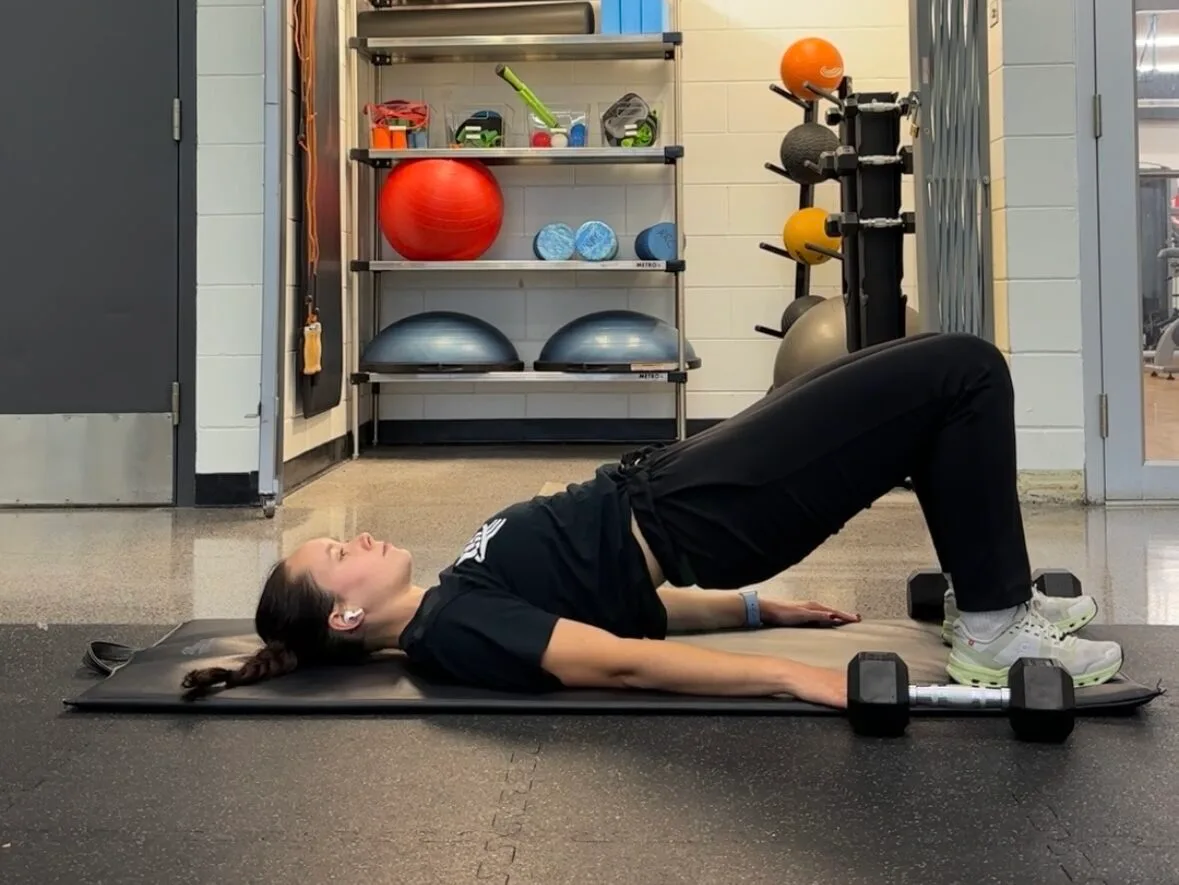
Glute Bridges isolate the hips and hamstrings, 15 to 20 controlled repetitions per set, making them the most underused exercise on this list for anyone who runs, climbs stairs, or cycles. Stronger posterior chain activation directly improves running economy, reducing the energy cost of each stride when fatigue accumulates. Lie flat, feet hip-width apart, drive hips toward the ceiling, and squeeze at the top for a full second before lowering. The limitation worth naming: glute bridges are isolation work and do not replace compound loading. Pair them with squats and lunges rather than substituting for them.
Most beginners doing these three movements hit a wall within weeks, not because the exercises stop working, but because nothing tells them when to progress. The same 25 squats at the same tempo every session trains the body to sustain that exact routine. That is where GetFit AI’s Athlete-Style Custom Workout Plans remove the guesswork.
The plans embed these exact lower-body movements inside a structured program arc that signals, from your very first workout session, when to add reps, shorten rest, or shift tempo, so adaptation keeps moving instead of stalling the way it does when you are estimating week to week. If you have previously struggled with consistency because nothing told you what to do next, the structure is the point: it answers the question beginners ask most, tell me exactly what to do in the gym today, which exercises, how many sets, in what order, and it keeps answering that question across every session.
Consistency past the first few weeks is also where the social layer matters. GetFit AI’s friends, challenges, and leaderboards are most effective after you have connected with at least one friend in the app. That shared accountability is the retention layer that keeps users training past week three, when the novelty has worn off and the soreness no longer feels like a reward.
Plans are available starting at $1.99 per week, $4.99 per month, or $49.99 per year on the Premium Yearly Subscription, structured support at every level of commitment.
Lower-body endurance is the engine. But without a stable core and full-body integration, that engine has nowhere to transfer its power. The next section covers the exercises that connect everything above the waist to everything below it, and why skipping them is the reason most beginners gas out mid-set even when their legs still have something left.
The Best Core and Full-Body Exercises for Muscular Endurance
The trunk fails before the limbs do. That single pattern explains why runners gas out mid-race, why lifters lose form on the last set, and why anyone who trains upper and lower body in isolation but skips core and full-body work hits a wall that feels mysterious. It also explains a pattern we see constantly among beginners juggling demanding physical jobs, electrical workers, tradespeople, athletes with compressed schedules, who arrive already carrying occupational fatigue and need every training minute to count.
Electrical workers in particular face significant cumulative physical strain: carrying equipment, working overhead, and standing on concrete for hours loads the posterior chain and erodes postural endurance long before a training session even begins. Every set they spend on movements that do not directly transfer to occupational demands is a set wasted. The seven movements below occupy a hybrid zone where muscular endurance and cardiovascular demand overlap, and that overlap is exactly what makes them disproportionately effective.
1. Forearm Plank - The Isometric Core Hold That Builds Endurance No Rep Count Can Match
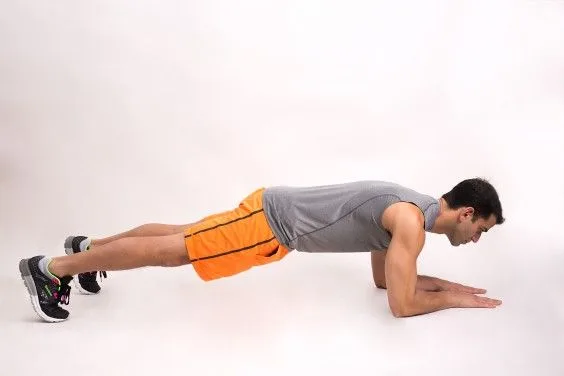
The forearm plank is the most underestimated tool in a full-body endurance workout. Research into isometric versus dynamic muscle actions confirms that holding isometric muscle actions produces faster spikes in EMG amplitude, heart rate, and perceived effort than dynamic repetitions, engaging neuromuscular control pathways that rep-based movements simply do not train. Hold for 30 to 60 seconds per set. The real trap: if holding a plank gets easier, that comfort is not proof of adaptation. Without progressively longer holds or added load, you are accumulating fatigue, not building fitness.
2. Farmer’s Walk - The Full-Body Loaded Carry That Overloads Grip, Posture, and Gait Endurance Simultaneously

Farmer’s walks expose the weakest link in your kinetic chain fast. Start with 30 percent of your bodyweight in each hand and walk 20 meters. If your grip fails before your legs or lungs, grip endurance is the limiting factor.
That distinction matters because research on musculoskeletal endurance and occupational training confirms that loaded carry movements reduce the incidence of back pain by training postural endurance across the traps, core, forearms, and calves simultaneously. For anyone whose job already loads the posterior chain, carrying equipment, working overhead, standing on concrete for hours, this is also a direct transfer movement. Loaded locomotion trains the entire postural chain in a way no isolation movement can replicate.
3. Mountain Climbers - The Dynamic Core Stabilizer That Bridges Strength Endurance and Cardiovascular Conditioning

Mountain climbers train two endurance systems at once: dynamic core stabilization and aerobic conditioning. Performed continuously for 30 to 45 seconds per set, they force the deep core to resist rotation while the cardiovascular system sustains the output. One of the most common confusions beginners face, runners especially, is treating movements like this as cardio substitutes for running.
They are not. A runner who swaps tempo miles for mountain climbers is trading sport-specific aerobic adaptation for gym-based core endurance. Both matter, but they are not interchangeable, and foundational exercise science on muscular endurance training draws a clear line between training that supports running volume, ankle stabilization, core bracing, and gait endurance, and gym-based muscular endurance work that builds capacity the trail or road cannot replicate.
The limitation worth knowing is that form breaks down quickly under fatigue, and a sagging hip or bouncing lower back shifts the load away from the core entirely. Slow the tempo before you extend the duration.
4. Dumbbell Thrusters - The Compound Strength-Endurance Burner That Taxes Legs, Shoulders, and Lungs in One Movement

Thrusters chain a front squat directly into an overhead press, which means no muscle group gets a rest between repetitions. That continuous demand is what makes them a core muscular endurance exercise in the truest sense: the trunk must stabilize through both the squat and the press, or the weight tips forward and the movement collapses. Use a load that lets you complete 15 clean reps before form degrades. If you cannot hold the front rack position, the shoulder endurance demand is masking a core stability deficit. For runners and time-pressed trainees who cannot afford separate lower-body and upper-body sessions, thrusters serve as an efficient compound stimulus, exactly the kind of movement that makes a 30-minute session productive rather than incomplete.
5. Kettlebell Swings - The Hip-Hinge Power Endurance Exercise That Conditions the Posterior Chain for Repeated Effort

Kettlebell swings train the posterior chain, specifically the glutes and hamstrings, for repeated ballistic effort rather than maximal single-rep force. Sets of 20 to 30 reps at a moderate load build the kind of hip-hinge endurance that carries over directly to running, rowing, and any sport requiring repeated hip extension. The most common failure point for beginners is learning the hinge before loading the swing. A squat-pattern swing, where the bell drops between the knees rather than behind them, removes the posterior chain from the movement entirely and turns a powerful exercise into a mediocre one. As musculoskeletal endurance research confirms in the context of loaded carry and hinge mechanics, posterior-chain training plays a direct role in reducing occupational back strain, which means getting this pattern right carries consequences well beyond the gym.
6. Battle Ropes - The Upper-Body Endurance Tool That Sustains Muscular Effort Through Continuous Wave Output
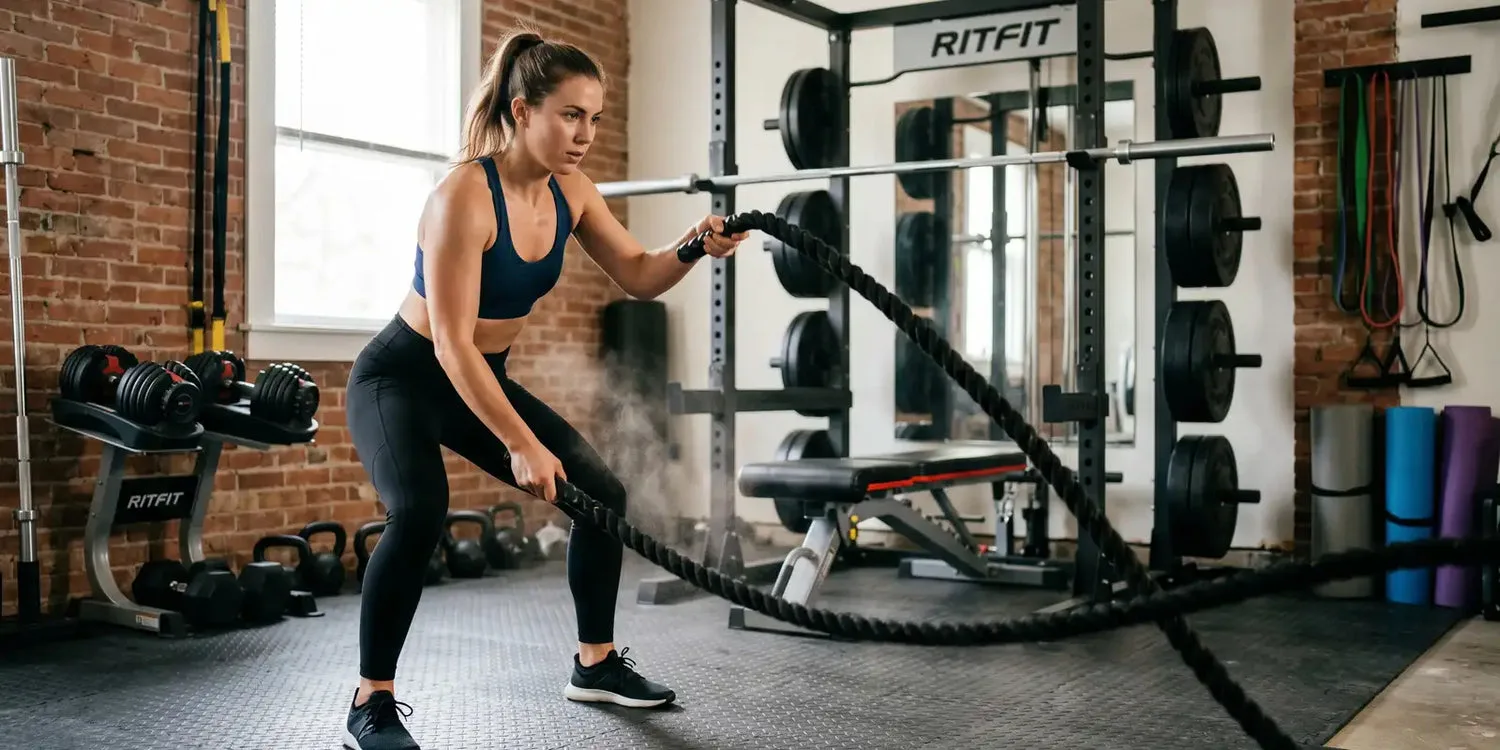
Battle ropes produce a fatigue pattern that most gym-goers have never experienced: the burn arrives in the forearms and shoulders within the first 15 seconds, and sustaining the wave output past 30 seconds requires the core to brace continuously or the movement efficiency collapses. That is the dual aerobic-plus-strength stimulus in real time. Work in 30 to 45 second intervals. The honest limitation is that battle ropes require anchored equipment, making them a gym-specific tool rather than a home training option.
7. Burpees - The Total-Body Endurance Finisher That Combines Strength, Core Stability, and Aerobic Output in Every Rep
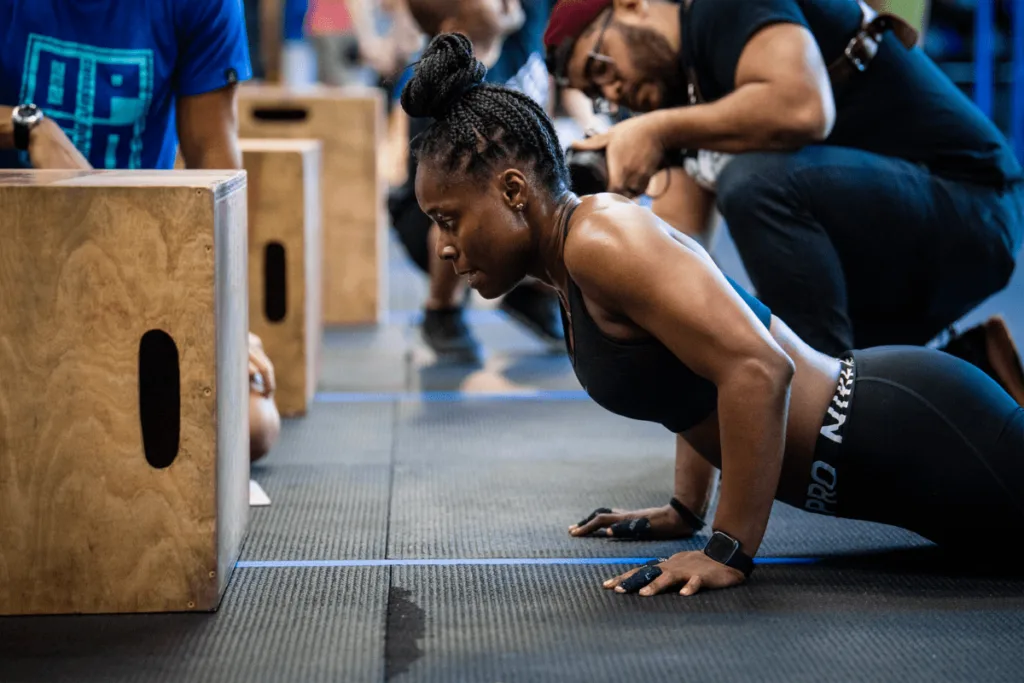
Burpees activate virtually every major muscle group across a single rep cycle: the push-up demands upper-body strength endurance, the plank position demands core isometric endurance, and the jump demands lower-body power endurance. That multi-system demand per rep is what makes burpees one of the most complete muscular endurance exercises in this list, combining dynamic strength, core stability, and aerobic output in a single rep cycle. The tradeoff is that form degradation under fatigue is rapid and increases injury risk at the wrist and lower back. Cap sets at 10 to 15 reps and prioritize a controlled chest-to-floor descent over speed.
Most people who find this list will bolt these seven movements onto whatever they were already doing, same weights, same sequence, no trigger to push further, which is exactly how a great exercise list produces zero adaptation after week two. The other pattern we see among runners and physical workers in particular is a structure problem that gets misread as a motivation problem: without a clear answer to “which exercises, how many sets, in what order, today,” most training sessions either default to habit or get skipped entirely. Runners already pressed for time between work and personal commitments cannot afford a session that starts with ten minutes of standing in the gym figuring out what to do next. Neither can an electrical worker who showed up carrying eight hours of occupational fatigue and needs every remaining minute to count.
GetFit AI’s Athlete-Style Custom Workout Plans address this directly. Tell the app your goals and available equipment, and it answers the only question that actually matters when you walk through the door: exactly what to do in the gym today, which exercises, how many sets, in what order. GetFit AI’s structured training is most beneficial when you have previously struggled with consistency due to lack of program structure, and it begins working from your very first workout session, continuing to guide load and progression across the entire training arc. For trainees who want to go further, Premium plans start at $1.99 per week, $4.99 per month, or $49.99 per year, each tier unlocking the full adaptive progression engine so the plan keeps escalating as you get stronger.
You now have all 13 exercises. But before you program a single set, there is one distinction that will determine whether you are training for endurance at all: the difference between muscular endurance and muscular strength is not just a rep range, it is an entirely different physiological target.
Related Reading
- Athletic Performance Analysis
- Does Vaping Affect Athletic Performance
- How to Avoid Feeling Sleepy After Workout
- How Does Sleep Affect Athletic Performance
- How to Measure Athleticism
- Velocity Based Training
- Building Stamina and Endurance
- Why Am I So Bad at Sports
- Endurance vs Strength Training
- Why Am I So Tired After Working Out
- How to Create a Personalized Workout Plan
How Muscular Endurance Training Differs from Muscular Strength Training
The same exercise can produce completely different physiological outcomes depending on how you program it. Perform it at 80% of your one-rep max for 5 reps with three minutes of rest, and you’re running a strength protocol. Drop to 50% for 20 reps with 30 seconds of rest, and the same lift becomes an endurance protocol.
One of the most common traps beginners fall into is standing at exactly this fork in the road, unsure whether low-rep, heavy strength training or high-rep, high-volume muscular endurance training will deliver better long-term results for their physique and performance, and defaulting to whatever they see most online. GetFit AI’s Athlete-Style Custom Workout Plans resolve this from the first workout session, setting parameters to the goal you’re actually chasing rather than the generic middle ground.
Two Different Goals, Two Completely Different Physiological Targets
| Goal | Primary Adaptation | Key Mechanisms |
|---|---|---|
| Strength training | Maximize force in a single effort | Denser motor unit recruitment, improved rate coding, increased contractile force |
| Endurance training | Sustain repeated submaximal contractions without failing | Greater mitochondrial density, improved lactate clearance, more efficient oxygen use at the cellular level |
Research on one-rep max testing confirms that load prescriptions tied to a true 1RM, not an estimated or arbitrarily chosen weight, produce reliable, reproducible training stimuli regardless of training experience or muscle group, which is why anchoring your parameters to an accurate baseline matters before anything else (Sports, MDPI).
The Parameter Gap: Why Rep Range, Load, and Rest Period Are Not Interchangeable
The International Journal of Physical Education and Sport Sciences distinguishes strength and endurance adaptations precisely along these load and volume axes.
| Parameter | Strength Training | Muscular Endurance Training |
|---|---|---|
| Repetitions | 1-6 reps | 15+ reps |
| Load | 80-100% of one-rep max | Below 60-70% of one-rep max |
| Rest periods | 2-5 minutes | 30-60 seconds |
This is where confusion runs deepest for beginners: the lack of clarity on how the two modalities differ in purpose and application means most people training for muscular endurance unknowingly run a strength protocol, and vice versa.
Why Beginners Gas Out Mid-Set: The Local Endurance Ceiling
Key takeaway: A beginner who gases out mid-set despite feeling generally fit is almost always hitting a local endurance ceiling, not a cardiovascular one. Local endurance limits are trainable with bodyweight and light loads, and produce visible improvement quickly.
GetFit AI’s structured training addresses this across each individual session and across the overall training program arc.
Related Reading
- How to Deal With Performance Anxiety in Sports
- Hydration Tips for Athletes
- How to Build Mental Toughness in Athletes
- Food for Athletes During Competition
- Strength Training Workout for Runners
- Best Plyometric Exercises for Speed
- Conditioning Workouts for Athletes
- Speed Training for Athletes
- Balance Exercises for Athletes
- Best Core Exercises for Athletes
How to Program These Exercises for Muscular Endurance Using Circuit Training
What turns a list into a self-advancing program is the structure wrapped around it: the station order, the rest windows, and the rules that force change week over week. GetFit AI’s Structured Training feature is built specifically for that failure mode: it is most beneficial when someone has previously struggled with consistency due to lack of program structure, and it begins delivering that structure from the very first workout session.
What Minimal Rest Actually Does to Your Muscles
Circuit training for muscular endurance works by moving directly from one exercise to the next with minimal rest, which sustains elevated heart rate and forces your muscles to keep contracting under metabolic fatigue.
Key takeaway: Across endurance-focused resistance programs, the standard prescription is 15 to 25-plus reps with rest periods of 30 to 60 seconds, a combination that improves oxidative capacity and cardiovascular efficiency simultaneously, as documented in PMC (National Library of Medicine).
What the research makes clear, and what PMC / National Institutes of Health confirms, is that resistance-based endurance training drives meaningful physiological adaptation.
A Starter Circuit Template Using the 13 Exercises
A sample Week 1 circuit looks like this:
-
Push-ups, 15 reps
-
Bodyweight squats, 25 reps
-
Forearm plank, 30 seconds
-
Mountain climbers, 30 seconds
-
Walking lunges, 15 per leg
Rest windows shorter than 30 seconds overwhelm beginners before technique holds; windows longer than 60 seconds let heart rate drop too far and blunts the metabolic stimulus.
StatPearls, National Library of Medicine identifies that rest interval management is a primary driver of the endurance adaptation response in resistance-based circuits.
The Week-Over-Week Progression Rules That Force Adaptation
Progressive overload for endurance means reducing rest, adding reps, or adding a round on a set schedule, because without a built-in trigger, the body adapts to the circuit itself and stops adapting to get fitter. The broader pattern across endurance training is unambiguous: without structured progression through volume increases or rest reductions, improvement stalls, a principle reinforced by StatPearls, National Library of Medicine.
-
Week 1: 3 rounds at 60-second rest between rounds
-
Week 2: Same reps, rest drops to 45 seconds
-
Week 3: Add a fourth round and reset rest to 60 seconds before compressing again
-
Week 4 check: If you finish all rounds without form breakdown, add 2 to 3 reps per station before the next cycle begins
GetFit AI’s Athlete-Style Custom Workout Plans solve the lever problem by building the progression trigger into the plan itself, adjusting rest windows and rep targets automatically as your fitness level shifts, during each workout session and across the overall training program arc, so the decision is made before you walk into the gym. And for those who train with a partner, GetFit AI is most beneficial when a friend or workout partner is also using the app: friends, challenges, and leaderboards add an accountability layer that keeps users training past week three, the point at which the novelty of a new circuit wears off and structure has to carry the load.
GetFit AI is available at $4.99 per month on the Premium Monthly Subscription or $49.99 per year on the Premium Yearly Subscription.
Why a Static Exercise List Cannot Replace a Plan That Adapts as You Get Stronger
Three Mid-Workout Friction Points That Kill Endurance Gains Before They Start
-
Form breaks down under fatigue and nobody catches it, so the movement pattern that was supposed to build endurance quietly builds a compensation habit instead.
-
The cable machine or pull-up bar is taken mid-circuit, and with no swap ready, momentum dies and the session gets abandoned or watered down.
-
Training happens in a nutritional vacuum. Sports science research confirms that training without corresponding dietary adjustments means the physiological adaptation signal never fully materializes, regardless of exercise selection.
Why Endurance Adaptation Requires a Plan That Pushes Back Every Week
The body adapts quickly; give it the same stimulus long enough and it stops treating that stimulus as a challenge. Progressive resistance training research is direct on this: repeating the same exercises at the same intensity does not drive continued adaptation once the body has adjusted to a given load.
Variety in exercise names that still hammers the same joint angles and energy systems is pattern repetition dressed up as variety, and that is one of the clearest signs a plan’s adaptive logic is more label than substance.
Genuine adaptation requires a plan with two things working together:
-
Escalating overload signals that adjust as you improve
-
Nutritional alignment that gives your body the raw material to convert training stress into actual fitness
How GetFit AI Closes the Gap Between Knowing the Exercises and Actually Getting Stronger
When a piece of equipment is unavailable mid-circuit, a quick message to the AI trainer surfaces a substitute exercise matched to the same endurance parameters, on the spot, without losing the training stimulus.
GetFit AI’s Athlete-Style Custom Workout Plans go further than exercise substitution. You can build a fully custom plan around your goals and available equipment, or train in the style of an AI athlete or trainer, structuring your sessions around a specific athletic identity and performance target rather than a generic template. Both routes are built around progressive overload principles, with adaptive routines that adjust as you get stronger, directly addressing the ceiling that static and semi-static plans hit once the body has absorbed an initial training stimulus.
Next steps
If your reps have flatlined despite consistent effort, the path forward starts with recognizing that the exercise list was never the problem. The problem is the absence of a progression structure telling your body when to adapt next. Start with our AI fitness app.
Doing the same upper-body or circuit movements at a fixed load and fixed rest guarantees a ceiling, because adaptation to a stable stimulus is biologically certain once the nervous system has adjusted. That is the first insight. The second is that most people training for muscular endurance are unknowingly running a strength protocol, with loads too heavy and rest too long to drive the metabolic fatigue resistance endurance actually requires. Together, these two realities point to the same corrective action: a plan that sets the right parameters from session one and escalates them automatically as you improve, rather than leaving you to guess when and how to push.
Start with GetFit AI. Tell it your goal, your equipment, and the athletic target you are working toward, and it generates a custom workout plan before your first session begins, one that specifies which exercises to do, how many sets, in what order, and when to add reps or shorten rest as your endurance climbs. The built-in macro and calorie calculator handles the nutritional side simultaneously, removing the second layer that causes adaptation to stall even when training is sound. The plan adapts as you get stronger. The guesswork does not come back.
Frequently Asked Questions
How many reps and sets should I do for muscular endurance?
Aim for 15 to 25-plus reps per set across 3 to 5 sets, using loads below 60 to 70 percent of your one-rep max. Rest periods should be kept to just 30 to 60 seconds between sets to sustain the metabolic stress that drives fatigue resistance.
Why does my progress stall even when I keep showing up to the gym?
When rep counts, loads, and rest windows never change, the adaptation signal disappears within weeks, your body adapts to a fixed stimulus and then stops. Deliberate, ongoing changes to intensity, volume, or structure are required to force new adaptation; repetition without progression is not building fitness, it is practicing a ceiling.
What bodyweight exercises are best for building muscular endurance?
Push-ups, pull-ups, and chin-ups are the top upper-body bodyweight options covered in the post. Push-ups target the chest, shoulders, and triceps through a scalable pushing pattern, while pull-ups and chin-ups build stamina across the lats, rhomboids, and biceps through repeated vertical pulling.
Does shortening rest periods actually make a difference for muscular endurance?
Yes, shortening rest from 90 seconds to 30 seconds meaningfully increases metabolic stress and drives muscular endurance gains. Holding rest constant removes that lever entirely, which is one of the primary reasons progress stalls mid-cycle.
I’m doing high-rep pull-ups but my grip gives out before my back does, is that normal?
Yes, grip failure preceding lat and bicep failure in high-rep sets is a common and expected limitation. Running parallel grip training alongside pull-up volume directly addresses this, and using a resistance band looped over the bar can help beginners accumulate pulling volume before grip strength catches up.