The Ultimate How-to Guide: Create a Personalized Workout Plan
Most gym-goers quit not from laziness, but from planlessness. Here is how a personalized workout plan closes the gaps that turn consistent effort into invisible progress.
The common assumption is that consistency alone is the ingredient. If you just keep showing up, your body will eventually adapt and results will follow. But most new gym members quit within the first few months of joining.
Most of those people weren’t lazy; they showed up. See our AI fitness app for how this works in practice.
They sweated. They meant it. The problem was what they did, or didn’t do, once they walked through the door.
Showing up is necessary. But industry research found that most members mentally quit weeks or months before they ever cancel, with the financial signal of cancellation lagging behind the actual decision to leave.
That gap is telling. Consistent attendance can mask a complete absence of meaningful progress. The gym registers you as “active.” Your body registers nothing new.
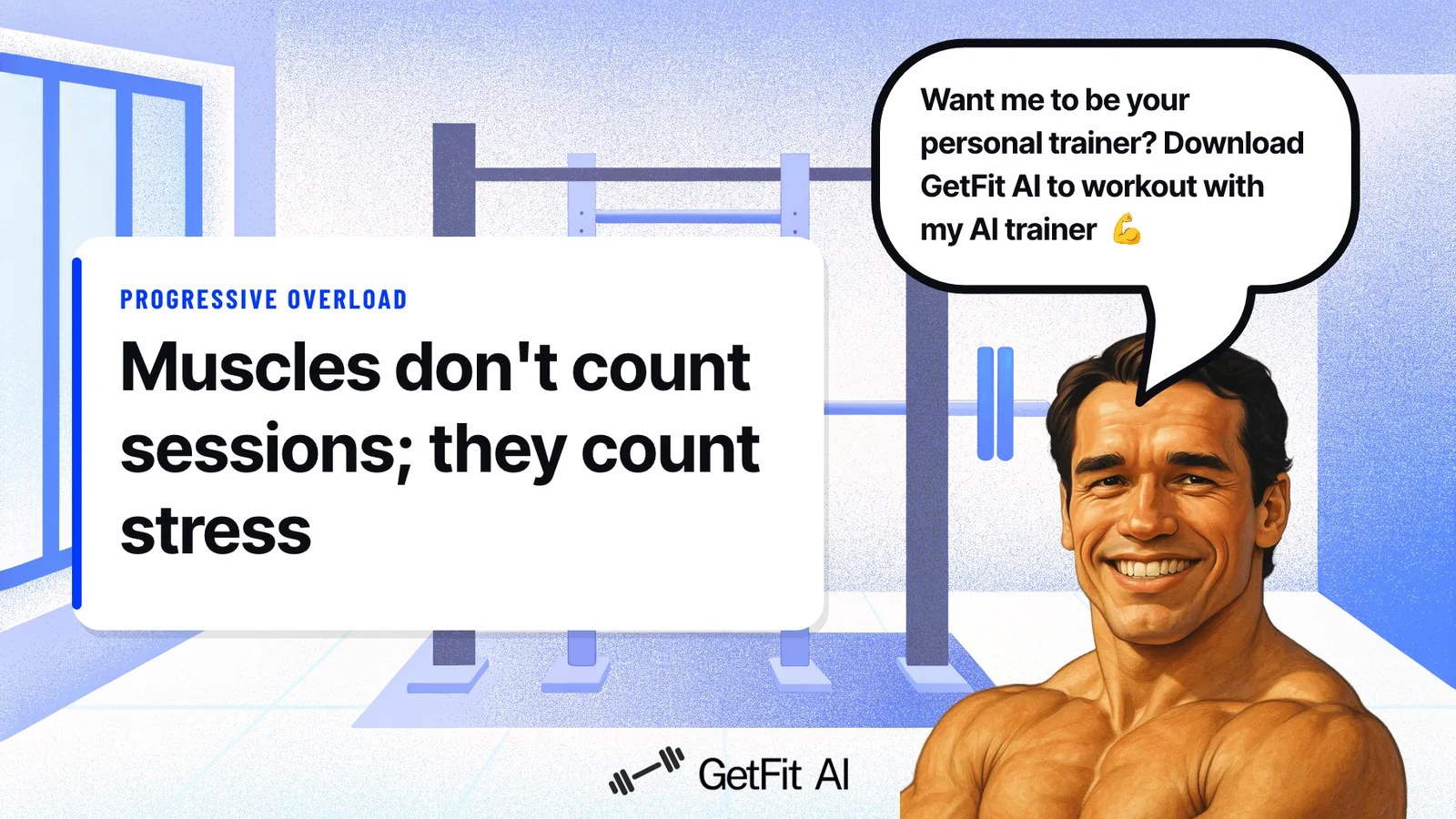
Repetition Without Progression: The first failure mode is same exercises, same weights, same order, every session. The body adapts fast, and once it does, identical stimulus produces identical results: none. Muscle tissue responds to one thing: a progressive increase in mechanical demand. Without systematically adding reps, load, or volume over time, adaptation stops. Muscles don’t count sessions; they count stress. The same stress, repeated identically, produces the same response after the first few exposures: nothing.
Muscles don't count sessions; they count stress. A structured, personalized stimulus is the missing variable, not more discipline.
The Random High-Rep Circuit Trap: The second failure mode is the random high-rep circuit: no coherent muscle-group logic, no volume tracking, no feedback loop to build on. Without a coherent structure, each session exists in isolation, unable to build on the one before it. Tools like the GetFit AI app replace guesswork with a custom plan built around your specific goal, experience level, and available equipment from day one, so every session has a purpose the one before it didn’t.
The cost of planless training is a compounding chain of friction that quietly makes quitting feel rational. The False-Proof Problem: The third failure mode is the false-proof problem: “I’m sore, so it must be working.” Soreness signals novelty, not growth.
It’s a terrible proxy for progress. When soreness becomes the primary measure of a productive session, training decisions get made on the wrong signal entirely. Without a real feedback loop, tracked volume, logged loads, measurable output, there is no way to know whether the work is accumulating into something or simply repeating itself in disguise.
Key takeaways
- Training without a plan isn't a slower path to results, it's a guarantee of plateaus, program-hopping, and the same weights six months from now.
- Most people who quit the gym weren't lazy; they showed up, sweated, and meant it, the problem was attendance without structure, not effort without enough of it.
- Three inputs, your current fitness level, your goal type, and your real weekly availability, determine everything about how a plan is built, progressed, and adjusted.
- The goal you set shapes the entire architecture of your training: pick the wrong goal type and you don't just miss the target, you build the wrong plan entirely.
- Volume and load are the workout, not decoration, the same squat done for 3×12 versus 5×3 produces a fundamentally different physiological outcome.
- A three-number training log (exercise, weight, reps) plus a simple RPE score is enough to make progressive overload visible and keep the plan working past the first few weeks.
- GetFit AI closes the execution gap with two routes: build a custom plan around your own goals and equipment, or train in the style of an AI athlete or trainer, either way, the plan adapts as you get stronger.
The Hidden Cost of Training Without a Personalized Workout Plan
Gym wandering kills your adaptation stimulus.
How Gym Wandering Quietly Locks You Into a Plateau From Day One
Research on beginner training outcomes consistently shows that unstructured training produces no measurable adaptation because the body never receives a repeatable signal to improve. Beginners we work with describe spending more time reading about programs than running one, a research paralysis that delays progress by weeks or months before a single adaptation is even possible.
GetFit AI removes that research paralysis entirely. Its athlete-style custom workout plans, built in the training styles of the athletes you actually follow, are waiting from the first workout session, so there is never a session without direction and never a morning wasted wondering whether your current split is working or needs to change.
The One Missed Week Trap That Turns Into Permanent Quitting
When a beginner misses a week, the problem is that without a structured plan, there is no obvious re-entry point. The plan feels broken rather than paused, and industry analysis confirms exactly this: beginners without programming treat a missed week as a ruined program rather than a normal setback, leading to full abandonment instead of course correction. This is the hidden cost of training without personalized guidance, the cognitive exit ramp that opens the moment a plan feels self-designed and therefore fragile.
The Nutrition Blindspot That Makes Every Training Session Invisible in the Mirror
Eating 600 calories over maintenance for two months will erase a solid hypertrophy block completely, and leaving eating to instinct quietly cancels the training work being put in. Without someone to guide the nutrition side, the mirror never reflects the effort.
This is where GetFit AI closes the loop. Whether you start on a Premium Weekly plan at $1.99, move to a Premium Monthly plan at $4.99, or commit with the Premium Yearly plan at $49.99, structured training and nutrition guidance are available from the first workout session, so there is never a session without direction, a missed week never signals a restart, and the mirror finally starts reflecting the effort.
At a glance
| Plan | Price | Includes |
|---|---|---|
| Premium Weekly plan | $1.99 | Structured training and nutrition guidance |
| Premium Monthly plan | $4.99 | Structured training and nutrition guidance |
| Premium Yearly plan | $49.99 | Structured training and nutrition guidance |
Related Reading
- Why Am I Not Getting Faster at Running
- Does Masturbation Affect Athletic Performance
- Biomechanics in Sports
- Why is Protein Important for Athletes
- What is Speed and Agility Training
- How to Be a Better Athlete
- How Does Sports Psychology Help Athletes
- Why is Hydration Important for Athletes
- Why Do Athletes Train at High Altitudes
- Why Do Athletes Stretch Before a Game?
- IV Therapy for Athletic Performance and Recovery
- Yoga and Athletic Performance
- Red Light Therapy for Athletic Performance
How to Assess Your Current Fitness Level Before Building Your Plan
The core insight here is that the habit of attendance creates a psychological substitute for honest data: members feel like “someone who goes to the gym” while invisible non-progress accumulates beneath the surface. Members who quit within six months rarely cancel the day they stop caring; they mentally disengage weeks or months earlier while still swiping through the turnstile, which means attendance records look healthy right up until the moment someone quits entirely. That pattern makes self-assessment before starting a plan more valuable than most beginners expect.
A starting point calibrated to your actual current level makes assessment the entry door, not an obstacle in front of it. GetFit AI’s onboarding quiz is designed around exactly this reality: it generates a custom, athlete-style plan immediately upon setup, sized to where you genuinely are, not where a generic template assumes you should be.
A 27-year-old who has lifted on and off for two years with no consistent structure has a realistic training age of “beginner,” regardless of how long ago they first touched a barbell. Movement quality tells a similar story.
If you cannot perform a bodyweight squat to full depth with control, a barbell back squat should not anchor your lower-body day yet. Research using fundamental movement screening consistently finds significant movement quality gaps in untrained adults, gaps that are detectable before programming begins and that predict injury risk when ignored.
Recovery capacity deserves the same scrutiny as movement quality. Team Grassroots identifies sleep quality, stress load, nutrition status, and life demands outside the gym as critical variables that must be evaluated before designing any training plan, because insufficient recovery prevents adaptation regardless of how many sessions per week you schedule.
The Honest Questions Most Beginners Skip Before Writing a Single Workout
Available equipment and real weekly schedule also belong in this audit, making the full checklist look something like this:
-
What is my actual training age, not how long ago I first touched a barbell, but how many months of consistent, structured training I have completed?
-
Can I perform foundational movements (e.g. bodyweight squat to full depth) with control?
-
What is my current sleep quality, stress load, and nutrition status?
-
Do I have any past injuries that could affect exercise selection or loading?
-
What equipment do I actually have access to?
-
How many days per week does my real schedule, with commute, work hours, and the two nights per week something always comes up, reliably support?
This is where GetFit AI’s onboarding quiz earns its place. It collects exactly these inputs, training history, movement comfort, equipment access, weekly availability, and past injuries, and uses them to generate a custom plan immediately at onboarding, calibrated to your real baseline, not an optimistic version of it. For anyone who does not have access to or the budget for a human personal trainer, GetFit AI’s AI Trainer Chat fills that guidance gap directly: it is available to answer the questions a coach would field, right from the moment your plan is live. That combination of honest intake and on-demand guidance is what turns a baseline from a formality into something genuinely useful.
How to Define Your Fitness Goals So Your Plan Actually Has Direction
Three Fitness Goals You Cannot Chase Simultaneously
| Goal | Caloric Environment | Weekly Structure | Key Mechanism |
|---|---|---|---|
| Strength | Caloric surplus | Progressive overload | Add load over time |
| Fat Loss | Caloric deficit | Resistance work to protect muscle | Preserve lean mass while cutting |
| General Conditioning | Maintenance | Movement quality + cardio focus | Cardiovascular capacity + mobility |
From “Get Stronger” to “Add 20 lbs to My Squat in 12 Weeks”
Novice linear progression research gives you a realistic anchor: beginners can add meaningful load to compound lifts every week for the first eight to twelve weeks, so “add 20 lbs to my squat in 12 weeks” is both specific and achievable.
Key takeaway: Pair your outcome anchor with a values-based reason and the goal survives the weeks when motivation is low. Across the market, evidence underscores that the psychological framing of a goal, not just its measurability, shapes long-term adherence.
GetFit AI’s Athlete-Style Custom Workout Plans are most effective when you have a concrete performance or physique goal in mind and need a structured program that works backward from that target rather than forward from a vague intention.
How Your Goal Type Determines Everything That Comes Next
A fat loss goal points to a caloric deficit, three to four resistance sessions per week, and movement choices that protect lean mass, along with nutritional guidance calibrated to help you lean out without sacrificing muscle. A muscle gain goal shifts the architecture entirely: four to five sessions, hypertrophy rep ranges (8-12), a caloric surplus to fuel recovery, and a nutrition strategy built around putting on size.
GetFit AI’s Structured Training is built around exactly this logic.
How to Choose a Weekly Workout Structure That Fits Your Real Life
The Three Beginner Structures Matched to Goal and Schedule
Full-body training three times per week is the most broadly recommended starting point, training every muscle group each session while leaving clear recovery windows between. Push/pull/legs across five or six days maps to advanced lifters with genuine recovery capacity. Beginners running on six hours of sleep and a full-time job belong elsewhere.
The goal type you defined earlier narrows the choice further. A general strength or fitness goal pairs cleanly with full-body 3x (Monday, Wednesday, Friday works as a concrete anchor), while a dedicated muscle-gain goal with four reliable days available makes an upper/lower split the logical next step.
Many beginners stall because the structure didn’t fit their actual week. They chose a structure that looked right on paper, missed one day, and treated that single missed session as proof that the whole program had failed. GetFit AI’s Athlete-Style Custom Workout Plans address this from the first workout session by building your schedule around your actual availability rather than an idealized template, so the structure you start with is already calibrated to the week you genuinely have.
If you have a friend or workout partner also using GetFit AI, the app’s friends, challenges, and leaderboards features add a social accountability layer that makes showing up on your three committed days significantly stickier, and research consistently shows that accountability is one of the strongest predictors of beginner adherence.
| Your Situation | Recommended Structure | Sessions/Week | Best For |
|---|---|---|---|
| Complete beginner, any schedule | Full-Body | 3x (Mon/Wed/Fri) | General strength + habit building |
| 4 reliable days, some experience | Upper/Lower Split | 4x | Muscle gain |
| 5-6 days, strong recovery capacity | Push/Pull/Legs | 5-6x | Advanced hypertrophy (not for beginners) |
| Unpredictable schedule | Full-Body + 1 flex day | 3-4x | Consistency over perfection |
Rule of thumb: choose the structure one level below what feels ambitious, then run it for 8 weeks before upgrading.
Why Training Frequency Should Be Set by Recovery Capacity
Key takeaway: Training five or six days per week is actively counterproductive when life stress or poor sleep prevent adequate recovery. Under-recovered sessions produce diminishing or negative returns.
A 3x full-body structure run consistently for twelve weeks outperforms a 5x split abandoned by week four, making adherence a more important variable than theoretical volume.
How to Build a Weekly Schedule That Survives a Missed Session
Resilience against missed sessions should be a design criterion, not an afterthought. Full-body 3x is especially resilient here because each session trains every muscle group, meaning no single skipped day creates a gap where an entire muscle group goes untrained for the week.
GetFit AI’s reminder system supports this directly by letting you set session notifications around your actual schedule, not a generic template, so the plan stays visible even when the week gets noisy. Beyond reminders, GetFit AI’s Structured Training feature works continuously across the overall training program arc, functioning as the retention layer that keeps users training past week three, when most beginners who started on a mismatched schedule have already dropped off.
The cost of getting this right is lower than most beginners expect. GetFit AI Premium is available on a weekly subscription for less than a cup of coffee, so the barrier to running a properly structured, accountability-backed plan for your first eight weeks is as low as it can reasonably be.
Once your weekly structure is locked, the skeleton of your plan exists. The next step is filling it with the right movements: a deliberate hierarchy of compounds and accessories chosen for the goal you defined earlier.
Related Reading
- Athletic Performance Analysis
- Does Vaping Affect Athletic Performance
- How to Avoid Feeling Sleepy After Workout
- How Does Sleep Affect Athletic Performance
- How to Measure Athleticism
- Velocity Based Training
- Building Stamina and Endurance
- Why Am I So Bad at Sports
- Endurance vs Strength Training
- Why Am I So Tired After Working Out
How to Select Exercises and Movements That Match Your Goal
The exercises you choose need to reflect a deliberate structure, starting with the compound, multi-joint movements that train the most muscle and build the patterns everything else depends on.
Compound Movements Are the Load-Bearing Walls
Compound, multi-joint exercises are the non-negotiable core of any beginner plan because they train the most muscle in the least time and build the neuromuscular patterns that carry over to everything else. Research on electromyographic activation consistently shows that movements like the squat, deadlift, bench press, bent-over row, and overhead press recruit multiple large muscle groups simultaneously, producing a training stimulus that isolation work cannot replicate at the same volume. Six foundational movement patterns (squat, hinge, horizontal push, horizontal pull, vertical push, vertical pull) cover the full body with minimal redundancy.
For a beginner targeting muscle gain on a 3x full-body schedule, a five-lift starter version looks like: Squat, Romanian Deadlift, Bench Press, Bent-Over Row, and Overhead Press.
One of the most persistent frustrations beginners face is not knowing whether an exercise labeled “beginner” is appropriate for where they are right now, and whether the number of movements in a session is too many, too few, or structured in a way that serves their goal. GetFit AI’s Athlete-Style Custom Workout Plans are built around this problem: rather than handing you a generic “Beginner Routine, 4 Weeks, Follow Along,” the app selects and sequences movements aligned to your actual fitness level and goal from the very first workout session, removing the guesswork about which exercises belong in your program and how many to include.
How to Map Movement Patterns to the Equipment You Actually Have
Every barbell compound has a dumbbell equivalent that produces comparable strength and hypertrophy outcomes for beginners, because the movement pattern is preserved even when the implement changes, a finding consistently reported in resistance-training literature comparing free-weight modalities.
Pros and cons at a glance
| ✓ Pros | ✗ Cons |
|---|---|
| Dumbbell equivalent preserves the movement pattern | Dumbbell loads cap out faster than barbell loads |
| Produces comparable strength and hypertrophy outcomes for beginners | Substitution becomes less equivalent as you get stronger |
Why Compounds Must Come First in Every Session
A 2010 study published in the Journal of Strength and Conditioning Research found that performing isolation exercises before compound lifts reduced force output on the primary movement by a measurable margin, because the target muscles arrive pre-fatigued at the exercise that demands the most from them.
GetFit AI’s Structured Training enforces this hierarchy automatically across every session and across the full program arc. The feature is most effective once you have connected with at least one friend in the app, so it works best when you and a workout partner are both using GetFit AI.
How Many Sets and Reps Actually Drive Muscle Growth for Beginners
The research here is unusually consistent: meta-analyses on dose-response relationships between weekly volume and hypertrophy show that beginners respond robustly to relatively low volumes precisely because their baseline is zero, and that somewhere between 10 and 20 weekly sets per muscle group represents the effective range for most untrained individuals before returns diminish.
For a beginner on a 3x full-body schedule, that translates practically to 3 working sets per compound movement per session, with rep ranges sitting between 6 and 12 for hypertrophy or 3 and 6 for strength, depending on the goal. The load should be heavy enough that the final 2 reps of each set are difficult but technically clean, a concept formalized in the literature as proximity to failure. Leaving 2 to 3 reps in reserve on working sets is the target.
Why Progressive Overload Is the Only Mechanism That Makes Any of This Work
Without a systematic mechanism for increasing the demand placed on the body over time, training produces adaptation once and then produces maintenance indefinitely, because the body has no reason to continue rebuilding tissue it has already adapted to handle. Longitudinal research on resistance training consistently demonstrates that strength and hypertrophy gains are tied to progressive increases in training load, volume, or both across weeks and months, not to the sophistication of any individual session.
For beginners, the most practical application is linear progression: add a small amount of load to each lift every session or every week for as long as that remains possible, which for untrained individuals is typically several months before more complex periodization becomes necessary. 5 kilograms added to a squat each week sounds modest until you calculate that it compounds to over 100 kilograms of added load across a year of consistent training.
How to Determine Training Volume - Sets, Reps and Load - Without Guessing
“I feel overwhelmed by conflicting information on optimal sets and reps, making it hard to determine the right training volume without guessing.”
— what we hear from fitness enthusiasts
At a glance
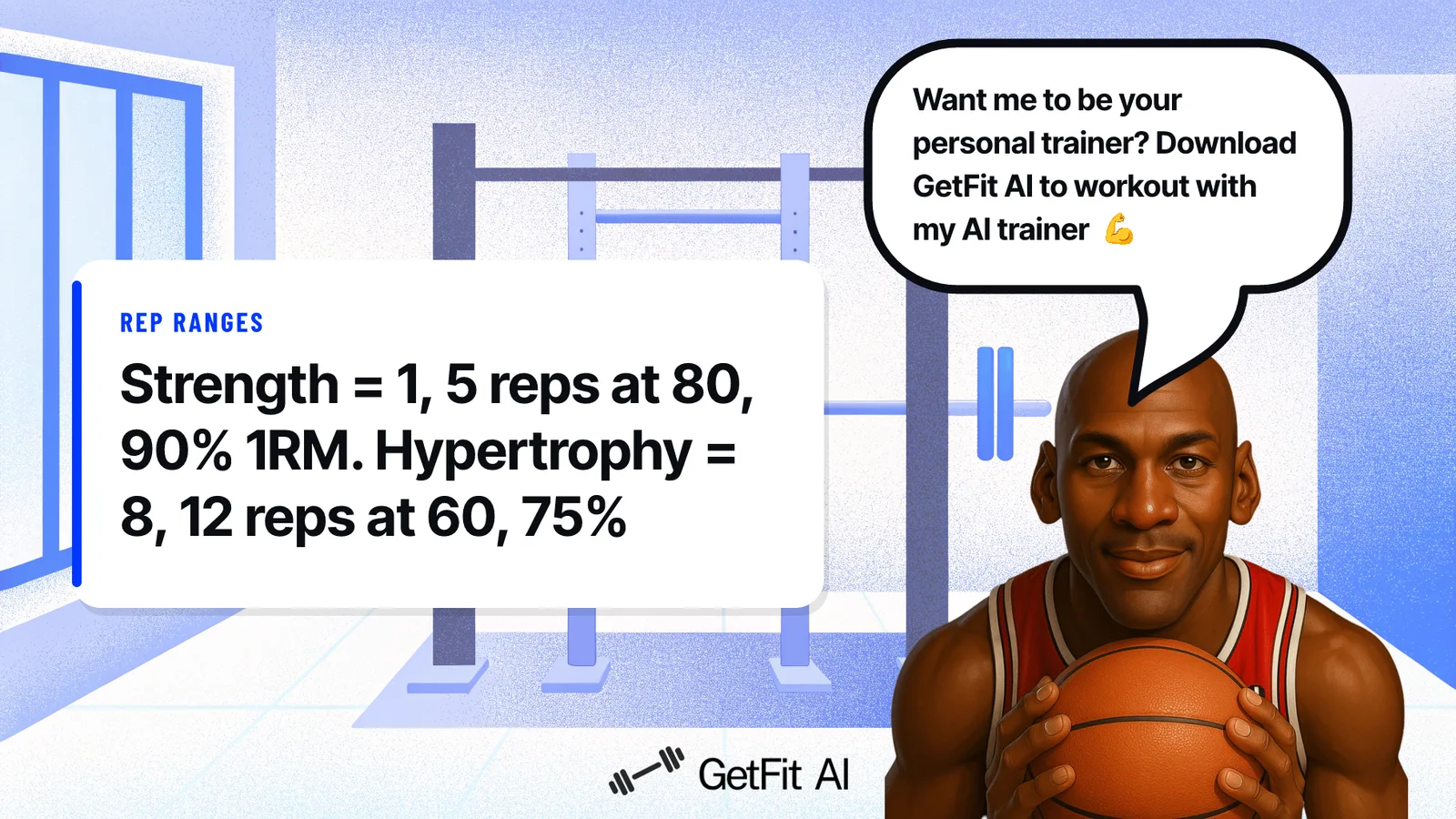
| Goal | Rep Range | Intensity (% of 1RM) | Sets x Reps Example | Rest Period |
|---|---|---|---|---|
| Strength development | 1-5 reps | 80-90% | 4 sets of 5 heavy reps | 2-3 minutes |
| Hypertrophy | 8-12 reps | 60-75% | 3 sets of 10 at moderate load | ~90 seconds |
| Muscular endurance | 15+ reps | Lighter load | N/A | N/A |
A strength goal means 4 sets of 5 heavy reps with two to three minutes of rest between them. GetFit AI’s Athlete-Style Custom Workout Plans cut through that noise by assigning goal-specific rep targets from your very first workout session, so you are not left piecing together contradictory advice from a dozen different sources.
Weekly Set Targets for Beginners - Why 10 to 20 Sets per Muscle Group Is Your Functional Ceiling
Meta-analyses put the effective range for most untrained individuals at 10 to 20 weekly sets per muscle group before returns diminish, so piling on sets past that ceiling is unstructured overload, not extra progress. GetFit AI’s Structured Training framework is built specifically for beginners who have previously struggled with consistency because of exactly this kind of unstructured overload.
How to Pick a Starting Weight When You Have No Idea What Your 1RM Is
The ACSM’s practical proxy is clean: choose a weight where the last two reps of a set are genuinely hard but your form does not break down. GetFit AI is built to be the answer to that question the second it appears, so you are not left guessing or waiting to ask someone.
How to Track and Adjust Your Progress So the Plan Keeps Working
GetFit AI handles the logging automatically inside each session, so the feedback loop that keeps training on track builds itself as you go.
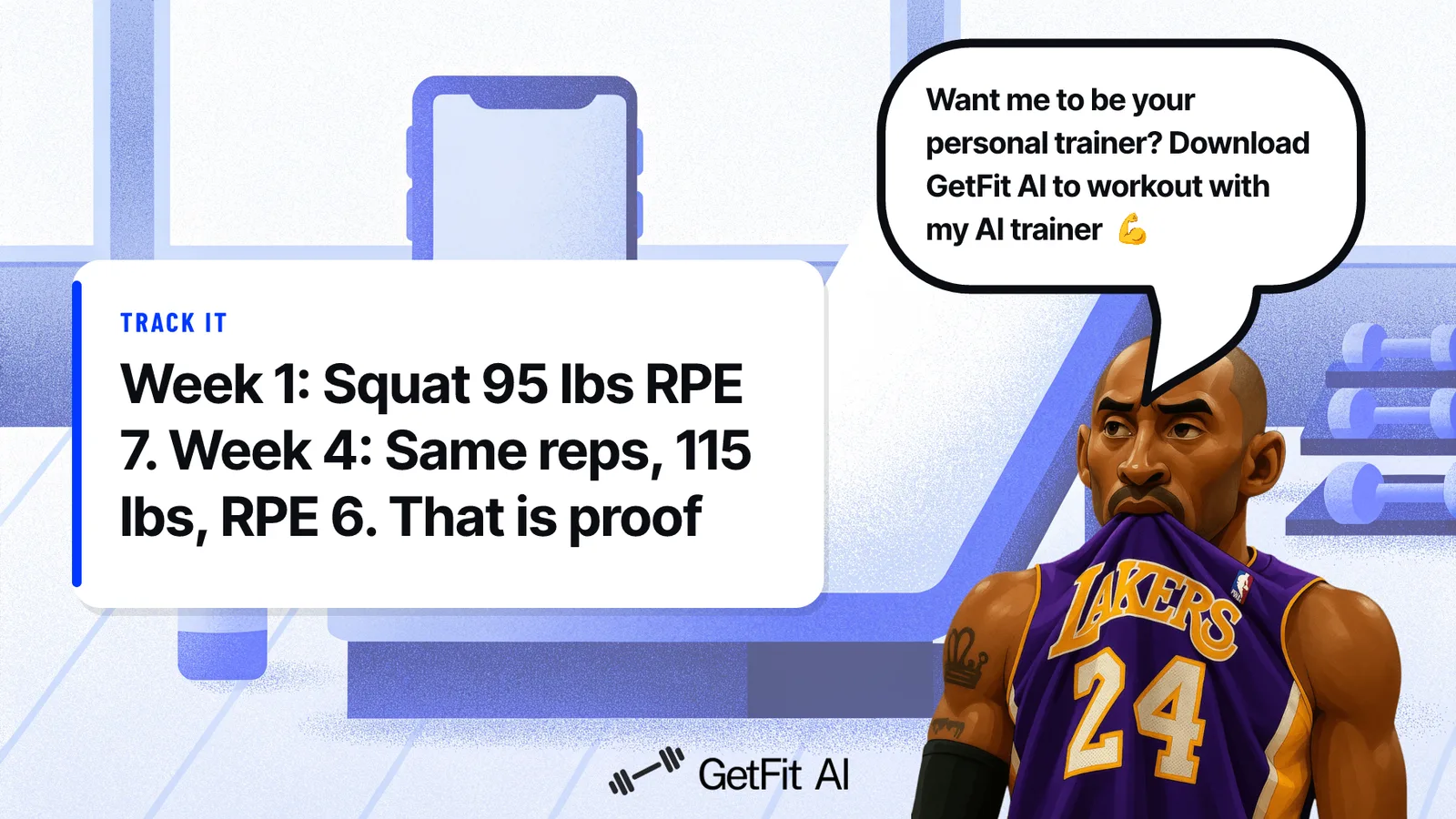
The Minimum Viable Training Log: What to Record Every Single Session
-
The exercise name
-
The weight used
-
The reps completed
-
Your RPE (rate of perceived exertion) on a 1-10 scale
Session logging is the reliable way to confirm that progressive overload is occurring, rather than assuming it is happening through consistency alone.
GetFit AI’s workout execution and logging removes the friction of logging by hand: every set is logged inside the session itself, automatically building the record that makes progress visible rather than assumed.
The Two-Session Rule: When to Progress, When to Hold, and When to Move On
The trigger for progression is specific: if the same weight and rep target feels easy across two consecutive sessions, that is your signal to move. Without a log, that two-session pattern is nearly impossible to confirm reliably.
GetFit AI’s workout execution and logging surfaces the two-session signal automatically, so the decision to progress is driven by your own recorded data. That same accountability extends beyond the log itself. GetFit AI’s friends, challenges, and leaderboards act as the retention layer that keeps you training when motivation alone would not, most effective once you have connected with at least one friend in the app, because shared accountability converts a solo habit into a commitment that is harder to quietly abandon.
Why Adjusting the Plan Is the Plan, Not a Sign Something Went Wrong
Beginners often read a needed adjustment as proof the plan has failed, the same broken-plan thinking that turns one missed week into quitting. GetFit AI’s Athlete-Style Custom Workout Plans address this from the first workout session, giving the plan the architecture it needs to hold up across weeks, not just days. Adjusting that plan as you go is how progress works.
GetFit AI is available on a Premium Monthly plan at $4.99 or a Premium Yearly plan at $49.99, so the tracking infrastructure and accountability layer that keep you past week three are accessible at whatever commitment level makes sense to start.
Related Reading
- How to Deal With Performance Anxiety in Sports
- Hydration Tips for Athletes
- How to Build Mental Toughness in Athletes
- Food for Athletes During Competition
- Strength Training Workout for Runners
- Best Plyometric Exercises for Speed
- Exercises That Improve Muscular Endurance
- Conditioning Workouts for Athletes
- Speed Training for Athletes
- Balance Exercises for Athletes
- Best Core Exercises for Athletes
How GetFit AI Builds Your Personalized Workout Plan So You Never Start From Scratch
Every framework in this guide, from the fitness assessment to the progress-tracking logic, was built for one purpose: to hand you a system you can actually execute. The problem most beginners hit next is that executing it still requires knowing how to build the thing. That gap is exactly where GetFit AI sits.
Two Ways to Build a Personalized Workout Plan
Most fitness apps ask you to log what you already did, which does nothing for the person standing in the gym doorway at 6 a.m. with no idea what to do first.
GetFit AI flips that sequence. At onboarding, the app takes your goal, equipment, and experience level and generates a complete custom workout plan before your first session starts. For someone who has a clear athletic role model, the second route is even faster: choose an AI athlete’s or trainer’s plan and train in their exact style from day one. This option is most valuable when you have a specific physique or performance goal and want a proven structure to follow rather than building one from scratch.
How Your Personalized Workout Plan Adapts as You Get Stronger
A plan that can’t change is a plan with an expiration date, and GetFit AI adapts the plan as your strength increases. That single feature addresses the “broken plan” spiral directly, the pattern industry research identified, where one missed session convinces beginners the whole program is ruined and quitting feels easier than returning.
Nutrition Included, Not Bolted On
Industry observers consistently note that leading fitness platforms now integrate nutrition tracking alongside workout programming precisely because exercise alone is insufficient for body composition goals without dietary alignment. GetFit AI closes that gap by including a macro and calorie calculator inside the same app, so the distance between “my training is dialed in” and “I can see it working” closes without opening a second app.
You’ve now got every piece of the framework: the goals, the structure, the volume, the tracking, and the tool that ties it all together. The only thing left is actually starting with a plan built for you.
Next steps
If your sessions keep ending without any visible change in the weights or the mirror, the path forward starts with building a plan that treats progression as a system, not a feeling. Showing up has never been the missing ingredient. Structure is. Start with our AI fitness app.
The insight that attendance creates a psychological substitute for honest data means that without an objective baseline, invisible non-progress accumulates until quitting feels rational. The finding that volume and load are a feedback loop, not a one-time configuration, means the plan that works in month one will actively stall in month three if nothing changes. Together, they point to one logical next step: a plan built around your actual goal and recovery capacity, with built-in tracking that surfaces the signal to progress before the plateau becomes invisible.
Start with GetFit AI. The two-minute onboarding quiz takes your goal, schedule, and equipment and outputs a fully structured, athlete-style custom plan before your first session starts, complete with goal-specific rep targets, session logging, and nutrition guidance in a single place. From there, the plan adapts as you get stronger, so the two-session rule, the trigger for knowing exactly when to add load, fires automatically from your own recorded data rather than guesswork. Progressive overload stops being something you hope is happening and becomes something you can see.
Frequently Asked Questions
Why doesn’t just showing up to the gym consistently produce results?
Muscles don’t count sessions, they count stress. Once your body adapts to an identical stimulus, repeating it produces no further adaptation, so consistent attendance without progressive overload quietly locks you into a plateau from day one.
What’s the difference between a plan and just having a fitness intention?
An intention shapes your mindset but doesn’t tell you what to do on Thursday when motivation is low, a structured plan does. Without measurable milestones and a weekly structure tied to your specific goal, what you have isn’t a plan; it’s a vague direction that can’t actually drive weekly decisions.
How do I know what fitness level to start my plan at?
Your starting point is determined by three inputs: your actual training age (not how long ago you first touched a barbell, but how many months of consistent structured training you’ve completed), your movement competency on foundational exercises like a bodyweight squat, and your recovery capacity, including sleep quality, stress load, and nutrition status. All three must be assessed honestly before a single workout is written.
What are the most common mistakes people make when training without a plan?
The post identifies three: repetition without progression (same exercises, same weights, same order every session), the random high-rep circuit trap with no coherent muscle-group logic or volume tracking, and using soreness as a proxy for progress. Soreness signals novelty, not growth, and is a poor indicator that your training is actually working.
If I miss a week of training, does that mean I have to start over?
No, missing a week is a normal part of any sustainable fitness life. The real problem is that without a structured plan, there’s no obvious re-entry point, so a missed week feels like a ruined program rather than a normal setback, which leads to full abandonment instead of simply picking up where you left off.