Best Strength Training Workout for Runners to Run Faster

More miles won’t fix weak glutes, and random gym sessions won’t either. Here is the exact strength work that closes the gap between effort and speed.
Runners log mile after mile chasing a faster finish time, and the common assumption is: “As long as I show up to the gym a few times a week and do something, it will eventually translate to faster running.” It usually won’t. Running is a repetitive, single-leg loading event, and the muscles that control each stride, absorb each impact, and drive each push-off need a stimulus that pavement cannot provide.
That gap between what running builds and what running demands is where injuries are born and plateaus get permanent. The fix is measurable. A structured strength plan built around your running schedule closes that gap in ways that extra mileage never will.
See our AI fitness app for how this works in practice.
Every running stride is a single-leg landing. At a comfortable pace, a runner accumulates many hundreds of foot strikes per mile, per leg, each absorbing two to three times body weight in ground reaction force. The glutes, hamstrings, and hip stabilizers are the primary shock absorbers in that sequence. Yet running volume alone does not load them with enough intensity to build meaningful strength. The pattern is predictable: a runner adds 10 miles per week, the weak glutes stay weak, and the IT band picks up the slack until it can’t.
Strength training improves running economy by 3 to 8 percent, so the same metabolic effort produces a measurably faster pace. Over a half marathon, even a modest improvement in running economy compounds meaningfully across the distance. The mechanism is neuromuscular: strength training increases motor unit recruitment, improves rate of force development, and enhances muscle-tendon stiffness. Heavy resistance and plyometric training are the most effective modalities; generic, unstructured gym sessions do not produce the same stimulus.
Overuse injuries are not bad luck. IT band syndrome, Achilles tendinopathy, and stress fractures are the predictable outcome of repetitive loading on muscles never trained to handle it. A systematic review found that strength training substantially reduces overuse injury risk in runners, making it the single highest-return addition to any training week.
Most runners who add strength work still walk into the gym without a plan built around their running schedule. GetFit AI’s custom workout plans address that directly, and the benefit is sharpest when you have a clear athletic role model and a specific performance goal (like breaking a 5K PR or running a pain-free half marathon), because the plan can be modeled on how that athlete trains and calibrated to your exact target. The result: a strength routine tuned to your goals, available equipment, and weekly mileage, so the weight room compounds every run.
Key takeaways
- Running is a single-leg loading event, the muscles that control each stride, absorb each impact, and drive each push-off need a targeted stimulus that pavement alone cannot provide.
- Showing up to the gym a few times a week and 'doing something' with weights is not a strength plan, and without one, you're not staying injury-free, you're just delaying the breakdown.
- One in five trail runners sustains a training-related injury, and unstructured gym work accelerates that risk rather than reducing it.
- Bilateral machine movements like the leg press and seated leg curl train patterns running never uses, single-leg, hip-dominant work is what actually transfers to faster splits.
- Scheduling strength sessions without accounting for your run days doesn't just cause soreness, it determines whether your two training modalities build on each other or quietly tear each other down.
- Most runners quit a new strength program before week six, which is exactly when the physiological payoff begins forming, the dropout is structural, not motivational.
- GetFit AI's Athlete-Style Custom Workout Plans close the execution gap: build a plan around your own goals and equipment, or train in the style of an AI athlete or trainer, with programming that adapts as you get stronger.
How Unstructured Strength Training Wrecks Your Running Before It Helps
According to a 2023 Applied Sciences study, one in five trail runners sustained a training-related injury in the 12 months before a race, with musculoskeletal errors and unstructured training loads listed among the most commonly cited modifiable risk factors.

Why Randomly Timed Leg Sessions Sabotage Your Next Tempo Run
Key takeaway: The Applied Sciences research found that inadequate recovery between sessions was directly associated with injury occurrence, confirming that random scheduling compounds risk rather than reducing it.
The Quad-Machine Trap - Why the Wrong Exercises Deepen Running Injuries
Unilateral movements such as the Bulgarian Split Squat, which loads the quads, glutes, and hamstrings while working the legs in opposite directions, the Glute Bridge, which targets the glutes and hamstrings to support running gait, and the Side Plank, which trains lateral stability and prevents hip drop, address exactly the gaps that bilateral machine work leaves open. Left unaddressed, those gaps tend to show up as:
-
Shin splints from undertrained tibial stabilisers
-
IT band syndrome from weak hip abductors
-
Piriformis syndrome from neglected deep rotators
The Applied Sciences study found that lower-limb injuries to the knee, ankle, and hip dominated the injury profile of runners, reflecting precisely the posterior-chain and unilateral stability gaps that bilateral machine work leaves unaddressed. GetFit AI’s Athlete-Style Custom Workout Plans are built around the same movement philosophy elite runners train with, so when beginners train the way the athletes they follow train, exercise selection becomes protective.
No Progression, No Adaptation - Why the Same Weights for Months Stall Speed Gains
No progression means no adaptation and no speed transfer, because the neuromuscular improvements that translate into faster splits require a training stress that keeps increasing over time.
GetFit AI’s Athlete-Style Custom Workout Plans auto-progress before you have a chance to plateau, applying the same progressive-overload principle that exercise science consistently identifies as the primary driver separating runners who build lasting adaptation from those who stall.
The problem was never that you weren't trying hard enough. It was that effort without architecture is just expensive fatigue.
Related Reading
- Why Am I Not Getting Faster at Running
- Does Masturbation Affect Athletic Performance
- Biomechanics in Sports
- Why is Protein Important for Athletes
- What is Speed and Agility Training
- How to Be a Better Athlete
- How Does Sports Psychology Help Athletes
- Why is Hydration Important for Athletes
- Why Do Athletes Train at High Altitudes
- Why Do Athletes Stretch Before a Game?
- IV Therapy for Athletic Performance and Recovery
- Yoga and Athletic Performance
- Red Light Therapy for Athletic Performance
Best Strength Exercises for Runners That Actually Build Speed
Gym leg work is not automatically runner leg work. The leg press, the seated leg curl, the Smith machine squat, all of them train muscles through bilateral, guided ranges of motion that running never uses. Every stride you take is a single-leg event: one foot on the ground, one hip extending, one glute firing to keep your pelvis level. Build your strength program around the wrong movements and you get stronger in positions that don’t transfer, while the biomechanical gaps that cause IT band flare-ups, hamstring tears, and late-race form collapse stay completely intact.
One tension worth naming directly: runners who genuinely love strength training often face a real identity conflict when they start a running program. Giving up the barbell, or even scaling it back, can feel like regression, not progress. The answer is exercise selection precise enough that every rep in the gym earns its place in a running plan. That is exactly the standard this list is built to meet.
The fix is better exercise selection, matched to the exact mechanics running demands.
1. Single-Leg Romanian Deadlift - Posterior Chain Foundation for Runners

The Single-Leg Romanian Deadlift (RDL) is the closest thing to a running-specific strength test in the gym. It forces hip hinging under load on one leg, the exact position your body is in during every stance phase, while simultaneously demanding glute activation and core stabilization to prevent the trunk from rotating. Runners who default to bilateral squats miss this entirely. The single-leg RDL earns its place as a posterior chain foundation because it builds the hip stability that keeps your pelvis level when fatigue sets in at mile 18.
2. Nordic Hamstring Curl - Eccentric Strength That Prevents Hamstring Tears

The hamstring’s highest-risk moment in running is late swing phase, when it must decelerate the leg under stretch before foot strike. That is an eccentric demand, and most gym exercises never train it. A systematic review and meta-analysis on the Nordic Hamstring Exercise found that Nordic hamstring curl programs reduce hamstring injury incidence by 51% compared to traditional training that excludes the exercise, a finding further supported by additional evidence on hamstring curl exercise and injury prevention in sport. A seated leg curl machine trains the same muscle in a shortened position under load that running never requires, producing strength that does not transfer and leaving the injury window wide open.
3. Pallof Press - Anti-Rotation Core Stability Over Crunches
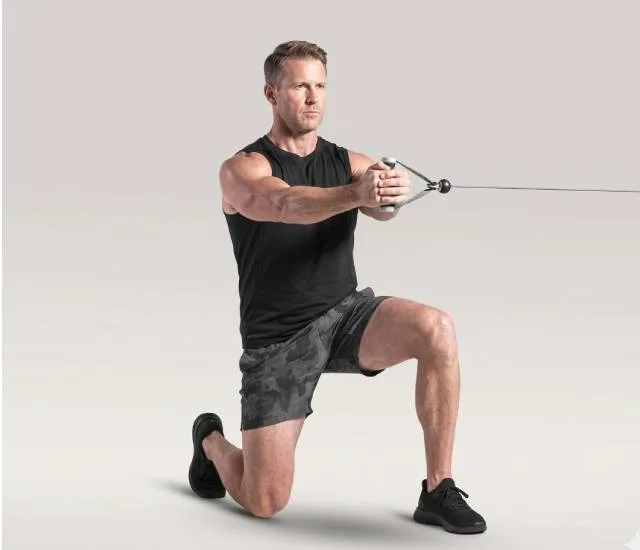
Running economy leaks through the torso when the trunk rotates side to side with each stride. Crunches and sit-ups train spinal flexion, which is not a movement running uses. The Pallof Press trains the core to resist rotation under load, building the trunk stiffness that keeps energy transfer efficient from foot to hip to forward momentum. Runners who add this movement consistently report less side-to-side sway in the final miles of a half marathon, where posture collapse is most costly.
4. Dead Bug - Hip Alignment and Lumbar Stability Without Spinal Flexion

The dead bug solves a problem crunches create: it builds deep lumbar stability while keeping the spine in a neutral position, teaching the hip flexors and contralateral shoulder to work together without the lower back compensating. For runners, this matters because lumbar instability allows the pelvis to tilt anteriorly under fatigue, shortening stride length and increasing ground contact time. This is not a glamorous exercise, and it will not feel hard at first. It trains the stabilization pattern before load, not after injury.
5. Box Jump and Broad Jump - Explosive Lower Body Power for Faster Turnover

Ground contact time is one of the clearest separators between slower and faster runners. The less time your foot spends on the ground per stride, the more efficient your gait. Plyometric training improves rate of force development, which directly reduces that contact time. Box jumps and broad jumps belong in a runner’s plan because they train the explosive hip extension and landing absorption that translates to snappier turnover. The tradeoff: plyometrics require fresh legs to execute safely, so they should never follow a hard running session on the same day.
6. Weighted Step-Up - Functional Leg Drive Strength in a Running-Specific Pattern
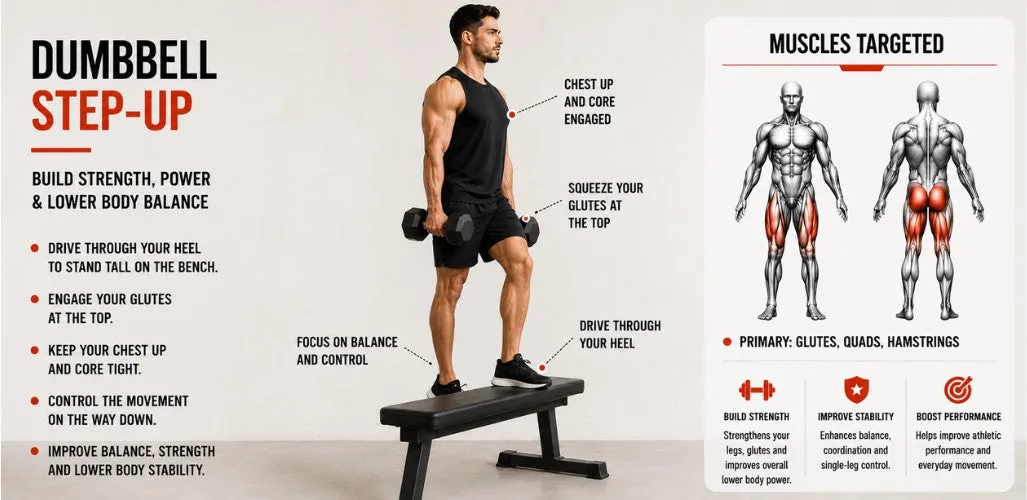
The weighted step-up mimics the single-leg push-off of running more closely than any squat variation. It trains the quad, glute, and hip flexor through a range of motion that directly maps to uphill running and late-race leg drive. It also exposes and corrects left-right strength imbalances that bilateral exercises mask entirely. Most runners who have dealt with IT band issues trace the problem back to a weak glute on one side; the step-up surfaces that gap and closes it. The Weighted Reverse Lunge works similarly, emphasizing single-leg strength and hip mobility while further lowering IT band syndrome risk by correcting left-right imbalances under load.
7. Pull-Up and Dumbbell Row - Upper Body Stability That Preserves Running Form Late in a Race

Upper body pulling strength is worth prioritizing for runners who race beyond 10K. As the miles accumulate, the upper back fatigues, the shoulders round forward, arm drive degrades, and the entire kinetic chain loses efficiency. Pull-ups and dumbbell rows build the posterior shoulder and upper back endurance that keeps arm drive active and posture upright when the body is screaming to collapse. Runners who dismiss this as “not running-specific” tend to be the ones whose form falls apart at mile 11.
Most runners who walk into the gym with good intentions still default to whatever machines are open, because knowing these seven exercises exist is not the same as having a plan that sequences them correctly and tells you exactly what to do when you show up. The deeper problem for runners who have previously struggled with consistency due to lack of program structure is the absence of a daily answer to the question: which exercises, how many sets, in what order, right now? GetFit AI gives you a starting point from day one, and the structured training arc spans each individual session as well as the full program, so progress compounds rather than stalls. That continuity is what keeps runners training past week three, when most good intentions quietly expire.
Knowing which exercises belong in your plan is only half the equation. The other half is knowing which ones to pair together, on which days, and how far apart from your hard running sessions. That is exactly what the weekly routine in the next section is built to answer.
Complete Weekly Strength Routine Alternating Lower-Body Power and Upper-Body Stability
“Runners who skip lower-body strength work develop muscle imbalances, weak glutes, and weak calves that cause injury and limit performance. That’s exactly why I need a structured lower-body power component built into my weekly routine.”
— what we hear from runners / endurance athletes
Skipping strength work feels harmless for a while. Then a hip flexor tightens, a knee starts barking, or the Achilles flares, and suddenly the runner who was logging 40 miles a week is logging zero. For runners past 40, where tissue recovery slows and accumulated wear starts compounding, getting the structure right the first time matters more than adding a fifth day of easy miles ever will.
Most runners already understand this in the abstract, yet they skip strength work anyway, because allocating a discrete 30-to-45-minute block for lifting, on top of an already-full run schedule, feels like a logistical problem they can’t solve consistently.
Two Weekly Strength Sessions, 30-45 Minutes, for Runners
Two to three strength sessions per week, each lasting 30 to 45 minutes, provides enough stimulus to drive adaptation without accumulating fatigue that degrades running quality. Concurrent training literature consistently identifies that window as the practical ceiling for most runners, a principle well-documented in industry research on minimum effective dose strength training for endurance athletes.
Day A - The Lower-Body Power Session Built to Drive Force Into the Ground
| Exercise | Sets x Reps | Primary Target |
|---|---|---|
| Bulgarian Split Squat | 3 x 5 (heavy) | Quads, glutes, hamstrings |
| Single-Leg RDL | 3 x 8-10 per side | Hamstrings, glutes, balance |
| Single-Leg Step-Up | 3 x 10 per leg | Calf and core stability |
| Box Jump | 3 x 6 | Power, ground reaction force |
| Calf Raises | 3 x 8-12 | Lower leg, Achilles resilience |
| Glute Bridge | 3 x 12-15 | Glutes, hamstrings, running gait |
Primary compound movements use 3 sets of 5 reps at heavy load to build power without the soreness that follows higher-rep hypertrophy work. That low-rep prescription sends a strength signal to the nervous system without the 48-hour muscle damage that would compromise your next run, consistent with the minimum effective dose approach that prioritizes adaptation quality over volume.
Day B - The Upper-Body Stability and Core Session That Holds Your Form Together
The postural chain that keeps your shoulders square and your hips level at mile 8 never gets trained on a run; it only gets exposed.
| Exercise | Sets x Reps | Primary Target |
|---|---|---|
| Pull-Ups or Lat Pulldowns | 3 x 8 | Upper back, posture |
| Bent-Over Rows | 3 x 10 | Back muscles, late-race form |
| Dumbbell Shoulder Press | 3 x 10 | Shoulder stability |
| Push-Ups | 3 x 10-20 | Chest, shoulders, posture |
| Pallof Press | 3 x 10 per side | Anti-rotation core strength |
| Plank Variations | 3 x 30-60 sec | Full core, hip alignment |
| Side Plank | 3 x 30-45 sec per side | Lateral stability, hip drop prevention |
| Dead Bugs | 3 x controlled reps | Core control |
Day B protects everything built in Day A, and it is the session most runners drop first when life compresses. Having it pre-built inside your GetFit AI plan, rather than mentally negotiated every Thursday, is what separates doing it from skipping it.
The Alternating A/B Structure as a Fatigue-Management System
| Day | Session |
|---|---|
| Monday | Easy run |
| Tuesday | Day A: Lower-body power |
| Wednesday | Intervals or tempo |
| Thursday | Day B: Upper-body and core |
| Friday | Rest or easy run |
| Saturday | Long run |
| Sunday | Rest |
Separating lower-body lifting from hard run days reduces the interference effect that blunts neuromuscular adaptation in both the weight room and on the road, a sequencing principle industry research identifies as foundational to concurrent training for endurance athletes.
For runners who want to train the way serious athletes structure their weeks rather than improvising around their run schedule, this kind of deliberate session placement is what GetFit AI’s Athlete-Style Custom Workout Plans deliver. Consistency past the first two or three weeks, the window where most self-programmed strength attempts collapse, is reinforced through the app’s friends, challenges, and leaderboard layer, which works best once you’ve connected with at least one training partner also using GetFit AI.
If you’re weighing whether the structure is worth committing to, the GetFit AI Premium Weekly Subscription is $1.99, a low-friction entry point that lets you run the full plan for a week before deciding whether to extend to monthly or yearly access.
When Your Schedule Compresses - How One Full-Body Session Preserves the Stimulus
For runners with compressed schedules, a single combined full-body session once per week can serve as an effective alternative. Choose two exercises from Day A (Bulgarian split squat and single-leg RDL) and two from Day B (rows and plank variations), keep the 3x5 loading on compound movements, and finish in under 40 minutes. That single session won’t replicate the full A/B stimulus, but it preserves the adaptation signal well enough to bridge a compressed week without losing ground.
Related Reading
- Athletic Performance Analysis
- Does Vaping Affect Athletic Performance
- How to Avoid Feeling Sleepy After Workout
- How Does Sleep Affect Athletic Performance
- How to Measure Athleticism
- Velocity Based Training
- Building Stamina and Endurance
- Why Am I So Bad at Sports
- Endurance vs Strength Training
- Why Am I So Tired After Working Out
- How to Create a Personalized Workout Plan
How to Incorporate Strength Training Into Your Running Routine Without Wrecking Your Legs
It’s worth naming something that doesn’t get said enough: a meaningful number of people who come to combined run-strength training carry real psychological weight around running itself.
As the research on the interference effect makes clear, stacking strength on rest days converts your only true recovery window into a second stimulus day, compounding fatigue exactly when your body needs to absorb the running load you’ve already accumulated.
Stack Strength After Hard Run Days to Protect Your Recovery Window
Schedule strength sessions on the same day as hard running efforts, performed after the run. That single rule protects rest days for genuine recovery and keeps quality workouts free of residual muscle fatigue.
A runner doing Tuesday tempo intervals and Thursday track repeats should place strength work immediately after each of those sessions, then treat Wednesday, Friday, and the weekend’s easy days as true recovery. Otherwise the legs that should be fresh for 16 miles at aerobic pace are instead carrying glycogen debt and micro-damage from the previous day’s deadlifts.
The One-Variable Rule for Progressive Overload Across Both Modalities
Increase only one training variable at a time, never strength volume and running mileage simultaneously. That constraint is the structural rule separating runners who build fitness from those who accumulate overuse injuries.
A practical example: adding a third strength day in week five only makes sense after confirming that easy run paces are stable and that load-sensitive areas like the Achilles and knee feel normal. GetFit AI’s Structured Training is most beneficial precisely for runners who have previously struggled with consistency because they lacked a clear program arc, people who were motivated but had no system telling them when to push and when to hold. The training program is managed across each session and across the overall arc, so the one-variable rule is enforced by the plan itself, not by your willpower at 6 a.m.
The Easy-Run Warning Sign Your Strength Volume Is Too High
Key takeaway: A sustained and noticeable slowdown across two or three consecutive easy runs, runs that should feel controlled, is a practical marker that strength volume has exceeded what the current running load can absorb. When that pattern appears, reduce strength volume before touching the running schedule.
Nutrition is the other lever worth monitoring closely: GetFit AI tells you exactly what to eat to hit your goal and lets you track it without doing the math yourself, which matters here because under-fueling a concurrent program is one of the fastest ways to manufacture false fatigue signals that look like overtraining but are actually just inadequate caloric support for the combined load.
Related Reading
- How to Deal With Performance Anxiety in Sports
- Hydration Tips for Athletes
- How to Build Mental Toughness in Athletes
- Food for Athletes During Competition
- Best Plyometric Exercises for Speed
- Exercises That Improve Muscular Endurance
- Conditioning Workouts for Athletes
- Speed Training for Athletes
- Balance Exercises for Athletes
- Best Core Exercises for Athletes
Why Most Runners Abandon Their Strength Plan Before It Pays Off
A significant share of people who start a new exercise program quit before week six, according to research published in the Journal of Physical Activity and Health, and they exit precisely when the physiological payoff is still forming. This pattern is the direct result of three structural execution gaps that no amount of willpower closes.
The Three Behavioral Failure Modes That Kill Strength Programs Before Week Six
The first failure mode is intermittent participation: showing up when motivation peaks rather than following a governed schedule. Sporadic attendance is associated with the highest dropout rates in adherence research, and those dropouts occur before programs can produce physiological benefits. The second is invisible stalling: runners lift the same weights for months, feel nothing changing, and quietly conclude the work isn’t worth it. The third is goal diffusion: no clear objective for the strength sessions, so the programming stays unfocused and the runner has no way to measure whether it’s working. Together these three gaps compound quickly.
Miss two sessions, lose the thread, stall on the weights, and the habit dissolves.
Why One Confusing Session Triggers a Full Program Collapse
A runner follows a downloaded plan for three weeks, arrives to find the plyo box taken, has no idea what to substitute, and skips the session. That single skip breaks the streak, and the streak was the only accountability structure holding the habit together.
Without it, the next session feels optional, then unlikely, then gone. The neuromuscular adaptations that improve running economy, motor unit recruitment, rate of force development, and muscle-tendon stiffness typically require consistent, progressive loading over multiple weeks to materialize, a timeline supported by the broader strength training adaptation literature. The runner who exits in week four hasn’t failed to respond. They’ve left the adaptation window one week before it paid off.
Adaptive Strength Plans vs Static Programs for Runners
Static PDF programs are written once and stay frozen, unable to respond when equipment is missing, schedules shift, or progress stalls.
An AI fitness app like GetFit AI pairs a custom workout plan that adapts as the runner gets stronger with an always-available AI trainer chat, removing the two friction points that static plans cannot touch: real-time confusion and invisible stalling. That responsiveness keeps the habit intact through the exact disruptions that collapse static programs.
The runner who gets stronger had a system that answered back when things got hard.
Next steps
If your strength sessions keep colliding with your best run days, leaving your legs too wrecked to hit your tempo targets, the path forward starts with a structured plan that sequences lifting and running so each one reinforces the other instead of competing for the same recovery window. Start with our AI fitness app.
The research on eccentric loading makes this concrete: a Nordic hamstring curl trains the hamstring under stretch at the exact moment running demands it, cutting hamstring injury incidence by 51 percent, while a leg curl machine produces strength that running never uses. That means exercise selection is not a preference but a performance decision. Add the scheduling principle that placing strength after hard runs, never the day before quality workouts, is what prevents the interference effect from blunting neuromuscular adaptation in both the weight room and on the track. Together, they point to one action: follow a plan that gets both variables right from session one, not after weeks of trial and error.
Start with GetFit AI. Input your running days, available equipment, and goal pace, and a periodized strength schedule generates immediately, one that adapts as you get stronger so you never exit the adaptation window one week before it pays off.
Frequently Asked Questions
How often should I strength train as a runner?
Two strength sessions a week is the recommended structure. That restraint is intentional, it’s built to make every session count without leaving your legs too wrecked to run the next day.
Will adding strength training make me bulk up and slow me down?
The post doesn’t support that concern, it focuses on heavy resistance and plyometric training as tools that improve running economy by 3 to 8 percent through neuromuscular adaptations like increased motor unit recruitment and better rate of force development, not muscle bulk. The exercise selection recommended is specifically matched to the mechanics running demands, not to hypertrophy.
Do runners actually need upper body strength training?
Yes, upper body pulling strength matters for any race beyond 10K. As miles accumulate, the upper back fatigues, shoulders round forward, arm drive degrades, and the entire kinetic chain loses efficiency. Pull-ups and dumbbell rows build the posterior shoulder and upper back endurance that keeps arm drive active and posture upright when the body is screaming to collapse.
What’s the best core exercise for runners, should I just do crunches?
Crunches are the wrong tool for runners because they train spinal flexion, which is not a movement running uses. The Pallof press trains the core to resist rotation under load, and the dead bug builds deep lumbar stability while keeping the spine neutral, both of which directly preserve running economy and posture in the final miles of a race.
Which strength exercises are most important for runners dealing with IT band or hamstring issues?
The single-leg Romanian deadlift targets the hip stability that keeps your pelvis level under fatigue, a key driver of IT band syndrome, while the Nordic hamstring curl trains the eccentric strength that research shows reduces hamstring injury incidence by 51 percent compared to traditional training that excludes it. The weighted step-up also surfaces and corrects left-right glute strength imbalances that bilateral exercises mask, which is where many IT band problems originate.