Bench Press Standards by Age, Weight, and Gender (2026)
Most lifters find their bench press standard, see the gap, and go back to doing the same thing. Here is how to read the numbers correctly, check if your reps even count, and actually use the data to move up a tier.
Knowing your bench press standard is useful information, and most lifters treat it as if that alone is enough, operating under the assumption that “once I know the standard, I’ll know whether what I’m doing is working, and I can keep doing it until I get there.” There is a gap between knowing the number and doing something about it, and most lifters fall straight into it. See our AI fitness app for how this works in practice.
A bench press standard is a 1RM-based benchmark. Across the broader strength training landscape (May 2026), the one-rep maximum (1RM) is defined as the maximum weight a lifter can move for a single clean repetition with proper form, and it is the universal unit used to express and compare bench press strength across all experience levels and demographics. Every major standards database anchors to this number because it strips out rep-range variation and gives you a single, comparable figure.
Gender is the primary split in bench press standards databases because of physiological differences in upper-body muscle mass and hormone profiles between males and females, which produce meaningfully different strength outputs at equivalent bodyweights. It is a biological baseline, and every credible standards system reflects it.
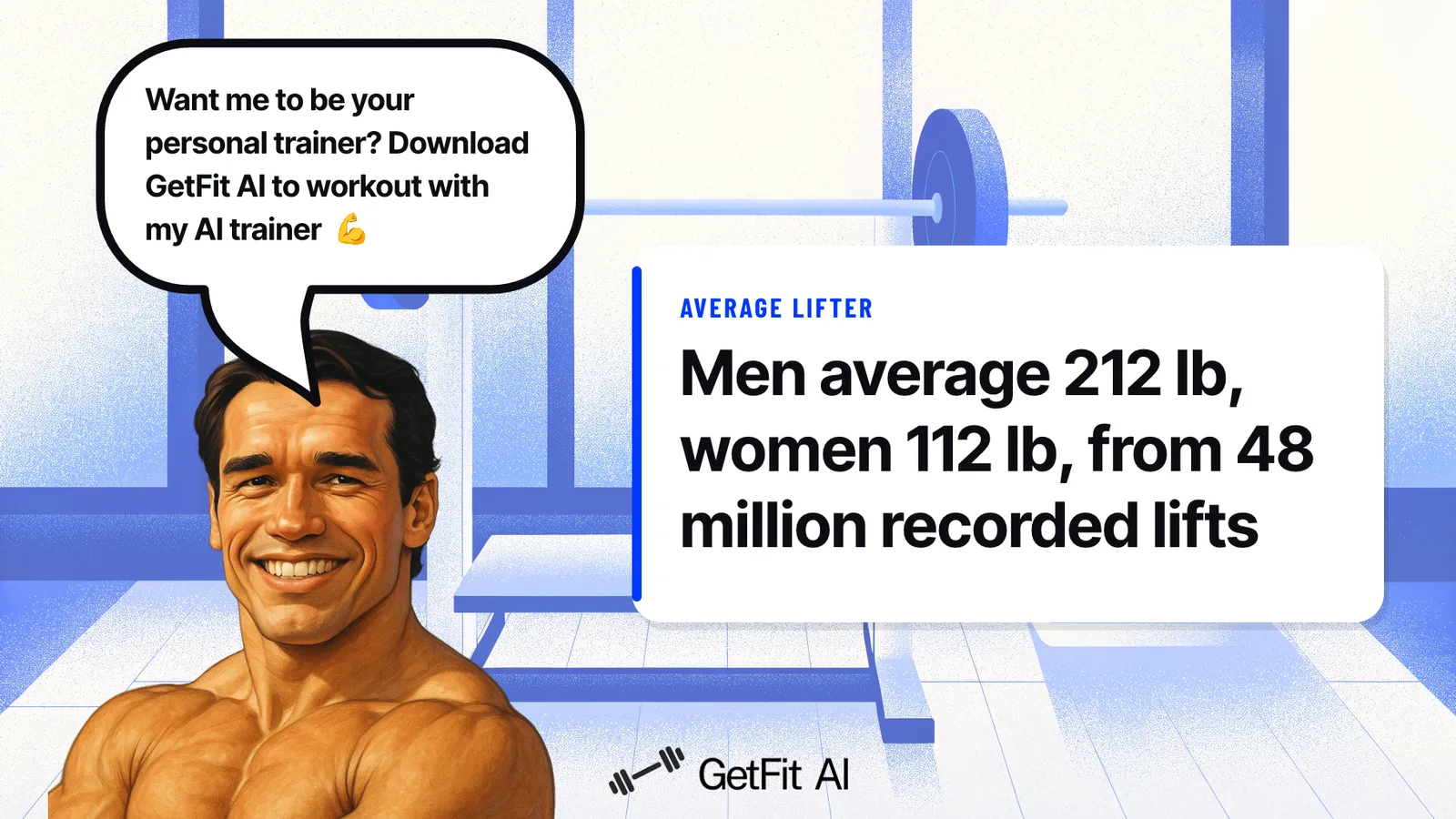
The numbers are stark. Based on 48,718,584 lifts recorded since 2014, the average bench press 1RM is 212 lb for men and 112 lb for women. That gap reflects the upper-body physiology difference above, not effort or commitment.
Most lifters find the standard, see they are behind, and walk back into the gym doing the exact same thing.
Key takeaways
- Bench press standards are bodyweight-relative, a 185 lb lift means something completely different on a 135 lb frame than on a 220 lb frame, and flat number comparisons mislead more lifters than they help.
- Published standards are built around the 18-to-39 performance window, which means lifters over 40 are being measured against a baseline that no longer applies to their physiology.
- The numbers assume a specific movement: free-weight barbell, bar touching chest, full lockout, partial reps and machine presses do not count toward the standard, no matter how the weight feels.
- Most lifters who look up their tier, feel behind, and walk back into the gym change nothing, same exercises, same weight, same rep count, which is exactly what keeps them stuck.
- Knowing your bench press standard without a session-by-session progression plan is just a mirror that makes you feel bad; the standard is the starting line, not the strategy.
- GetFit AI closes that gap by turning your current numbers into a custom training plan built in your favorite athlete's style, with an AI trainer available anytime to adjust the plan as you progress.
Bench Press Standards by Bodyweight and Experience Level: The Full Classification Table
Two lifters walk into a gym. Both bench 185 lb. One weighs 135 lb; the other weighs 220 lb. Same number, completely different story. The problem with using a fixed benchmark like “225 for men” or “bodyweight for women” is that it strips out the two variables that actually determine whether a number is impressive, average, or a sign you need to change your approach: how much you weigh and how long you’ve been training.
The Five-Tier Classification System Explained
According to ExRx.net, bench press strength falls into five tiers: Untrained, Novice, Intermediate, Advanced, and Elite. Each tier reflects a meaningful jump in neuromuscular efficiency. Untrained means no structured training history. Novice means you’ve followed a consistent program for a few months. Intermediate means you’ve earned real adaptation through progressive overload. Advanced and Elite represent years of deliberate, structured work that most recreational lifters never reach.
Bodyweight Multipliers: The Fastest Way to Locate Your Tier
Per ExRx.net’s 2024 standards, the cleanest way to find your tier without a calculator is to express your bench as a fraction of your bodyweight. For men, Untrained sits near 0.6x bodyweight, with each successive tier, Novice, Intermediate, Advanced, and Elite, requiring meaningfully higher multiples of bodyweight, scaling progressively up through the classification ladder. For women, the multipliers are lower: Untrained near 0.3x, with Novice, Intermediate, Advanced, and Elite tiers each requiring progressively greater fractions of bodyweight above that baseline.
These multipliers are the fastest diagnostic tool you have. If you bench 170 lb and weigh 170 lb, you are right at the Intermediate threshold for men. If you bench 90 lb and weigh 130 lb as a woman, you are between Novice and Intermediate.
Men’s Bench Press Standards by Bodyweight Class. The table below uses ExRx.net’s 2024 classification data. All figures are approximate 1RM in pounds for men aged 18-39 lifting with a free-weight barbell.
Related Reading
- Best Fitness Apps
- How Many Pull Ups Should I Be Able To Do
- Average Grip Strength Male
- Average Bench Press
- How Much Does A Bench Press Bar Weigh
- Average Male Bench Press
- How Much Can The Average Man Bench Press
- Grip Strength Chart
- Symmetric Strength
How to Know If Your Bench Press Form Meets the Standard, and Why It Matters
Finishing a set and genuinely not knowing if those reps counted is more common than most lifters admit. The common assumption is: “Once I know the standard, I’ll know whether what I’m doing is working, and I can keep doing it until I get there.” The published standards assume a specific movement: free-weight barbell, bar touching chest, full lockout, hips planted. Stray from any one of those conditions and the number you lifted no longer maps to the tier you think you’re in.
The Three Form Checkpoints That Make a Bench Press Rep Official
A rep qualifies when three things happen together: the bar makes contact with the chest (not hovering an inch above it), the arms reach full lockout at the top, and the hips stay on the bench throughout the movement. Miss any one checkpoint and the rep doesn’t satisfy the criteria the standards are built on. Partial-range pressing allows significantly heavier loads to move because the hardest portion of the lift, off the chest, never gets trained. That inflated load creates an inflated tier placement.
Before logging any rep toward your standard, confirm all three checkpoints:
-
Bar makes full contact with the chest (not hovering an inch above it)
-
Arms reach full lockout at the top of the movement
-
Hips remain planted on the bench throughout the rep
Why a Smith Machine Number Is a Different Lift Entirely
A 2010 study in the Journal of Strength and Conditioning Research by Schick et al. measured muscle activation via EMG across the anterior deltoid, medial deltoid, and pectoralis major during both movements. The free-weight bench press produced significantly greater anterior deltoid activation than the Smith machine version. The Smith machine’s fixed rail eliminates the stabilization demand entirely, so the muscles responsible for controlling bar path never have to fire.
Key takeaway: A Smith machine number and a barbell number are not the same lift, and no published standard treats them as equivalent.
The Bounced-Rep Trap
Bouncing the bar off the chest uses the rebound to assist the press through its weakest range. It works. The weight moves. But it bypasses the very portion of the lift the standard is testing. A lifter who bounces 185 lb off the chest on a Smith machine has demonstrated neither the strength nor the control the Intermediate tier requires. The number looks right. The qualification isn’t there.
How Age Affects Bench Press Standards, and What to Expect After 40
Most bench press standards you’ll find online were built around lifters in their prime, which means reading them after 40 puts you in the position of measuring yourself against a target that was never designed for you. Understanding why those numbers don’t apply, what a realistic decade-by-decade decline actually looks like, and where age-adjusted benchmarks can quietly mislead you gives you a far more useful foundation for setting goals. GetFit AI is built to work with that full picture, not against it.
Why Published Standards Are Built Around the 18-39 Window
According to Strength Level’s database of 48,718,584 lifts recorded since 2014, the published bench press standards implicitly treat the 18-to-39 age range as the performance baseline. That is not an accident. Strength peaks between the mid-20s and late-30s, which means every tier label, from Novice to Elite, was calibrated against what a body in that window is physiologically capable of producing. A 50-year-old reading those same tiers is comparing himself to a standard that was never built for him.
What the Decade Drop Actually Looks Like
Pushing power peaks between the mid-20s and late-30s, then meaningfully declines with each passing decade after age 40. Research on age-related neuromuscular decline supports this trajectory, driven partly by the loss of Type II fast-twitch muscle fibers, which decrease at an accelerating rate from the fourth decade onward, and partly by falling testosterone levels, which decline gradually in men beginning in their 30s. The hormonal backdrop matters because testosterone is directly tied to the rate of muscle protein synthesis and recovery between sessions. Slower recovery means less training volume tolerated per week, which compounds the strength loss if programming does not adapt.
The Hidden Risk Inside Age-Adjusted Numbers
Matching the age-adjusted benchmark is not the same as training in a way that slows the underlying decline. A lifter in their late 40s who sits comfortably inside the “Intermediate” bracket for their age group may feel validated, but if they are not periodizing load progression to offset neuromuscular losses, they are losing ground faster than the bracket accounts for. The number looks fine. The trajectory does not.
Matching the age-adjusted benchmark is not the same as training in a way that slows the underlying decline.
How to Improve Your Bench Press: Why the Standard Is Useless Without a Structured Plan
The gap between knowing your bench press tier and actually climbing to the next one is a structure problem. Most lifters who look up their standard, feel the sting of being behind, and walk back into the gym are doing exactly what will keep them stuck: the same three exercises, the same weight on the bar, the same rep count they have done for months.
“I struggle with stalled bench press progress when I just try to lift heavier every session without a structured plan.”
— what we hear from weightlifters / gym enthusiasts
Why Most Lifters Stay Stuck After Finding Their Standard
Picture this: you look up the intermediate standard for your bodyweight, realize you are sitting firmly in the Novice tier, feel a familiar wave of frustration, and then… do the same workout you did last Tuesday. The standard becomes a number you feel bad about rather than a target you are actually closing in on. This is one of the most common and damaging patterns in beginner strength training: attempting to progress by trying to lift heavier each session, without a structured plan underneath it. Effort without escalation is maintenance, and industry research makes the mechanism explicit: without progressive overload, training effort does not translate into measurable progress on the bar.
Real life compounds the problem. Working multiple jobs, irregular schedules, and competing demands do not pause for your training block. Lifters who are closing in on a meaningful milestone know exactly how quickly life circumstances can force them off a structured plan and drain the momentum they spent months building. The structure collapses, the milestone recedes, and starting over feels harder than it did the first time.
This is precisely the problem GetFit’s Structured Training is built to solve. Most beneficial for lifters who have previously struggled with consistency due to lack of program structure, it generates a custom plan immediately at onboarding, before you ever touch a bar, so there is no ambiguous week one where you are guessing what to do. From your first workout session, and across the entire training arc that follows, the plan adapts instead of staying fixed while your life changes around it. A plan you fall behind on eventually becomes a plan you quit. A plan that adjusts to where you actually are keeps you moving.
Progressive Overload: The Only Mechanism That Moves the Bar
Progressive overload is a specific, week-to-week requirement: add load, add reps, or add sets on a defined schedule. A Novice lifter who follows a consistent linear progression, adding small increments of load on a defined schedule, can realistically reach Intermediate within a matter of months. It is arithmetic applied to a plan, but only if the plan is running. The moment a lifter loses the thread of what comes next, the arithmetic stops.
GetFit AI removes that friction at the source. The app answers the questions lifters would otherwise have to track down a coach or wade through conflicting articles to resolve, immediately, without requiring them to ask a person. These are not small questions; unanswered, they are the exact points where structure quietly collapses:
-
What weight should I use this session?
-
Should I add a set or increase load?
-
Am I recovering adequately between sessions?
Having them answered automatically, inside the same session where they arise, keeps the progressive overload mechanism running without interruption.
Sets, Reps, and Frequency: Strength vs. Hypertrophy
The prescription depends on your goal, and conflating the two is one of the most common reasons lifters stall. For strength, Schoenfeld, Grgic, Van Every, and Plotkin (2021) found that heavier loads in the 1 to 5 rep range preferentially develop the neuromuscular adaptations that actually move your one-rep max. Simply doing more reps at a comfortable weight will not close a strength gap. For hypertrophy, moderate loads across 6 to 12 reps, taken close to muscular failure, produce comparable muscle growth across a wide rep range. Match the rep range to what you are training for, and let your plan hold that prescription across every session, not just the ones where you remember to check.
GetFit AI’s Athlete-Style Custom Workout Plans are built around exactly this logic: the rep ranges, load progressions, and session structures are matched to your stated goal from the start, then recalibrated as your capacity changes. You are not inheriting a generic template. You are working a plan that was generated for your starting point and adjusts as you move through it, which is what closes the gap between where a standard says you are and where you are capable of going. Access to that plan starts at $1.99 per week, $4.99 per month, or $49.99 per year on a Premium subscription.
Related Reading
- Do Pull Ups Work Chest
- Grip Strength Norms
- Average Deadlift Weight
- 1 Rep Max Chart
- Average Male Deadlift
- Good Bench Press Weight
- Weightlifting Standards
- Average Bench Press Kg By Age
- Average Deadlift Weight Kg
The Standard Is Just the Starting Line: Here’s How to Actually Reach It
Your current numbers are the starting line, not a verdict. The gap between reading a bench press chart and actually training from it is where most lifters lose months, not because they lack information, but because they never convert that information into a session-by-session structure that moves them forward.
The Most Common Bench Press Mistake Beginners Make After Finding Their Standard
The sting of seeing “Novice” next to your name fades fast. What lingers is the return trip to the gym where nothing has changed: same warm-up, same three machines, same bar weight. Exercise science is clear on this point: the body adapts to a fixed stimulus and stops improving, a principle confirmed across controlled studies and repeated in applied training settings.
A PeerJ study by Plotkin et al. demonstrated that muscular adaptations depend on progressing the training stimulus, whether that progression comes through load, volume, or repetitions. That is biology responding exactly as designed.
The standard told you where you stand; it cannot tell you what to load next Tuesday. The high dropout rate within the first 90 days is a feedback latency problem. Strength standards only update when the bar weight moves, which on a beginner timeline can take weeks, so lifters lose confidence and quit before the adaptation cycle completes.
Most fitness apps function only as workout logs, a place to record sets and reps, offering no real guidance on how to progress. Logging a session is not the same as being shown what to load next Tuesday, and most apps never bridge that gap. Beginners who use them are essentially writing stuff down without getting stronger.
A coach who doesn’t update programs, ignores check-ins, and allows plateaus is failing the same way: the baseline of “having a plan” or “having a coach” is not enough if neither responds to where you actually are right now. What predicts long-term progress is how closely a lifter’s daily training behavior matches the demands of a clear, structured plan, a position consistent with what most coaches and practitioners observe: program consistency outweighs program design in determining real-world outcomes.
GetFit AI addresses this directly. Its Athlete-Style Custom Workout Plans are structured from the first workout session, built around progressive overload so that every session has a specific prescription, not a blank log waiting to be filled. This is most valuable for lifters who have previously struggled with consistency precisely because no structure existed to follow.
Three Gaps That Stall Bench Press Progress Between Tiers
Three specific gaps separate lifters who move tiers from those who stall. A fourth gap is worth naming because it is the one beginners least expect: the absence of accountability past week three. Early motivation is easy. The session where nothing feels different, where the bar weight hasn’t moved and the mirror hasn’t changed, is where most lifters quietly stop showing up.
-
No load prescription: Without a plan specifying when and how to increase weight, sets, or reps, lifters default to comfortable numbers.
-
As Plotkin et al. show, progression, not repetition of a fixed stimulus, is what drives adaptation, and Planet Fitness echoes this in practical terms for beginners.
-
No nutrition target: Adequate protein and total calories are prerequisites for the muscle repair that translates gym effort into bar weight.
-
Mid-session confusion: When a machine is taken or grip width feels wrong, there is nobody to ask, so the set gets skipped entirely.
-
No accountability past week three: GetFit AI’s social layer, friends, challenges, and leaderboards, is built specifically for this window.
-
It is most effective once a user has connected with at least one friend in the app, and it functions continuously as the retention layer that keeps users training past the early weeks, the point where many unsupported beginners drop off.
Each friction point has a fix. GetFit AI’s Structured Training feature operates during each workout session and across the overall training program arc, prescribing what to do today and mapping how today’s session connects to the tier you are trying to reach. For lifters who want to confirm they are getting stronger rather than just showing up, the plan updates with the bar weight, so the feedback loop that most beginners never experience, progress confirmed session by session, is built in from day one. Premium access starts at $1.99 per week, with monthly ($4.99) and yearly ($49.99) options for lifters ready to commit to the full adaptation cycle.
The Hidden Cost of Skipping a Structured Plan Entirely
The third gap is the one that costs lifters the most time without them realizing it: starting without any structured plan at all. No plan beyond showing up and doing something. This is more common than most gym content acknowledges, and the cost compounds quietly. A lifter who trains three days a week for twelve weeks without a structured progression has not accumulated twelve weeks of progress; they have repeated roughly the same stimulus thirty-six times and wondered why the bar weight never moved.
The research framing here matters. Adherence to a structured program, one with defined exercises, set and rep targets, and a progression model, produces meaningfully better outcomes than equivalent training volume performed without that structure, because structure removes the decision fatigue that causes lifters to default to what is comfortable rather than what is productive. When every session begins with a question mark, mental energy that should go into executing the lift goes into figuring out what to do next, and the session degrades before the first warm-up set is loaded.
GetFit AI closes this gap at the entry point rather than after the fact. The Athlete-Style Custom Workout Plans are generated before the first session begins, so a lifter who opens the app knowing only their current bench press number leaves with a full session prescription, not a blank template. For beginners who have previously tried and abandoned self-directed training, this is the structural difference: the plan exists on day one, it updates as performance updates, and the next session is never a question mark. That continuity, from the standard to the session to the next tier, is what converts a benchmark into actual progress.
Related Reading
- Average Deadlift Weight For Male
- Best Calisthenics Workout App
- Best Hiit Workout App
- Best Gym Workout App
- Best Workout Apps
- Best Free Workout Apps
Next steps
If your bench press number is sitting at Novice when you expected Intermediate, the path forward starts with accepting that the standard only tells you where you are, not what to load next Tuesday. Start with our AI fitness app.
The five-tier classification system is built on specific conditions, free-weight barbell, full range of motion, bodyweight multipliers, which means the number you looked up is only valid if your equipment and form match how it was measured. That matters because most lifters carry forward an inflated sense of where they actually stand. More critically, progressive overload requires a structured, incrementally escalating plan, not repeated effort at a comfortable weight. Research is explicit that repeating the same stimulus produces stagnation, and the 80% dropout rate within 90 days confirms what happens when lifters have no session-by-session feedback to stay oriented. Together, they point to one practical next step: trading an unstructured routine for a plan that specifies what to lift today and adjusts as your capacity changes.
Start with GetFit, an AI fitness app that generates a progressive, athlete-style custom workout plan from your first session. From there, every workout carries a specific prescription tied to your current tier and target, so the gap you found in the standards table becomes a distance you are actively closing rather than a number you feel bad about on the way to the squat rack.
Frequently Asked Questions
What is the average bench press for someone who has never trained before?
For untrained men, the benchmark sits near 0.6x bodyweight, for example, roughly 70 lb at a 114 lb bodyweight and 130 lb at a 220 lb bodyweight. For untrained women, the baseline is near 0.3x bodyweight, with each successive tier requiring progressively higher fractions above that.
Do I need to bench press my own bodyweight to be considered good?
Bodyweight on the bar is a rough milestone, but the post treats it as an oversimplification, what actually matters is your bench relative to your bodyweight AND your training experience. For men, benching 1x bodyweight sits around the Intermediate threshold, so it is a meaningful marker, but a 135 lb lifter pressing 185 lb and a 220 lb lifter pressing 185 lb are in completely different tiers despite hitting the same absolute number.
What are the key factors that affect how much I can bench press?
The post identifies upper-body muscle mass, hormone profile (particularly testosterone), bodyweight, training age, age-related loss of Type II fast-twitch muscle fibers, and recovery capacity as the primary factors. Form also plays a direct role, partial range of motion or bouncing the bar inflates the number without reflecting the strength the standard is actually measuring.
What sets and reps should I do to actually improve my bench press 1RM?
For strength specifically, the post cites research by Schoenfeld, Grgic, Van Every, and Plotkin (2021) supporting heavier loads in the 1-5 rep range as the prescription that preferentially develops the neuromuscular adaptations that move your one-rep max. For hypertrophy, moderate loads across 6-12 reps taken close to muscular failure produce comparable muscle growth, but the post is clear that conflating the two goals is one of the most common reasons lifters stall.
Does it matter if I do my bench press on a Smith machine instead of a barbell?
Yes, a Smith machine number and a barbell number are not the same lift, and no published standard treats them as equivalent. A 2010 study in the Journal of Strength and Conditioning Research found that the free-weight barbell bench press produces significantly greater anterior deltoid activation than the Smith machine version because the fixed rail eliminates the stabilization demand entirely, meaning the muscles responsible for controlling bar path never have to fire.