Average Bench Press Kg by Age, Gender and Weight Standards

The average bench press for your age is a useful anchor, but a number with no route is just a coordinate. Here is what the data actually tells you, and what it cannot.
You found the number. Now what? The common assumption is: “If I just look up what the average bench press is for my age and try to match it, I’ll know whether I’m on track and what to do next.” That moment happens constantly: a lifter searches “average bench press by age,” lands on a population table, locates their bracket, and feels a sharp mix of motivation and dread. The gap between their current lift and the published average looks enormous. What almost never follows is a clear answer to the only question that actually matters: what do I change at my next session?
See our AI fitness app for how this works in practice. The problem is the data arriving without context. The data is genuinely useful. According to Strength Level’s 2024 database, compiled from over 48 million recorded lifts, the average bench press 1RM is 96 kg for men and 51 kg for women. Those are real anchors. But a single number, stripped of context, is a coordinate with no route attached.
The headline figures shift meaningfully once age enters the picture. Strength Level’s 2024 data shows male bench press capacity peaks in the 20s and 30s, where intermediate lifters cluster around 95-102 kg, then declines gradually through the 40s and 50s.
Women follow the same arc at lower absolute loads, with averages in the 48-55 kg range during peak years.
Bench press capacity depends heavily on body weight, age, and training experience working together. Strength Level’s standards make this explicit: raw kg averages without bodyweight context are genuinely misleading. The same 80 kg bench press represents near-elite output for a 65 kg lifter and a beginner result for someone weighing 110 kg. This is where most lifters lose months. The pattern is familiar: find the intermediate standard, feel motivated for a week, return to the gym, load the same bar, and do the same three exercises with no signal for when or how to progress.
Key takeaways
- Men at the intermediate level peak bench press in their 20s and 30s, averaging 80-102 kg for an 80 kg bodyweight, women at the same tier average roughly half that figure.
- Age-bracket averages are population snapshots, not personal ceilings; the decline most lifters see across their 40s and 50s is as much a programming failure as a biological one.
- Bodyweight-relative standards expose the truth a raw kilogram number hides, a 70 kg lift means something completely different on a 65 kg frame versus a 100 kg one.
- Five classification tiers separate beginner from elite, and stalling between them almost always traces back to the absence of a clear next step, not a lack of effort.
- Spreading bench volume across more sessions with planned progressive overload is the single biggest lever against both plateaus and age-related strength loss, effort without structure doesn't move the needle.
- GetFit AI's structured training closes the gap between knowing your benchmark and actually surpassing it, workouts are built around coherent program progression, so every session tells you exactly what to lift next rather than leaving you to guess.
What is the Average Bench Press by Age for Intermediate Lifters?
Age tells only half the story. A bench press number without knowing the lifter’s decade of life is like a lap time without knowing the track; the raw figure means almost nothing until you place it in context. Intermediate lifters span every age group, from teens through their 70s and beyond, and the standards shift meaningfully across each decade.
Intermediate Bench Press Averages by Age Group
The table below draws on data from Strength Level’s community database, which covers tens of millions of logged lifts, and corroborating figures from liftoffrank.com’s age-bracketed standards. These are one-rep-max estimates for intermediate lifters, people with consistent training history, not first-timers and not competitive athletes.
| Age Group | Men (kg) | Women (kg) |
|---|---|---|
| Teens (15-19) | 82-90 | 40-45 |
| 20s and 30s | 95-102 | 48-52 |
| 40s | 92-95 | 42-48 |
| 50s | 84-85 | 37-42 |
| 60s | 72-75 | 32-35 |
| 70+ | 59-66 | 25-28 |
Peak Years (20s–30s): Intermediate Bench Press Benchmarks
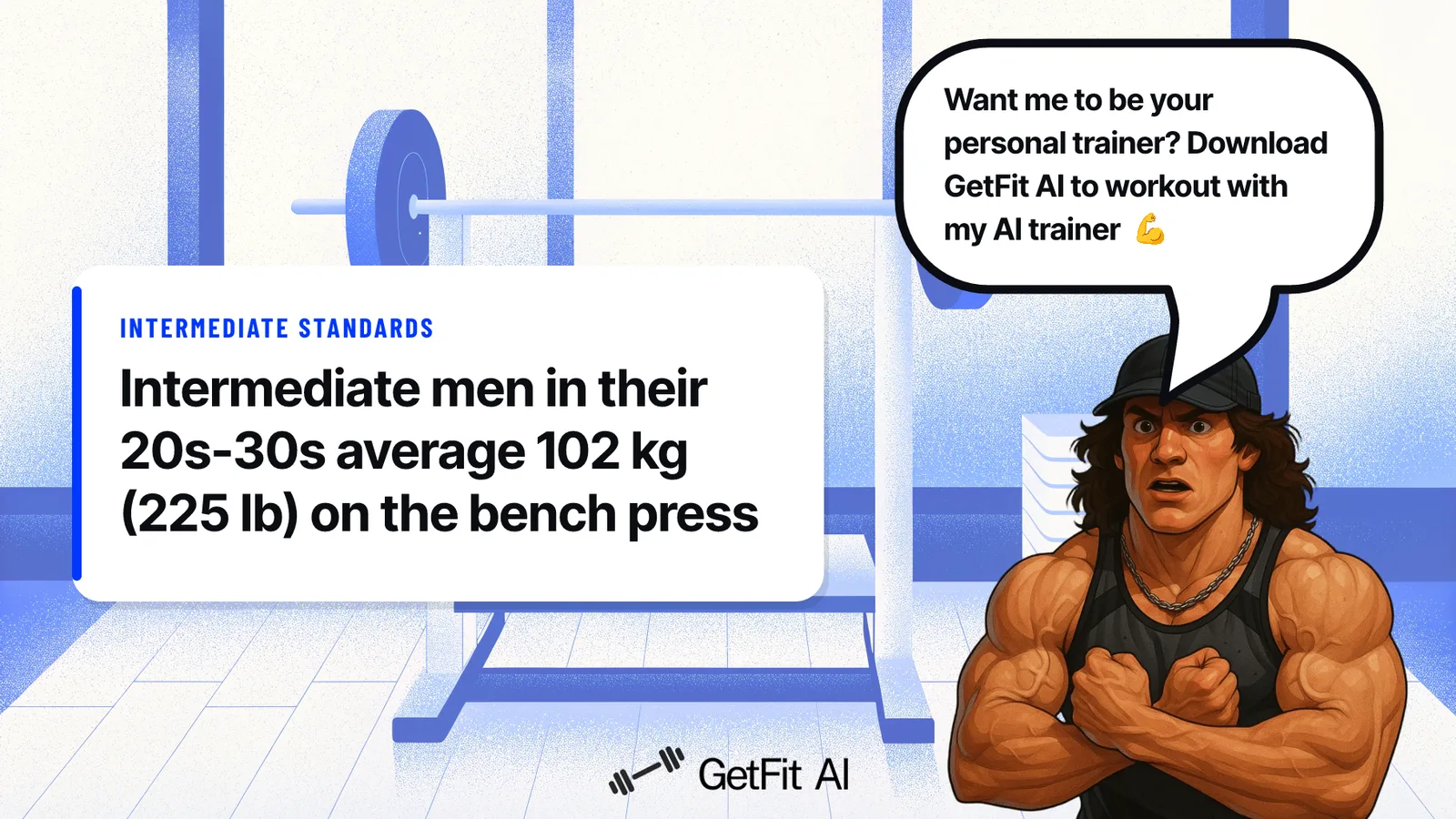
This is the window where biology cooperates most fully. Testosterone is near its ceiling, muscle protein synthesis is efficient, and recovery between sessions is faster. According to Strength Level’s standards, intermediate men in their 20s and 30s average around 102 kg (225 lb) on the bench press. Women in the same bracket land near 48-52 kg.
These numbers set the reference point for every decade that follows. Lifters in their 40s, 50s, and beyond are operating on a different part of the same curve.
The Gradual Slide: How Intermediate Averages Shift Through Your 40s, 50s, 60s, and Beyond
The decline is real, but it is not a cliff. Industry data notes that men in their 40s typically bench 10-20% below their peak, mapping to roughly 92-95 kg at intermediate level. The 50s see a further step down to around 85 kg for men, a figure that directly answers the common question about bench press for 50-year-old men. For women, the equivalent intermediate standard in the 50s sits near 37-42 kg.
By the 60s, intermediate men average closer to 72-75 kg, so a 65-year-old pressing 75 kg is right at the norm for his age group. The 70+ bracket drops to approximately 59-66 kg for men and 25-28 kg for women, per Strength Level’s data.
Lifters who stall in their 40s and 50s are usually stalling because they are still running an unplanned approach that worked at 25 and stopped working at 42.
How Does Bench Press Strength Change with Age, and Why the Drop Isn’t Inevitable
That drop in intermediate bench numbers across the decades has two causes that most lifters never bother to separate. One is genuine biology. The other is programming that quietly surrenders to an expectation of decline before the biology has actually demanded it. The first is real but slower-moving than most people assume. The second is where the majority of strength is actually lost.
The Real Physiology Behind Age-Related Bench Press Decline
Sarcopenia is real, and the numbers are worth knowing. According to research published in Current Opinion in Clinical Nutrition and Metabolic Care, adults lose muscle mass at roughly 1-2% per year after age 50, with strength declining at approximately 1.5% per year after 50 and accelerating to 3% per year after 60. Adults lose 3-5% of muscle mass per decade after age 30, with the rate accelerating after age 60.
The drivers behind that loss are multiple and interacting. Testosterone drops gradually, averaging roughly 1-2% per year after age 30. Growth hormone follows a similar curve. Add reduced muscle protein synthesis and connective tissue that recovers more slowly, and you have a system that demands smarter training, not just harder training.
Why Most Lifters in Their 30s and 40s Stall Early
The failure point is usually hormones less often than it is the absence of a plan. A common pattern: a lifter in his early 40s is still running the same loose 5x5 he defaulted to at 24, same weights, same order, no real progression logic. His shoulder flares up. His bench hasn’t moved in six months. He calls it age. That stall is a programming problem wearing a biology costume.
That stall is a programming problem wearing a biology costume.
The research from Volpi et al.
Related Reading
- Best Fitness Apps
- How Many Pull Ups Should I Be Able To Do
- Average Grip Strength Male
- Average Bench Press
- How Much Does A Bench Press Bar Weigh
- Average Male Bench Press
- How Much Can The Average Man Bench Press
- Grip Strength Chart
- Symmetric Strength
- Bench Press Standards
Bench Press Strength Level Classifications: Beginner to Elite, Explained
Five bench press tiers separate a first-time lifter from a competitive athlete, and the distance between them is measured in years, not weeks. Understanding exactly where you sit on that ladder matters because each tier carries a different set of training demands, and arriving at one without a plan for the next is how most lifters end up pressing the same weight for months on end.
A raw kilogram average for your age bracket tells you almost nothing about where you personally stand. Bodyweight-relative strength ratios expose a 50-80 lb structural difference that the same absolute number completely hides, yet the five-tier classification system already encodes this bodyweight context into every threshold, making your tier placement a far more honest diagnostic than whether you hit the age-group average.
The Five Bench Press Tiers: Exact kg Thresholds and Bodyweight Multipliers
Bench press strength level classifications run from Untrained through Novice, Intermediate, Advanced, and Elite, with each tier defined by both an absolute kg value and a bodyweight multiplier. Thresholds differ by sex and bodyweight class across the market, but for an 80 kg male lifter the ladder looks roughly like this: Beginner, around 40-50 kg (0.5x bodyweight); Novice, approaching 70 kg (close to 1.0x); Intermediate, 95-100 kg (1.0-1.25x); Advanced, 130 kg or more (1.5-1.75x); Elite, reserved for competitive-level output built over many years.
The multiplier matters because a 100 kg lift on a 70 kg frame is a fundamentally different achievement than the same number on a 100 kg frame, a structural difference the raw kilogram figure completely hides.
One confusion that genuinely undermines confidence in the system: a lifter can hit a bodyweight bench press, which maps to Novice on the Vitruve Strength Level Calculator, while still falling short of a Beginner threshold in a closely related pressing movement like the overhead press or dip. That apparent contradiction is a signal that strength is movement-specific and that isolated progress on one lift does not guarantee proportional carry-over to another. The tier you occupy in the bench press is a bench press diagnosis, not a whole-body one.
GetFit AI’s Athlete-Style Custom Workout Plans are built around this reality. Rather than optimising a single lift in isolation, the program structures your sessions to develop pressing strength across patterns, so your tier placement in one movement stops being a ceiling in every other.
What Each Tier Actually Costs in Training Time
The tiers are not just numbers. They are phases of training history. What most teams of coaches and programmers report holds consistently: Untrained reflects no structured programme, Beginner and Novice represent several months of consistent training, Intermediate spans one to two years, Advanced demands multiple years of structured programming, and Elite reflects competitive-level dedication over many years.
That timeline is honest, and it is also the part most lifters skip when they read a classification chart. Reaching Novice by accident is common. Reaching Advanced by accident is nearly impossible.
Structured training is the variable that separates lifters who move up the ladder from those who stall on it. GetFit AI’s Structured Training feature is most beneficial for lifters who have previously struggled with consistency due to lack of program structure, and it activates from the first workout session, building a program arc that accounts for where you are on the tier ladder and what the next tier actually demands. 1,480 exercises, each with a video guide, step-by-step instructions, form tips and common mistakes, plus muscle maps and free calculators on the website, give you an immediate starting point without any barrier to entry, so the question of “what do I train today” is answered before it becomes the reason you skip the session.
Nutrition is the other half of the equation the classification chart never shows you. Moving from Novice to Intermediate requires not just more volume and progressive overload, but the caloric and protein surplus, or precise deficit, that your tier transition demands. GetFit AI’s nutrition guidance answers the question of what to eat to actually put on size or lean out in direct relation to your training phase, removing the guesswork that stalls more intermediate lifters than any programming error.
Why Intermediate Is the Most Dangerous Classification
Intermediate is where unplanned lifters stall indefinitely. Broader training research places Intermediate at one to two years of consistent training, which means by the time you arrive there, the beginner gains that rewarded inconsistency are completely gone. Linear progression stops working. Sessions that used to feel productive start feeling flat. Without a structured program that deliberately targets the Advanced threshold, the Intermediate tier becomes a permanent address rather than a waypoint.
This is also where social accountability separates lifters who break through from those who don’t. GetFit AI’s friends, challenges, and leaderboards feature is most beneficial once you have connected with at least one friend in the app, and it functions as the retention layer that keeps users training past week three, which is precisely when Intermediate stagnation begins to feel like a reason to quit rather than a problem to solve. A training partner who is also inside GetFit AI turns your tier placement into a shared target rather than a private frustration, and the challenge structure gives the Advanced threshold a competitive frame that raw numbers on a chart never provide.
How Much Should You Bench Press for Your Body Weight? Standards by Bodyweight
Two lifters. Same bar. Same 70 kg loaded on it. One weighs 65 kg; the other weighs 100 kg. By raw numbers, they look equal. By any honest measure, they are not even close.
A bodyweight-relative benchmark is the only standard that tells you the truth about where you actually stand, regardless of how much you weigh. Your bench press does not exist in isolation from your body. It exists as a ratio, and that ratio is the number worth tracking.
Why Your Bodyweight Is the Most Honest Denominator for Any Bench Press Standard
How much you should bench press for your body weight depends directly on your bodyweight multiplier. A 65 kg lifter benching 70 kg is pressing 1.08 times their bodyweight, which sits comfortably in the novice-to-intermediate range. A 100 kg lifter pressing the same 70 kg is at 0.7 times bodyweight, still in the beginner tier. Same absolute weight, entirely different story.
Raw kg averages systematically flatter heavier lifters. According to Strength Level’s database, built from nearly 49 million logged lifts, bench press standards are expressed as a function of bodyweight precisely because heavier lifters carry mechanical and leveraging advantages that make absolute comparisons misleading.
One mechanical nuance that standard bodyweight benchmarks routinely miss: long limbs, think a wingspan that stretches well beyond your height, create a measurably longer range of motion under load. A lifter with a 7-foot wingspan is moving the bar a significantly greater distance on every rep than a compact lifter of the same bodyweight. That is geometry. Comparing your multiplier to someone with a much shorter stroke without accounting for that difference is like comparing a marathon split to a 5K split and calling it fair. When you understand this, a multiplier that sits a tier below what you expected stops feeling like failure and starts feeling like honest data.
Similarly, it is genuinely disorienting to watch a teenager who appears visibly smaller match or approach your loaded bar. What looks like a gap in your performance is almost always a gap in your frame of reference: different training age, different limb ratios, different body composition. The multiplier system does not eliminate those variables, but it shrinks the noise enough that you can finally see the signal: your ratio, measured against your body, at your training age.
The Self-Calibrating Formula: Your Bodyweight Times These Multipliers Equals Your Real Target
According to industry data, the multiplier tiers break down as follows: beginner (~0.5 times bodyweight), novice (~0.75 to 1.0 times), intermediate (~1.0 to 1.25 times), and advanced (~1.5 to 1.75 times). Multiply your bodyweight in kg by the target multiplier for your tier, and you have a personalized gap to close rather than a population average to chase.
This formula travels with you as your body changes. If you gain or lose weight, your target shifts automatically. It reveals whether you are genuinely stronger or simply heavier.
This is also exactly where progress analytics inside GetFit AI earn their place. The app’s Progress Analytics feature tracks your ratio over time, not just the absolute kg on the bar, so you can see your multiplier trend across weeks and sessions. When the weights stop moving, GetFit AI’s plateau-detection layer identifies why they stopped: whether the issue is load progression, volume, recovery patterns, or a program structure that has run its course. That diagnostic answer, break the plateau, here is what to change, gives you a targeted adjustment this week instead of another month of spinning your wheels. GetFit AI’s Athlete-Style Custom Workout Plans are built around that same logic: structured training that adapts to where you are in the multiplier curve, not where an average lifter your age happens to sit.
For lifters who have previously struggled with consistency because they lacked program structure, structured training inside GetFit AI activates from the very first workout session and carries through every session and across the full training program arc, the retention layer that keeps you training past week three, when most self-directed programs quietly die.
Bench Press Targets for an 80 kg Lifter Across Every Tier
For an 80 kg lifter, the Strength Level and Stronger frameworks translate into concrete targets across every tier:
| Tier | Multiplier | Target (80 kg lifter) |
|---|---|---|
| Beginner | ~0.5× | ~40 kg |
| Novice | ~0.75-1.0× | ~60-80 kg |
| Intermediate | ~1.0-1.25× | ~80-100 kg |
| Advanced | ~1.5-1.75× | ~120-140 kg |
Each row is a milestone. Your current multiplier tells you which row you are on; GetFit AI’s Progress Analytics tells you how fast you are moving up it, and flags when forward motion stalls so you can do something about it rather than repeat the same session hoping for a different result.
GetFit AI is available on a Premium Weekly Subscription at $1.99 per week, a Premium Monthly Subscription at $4.99 per month, or a Premium Yearly Subscription at $49.99 per year, giving you access to the full analytics stack, structured plans, and plateau diagnostics at whatever commitment level fits where you are right now.
Related Reading
- Do Pull Ups Work Chest
- Grip Strength Norms
- Average Deadlift Weight
- 1 Rep Max Chart
- Average Male Deadlift
- Good Bench Press Weight
- Weightlifting Standards
- Average Deadlift Weight Kg
How to Improve Your Bench Press When the Averages Feel Out of Reach
Falling short of the average for your age group rarely means you have hit a biological ceiling. It usually means the structure around your training is broken, specifically how often you lift and whether your loads are progressing on a plan rather than a feeling. Fixing that structure is where the real gains are, and what every recommendation in this section is built around.
Why Bench Press Plateaus Are a Programming Problem, Not a Willpower Problem
The failure point is almost never effort. It is structure. The single biggest lever a lifter has against both stagnation and age-related decline is session frequency paired with planned progressive overload, because, as Stronger By Science reports, spreading volume across more sessions produces greater strength gains than cramming the same volume into fewer sessions, and random heavy attempts cannot consistently hit the anabolic window that structured twice-weekly programming captures. Muscle protein synthesis stays elevated for only 24-48 hours after a training session, and age-related strength decline accelerates muscle loss at up to 3% per year after 60, which means the timing and regularity of stimulus matter far more than how hard any single session feels.
One of the most common and frustrating patterns we see in lifters who are stuck below the average for their age group is the plateau wall, the feeling of being pinned at a specific weight, say 180 lbs, where the next increment feels completely out of reach. The culprit is almost always the same: they add weight only when they “feel strong enough,” rather than following a planned weekly progression. That feeling-based approach sounds sensible, but it produces wildly inconsistent stimulus. Some weeks the load is too light to drive adaptation; others it is too heavy to complete enough quality reps. Neither extreme moves the needle.
Confidence and form consistency compound this problem earlier than most lifters expect. Small setup errors, an offset bench, a bar that wobbles before the first rep, can quietly erode both, making it harder to trust the movement enough to push it. That loss of confidence in the setup translates directly into loss of confidence in the load, which is exactly when lifters start waiting for the “feel strong” signal instead of following a rule.
This is precisely why GetFit AI’s Structured Training and Athlete-Style Custom Workout Plans are most valuable from the very first workout session, not after a lifter has already tried and failed. The program removes the guesswork that produces inconsistent stimulus by building planned progression directly into each session and across the overall training arc. And because motivation is its own variable, one that runs out for everyone eventually, GetFit AI keeps you accountable when that happens, so the structure holds even when the feeling doesn’t.
Spreading volume across more sessions per week produces greater strength gains than cramming the same volume into fewer sessions, because each session can be performed with higher quality and better recovery between bouts. A structured plan captures that benefit automatically; a feeling-based approach never will.
The Set and Rep Schemes That Actually Move the Needle (Strength vs. Hypertrophy)
The evidence is cleaner than the internet makes it look. Across the strength research literature, heavier loads in lower rep ranges (approximately 1 to 5 reps) produce superior neuromuscular adaptations for strength, while moderate loads in the 6 to 12 rep range are most efficient for hypertrophy.
A practical translation: if your primary goal is a stronger bench press, 3 to 5 sets of 3 to 5 reps at a challenging load is the right architecture. If you want more muscle mass supporting that press, 3 to 4 sets of 8 to 12 reps gets the job done. The critical caveat: sets must be taken close to muscular failure for either range to drive meaningful adaptation.
Many lifters who feel their bench press is disproportionately weak compared to their squat and deadlift are running the wrong rep architecture for their goal, or they are running the right rep range with the wrong load. GetFit AI’s Athlete-Style Custom Workout Plans assign the correct scheme for your specific goal from session one, and if the gym is packed and a piece of equipment is unavailable, the app lets you swap an exercise on the fly, so the right stimulus is delivered regardless of what the floor looks like that day.
Progressive Overload Is a System, Not a Feeling
Progressive overload is the single mechanism that separates a plan from a workout. The well-established principle across training science is that without planned load progression, adaptation stalls regardless of exercise selection; progress stalls not because the lifter stopped trying, but because the program stopped directing. A defensible session-by-session rule: once you can complete all target reps across all sets with clean form, add 2.5 kg at the next session. No waiting until you “feel strong.” The rule removes the guesswork entirely.
GetFit AI encodes this rule into the training program itself, so the progression trigger is never left to perception. That matters most in weeks three and beyond, the window where motivation typically drops and feeling-based decisions creep back in. GetFit AI’s social layer, Friends, challenges and leaderboards, is most beneficial once you have connected with at least one friend in the app, and it operates continuously as the retention layer that keeps users training past week three, precisely when a purely self-directed approach starts to erode.
Nutrition is the other variable that determines whether the training actually shows. GetFit AI helps sort out your eating so that the structured overload you are applying has the substrate it needs to produce visible results, because a perfectly programmed progressive overload plan running on a misaligned diet is a system working against itself.
Structured vs. Random Improvement: What Periodization Does That Guessing Cannot
Periodization means organizing training into phases, each with a defined load, rep target, and goal, so that the body is exposed to the right stress at the right time, rather than random stress whenever motivation is high. Where feeling-based training produces inconsistent stimulus, periodization produces a deliberate sequence: accumulation of volume, intensification of load, and planned recovery. What the evidence establishes, consistently across the market of training methodologies, is why the specific loading parameters within each phase matter; the rep range, proximity to failure, and load selection are not interchangeable. Guessing at any one of them introduces noise into the system; planning all three is what periodization does that guessing cannot.
Related Reading
- Average Deadlift Weight For Male
- Best Calisthenics Workout App
- Best Hiit Workout App
- Best Gym Workout App
- Best Workout Apps
- Best Free Workout Apps
Stop Guessing at the Gym: Get a Plan That Tells You Exactly What to Bench Next
Knowing where you stand against an average is only half the equation. Without a structured plan telling you when to add weight and by how much, that benchmark sits idle and most lifters end up repeating the same loads for months, mistaking a programming gap for a strength ceiling. This section explains why that stall happens and how a plan built around progressive overload turns your benchmark into an actual route forward.
Benchmarks Need a Structured Plan
Most lifters treat a benchmark like a finish line. In practice, it is closer to a GPS coordinate: useful only when something is plotting the route. According to industry research, progressive overload requires structured progression of either load or repetitions to drive continued muscular adaptation. Knowing a target weight satisfies none of that requirement on its own.
“Beginners feel lost about which exercises are truly necessary. I think the core need is a structured plan that removes the guesswork, which is exactly what ‘Stop Guessing at the Gym’ addresses.”
— what we hear from beginner gym-goers
Why Lifters Stall at the Same Weight
“I’ve been stuck at the same weight for months.” That frustration is almost universal among lifters training without a plan. The root cause is rarely physical. The pattern is consistent: same machines, same loads, no signal for when to add weight or how much. Effort is present. Direction is not. That gap is a programming problem.
Next steps
If your bench press number sits below the average for your age group and you have no idea what to actually change next session, the path forward starts with recognizing that the benchmark is a coordinate, not a route. Start with our AI fitness app.
The five-tier classification system already encodes bodyweight context into every threshold, making your tier placement a far more honest diagnostic than whether you hit the age-group average. That means the first honest question is not “am I above or below the population average” but “which tier am I on, and what does the next one actually require.” Session frequency paired with planned progressive overload is the single biggest lever against both stagnation and age-related decline, because muscle protein synthesis stays elevated for only 24 to 48 hours after a session and random heavy attempts cannot consistently hit that window. Together, those two realities point to one action: replace the scoreboard with a structured plan that assigns specific weights, rep targets, and load-progression rules before you walk in.
Start with GetFit to get a structured plan built around your tier placement and bodyweight ratio from your very first session. The app tracks your multiplier trend over time, flags plateaus before they cost you months, and keeps the progression rule running even when motivation drops.
Frequently Asked Questions
Is 225 lb (102 kg) a good bench press?
Yes, 225 lb maps to roughly 102 kg, which is right at the intermediate standard for men in their 20s and 30s according to Strength Level’s 2024 database. That makes it a genuinely meaningful benchmark, but whether it’s ‘good’ for you personally depends on your bodyweight: the same absolute number represents near-elite output for a lighter lifter and a beginner result for a much heavier one.
How much should a 65-year-old man bench press?
According to Strength Level’s 2024 data, intermediate men in their 60s average around 72-75 kg on the bench press, so a 65-year-old pressing 75 kg is right at the norm for his age group.
What is the average bench press for a 50-year-old man and woman?
For intermediate lifters in their 50s, Strength Level’s 2024 data places men at around 84-85 kg and women at approximately 37-42 kg for a one-rep max. These figures reflect a gradual decline from peak-decade averages, not a sudden drop-off.
Why does my bodyweight matter so much when comparing bench press numbers?
Because the same absolute weight tells a completely different story depending on how much you weigh, a 65 kg lifter benching 70 kg is pressing 1.08 times their bodyweight (novice-to-intermediate range), while a 100 kg lifter pressing the same 70 kg is only at 0.7 times bodyweight (beginner tier). Raw kg averages without bodyweight context are genuinely misleading, which is why bodyweight multipliers are a far more honest diagnostic than any population average.
Why do lifters in their 40s and 50s stall on the bench press, is it really just age?
Usually not. The post distinguishes between genuine biology, sarcopenia, gradual testosterone decline, slower recovery, and a programming problem wearing a biology costume. Lifters who are still running the same unplanned approach they used at 25 will stall not because of age, but because linear progression has stopped working and their training hasn’t adapted to reflect that.