Average Deadlift Weight For Male: Standards by Level Chart
340 lbs is the benchmark. But that number lies to most men who read it. Here is what it actually means, and the smarter scale that tells you where you really stand.
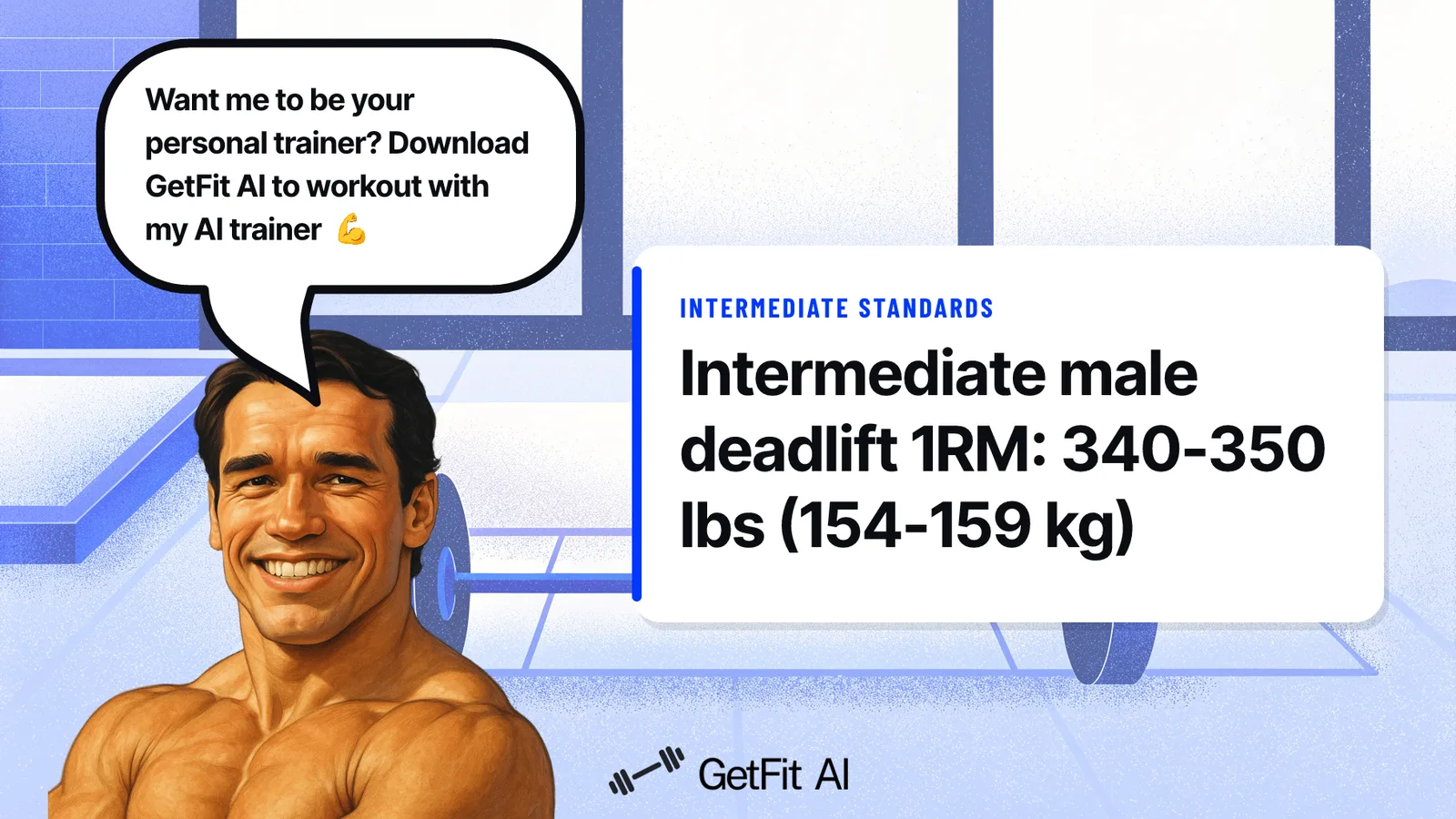
The average intermediate male deadlift is 340-350 lbs (154-159 kg) for a one-repetition maximum. Knowing it is useful. Knowing what it actually represents is what stops you from drawing the wrong conclusion about where you stand.
Three independent sources point to one consistent answer:
-
Strength Level’s 2024 aggregated data, drawn from tens of millions of logged lifts, places the intermediate male deadlift 1RM at approximately 340 lbs.
-
Gravitus’s 2024 community dataset corroborates this, putting the intermediate benchmark in the 340-350 lb (154-159 kg) range.
-
Independent reviewed intermediate standards land in the same window.
A 200-pound male who has trained consistently for roughly two years sits in that intermediate band at around 350 lbs according to industry data filtered by bodyweight and experience.
Here is the part most benchmark articles skip. Every lifter in that dataset chose to track their lifts on a platform, a self-selected pool of motivated, consistent people. Casual gym-goers and anyone who quit after six weeks are not in that database. The 340-350 lb figure likely skews higher than a true population average would.
That distortion matters less than a deeper structural problem: population-average deadlift standards are incapable of telling any individual lifter what they should be lifting.
Source 1: Strength Level (2024)
Strength Level aggregates data from tens of millions of logged lifts submitted voluntarily through its platform and partner integrations. For a male lifter classified as intermediate, the site places the deadlift one-repetition maximum at approximately 340 lbs (154 kg), scaled to a 200-pound bodyweight. The classification system divides lifters into five tiers, beginner, novice, intermediate, advanced, and elite, using percentile cutoffs derived from the full distribution of submitted lifts.
Intermediate sits at roughly the 50th percentile of experienced trainees, meaning half of the self-reported intermediate lifters in the dataset pull more and half pull less. The platform updates its standards periodically as new data accumulates, and the 340 lb figure has remained stable across recent update cycles, suggesting the sample size is large enough to resist meaningful drift from individual data points.
Source 2: Gravitus (2024)
Gravitus publishes aggregate strength benchmarks drawn from its training log community, a population of lifters who record sessions actively enough to generate statistically usable lift histories. Its intermediate male deadlift benchmark lands in the 340-350 lb (154-159 kg) range, consistent with Strength Level’s figure despite the two platforms drawing from largely non-overlapping user bases. Gravitus pairs its benchmark data with a one-rep max calculator that back-calculates estimated maxes from submitted rep-range sets, which introduces a layer of estimation into the underlying dataset.
Lifters rarely test true one-rep maxes in training, so a portion of the figures feeding that 340-350 lb benchmark are projected rather than directly observed. That methodological detail does not invalidate the number, but it does mean the benchmark reflects estimated capacity as much as demonstrated performance.
Key takeaways
- The average intermediate male deadlift sits at 340-350 lbs (154-159 kg) for a one-rep max, based on Strength Level's database of over 22 million recorded lifts.
- Raw pound targets mislead you, 315 lbs means something completely different at 150 lbs bodyweight than at 220 lbs, which is why bodyweight multipliers are the honest benchmark.
- Five lifters training consistently for a year at similar ages and body weights can finish with deadlift totals more than 100 lbs apart; training age alone explains almost none of that gap.
- Age changes the math: a 47-year-old pulling 315 lbs is in a different physiological situation than a 27-year-old at the same weight, and flat standards charts treat them identically.
- Most lifters stall not because they stop showing up, but because they keep loading the same weight with no session-by-session plan telling them what to lift next.
- GetFit AI's Structured Training closes that gap, workouts are delivered as a coherent program progression that adapts as you get stronger, replacing the guesswork that keeps lifters stuck at the same number for months.
Deadlift Standards by Experience Level, the Full Chart From Beginner to Elite
Raw numbers mean nothing without a reference point, and that reference point changes depending on how long you have been training. The chart below maps five classifications from Beginner to Elite against a 200-pound male, with each tier tied to a realistic training age so you can locate yourself on the curve rather than just compare a single number.
Exact Deadlift Standards for a 200-Pound Male
According to Strength Level’s database of over 22 million recorded lifts, the five-tier deadlift standards for a 200-pound male break down as follows:
| Classification | 1RM Standard (lbs) | 1RM Standard (kg) |
|---|---|---|
| Beginner | 199.8 lbs | 90.6 kg |
| Novice | 269.7 lbs | 122.3 kg |
| Intermediate | 349.7 lbs | 158.6 kg |
| Advanced | 429.6 lbs | 194.9 kg |
| Elite | 539.5 lbs | 244.7 kg |
These figures come from Strength Level’s 2024 standards, calculated from millions of qualifying results. Independently reviewed standards corroborate the same intermediate benchmark for a male of this bodyweight, which gives the table strong cross-source consistency. One honest limitation worth flagging: both databases draw from people who chose to log a deadlift into a tracking app, so the sample skews toward active, motivated lifters. True population averages would likely sit lower.
What Each Classification Actually Means in Gym Time, Not Just Pounds
The gap between each tier looks manageable on paper. In practice, each jump represents a meaningfully different training age.
Beginner (under 199.8 lbs) describes someone in their first weeks under the bar, still learning the hip hinge and building basic motor patterns. Novice (around 270 lbs) typically reflects three to six months of consistent training. Reaching Intermediate at 349.7 lbs generally takes one to two years of structured work. Advanced (429.6 lbs) represents several years of deliberate progressive overload, and Elite (539.5 lbs) is a threshold most recreational lifters never cross, often requiring five or more years of serious, coached programming.
Is 300 lbs a Lot?
Is 500 lbs Elite? Mapping the Numbers You’ve Heard to the Chart
A 300-lb deadlift for a 200-pound male sits in the Novice-to-Intermediate gap, above the 269.7-lb Novice threshold but well short of the 349.7-lb Intermediate mark. Per Strength Level’s 2024 data, that places a 300-lb pull comfortably above the Novice threshold but roughly 50 lbs short of the Intermediate mark, meaningful progress, with a clear and achievable next target ahead.
Related Reading
- Best Fitness Apps
- How Many Pull Ups Should I Be Able To Do
- Average Grip Strength Male
- Average Bench Press
- How Much Does A Bench Press Bar Weigh
- Average Male Bench Press
- How Much Can The Average Man Bench Press
- Grip Strength Chart
- Symmetric Strength
- Bench Press Standards
What Bodyweight Multipliers Represent Good vs. Great Deadlift Performance?
Bodyweight multipliers give you a body-weight-honest answer to “how much should I deadlift?” instantly. A raw pound target cannot do that, because 315 lbs means something completely different depending on whether you weigh 150 lbs or 220 lbs.
Why Bodyweight Multipliers Outperform Raw Pound Targets
One of the most common traps beginners fall into is chasing a plate-based milestone, “I want to pull four plates”, without understanding what that number actually means relative to their frame. A lifter who weighs 220 lbs hitting a 405-lb deadlift is performing at a very different relative level than a 165-lb lifter hitting the same bar. The milestone sounds identical; the athletic reality is not. Raw pound targets blind you to that gap entirely.
According to industry data, bodyweight multipliers self-adjust for size, making them a more universal benchmark than fixed pound goals. A heavier lifter pulling 315 lbs may actually be undertrained relative to his frame, while a lighter lifter hitting the same number is performing at an elite level. This is why coaches and strength communities have shifted toward relative standards over the last decade, and it is exactly the kind of objective, universal benchmark that makes self-assessment meaningful rather than arbitrary.
The Five-Level Multiplier Scale
The five tiers, drawn from Strength Level’s deadlift standards dataset, break down as follows: Beginner at 1.0x bodyweight, Novice at 1.35x, Intermediate at 1.75x, Advanced at 2.15x, and Elite at 2.7x bodyweight. These multipliers apply regardless of how much you weigh, which is precisely why they work as a universal progress gauge, whether you are chasing a specific performance milestone or modeling your training after an athlete whose physique or strength output you admire.
GetFit AI’s Athlete-Style Custom Workout Plans are built around this kind of relative progression logic. Rather than assigning a fixed pound target, the structured training inside the app gives you access to 1,480 exercises, each with a video guide, step-by-step instructions, form tips and common mistakes, plus muscle maps and free calculators on the website.
Practical Examples for a 150 lb and 200 lb Lifter
For a 150 lb male: Beginner targets 150 lbs, Novice 202 lbs, Intermediate 262 lbs, Advanced 322 lbs, Elite 405 lbs. For a 200 lb male: those same tiers land at 200 lbs (Beginner), 270 lbs (Novice), 350 lbs (Intermediate), 430 lbs (Advanced), and 540 lbs (Elite). The multiplier scale makes the relative demand identical across both lifters; what changes is only the absolute load on the bar.
That clarity matters most when you can see how you stack up against someone training alongside you. GetFit AI’s friends, challenges, and leaderboards feature is most powerful once you have connected with at least one friend in the app, because shared relative benchmarks, not raw pound comparisons, make the competition fair and the progress readable for both of you. Structured accountability past the early weeks is where consistency compounds, and having a training partner working against the same bodyweight-scaled standard is the retention layer that keeps both of you training well past week three.
Unlocking that full experience starts at $1.99 per week on the Premium Weekly plan, $4.99 per month on Premium Monthly, or $49.99 per year on Premium Yearly, so the cost of having a smarter, relative strength target (and the community to train toward it with) is lower than a single post-workout meal.
Deadlift Standards by Age: Why Your Number Should Look Different at 25 vs. 45
Two men walk into the gym pulling 315 pounds. Same weight, same bar, completely different situations. One is 27, six months into structured training, sitting at the front edge of his physiological peak. The other is 47, managing a recovery schedule that looks nothing like it did a decade ago. A flat standards chart treats them identically. That is the problem this section exists to fix.
“At 45 years old, I feel embarrassed about my deadlift numbers, 315 lbs x5 at 195 lbs bodyweight. I just wish there were clearer, age-adjusted standards so I could properly contextualize my performance.”
— what we hear from strength training enthusiasts
Why Age-Adjusted Standards Exist and Why Flat Charts Mislead More Than They Help
Most deadlift charts published online assign a single number to each experience tier and call it done. Hit the listed number and you are intermediate. Pull 405 and you are advanced.
No asterisk for age, no footnote for recovery capacity, no acknowledgment that the same total means something entirely different depending on where you sit on the strength curve. According to Strength Level’s dataset, which draws on nearly 23 million real-world lifts, standards shift meaningfully across age bands.
A flat chart collapses that variation into a single row and calls it a benchmark. It is an average of averages, stripped of the context that makes it useful.
The deeper problem is what those averages actually measure, and this is the key claim worth naming directly: age-segmented norms drawn from that 23-million-lift dataset reflect what everyday lifters actually pull at each life stage. Because a large share of that population trains without structured progressive overload, the “average” at any age band is partly a measurement of how many people are spinning their wheels without a plan, making it an inadvertent standard of structured mediocrity rather than genuine athletic potential.
What Age-Adjusted Good Looks Like: A Practical Benchmark Table Across Four Decades
The following table presents directional 1RM benchmarks by age band for males at that same bodyweight. Treat these as orientation points rather than precise figures, as individual recovery capacity, training history, and lifestyle stress all influence where any specific lifter lands within a band.
| Age Band | Beginner | Novice | Intermediate | Advanced | Elite |
|---|---|---|---|---|---|
| 18-29 | ~that same figure lbs | ~270 lbs | ~350 lbs | ~430 lbs | ~540 lbs |
| 30-39 | Slightly below 18-29 | Slightly below 18-29 | Slightly below 18-29 | Slightly below 18-29 | Slightly below 18-29 |
| 40-49 | Moderately below peak | Moderately below peak | Moderately below peak | Moderately below peak | Moderately below peak |
| 50-59 | Notably below peak | Notably below peak | Notably below peak | Notably below peak | Notably below peak |
The drop across decades is real but modest through the 30s, then steepens in the 40s and beyond, which is less about muscle loss and more about the compounding cost of slower recovery, higher injury caution, and reduced training frequency that most lifters over 40 reasonably adopt.
Related Reading
- Do Pull Ups Work Chest
- Grip Strength Norms
- Average Deadlift Weight
- 1 Rep Max Chart
- Average Male Deadlift
- Good Bench Press Weight
- Weightlifting Standards
- Average Bench Press Kg By Age
- Average Deadlift Weight Kg
Factors That Influence Deadlift Strength (Beyond Just How Long You’ve Trained)
Five lifters walk into the gym every Monday. Same age, similar body weight, all showing up consistently for a year. Their deadlift totals at the end of that year can vary by 100 pounds or more, and training age explains almost none of that gap. The common assumption is that once you know where you stand against the average, you’ll know what to work toward and your deadlift will start climbing. That belief is widespread, understandable, and mostly wrong, because the chart measures something far more complicated than time under a barbell.
The deadlift standards chart measures output. It does not care how many sessions you logged, how sore you were, or how hard you tried. What it captures is the result of several variables working together, and most of them have nothing to do with how long you have been training.
1. Limb Proportions and Leverages: The Structural Lottery That Sets Your Starting Point
Your skeleton was decided before you touched a barbell. According to a 2019 study published in the Journal of Sports Science and Medicine by Cholewa et al., anthropometric variables including limb proportions and body segment lengths are significant determinants of deadlift performance, so two lifters with identical training histories can produce very different results based purely on physical structure. A lifter with longer arms relative to torso length sits in a mechanically advantageous position at the start of the pull. That structural advantage can separate two lifters by a full tier on the chart before either one has written a single session note.
Knowing your leverages helps you choose the right variant and set realistic expectations against a population average that was never calibrated to your body.
2. Grip Strength: The Hidden Ceiling That Caps Your True Pulling Potential
Grip failure on a deadlift max attempt is not a fringe event; it is a structural limit that appears well before the posterior chain runs out of capacity, particularly in lifters who have not trained grip directly. Grip is a trainable ceiling, not a fixed one.
3. Sleep and Recovery Quality: The Silent Variable Suppressing Weekly Progress
Sleep deprivation measurably reduces maximal strength output and blunts neuromuscular recovery between sessions. A male lifter averaging five hours of sleep can train with identical volume and frequency as one sleeping eight hours and still plateau well below the intermediate average deadlift weight for his age group. Recovery quality is not a lifestyle footnote, it is a direct determinant of where you land on any strength tier chart.
4. Nutrition and Caloric Status: Why a Deficit Quietly Moves You Down the Tier Chart
A sustained caloric deficit slows tissue repair and, beyond roughly 500 calories per day, halts lean mass gains entirely, meaning consistent training produces diminishing deadlift returns regardless of effort. Male lifters cutting body weight often see their numbers stall or regress relative to population averages, which distorts any self-assessment against a standard chart. Caloric status must be factored in before concluding your deadlift is ‘below average.’
5. Training Consistency vs. Training Structure: Why Two Lifters With the Same Experience Can End Up Two Full Tiers Apart
Consistency, simply showing up, produces early gains but plateaus fast without deliberate structure: defined load progression, planned intensity cycles, and targeted weak-point work. Two males with identical three-year training histories routinely sit two full tiers apart on the average deadlift weight chart when one followed a structured program and the other accumulated random volume. This is the central variable most lifters underestimate when asking how much they should be deadlifting by now.
Tips to Improve Your Deadlift, and Why Your Next Number Needs a Plan, Not a Chart
That finish line is only useful once you know what to load the bar with on Tuesday. A target number and a session-by-session plan are two different things, and the distance between them is precisely where most lifters stall for months, pulling the same weight every week and wondering why nothing changes.
The most important insight hidden inside the progressive overload research is that the mechanism matters more than the target: both load-progression and rep-progression groups got significantly stronger, while lifters who just show up and pull whatever feels heavy have no escalation mechanism at all. The gap between a lifter who improves and one who plateaus is whether their plan tells them exactly what to lift today and automatically increases that demand next session.
1. GetFit AI Structured Training: Adaptive Session Targets That Replace Guesswork With Precision
GetFit AI delivers exact deadlift loads for every session and recalculates targets automatically after each logged workout, turning the average deadlift weight for male into a personalized, moving milestone rather than a fixed population stat. Where a spreadsheet gives you a number, GetFit AI gives you a number that evolves with your actual performance data. The one limitation worth noting: the adaptive engine needs at least two to three logged sessions before its recommendations fully calibrate to your strength curve.
2. Progressive Overload + Accessory Work: The Compound Formula That Actually Moves Your Deadlift
Add 2.5-5 kg to the bar every one to two weeks, and pair main deadlift sessions with Romanian deadlifts (8-12 reps for posterior chain hypertrophy), rack pulls to overload the lockout, and barbell rows to reinforce upper-back tightness. This compound approach addresses every weak link simultaneously. The tradeoff: managing four movements demands honest fatigue tracking, skip that and accessory work becomes junk volume.
3. Hip-Hinge Form Mastery: The Technique Cue That Separates Safe PRs From Injury Plateaus
A pattern we see among lifters stuck between 225 and 275 lbs, often after hitting a promising PR near 295 lbs, is lower back pain that forces regression right when momentum should be building. The frustration compounds quickly: the weight felt manageable, the PR seemed earned, and then pain pulls everything back four months of progress. The cause is almost always a rushed setup before the brace is fully engaged. Lifters who are eager to hit a new number frequently skip the deliberate walkout, skip the lat set, and skip the full belly breath, and under heavier loads, those ten seconds are not optional. They are what separates a training block that keeps building from one that ends early with a back that needs two weeks off.
Slowing the walkout, setting the lats, and breathing into the belly before the pull costs ten seconds per rep and protects months of progress. Skipping this step under heavier loads is how a good training block ends early. GetFit AI’s Athlete-Style Custom Workout Plans embed these setup cues as part of the structured session guidance, so the deliberate, planned approach to each lift is part of the program from day one, not an afterthought added once something goes wrong.
4. The Benchmark Reality Check: Knowing Your Number Is Useful for Five Minutes, a Plan Is Useful Forever
Population averages tell you where you stand right now; they cannot tell you what to lift next Tuesday. The lifters who consistently exceed the average deadlift weight for male are not the ones who checked a chart, they are the ones who had a session-by-session plan that adapted when they got stronger. Treating a benchmark as a destination rather than a starting coordinate is the single most common reason intermediate lifters stall for months.
5. The Strength Rep Protocol: 3-4 Sets of 3-5 Reps at 80-85% 1RM With Planned Deload Weeks
For lifters whose primary goal is a higher 1RM, working in the 3-to-5 rep range at 85-90% of current estimated max delivers the neural and mechanical adaptations most directly tied to peak strength, a conclusion supported by Plotkin et al. (2022), whose structured-progression groups achieved significant 1RM gains precisely because the demand escalated systematically rather than arbitrarily. Three to four sets per session, two deadlift-focused sessions per week, with at least 72 hours between heavy pulls: this structure gives the central nervous system enough stimulus to adapt and enough recovery time to actually do so.
GetFit AI’s Structured Training programs this arc automatically, recalibrating load targets after each logged session so the escalation continues without requiring you to calculate percentages manually. The trade-off is straightforward: lower-rep, higher-load training leaves less room for technique errors, so this protocol pays off most for lifters whose hip-hinge pattern is already consistent under moderate loads. For lifters ready to commit to that structure, GetFit AI is available on a Premium Weekly Subscription at $1.99/week, a Premium Monthly Subscription at $4.99/month, or a Premium Yearly Subscription at $49.99/year, the yearly plan being the lowest cost-per-session path for anyone serious about running a full progressive overload cycle through to a genuine PR.
Related Reading
- Best Calisthenics Workout App
- Best Hiit Workout App
- Best Gym Workout App
- Best Workout Apps
- Best Free Workout Apps
Next steps
If your deadlift has been stuck at the same number for months despite knowing exactly which tier you occupy on the standards chart, the path forward starts with accepting that the benchmark was never the missing piece. A coordinate tells you where you are. It has never once told you what to load the bar with on Tuesday. Start with our AI fitness app.
The progressive overload research makes the logical sequence plain. Structured escalation, not a static target number, is the operative mechanism behind strength gains, meaning two lifters chasing the same intermediate benchmark diverge entirely based on whether their plan tells them exactly what to lift today and increases that demand next session. The age-segmented norms drawn from nearly 23 million real-world lifts compound the problem, because a meaningful share of that population trains without any escalation mechanism at all, making the average an inadvertent standard of structured mediocrity rather than genuine athletic potential. Together, those two realities point to one obvious next step: stop comparing and start following a plan that decides the load, the progression, and the timing for you.
Start with the AI fitness app that generates a structured, athlete-style workout plan at onboarding and recalibrates your next load automatically after every logged session. Your number moves when the mechanism is in place.
Frequently Asked Questions
Is deadlifting 300 lbs a lot for a guy?
For a 200-pound male, 300 lbs sits above the Novice threshold of 269.7 lbs but roughly 50 lbs short of the Intermediate mark of 349.7 lbs, meaningful progress, with a clear and achievable next target ahead. It is a solid number, not elite, but well past beginner territory.
Is pulling 2x bodyweight a good deadlift?
Yes, according to the bodyweight multiplier scale in the post, 2x bodyweight places you solidly between the Intermediate (1.75x) and Advanced (2.15x) tiers, which represents several years of deliberate, structured training for most lifters. It is a genuinely strong result by any recreational standard.
How much should a 200-pound man be able to deadlift?
It depends on experience level. For a 200-pound male, the benchmarks from Strength Level’s 2024 data are: Beginner ~200 lbs, Novice ~270 lbs, Intermediate ~350 lbs, Advanced ~430 lbs, and Elite ~540 lbs. A lifter with one to two years of consistent structured training should be targeting that 350-lb Intermediate mark.
How much should a 150-pound man be able to deadlift?
Using the bodyweight multiplier scale, a 150-pound male should target roughly 150 lbs as a Beginner, 202 lbs at Novice, 262 lbs at Intermediate, 322 lbs at Advanced, and 405 lbs at Elite. The multipliers scale the demand proportionally to bodyweight, so the relative challenge at each tier is identical to that of a heavier lifter.
Does age affect how much I should expect to deadlift?
Yes, the post notes that deadlift standards shift meaningfully across age bands based on Strength Level’s dataset of nearly 23 million lifts. The drop from peak (ages 18-29) is modest through the 30s, then steepens in the 40s and beyond, driven less by muscle loss and more by slower recovery, higher injury caution, and reduced training frequency that most lifters over 40 reasonably adopt.