Weightlifting Standards by Age, Weight, and Lift (2026)
Most lifters misread their own tier, run the wrong program, and wonder why nothing moves. Here is how strength standards actually work, and how to use them to train smarter starting today.
The common assumption among lifters is that if they know their strength standard tier, they can figure out how to improve on their own, and that a single classification is enough to self-direct progress without further guidance. Strength standards do answer a question most lifters ask eventually: am I actually strong, or do I just feel strong compared to the people around me? The answer requires a common unit of measurement, a reference population, and an honest look at where you sit inside it. That is what weightlifting strength standards are built to provide, and understanding how they work is the first step toward using them for something more than a fleeting ego check. See our AI fitness app for how this works in practice.
Weightlifting strength standards are numerical benchmarks that measure maximal lifting capacity relative to body weight, sex, and experience level. They exist because raw numbers lie. A 225-pound squat means something very different on a 140-pound frame than on a 240-pound one, and comparing the two without adjustment produces a ranking that tells you almost nothing useful. According to the NSCA Kinetic Select (2024), normalizing fitness data involves expressing performance metrics relative to body weight, allowing meaningful comparisons across individuals of different sizes, sexes, and experience levels rather than using raw absolute numbers. That normalization is what transforms a raw lift into a genuine benchmark.
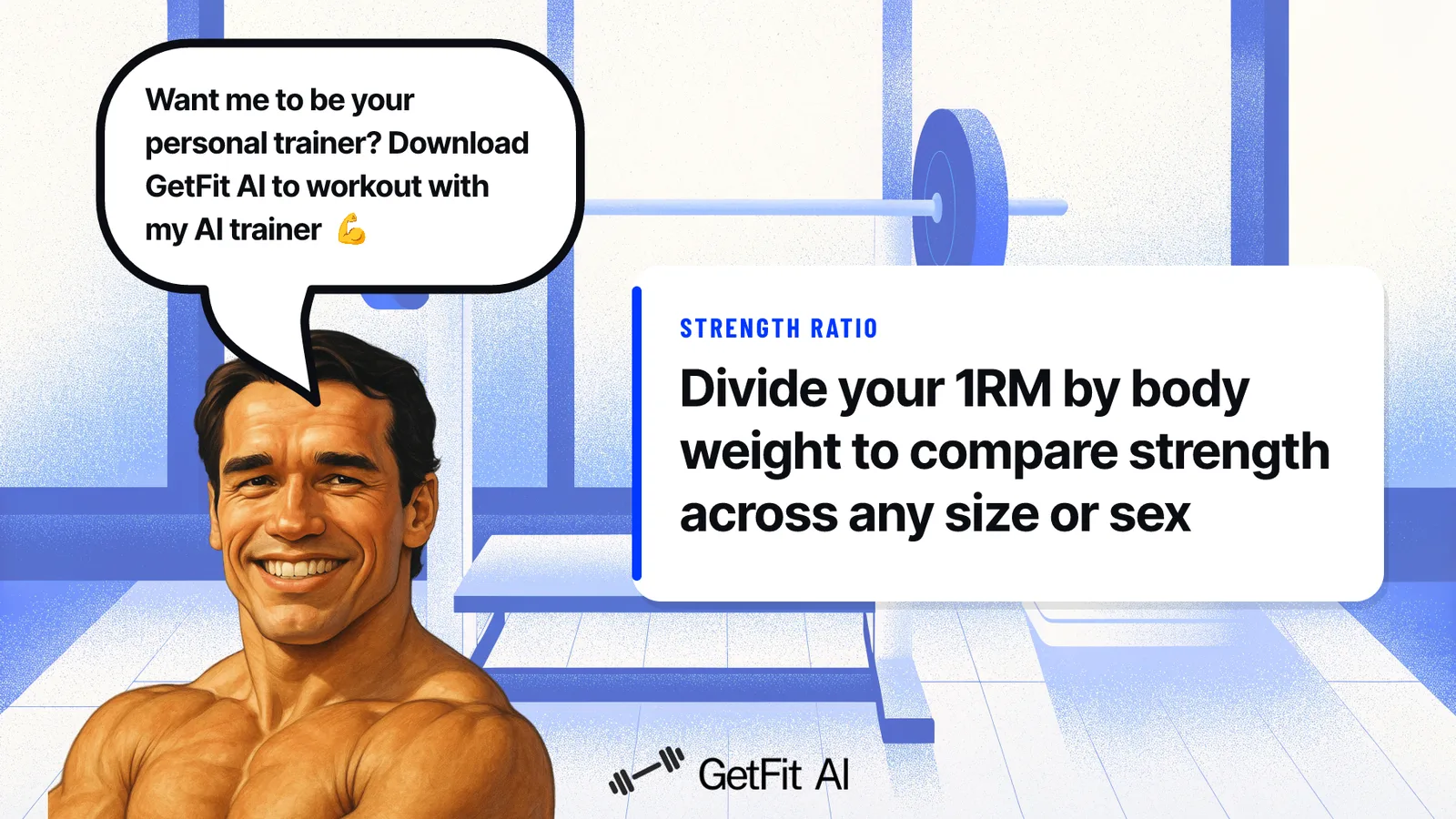
One-rep max (1RM) expressed as a ratio to body weight is the standard unit used to benchmark and compare lifting performance across different weight classes and demographic groups. The ratio is simple: divide your 1RM by your body weight. Without it, heavier lifters always look stronger in absolute terms, lighter lifters always look weaker, and the standard becomes meaningless noise.
The NSCA Kinetic Select (2024) is direct on this point: strength standards are derived from aggregated lifting data across populations and are not arbitrarily assigned. Sites like Strength Level build their tables from surveys of real lifting populations, with tier cutoffs set at statistical distributions within that data, an approach consistent with how population-normed athletic benchmarks are constructed across the strength and conditioning literature.
Key takeaways
- Strength standards tell you where you rank, they don't tell you why you're stuck or what to do Monday morning.
- Your weakest lift sets the ceiling for your total strength, not your best one, most lifters never audit all four movements at once.
- The five tiers (Untrained through Elite) describe different training demands, not just different numbers; what works at Novice actively stalls you at Intermediate.
- Female and male strength standards don't scale the same way across every lift, the gap shifts by muscle group, which changes how women should prioritize their programming.
- Only 8% of people training reach their stated fitness goals, the bottleneck isn't motivation or information, it's the absence of a structured path forward.
- Benchmarking your tier without changing your program is the most common way lifters stay stuck at the same level for years.
- GetFit AI's Structured Training closes that gap by delivering workouts as a coherent program progression, not random sessions, so your training actually moves you toward the next tier instead of just confirming you haven't reached it.
The Five Strength Training Experience Levels, and What Each One Actually Requires
The common assumption among most lifters is: “If I know my strength standard tier, I can figure out how to improve on my own.” Pick up any strength standards chart and you will find five tiers listed in a neat column: Untrained, Novice, Intermediate, Advanced, Elite. What those labels rarely tell you is which one actually describes you right now, and the gap between where you think you are and where you actually are is costing you real progress.
According to Mirrors Delivered, the majority of gym members self-report as intermediate or experienced despite lacking the one to two years of consistent, structured training that authoritative sources use to define that tier, a mismatch confirmed across industry surveys. The programming logic that works for each tier is completely different, and running the wrong one does not just slow you down; it can stop progress entirely.
One of the clearest signs of a misidentified tier is a training problem beginners we work with describe almost universally: showing up consistently but never being able to prove they are actually getting stronger. The desire to show me I’m actually getting stronger, not just showing up is a legitimate signal that a program is failing to deliver measurable, session-by-session feedback. GetFit AI addresses this directly through Structured Training, which is most beneficial when a user has previously struggled with consistency due to lack of program structure. It begins delivering that structure from the very first workout session, then sustains it across the overall training program arc.
1. Untrained: Zero Consistent Training History, Baseline Strength Only
The Untrained lifter’s nervous system has never been asked to produce force under a barbell in a repeatable, progressive way. The body’s first adaptation is neurological, not muscular. Strength jumps fast here because the brain is learning to recruit what is already there, not because muscle is being built at speed.
Another struggle that surfaces at this exact tier: the pull to train the way the athlete I follow trains. It is a natural instinct; mimicking someone whose results you admire feels like a shortcut. But elite and advanced programming applied to an untrained nervous system removes the very stimulus that produces fast early gains, replacing it with volume and intensity the body cannot yet use. GetFit AI’s Athlete-Style Custom Workout Plans are built to resolve this tension: they give users the structured, athlete-caliber programming feel they are looking for, scaled precisely to where they actually are, so the program works with the nervous system’s current adaptation capacity rather than against it.
2. Novice: 0 to 6 Months of Consistent Training, Session-to-Session Progress
The novice tier is defined by one biological fact: you can add weight to the bar every single session. It reflects the reality that an untrained nervous system recovers fully within 24 to 48 hours and is ready to be pushed harder. Mark Rippetoe’s Starting Strength model puts this linear progression window at roughly 12 to 16 weeks before recovery demands outpace a simple session-to-session model. That window is the fastest strength will ever accumulate.
Key takeaway: The novice linear progression window, roughly 12 to 16 weeks, is the fastest strength will ever accumulate. Most gym members quit before they finish it.
The novice linear progression window, roughly 12 to 16 weeks, is the fastest strength will ever accumulate. Most gym members quit before they finish it.
It is also, according to Mirrors Delivered, the window in which most gym members quit. Beginners we work with commonly hit what feels like invisible resistance around weeks three and four, a motivation and accountability gap that structured programming alone cannot always close. GetFit AI’s friends, challenges, and leaderboards layer is built precisely for this moment: it is most beneficial when a user has a friend or workout partner also using the app, activates after connecting with at least one friend in the app, and operates continuously as the retention layer that keeps users training past week three.
Pairing that social accountability with the nutrition clarity beginners need, sort out my eating so the training finally shows, means the novice window does not get wasted on programs that address the lift but ignore the plate.
3. Intermediate: 1 to 2 Years of Training, Not a Compliment
Intermediate is a technical classification, not a badge of honor. It means roughly one to two years of consistent, structured training, and it means linear progression no longer works session to session. Progress now requires weekly periodization. Most gym-goers who self-identify as intermediate are actually still novices running the wrong program. The real tradeoff: intermediate programming is significantly more complex, and lifters who skip the novice phase properly will struggle to execute it effectively.
4. Advanced: 3 to 5-Plus Years, Progress Measured in Months
Advanced lifters have typically trained seriously for three to five or more years and require highly individualized programming to make measurable strength gains over months, not weeks. Weightlifting standards at this tier place lifters in the top percentile of the general population for their bodyweight. The hard truth: most people who claim to be advanced are accomplished intermediates. True advanced status means your programming must be tailored specifically to your own recovery patterns and weak points.
5. Elite: Competitive-Level Output, Near Genetic Ceiling
Elite is the top tier across all major weightlifting standards frameworks, Rippetoe, Strengthlevel, and Legion all converge here despite slight numerical variation by bodyweight class. Elite lifters are approaching their genetic ceiling, competing or having competed at a high level, and making progress that is painstakingly slow even with perfect nutrition, recovery, and programming. This tier represents a fraction of a percent of all lifters. The limitation is simple: gains at this level are measured in kilograms per year, not per month.
Related Reading
- Best Fitness Apps
- How Many Pull Ups Should I Be Able To Do
- Average Grip Strength Male
- Average Bench Press
- How Much Does A Bench Press Bar Weigh
- Average Male Bench Press
- How Much Can The Average Man Bench Press
- Grip Strength Chart
- Symmetric Strength
- Bench Press Standards
Strength Standards by Lift for Men: Squat, Bench, Deadlift, and Overhead Press
Four numbers sit in your training log right now, and the smallest one is running the show.
Most lifters mentally file each lift separately: the squat feels solid, the deadlift is coming along, the bench is “decent.” That isolated view is comfortable, but it hides the real story. When you lay all four lifts side by side as a single profile, a lagging ratio almost always surfaces, and that ratio is the number that should be directing your next training block.
The Four-Lift Standards Table
Intermediate male strength benchmarks, expressed as bodyweight multiples, break down as follows across the four main lifts:
| Lift | Novice | Intermediate | Advanced | Elite |
|---|---|---|---|---|
| Squat | 1.0x BW | 1.5x BW | 2.0x BW | 2.5x+ BW |
| Bench Press | 0.75x BW | 1.2x BW | 1.5x BW | 1.8x+ BW |
| Deadlift | 1.25x BW | 2.0x BW | 2.5x BW | 3.0x+ BW |
| Overhead Press | 0.5x BW | 0.8x BW | 1.1x BW | 1.4x+ BW |
These figures represent one-rep max (1RM) performance for a male lifter in the 18-39 age range at a typical training bodyweight. The overhead press standard is notably strict: 0.8x bodyweight at intermediate is a bar that stops more recreational lifters cold than any other ratio on the table. Per ExRx.net, heavier lifters (220 lb and above) face proportionally lower ratio expectations at each tier, and lifters past 50 should apply a roughly 5-10% downward adjustment per decade to account for age-related strength differences.
1. Squat Weightlifting Standards: Untrained Through Elite (×BW Tiers)
For men, squat weightlifting standards run from untrained (under 0.75× bodyweight) through novice (1.0×), intermediate (1.5×), advanced (2.0×), and elite (2.5×+). The intermediate mark of 1.5× is the most actionable milestone for recreational lifters, it separates casual gym-goers from consistent trainees. The tradeoff: heavier lifters (220 lb+) rarely hit the same ratios as lighter men, so absolute-pound tables are more honest for that population.
2. Bench Press and Overhead Press Standards: Upper-Body Tier Tables for Men
Bench press weightlifting standards for men span novice (0.75× BW), intermediate (1.2×), advanced (1.5×), and elite (1.8×+). The overhead press follows a proportionally lower curve: novice 0.5×, intermediate 0.8×, advanced 1.1×, elite 1.4×. The OHP is the hardest upper-body standard to hit relative to bodyweight, making it the clearest indicator of true pressing strength. Lifters often overestimate their tier because they compare bench numbers without accounting for bodyweight.
3. Deadlift Weightlifting Standards: The Highest Absolute-Load Tier Table
Deadlift standards carry the highest absolute multiples of any main lift: novice 1.25× BW, intermediate 2.0×, advanced 2.5×, and elite 3.0×+. The 2.0× intermediate mark is the single most-cited strength milestone in recreational lifting communities and a reliable proxy for overall posterior-chain development. The key limitation is that conventional and sumo stance produce meaningfully different numbers, yet most published standards do not distinguish between them.
4. How Bodyweight and Age Adjust All Four Strength Standards
Strength standards by bodyweight show a consistent pattern: lighter men (under 165 lb) can hit higher BW multiples at each tier, while heavier men (220 lb+) face lower ratio expectations at equivalent competitive levels. Age compounds this, lifters over 50 typically apply a 5-10% reduction per decade to remain within the same tier. These adjustments matter most for intermediate and advanced lifters benchmarking themselves against raw population data rather than age- and weight-class-matched peers.
Strength Standards for Women: How Female Benchmarks Scale Across Every Tier
Here is a fact that surprises most women who start tracking their lifts: the gap between female and male strength standards is not the same across every exercise. It shifts depending on which muscles are doing the work, and that shift has real consequences for how you should train.
Female Strength Standards at a Glance
Women’s strength standards, expressed as bodyweight multiples, give you a concrete target for each lift at every experience level. Across the broader strength training landscape, intermediate female benchmarks sit at roughly 1.0x bodyweight for the squat, 0.75x for bench press, 1.5x for deadlift, and 0.5x for overhead press. A 140 lb woman who deadlifts 210 lbs is squarely intermediate on that lift, the same relative achievement as a 180 lb man pulling 360 lbs. Beginner targets fall meaningfully below those numbers; advanced targets push well above them.
The Upper-Body and Lower-Body Split: Where Women Close the Gap Fastest
The gap between male and female standards is largest in upper-body lifts (bench press, overhead press) and smallest in lower-body lifts (squat, deadlift), and this pattern holds consistently across the market. Women carry a higher proportion of their total muscle mass in their lower bodies relative to men, which means the female squat and deadlift standards sit much closer to male equivalents than the bench press or overhead press standards do. In practice, a woman can reach intermediate on the deadlift and squat well before she reaches intermediate on the bench.
Key takeaway: Women’s lower-body strength ratios sit much closer to male equivalents than upper-body ratios do, meaning a woman can reach intermediate on squat and deadlift well before she reaches intermediate on bench or overhead press.
This asymmetry is also where a common consistency trap hides. Women we work with who have previously struggled with consistency due to lack of program structure often gravitate toward the lifts they are already relatively strong in. Squats and deadlifts feel rewarding because progress is visible, while bench press and overhead press quietly stagnate. A generic program treats all four lifts as equal in priority and never flags the drift. GetFit AI’s Structured Training feature addresses this from the first workout session, building an Athlete-Style Custom Workout Plan that accounts for exactly this kind of inter-lift asymmetry rather than defaulting to equal volume distribution across all movements.
How to Read Your Weakest Female Lift Ratio as a Programming Signal
Because the tier gap a female lifter must close is not uniform across lifts, largest in upper-body movements, smallest in lower-body ones, a woman who benchmarks against a single aggregate standard and designs her own progression plan is almost certainly under-prioritizing upper-body volume relative to what her individual gap actually demands. No standard chart, on its own, will surface that asymmetry for her. The Strength Level benchmarks show where you stand; they do not automatically prescribe how to rebalance.
Most women who discover they are intermediate on squat and deadlift but still beginner on bench and overhead press keep following a generic plan that trains all four lifts equally. That feels balanced. It is not. The upper-body gap is real, measurable in bodyweight-ratio terms, and it widens every week a training plan treats bench press and overhead press as equal in priority to squat and deadlift. Closing it requires deliberately over-weighting upper-body volume until those ratios catch up to the lower-body tiers, a rebalancing that a generic program will never perform automatically.
The motivation layer matters here too. The aspiration to train the way an athlete you admire trains is a genuine and powerful driver, and it is most sustainable when accountability is built into the structure around you. GetFit AI’s friends, challenges, and leaderboards features are most beneficial once you have connected with at least one friend in the app, and they function as the retention layer that keeps users training past week three, the point where consistency most commonly collapses. If you have a workout partner also using GetFit AI, those social accountability tools compound: your upper-body rebalancing plan becomes a shared, visible commitment rather than a private intention that is easy to quietly abandon.
GetFit AI Premium starts at $1.99 per week, $4.99 per month, or $49.99 per year, with structured training, athlete-style custom plans, and the social layer included across all tiers.
Related Reading
- Do Pull Ups Work Chest
- Grip Strength Norms
- Average Deadlift Weight
- 1 Rep Max Chart
- Average Male Deadlift
- Good Bench Press Weight
- Average Bench Press Kg By Age
- Average Deadlift Weight Kg
How to Actually Use Strength Standards to Set Training Goals (Not Just Feel Bad About Them)
You have a number. Now what?
That is the question most lifters never answer. They pull up Strength Level or Symmetric Strength, confirm they are Novice on the deadlift and Intermediate on the squat, screenshot the results, and walk into the gym the next Monday doing the exact same session as the Monday before. The benchmark did its job. The training did not change.
Calculate Your Strength Tier From Your Bodyweight and 1RM
Calculate your tier by entering your bodyweight and one-rep max for each lift. The site returns your tier instantly, expressed as a bodyweight ratio, for every major compound. Symmetric Strength does the same across multiple lifts simultaneously, surfacing which lift sits lowest relative to your overall profile. Both tools are free. The output is the same: a tier per lift, not a single blended score.
Your Weakest Lift by Tier Is Your Training Priority
The lift where you land one full tier below your others is your bottleneck. A lifter who is Intermediate on squat and deadlift but Novice on bench should run a bench-prioritized training block. The standard just made that decision for them.
Most lifters treat all four lifts as equally urgent and spread their effort thin across everything.
Convert Your Tier Gap Into a Specific Weight Target
Strength standards are expressed as bodyweight ratios. The gap between where you are and the next tier translates directly into a target weight. If you weigh 180 lbs and the next tier requires a 1.5x bodyweight squat, your target is 270 lbs. That is a number you either hit or you do not.
Why Strength Standards Mislead Without Context
A lifter with long femurs will almost always squat lower relative to bodyweight than a lifter with shorter femurs at the same training age, because the mechanical disadvantage is structural, not a reflection of actual strength development. Similarly, a lifter who has trained for three years but spent the first two on machines has a very different strength base than someone who has run barbell compounds for the same period. Standards are population averages; they do not know your limb lengths, your injury history, or how many of your training years were actually productive. Use them as a compass bearing, not a verdict.
Tier-to-Action Decision Checklist
Use this after you calculate your tier on Strength Level or Symmetric Strength:
- Record your bodyweight-ratio score for each lift (squat, bench, deadlift, OHP)
- Identify which lift sits the lowest tier relative to the others
- Convert the gap to a specific weight target (bodyweight × next-tier ratio)
- Check whether your current program gives that lift priority volume or equal volume
- If equal volume: redesign the next 4-week block to add one extra work set per session to the lagging lift
- Re-test that lift's 1RM at the end of the block and recalculate your tier
Related Reading
- Average Deadlift Weight For Male
- Best Calisthenics Workout App
- Best Hiit Workout App
- Best Gym Workout App
- Best Workout Apps
- Best Free Workout Apps
From Strength Standard to Structured Plan: Why the Number Alone Won’t Move Your Lifts
Knowing your strength tier feels like progress, and in a narrow sense it is. But a label without a plan attached to it has a poor track record of actually moving your lifts forward, and understanding why that gap exists is what separates lifters who stall at their current tier from those who climb out of it. The structural reasons benchmarks fall short come down to what needs to sit behind the number to make it useful.
The Benchmark Trap
Most lifters feel a small rush when they finally look up their strength standard and confirm their tier. Intermediate on the deadlift. Novice on the bench. It feels like progress. But the data is sobering: Industry research finds that only 8% of people training without structured guidance achieve their fitness goals, compared to 73% of those who train with a structured plan, a gap that is most pronounced for lifters who have previously struggled with consistency because they lacked a repeatable program structure to follow week over week. The benchmark told you where you are. It did not load a route.
The high drop-off rate among solo trainees is structurally predictable. Lifters who are new to structured strength training genuinely struggle to translate early motivation into consistent, progressive programming, and that absence of structure creates long-term gaps even in otherwise dedicated people. Self-directed lifters using only a tier chart have no mechanism for adjusting programming as their needs change, no external check on whether effort is pointed at the right variable, and no accountability loop when progress stalls. A tier chart can accelerate this failure pattern rather than prevent it: it gives the illusion of direction without providing the adaptive, week-to-week structure that converts a benchmark into actual movement.
This is precisely the gap GetFit AI’s Structured Training is designed to close, and it is most beneficial when a lifter has previously struggled with consistency due to lack of program structure. Rather than handing you a static chart and wishing you luck, GetFit AI generates a custom Athlete-Style Workout Plan immediately upon setup. From the first workout session, the plan is already working for you, not waiting for you to figure out what to do next.
Three Friction Points That Stall Lifters
The first friction point is the most common one. A lifter confirms they are below intermediate on the bench press, walks back into the gym the next day, and does the exact same session they did the week before. The standard gave them a verdict, not a sequence. Without a structured training plan that specifies exercise order, load, and weekly progression, the number has nowhere to go. GetFit AI removes this friction from the first workout session: because a custom plan is generated at onboarding, there is no blank day-one staring back at you.
The second friction point is program paralysis. The gap between knowing your tier and knowing which strength program progression to follow is not obvious, and many lifters spend weeks circling the question rather than training through it. GetFit AI’s Athlete-Style Custom Workout Plans resolve this directly. The plan adapts as you progress, so the question “what do I run next?” is answered before it even forms. As one framing that captures exactly what this solves: give me a plan that adapts instead of one I fall behind on and quit.
The third friction point is the absence of any feedback during the session itself. Form breaks down. A machine is taken. A set feels wrong and there is nobody to ask. That single derailed moment compounds over weeks into stalled progress or, worse, an injury that sidelines training entirely. GetFit AI’s structured guidance operates during each workout session and across the overall training program arc, not just at setup, so the adaptive layer is present when sessions go sideways, not only when you are feeling motivated at the start of a new block.
Why Nutrition Blindness Kills Strength Gains
Training hard but not eating for it is one of the most common reasons lifters plateau. Recreational lifters routinely miss their protein and calorie targets even when training consistently. Eating at a significant calorie deficit suppresses recovery, and chronically low protein intake limits the muscle-protein synthesis that strength training is designed to trigger. A tier chart has no way to surface this. A structured program that integrates nutrition targets alongside training loads does.
GetFit AI’s plan generation addresses this from onboarding, building nutrition alongside training into the same adaptive structure, so the program is never working against your intake, and your intake is never invisible to your program.
The Retention Layer
Research on what actually keeps people training points to social accountability as one of the most reliable drivers of consistency. GetFit AI builds this in through friends, challenges, and leaderboards, a retention layer that keeps users training past week three, which is where the drop-off is sharpest for solo trainees. This feature is most beneficial when you have friends or a workout partner also using GetFit AI, and it activates after connecting with at least one friend in the app. The benchmark got you in the door. The social layer is what keeps you coming back until the number actually changes.
GetFit AI Premium is available as a Weekly plan at $1.99, a Monthly plan at $4.99, or a Yearly plan at $49.99, structured to let you start at whatever commitment level makes sense and scale as your training does.
Next steps
If your tier label has left you benchmarked but not actually moving, the path forward starts with treating the standard as a starting coordinate, not a training plan. Start with our AI fitness app.
Knowing you visit the gym fewer than twice a week can inflate your self-reported tier into a statistical artifact rather than an accurate diagnosis, which means any goal built from that number alone is already on a flawed foundation. And because the limiting factor keeping you from the next tier, a weak posterior chain, poor bracing, insufficient frequency, is never visible in the chart itself, two lifters at the exact same tier almost certainly need completely different fixes. Together, those two realities point to one logical next step: a structured program built around your actual lift profile, not a label.
Start with the AI fitness app to get a custom plan generated from your specific tier and weakest lift ratio. From your first session, the program prioritizes the movement where your bodyweight ratio sits lowest and adapts as your numbers change.
Frequently Asked Questions
Where do strength standards actually come from, are the numbers just made up?
No. According to the NSCA Kinetic Select (2024), strength standards are derived from aggregated lifting data across real populations, not arbitrarily assigned. Sites like Strength Level, for example, build their tables from surveys of actual lifting populations, with tier cutoffs set at statistical distributions within that data.
Why is my bodyweight used to calculate strength standards instead of just the weight I lifted?
Raw numbers are misleading without context, a 225-pound squat means something very different on a 140-pound frame than on a 240-pound one. Expressing your one-rep max as a ratio to your bodyweight normalizes the comparison, so lifters of different sizes and sexes can be measured on a genuinely level playing field.
Can I trust my strength tier to tell me exactly how ready I am to progress?
Not entirely. Because tier benchmarks are derived from population averages, they capture what lifters lift, not how consistently, how frequently, or how long they have actually trained. A lifter who hits an intermediate ratio after two years of sporadic training is not in the same position as one who hit it in six months of structured work, even though the number looks identical. Treat the tier as a snapshot of output, not a diagnosis of readiness.
Do strength standards shift as I get older?
Yes. The post notes that lifters past 50 should apply a roughly 5-10% downward adjustment per decade to account for age-related strength differences. The standard tables are based on lifters in the 18-39 age range, so older lifters should scale expectations accordingly.
Why do women reach intermediate on squat and deadlift faster than on bench press or overhead press?
Women carry a higher proportion of their total muscle mass in their lower bodies relative to men, which means female squat and deadlift standards sit much closer to male equivalents than bench press or overhead press standards do. The gap between male and female strength standards is largest in upper-body lifts and smallest in lower-body lifts, so a woman can realistically reach intermediate on deadlift and squat well before she reaches intermediate on bench or overhead press.