How Much Does a Bench Press Bar Weigh? (Answered Simply)
The bar is 45 lbs, but only if you grabbed the right one. One wrong assumption about bar weight silently corrupts every log, every progression, and every PR you think you hit.
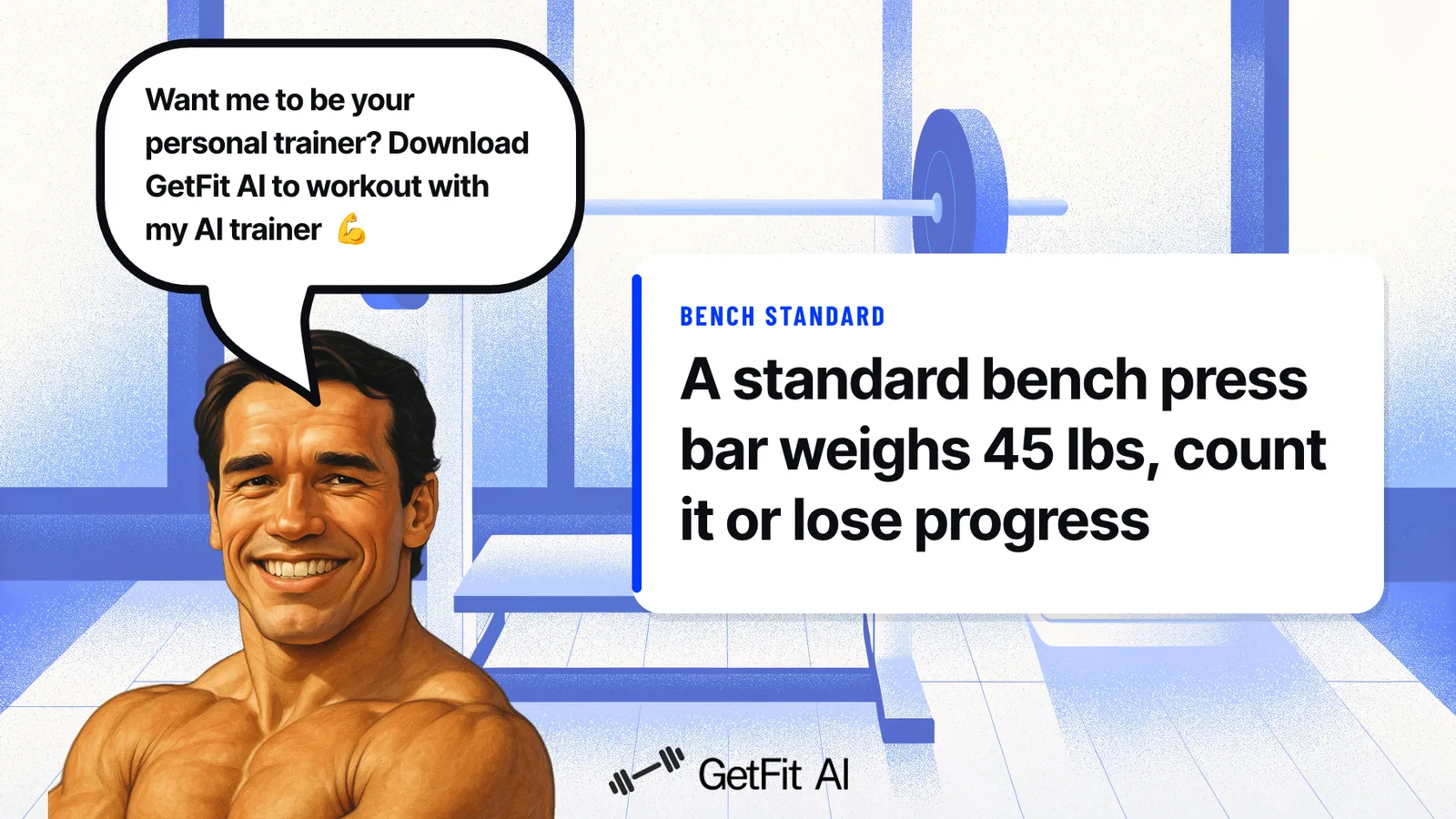
A standard bench press bar weighs 45 pounds (20 kilograms). The common assumption among beginners is that the bar is just “the bar” and doesn’t really count as weight, so they only need to track the plates. Knowing that number as trivia and counting it in your logs are two different things, and the gap between them is where months of progress quietly disappear. See our AI fitness app for how this works in practice.
The International Weightlifting Federation (IWF) standardizes the men’s Olympic barbell at exactly 20 kilograms. Walk into almost any commercial gym, load up the bench press rack, and that’s what’s sitting in the j-hooks before you touch a single plate. Your muscles don’t distinguish between bar weight and plate weight. The bar is load.
Your muscles don't distinguish between bar weight and plate weight. The bar is load.
A beginner loads one 45-lb plate per side, logs “90 lbs,” and moves on. The “progress” they’re tracking is fiction.
This is how progressive overload breaks silently. Progressive overload, systematically increasing the stress placed on the body during training, is the foundational mechanism by which strength and muscle are built. Any miscalculation of total load directly undermines that process.
You can’t reliably add weight each week if your baseline number was wrong from session one. The 45-lb figure is a rounded convention, not a precise conversion, a deliberate simplification that makes mental math faster at the gym without meaningfully affecting how you program your training.
Key takeaways
- A standard bench press bar weighs 45 pounds (20 kg), and not counting it in your logs means your program's math is wrong before you touch a single plate.
- Loading one 45-lb plate on each side of a standard bar puts 135 lbs on the bar, not 90. That missing 45 lbs is a third of the lift, not a rounding error.
- Not every bar in a commercial gym weighs 45 lbs, Smith machine bars, EZ-curl bars, and specialty barbells all differ, and assuming otherwise compounds the miscalculation across every session.
- Most bars broadcast their weight through physical markings, sleeve length, and knurling pattern, readable in under 30 seconds without asking anyone.
- Counting the bar correctly solves today's math. It does not tell you when to add weight, how to structure sets, or whether last week's lift was actually progress.
- GetFit AI closes that execution gap, its AI-powered trainer builds a custom program in your favorite athlete's style and stays available to answer questions anytime, so the bar weight you now know feeds into a plan that actually moves the number.
Types of Barbells and Their Weights: So You Know Exactly What’s in Your Hands
The common assumption is that the bar is just “the bar,” it doesn’t really count as weight, so you only need to track the plates. Walk into any commercial gym and you’ll find at least three to five different barbells on the rack, and they do not all weigh the same. Bar types found in commercial gyms span a wide range of weights, a spread confirmed by manufacturer specifications published by major barbell producers and widely documented in strength-training communities, so the assumption that every bar is “just the bar” at 45 lbs can quietly corrupt every set you log. Here is the complete map so you always know what is in your hands before the first rep.
| Bar Type | Weight | Key Feature |
|---|---|---|
| Men's Olympic / Power Bar | 45 lbs (20 kg) | 7-foot shaft, 2-inch sleeves, gym standard |
| Women's Olympic Bar | 33 lbs (15 kg) | Shorter shaft, thinner grip |
| Standard Home Gym Bar | Varies by model | 1-inch sleeves, non-Olympic plates |
| Technique / Training Bar | Lighter than standard bars | Aluminum build, beginner-focused |
| Swiss / Multi-Grip Bar | Varies by model | Neutral handles, shoulder-friendly |
1. Men’s Olympic/Power Bar: 45 lbs (20 kg), the Gym Standard
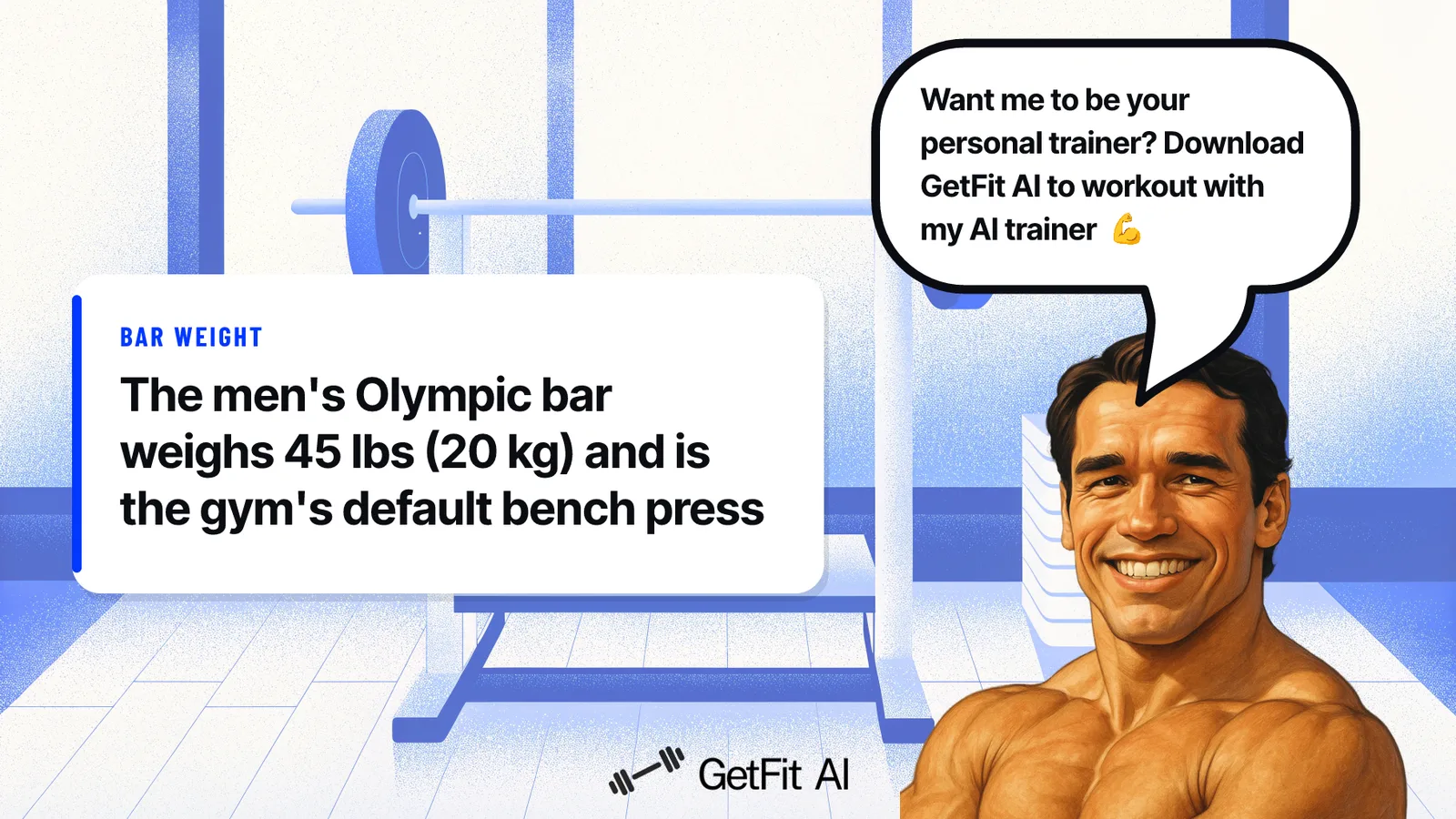
The men’s Olympic bar is the one you picture when someone says “barbell.” It weighs 45 lbs (20 kg), runs seven feet long, and fits 2-inch Olympic plate sleeves. This is the bar loaded on nearly every flat bench press rack in a commercial gym, and it is the baseline the rest of this guide measures against. If you grab a bar that feels textured all the way across, is clearly seven feet long, and sits on a standard bench press rack, you are almost certainly holding a 45-lb Olympic bar. Count it.
GetFit AI’s Athlete-Style Custom Workout Plans log this bar weight automatically from your first session, so every progressive-overload decision is built on accurate total load. When the app tells you exactly which exercises to perform, how many sets, and in what order for today’s workout, it is already accounting for the 45 lbs of bar you have in your hands before a single plate goes on.
2. Women’s Olympic Bar: 33 lbs (15 kg), Shorter Shaft and Thinner Grip
The women’s Olympic bar weighs 33 lbs (15 kg) and features a slightly shorter and thinner shaft for a more comfortable grip, as documented by Texas Power Bars, The Barbell Journal. It still uses 2-inch Olympic sleeves, so it looks nearly identical to the men’s bar at a glance. A beginner who grabs a women’s bar thinking it is the standard 45-lb Olympic bar will log meaningfully less than the actual load every session, a systematic undercount that distorts every progressive-overload decision that follows.
This is one of the subtler pain points beginners face: without a structured program prompting you to confirm which bar you are using, the error compounds silently across weeks. GetFit AI’s structured training layer surfaces the right question at the right moment, during each workout session, so the gap never has the chance to quietly undermine your program arc. Pair that with the friends, challenges, and leaderboard features (most powerful once you and at least one friend are both in the app), and a training partner can catch the bar-swap mistake you might otherwise miss on your own. That social accountability layer is what keeps beginners training past week three, long enough for accurate logging to actually matter.
3. Standard Home Gym Bar: 15-20 lbs, Built for 1-Inch Plates
The standard bar is the budget-friendly option commonly bundled with entry-level home gym sets. Weighing just 15-20 lbs and featuring a 1-inch diameter sleeve rather than the Olympic 2-inch, it only accepts standard (non-Olympic) plates. It’s fine for light training and beginners on a tight budget, but the real limitation is that its weight varies wildly by brand, some are 15 lbs, others 20, so you must weigh it yourself before trusting any total.
4. Technique/Training Bar: 11-33 lbs, Aluminum Build for Beginners
Technique bars are lightweight aluminum barbells ranging from roughly 11 to 33 lbs (5-15 kg), designed to let beginners and youth athletes drill bench press form before graduating to a full Olympic bar. Titan Fitness’s aluminum version weighs just 8 kg and mimics the feel of a real bar without the intimidating load. The tradeoff is durability, aluminum bars have lower weight ratings and aren’t built for heavy loading, making them a stepping stone, not a long-term tool.
5. Swiss/Multi-Grip Bar: 35-45 lbs, Neutral Handles to Protect Shoulders
The Swiss bar (also called a football bar or multi-grip bar) weighs between 35 and 45 lbs depending on the manufacturer and features multiple parallel neutral-grip handles instead of a straight shaft. This makes it a popular bench press alternative for lifters with shoulder or wrist discomfort. The tradeoff: because the weight varies significantly between brands and models, you can’t assume it’s 45 lbs, always check the spec sheet before loading plates.
Related Reading
- Best Fitness Apps
- How Many Pull Ups Should I Be Able To Do
- Average Grip Strength Male
- Average Bench Press
- Average Male Bench Press
- How Much Can The Average Man Bench Press
- Grip Strength Chart
- Symmetric Strength
- Bench Press Standards
The Smith Machine Bar Weight, the One Exception That Trips Everyone Up
Somewhere in almost every commercial gym sits a piece of equipment that quietly breaks beginners’ math without anyone saying a word about it. The common assumption is that the bar is just “the bar”, it doesn’t really count as weight, so you only need to track the plates. The Smith machine looks like a barbell setup. It loads like one. But the number you log after using it is almost certainly wrong.
“People are confused about whether the 3D Smith Machine qualifies as a true Smith machine, making it unclear how to account for bar weight. The kind of exception that trips people up when calculating actual load.”
— what we hear from gym & fitness enthusiasts
The Smith Machine Bar’s Effective Weight Is 15-25 lbs, Not 45
The Smith machine bar’s effective weight is typically 15-25 lbs, not the 45 lbs of a standard Olympic barbell. According to Altas Strength (2024), this reduced effective weight comes directly from the machine’s built-in counterbalance and tracking system, which offsets much of the bar’s actual mass before you ever touch it.
Key takeaway: Logging the full 45-lb Olympic bar figure on a Smith machine press will substantially overstate your load. The effective weight is as little as 15 lbs.
Why the Counterbalance System Makes the Bar Feel Almost Weightless
The counterbalance mechanism works by attaching a weight stack or spring system inside the machine’s frame that pulls upward against the bar’s downward mass. The bar moves freely along its fixed vertical track, and what you feel in your hands is only the residual load after that offset. As equipment reviewers and gym equipment manufacturers have noted, the bar’s actual physical weight is often heavier than what you feel in your hands, but the counterbalance reduces the effective load to as little as 15 lbs, so logging the full 45-lb Olympic bar figure on a Smith machine press will substantially overstate your load.
How to Identify Your Bar’s Weight, and Verify It When There’s No Label
That field check starts with one simple observation: most bars broadcast their weight through a combination of physical markings, sleeve length, and knurling pattern that you can read in under thirty seconds without asking anyone for help.
The core claim this section rests on is this: assuming “the bar is 45 lbs” is not a harmless default but an active miscalculation that compounds differently depending on which bar you are actually using, because real-world gym equipment ranges from 11 lbs to 55 lbs and is rarely labeled, making verification at every gym, every time, the only safe habit. That structural error quietly corrupts every set you log, and it is entirely avoidable in under two minutes.
Grab the bar you actually plan to use, because the number stamped on it (if there is one) is the only figure worth trusting. Bars in a typical commercial gym vary considerably in weight, and as lifters visiting multiple gyms have noted across strength-training communities, the same bar can feel meaningfully heavier or lighter depending on which gym you are training at that week. Here is how to verify yours, no embarrassment required.
1. Check the Sleeve or Collar for Stamped Weight Markings
Most Olympic barbells have the weight engraved or stamped near the sleeve end, look for markings like ‘20 kg’ or ‘45 lb’ on the collar. This is the fastest zero-effort method and works on the majority of commercial gym bars. The real limitation: older bars, budget gym equipment, or heavily used bars may have worn, painted-over, or simply absent markings, making this method unreliable in those settings.
2. Use a Gym Scale: Weigh Yourself Alone, Then Holding the Bar
Step on the gym’s floor scale, note your weight, then pick up the bar and step on again. Subtract the first number from the second. Consumer gym scales carry some margin of error, so treat the result as a close estimate rather than a certified figure. Still, a 33-lb or 44-lb reading tells you immediately that you are not holding a standard 45-lb Olympic bar, and that distinction alone is enough to correct your log before the first set.
-
Flip the bar sleeve-end toward you and check for stamped or engraved weight markings (“20 kg” / “45 lb”).
-
If no markings are visible, step on the gym floor scale alone and note your weight.
-
Pick up the bar, step on the scale again, and subtract to get the bar’s weight.
-
Treat the scale result as a close estimate and correct your log before the first set.
3. Ask Gym Staff: They Should Know Their Own Equipment
Gym staff and personal trainers are responsible for the equipment on the floor and should be able to tell you the weight of any bar in the facility, this is a completely reasonable question, not a beginner embarrassment. It’s especially useful for specialty bars like safety squat bars or Swiss bars where visual identification is harder. The one limitation: staff at large commercial gyms occasionally don’t know off the top of their heads and may need to look it up.
4. Use Visual Cues: Length and Diameter as Fast Bar-Type Proxies
A 7-foot bar with a 28-29mm shaft diameter is almost certainly a men’s Olympic bar weighing 45 lbs (20 kg). A shorter bar or one with a noticeably thinner 25mm shaft is likely a women’s bar at 35 lbs (15 kg). This visual shortcut is useful when markings are absent and no scale is handy. The tradeoff is that it’s a probabilistic guess, non-standard or budget bars can share dimensions without matching standard weights, so verify when precision matters.
5. Bust the Myth: Not All Bench Press Bars Weigh 45 lbs
A common assumption is that every bar in a gym weighs 45 lbs, but women’s Olympic bars weigh 35 lbs (15 kg), junior bars can be as light as 22 lbs (10 kg), and Smith machine bars often range from 15-25 lbs depending on the counterbalance system. Assuming 45 lbs without confirming can meaningfully skew your logged totals and percentage-based programming. Always verify using markings, a scale, or staff confirmation rather than defaulting to the 45-lb assumption.
Related Reading
- Do Pull Ups Work Chest
- Grip Strength Norms
- Average Deadlift Weight
- 1 Rep Max Chart
- Average Male Deadlift
- Good Bench Press Weight
- Weightlifting Standards
- Average Bench Press Kg By Age
- Average Deadlift Weight Kg
Why Bar Weight Matters for Your Total, the 135-Pound Math Most Beginners Get Wrong
Most beginners learn to count plates and forget the bar exists, which means the very first number they log is already wrong. That single blind spot quietly corrupts every progress comparison that follows, because you cannot track improvement accurately when your baseline is off by a third of the actual load. This section breaks down exactly how the math works and why the bar has to be part of the calculation from your very first rep.
The 135-Pound Calculation Every Beginner Should Tattoo on Their Brain
Total bench press weight = bar + (plate weight × 2). Always. No exceptions. Load a 45-lb bar with one 45-lb plate on each side and you are lifting 135 lbs, not 90. That 45-lb gap is a third of the lift, hiding in plain sight.
One pattern we see again and again with beginners: the same mental leap that makes machine-loaded weight feel disconnected from real-world load makes the bar feel like furniture. On a cable machine or a Smith machine, the starting resistance is part of the system, and beginners frequently ignore it, just as they ignore the barbell. The confusion is a structural gap in how weight is perceived versus what is actually moved. Count the bar. Every time. From rep one.
Why “I Benched 90 Pounds” Is Almost Always a 135-Pound Lift in Disguise
The confusion is understandable. You load the plates. You feel the plates. The bar feels like furniture. So you log the plates and move on.
But the math does not care about intuition. Two 45-lb plates plus a 45-lb bar equals 135 lbs. Log only the plates and you have recorded a lift that is significantly lighter than what you actually moved. For a beginner benching near that range in their first month, that is not a small discrepancy. It is nearly half the total load, silently missing from the record.
This is the kind of foundational tracking error that derails beginners who have previously struggled with consistency, because their program has no structure to catch and correct it. When your log is wrong from session one, every future decision about progression is built on sand. A structured training plan, applied from the very first workout session, closes that gap before it compounds.
Does 225 Include the Bar?
Yes. Here’s the Exact Plate Math That Proves It
Yes. Always. Four 45-lb plates (two per side) plus the 45-lb bar equals 225 lbs. In powerlifting competition, the International Powerlifting Federation includes the bar’s 20 kg in the total lifted. There is no asterisk, no “just the plates” convention. The bar is part of the lift because it is part of the load. Industry data captures the real-world weight of this confusion well; mislogged totals are one of the most common sources of stalled progress that lifters only recognize in hindsight.
How Ignoring Bar Weight Breaks Progressive Overload Before You’ve Added a Single Plate
Strength research recommends adding small, consistent increments per week for beginners on compound lifts. That increment is small by design. It keeps progress sustainable and measurable.
A 45-lb baseline error does not just misrepresent one session. It mathematically inflates every future milestone; your “45-lb bench” becomes a 90-lb bench in reality, and every incremental add-on week compounds on a false baseline, making genuine progress invisible until the gap becomes too large to ignore.
This is where program structure is protective. GetFit AI’s Athlete-Style Custom Workout Plans are built to track total load correctly from the first workout session, through each subsequent session, and across the full arc of a training program. For beginners who have previously struggled with consistency due to a lack of program structure, having that architecture in place from day one means the 45-lb bar is never invisible in the log.
For those training alongside a friend or workout partner also using GetFit AI, the shared accountability through friends, challenges, and leaderboards creates the retention layer that keeps users training and logging accurately past week three, the point where most beginners, left without structure, quietly stop. 99 per year, making structured, accountable training accessible at every commitment level.
Related Reading
- Average Deadlift Weight For Male
- Best Calisthenics Workout App
- Best Hiit Workout App
- Best Gym Workout App
- Best Workout Apps
- Best Free Workout Apps
Knowing the Bar’s Weight Is Step One: Here’s What Happens When You Still Have No Plan
Knowing the bar’s weight closes the knowledge gap. It does nothing about the execution gap, which is where most beginners actually lose. The difference between someone who stalls and someone who progresses comes down to whether they have a system that tells them what to do with that number next.
The Knowledge Gap vs. The Execution Gap
The arithmetic is the easy part. The hard part is knowing what to do with it. A common pattern among beginners is showing up consistently for weeks, counting plates correctly, and still making zero progress because no one told them to add weight, adjust sets, or track whether last Tuesday’s lift was heavier than the Tuesday before.
Key takeaway: According to Medium / Jeremy Snowden (citing personal trainer meeting discussion) (2025), roughly 80% of gym-goers quit within the first 90 days. Accurate logs did not save them.
The absence of a system did.
Across the market, roughly the same pattern holds. Accurate logs did not save them. The absence of a system did.
Progressive Overload Requires a System That Adapts
Knowing your starting weight is the floor. Progressive overload means adding stress systematically over time, and that requires knowing your previous numbers, your target rep range, and when to push versus when to back off. What most teams report in the data holds true here too: fewer than 4% of new gym members were still training consistently after 12 months, with enjoyment and autonomy as the factors that kept people going. A single corrected number cannot manufacture either of those.
Most beginners handle this by piecing together YouTube clips and scattered online content, hoping something sticks. An AI fitness app like GetFit AI handles this layer automatically, logging the bar, tracking plate math, and adjusting your program week over week so the system does the remembering and you focus on the lifting.
Next steps
If your logged lifts have never matched what you actually moved, the path forward starts with treating the bar as load from rep one, not as background furniture you account for later. Start with our AI fitness app.
The assumption that “the bar is just the bar” is not a harmless default. It is an active miscalculation that compounds differently across every bar type in the gym, from a 15-lb counterbalanced Smith machine bar to a standard 45-lb Olympic barbell, meaning a single unchecked habit corrupts every progressive-overload decision that follows. And fixing the arithmetic alone does not finish the job. A beginner who corrects their bar-weight logging but still trains without a structured, adaptive plan is sitting on accurate numbers that never produce real progression, because the data accumulates without a system to act on it. Together, those two realities point to the same next step: accurate logging inside a program that knows what to do with the numbers.
Start by tracking your total load, bar included, inside GetFit AI. From your first session, it counts full bar-and-plate math automatically, builds week-by-week programming on that correct baseline, and flags stalls before they become months of invisible non-progress.
Frequently Asked Questions
Why does a 20 kg bar get called 45 lbs if that’s not the exact conversion?
Twenty kilograms converts to exactly 44.09 pounds, so 45 lbs is a rounded convention, not a precise conversion. It’s a deliberate simplification that makes mental math faster at the gym without meaningfully affecting how you program your training.
If I put one 45-lb plate on each side, am I really lifting 90 lbs?
No, you’re lifting 135 lbs. The formula is always bar + (plate weight × 2), so a 45-lb bar plus two 45-lb plates equals 135 lbs. That 45-lb gap is not a rounding error; it’s a third of the total lift.
Does the women’s Olympic bar fit the same plates as the standard men’s bar?
Yes. The women’s Olympic bar weighs 33 lbs (15 kg) and has a shorter, thinner shaft, but it still uses 2-inch Olympic sleeves, so it looks nearly identical to the men’s bar at a glance. A beginner who grabs it thinking it’s the standard 45-lb bar will systematically undercount their load by 12 lbs every session.
How do I figure out what a bar weighs if there’s no label on it?
First, flip the bar so the sleeve end faces you and look for small stamped or engraved text near the collar, most quality Olympic bars print ‘20 kg’ or ‘45 lb’ directly on the metal. If there’s no marking, step on a gym floor scale alone and note your weight, then pick up the bar and step on again; subtract the first number from the second to get a close estimate of the bar’s weight.
Is the Smith machine bar the same weight as a regular barbell?
No, the Smith machine bar’s effective weight is typically only 15-25 lbs, not 45 lbs, because the machine’s built-in counterbalance and tracking system offsets much of the bar’s actual mass before you ever touch it. Logging the full 45-lb Olympic bar figure on a Smith machine press will substantially overstate your load.







