Average Deadlift Weight Kg Standards by Age and Gender
The 154 kg average you keep seeing is not the gym-goer average. It is the motivated minority average, and knowing the difference changes every tier you are chasing.
The average deadlift weight is 154 kg (340 lbs) for men and 91 kg (200 lbs) for women, based on nearly 23 million logged lifts recorded in Strength Level’s deadlift standards database since 2014. Those are clean, confident numbers. The problem is what these figures don’t tell you. See our AI fitness app for how this works in practice.
“As a beginner, I’m unsure what weight benchmarks to aim for at different stages (novice vs. intermediate). There’s a real gap in accessible, relatable deadlift standards by experience level.”
— what we hear from beginner strength trainees
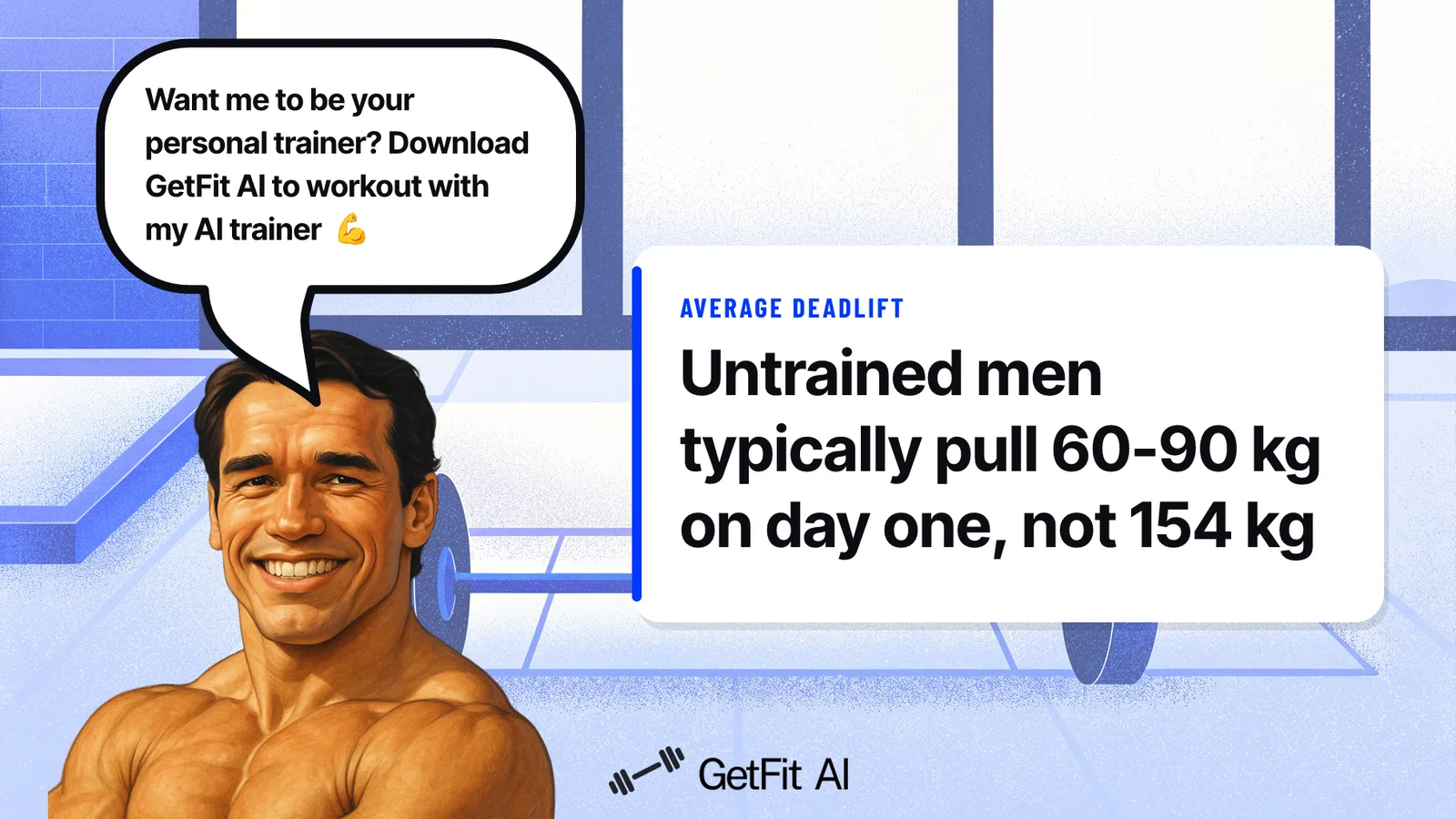
Most people who find these figures assume they represent a fair cross-section of gym-goers. They don’t.
Strength Level’s database reflects people who actively log their workouts, a self-selected group who already train harder, smarter, and longer than average. So when you compare yourself to a 154 kg average, you’re not comparing yourself to the person who shows up three times a week and figures it out as they go. A truly untrained adult male walking in on day one typically pulls 60-90 kg. Women starting from scratch generally land in the 35-50 kg range. That distance isn’t a flaw in you; it’s just what the headline average actually measures.
Knowing this reframes the number from a discouraging ceiling into a realistic long-term target. Strength Level Standards categorize lifters by experience tier, but a single average says nothing about your starting point, your rate of progress, or what tier to target in the next six months. Note for beginners who have previously struggled with consistency: if past stalls came from a lack of program structure rather than effort or genetics, a structured progression plan is likely the highest-leverage intervention, not more information about standards.
Key takeaways
- The average deadlift is 154 kg for men and 91 kg for women, drawn from nearly 23 million logged lifts, but that number means almost nothing without knowing your bodyweight and training history.
- Deadlift standards run five tiers from beginner to elite, and the tier you occupy shifts the moment you factor in bodyweight ratio, two lifters pulling the same bar weight can land in completely different categories.
- Age doesn't just lower the ceiling on your deadlift, it shifts the entire performance timeline, which means a single universal table will misread where you actually stand.
- Progressive overload is the entire mechanism behind strength gains, not a vibe you apply when the weight feels manageable, without tracked increments, most lifters stall inside six weeks.
- Knowing your standard tells you where you are; it does not tell you what to lift next session, and that gap is where most self-directed progress dies.
- GetFit AI's Structured Training closes that gap by delivering workouts as a coherent program progression, not random exercises, so every session builds on the last with a clear directive, not a guess.
Deadlift Standards by Experience Level: From Beginner to Elite (Kg)
Deadlift strength standards sort into five distinct tiers, and knowing which tier you occupy is genuinely useful, but only if you understand what each number actually represents. The ranges below draw on StrengthLog’s deadlift strength standards alongside Strength Level’s dataset of nearly 23 million logged lifts, giving you two independent sources pointing at the same benchmarks.
How Deadlift Standards Are Classified: The Five-Tier Framework Explained
Deadlift strength standards vary by experience level across five tiers: Beginner, Novice, Intermediate, Advanced, and Elite. According to StrengthLog (2024), each tier is defined by a load-to-bodyweight ratio, not just an absolute number, which lets lifters of different sizes self-locate accurately on the progression ladder. Reading both absolute kg values and bodyweight multipliers side by side gives you the clearest picture of where you stand.
One of the most common frustrations beginners bring to us at GetFit AI is that this information feels hard to track down, especially when they’re trying to benchmark against regional or state-level competition standards. Deadlift standards are scattered across sources that rarely agree on definitions. The five-tier framework below is designed to cut through that noise.
One important caveat before reading any tier label as objective truth: the experience-tier labels on deadlift charts create a false sense of precision. Because Strength Level’s dataset is built from self-selected, actively logging gym-goers rather than the general population, a true beginner comparing themselves to these figures is seeing the midpoint of a motivated minority, which makes the gap look larger and more discouraging than it actually is.
Beginner and Novice Deadlift Standards in Kg (With Bodyweight Multipliers)
Beginner men typically pull around 80 kg with little to no structured training experience; beginner women land near 45 to 50 kg, per StrengthLog’s standards. At this stage, bodyweight multipliers sit below 1.0x for most builds.
This is also the stage where confusion about “reps versus load” benchmarks is most acute. A beginner pulling 70 kg for 10 to 12 controlled reps is demonstrating real strength, yet online rep-count standards (some citing 30+ reps in 60 seconds at lower loads) can make that feel inadequate. It isn’t. Load-based, bodyweight-relative standards like those used by StrengthLog are the correct lens at this stage, and GetFit AI’s Athlete-Style Custom Workout Plans are calibrated to those load-based progressions from the very first workout session, so you’re never chasing an irrelevant metric.
Novice standards step up meaningfully. StrengthLog places novice men at 100 to 130 kg, roughly 1.25x to 1.5x bodyweight, and novice women at 55 to 75 kg. A man deadlifting 120 kg can legitimately call himself novice-to-intermediate. The tier is descriptive, not a verdict.
Intermediate Deadlift Standards: Where Most Consistent Gym-Goers Land
Intermediate men average 140 to 170 kg (with 150 to 154 kg as the most commonly cited midpoint); intermediate women average 80 to 100 kg, around 89 to 91 kg at the center. These figures align across both StrengthLog and Strength Level’s larger dataset.
Here is where the self-selection problem bites hardest. Because Strength Level’s data comes from people who actively log workouts, the “average” pull of that dataset already sits at what StrengthLog (2024) defines as the Intermediate tier, meaning the dataset’s midpoint reflects a dedicated minority, not the full bell curve of gym-goers. If you hit 150 kg as a man and feel merely average, you are solidly in the upper half of people who train with any real intention.
This is also the tier where a second, quieter fear tends to surface: the anxiety of losing hard-earned strength during a cut. Lifters who have spent months climbing from novice to intermediate are understandably reluctant to drop into an aggressive caloric deficit that might pull their deadlift back below the tier they just crossed. GetFit AI’s Structured Training programs are built to address this directly; the program arc accounts for performance maintenance across diet phases, not just hypertrophy blocks.
That continuity is most powerful when applied consistently during each workout session and across the overall training program arc, which is exactly how the plans are structured. The Friends, challenges, and leaderboards layer compounds this: after connecting with at least one friend in the app, the social accountability that tends to keep intermediate lifters training past week three becomes a built-in feature of the experience rather than something you have to manufacture yourself.
Advanced and Elite Deadlift Standards: What Serious and Competitive Lifters Are Pulling
Advanced men pull 190 to 230 kg, roughly 2.25x to 2.75x bodyweight; advanced women pull 110 to 140 kg, around 1.5x to 2.0x bodyweight. Elite lifters, competitive powerlifters and the top percentile of serious gym-goers, pull 250 kg or more for men and 155 kg or more for women, at or above 3.0x bodyweight. These numbers represent genuine outliers, and comparing yourself to them at any stage below advanced is a reliable way to manufacture unnecessary discouragement.
For lifters targeting these upper tiers with structured intent, GetFit AI’s Premium plans, Weekly at $1.99, Monthly at $4.99, or Yearly at $49.99, provide the Athlete-Style Custom Workout Plans and program structure that make tier-to-tier progression a trackable process rather than a guessing game.
Related Reading
- Best Fitness Apps
- How Many Pull Ups Should I Be Able To Do
- Average Grip Strength Male
- Average Bench Press
- How Much Does A Bench Press Bar Weigh
- Average Male Bench Press
- How Much Can The Average Man Bench Press
- Grip Strength Chart
- Symmetric Strength
- Bench Press Standards
Deadlift Standards by Bodyweight: How Much Should You Deadlift for Your Weight?
Knowing how much you deadlift in raw kilograms tells you far less than you might think, because the same number on the bar means something completely different depending on how much you weigh. The sections below break down why relative strength is the signal that actually matters, how to read your lift against bodyweight-adjusted standards, and why chasing an arbitrary kilogram target without that context is one of the most common reasons lifters stall. GetFit AI’s custom workout plans are built around this principle from day one, anchoring your program to your bodyweight and starting point rather than locker-room benchmarks.
Why the Number on the Bar Means Nothing Without Your Bodyweight
Two lifters walk into the gym. Both pull 105 kg off the floor. One is 70 kg bodyweight; the other is 90 kg.
Same bar, same plates, same number on the whiteboard, but across the strength community those two lifts land at entirely different tiers the moment you divide by bodyweight. 5x bodyweight, a solidly intermediate result. 17x, still in novice territory.
Absolute kilograms are a near-useless self-coaching signal, because a lighter lifter who matches a heavier peer’s kilogram number is expressing superior relative strength, yet almost every beginner compares raw numbers instead of ratios.
This confusion runs deeper than most beginners expect. Many lifters train for years targeting a landmark number, four plates, 180 kg, whatever the locker-room benchmark is, only to find that number remains elusive, or worse, that hitting it still feels meaningless without context. That stall is rarely about effort. It is almost always about chasing the wrong signal: absolute kilograms instead of relative strength, and a fixed target instead of a personalised program arc calibrated to your bodyweight and starting point. GetFit AI’s Athlete-Style Custom Workout Plans are built specifically for lifters who have previously struggled with consistency due to lack of program structure, delivering a structured training path from the very first session, one anchored to where you actually are, not where gym mythology says you should be.
Why Absolute Kilograms Lie
Relative strength, weight lifted divided by bodyweight, is the only metric that lets you compare deadlift performance honestly across different body sizes. The principle is straightforward: a heavier lifter accumulates more muscle mass and more favourable mechanical leverage, which inflates their absolute kilogram total without necessarily reflecting superior strength. Chasing a single kg target without anchoring it to your own bodyweight can actively mislead you, causing you to stop progress too early or push past your real current ceiling.
The same gap exists beyond the barbell entirely. Beginners working with sandbags, trap bars, or other non-standard implements often find that published standards simply do not cover them, leaving them with no objective way to benchmark progress at all. Relative strength ratios solve this: divide load by bodyweight and the comparison becomes meaningful regardless of the implement.
When weights stop moving and the plateau hits, the cause is almost always one of three things: the program has no logical progression built in, recovery is being ignored, or the target was never calibrated to the lifter’s actual tier in the first place. GetFit AI’s structured training addresses all three by building the progression for you across each workout session and across the overall training program arc, so you are never left guessing what to change.
Deadlift Standards by Bodyweight Category
The table below uses bodyweight multiplier tiers sourced from established deadlift benchmarks and cross-referenced against what coaches and competitive lifters broadly report across the market. Values are approximate 1RM guides.
| Tier | Bodyweight Multiplier (Men) | Bodyweight Multiplier (Women) |
|---|---|---|
| Beginner | 0.75-1.25x BW | 0.5-0.75x BW |
| Novice | 1.25-1.5x BW | 0.75-1.0x BW |
| Intermediate | 1.5-2.0x BW | 1.0-1.25x BW |
| Advanced | 2.25-2.75x BW | 1.5-2.0x BW |
| Elite | 3.0x BW or more | 2.0x BW or more |
These standards calibrate intermediate against active gym-goers, people who actually train, so these benchmarks already account for the fact that you are not comparing yourself to someone who never lifts. A committed beginner can feel discouraged when they cannot hit what they assume is an “intermediate” standard, without realising the standard is set against a competitive reference group. Knowing your actual tier removes that false pressure and gives you a clear, achievable next step.
The social layer accelerates this. GetFit AI’s friends, challenges, and leaderboards are most powerful once you have connected with at least one friend or workout partner also using the app; at that point the relative-strength table above stops being a solo benchmark and becomes a shared target, the kind of accountability that keeps training consistent past the first few weeks.
Is a 100 kg Deadlift Good?
It Depends Entirely on What You Weigh
Direct answer: a single deadlift number can be intermediate for a 60 kg lifter and beginner for a 90 kg lifter. Same bar. Completely different story. The only honest self-assessment runs the ratio first, then maps the result to a structured plan that actually moves the needle from where you are.
Deadlift Standards by Age: How Performance Peaks and Shifts Over Time
Deadlift performance follows no single curve that everyone rides at the same pace. Across the broader population, age brackets reflect meaningfully different performance expectations, because the physiology behind strength production shifts across decades in ways a single universal table cannot capture.
Age shifts the entire timeline of what “on track” means, yet most published standards present a single table as if a 45-year-old and a 28-year-old are racing toward the same destination. The cost of training without a real progression plan compounds differently depending on where you sit on the strength curve.
Age-Bracketed Deadlift Standards Table: Untrained vs. Trained Averages by Decade (Kg)
The figures below draw on population-level tracking data and widely reported intermediate benchmarks, segmented by training status.
| Age Group | Untrained Men | Trained Men | Untrained Women | Trained Women |
|---|---|---|---|---|
| 18-24 | 70-85 kg | 120-140 kg | 40-50 kg | 65-80 kg |
| 25-34 | 80-95 kg | 140-165 kg | 45-55 kg | 75-95 kg |
| 35-44 | 75-90 kg | 130-155 kg | 42-52 kg | 70-88 kg |
| 45-54 | 65-80 kg | 115-140 kg | 38-48 kg | 62-80 kg |
| 55+ | 55-70 kg | 95-120 kg | 32-42 kg | 52-70 kg |
The gap between columns is the point. It widens with every decade.
Why the 25-35 Window Is the Highest-Leverage Period
Trained populations consistently show deadlift capacity peaking in the late 20s to mid-30s, driven by the convergence of near-maximum testosterone output, full skeletal maturity, and the nervous system’s highest capacity for motor unit recruitment. Sources such as Marathon Handbook, a widely referenced source for intermediate standards, reflect this pattern in their age-adjusted benchmarks. A lifter in that window who lacks a structured plan is burning the highest-yield period of their strength development on random effort. The compound gains that accumulate in this decade are disproportionately hard to recover later.
Related Reading
- Do Pull Ups Work Chest
- Grip Strength Norms
- Average Deadlift Weight
- 1 Rep Max Chart
- Average Male Deadlift
- Good Bench Press Weight
- Weightlifting Standards
- Average Bench Press Kg By Age
What Actually Influences Your Deadlift Performance: Body Weight, History, and Technique
Most people treat the deadlift as a simple numbers game: find the average, chase the average, done. But your actual capacity is shaped by how your body weight and training history interact over time, and misreading either one leads to targets that are either discouraging or meaninglessly easy. What follows breaks down how those variables actually work together, so you can set a standard that reflects your real starting point rather than someone else’s snapshot.
Body Weight Cuts Both Ways
Deadlift capacity depends on body weight and training history. That is the short answer. The longer one, supported by what most serious coaches and researchers consistently observe, is that heavier and more experienced lifters demonstrate systematically higher load-velocity relationship intercepts, with both variables compounding over time rather than operating independently. A 90 kg lifter moving 110 kg absolute is not stronger than a 70 kg lifter moving 105 kg once you account for relative load. Body weight cuts both ways: it gives you more muscle mass and mechanical leverage to pull from, but it also raises the bar for what counts as a meaningful lift relative to your frame.
Beginners often treat body weight as a fixed disadvantage or a free pass, depending on which side of the scale they sit on. Neither reading is accurate. The variable is dynamic, and it compounds with training history in both directions.
Training History Determines Your Starting Ceiling More Than Raw Strength Does
Across the broader strength training field, maximal strength is understood as a foundational, accumulating ability whose expression depends on accumulated training history, not a single snapshot number a beginner can aim at in isolation. Two lifters with identical body weight and identical current 1RMs can have completely different ceilings based purely on how long and how consistently they have trained. The one with two years of structured history has built neuromuscular efficiency, tendon resilience, and movement pattern depth that the newer lifter simply has not had time to develop yet.
One of the most common places beginners stall is right here: they are getting stronger, but they cannot see it clearly enough to know which input is responsible. Volume, frequency, technique, and training continuity all interact; pull on the wrong lever and you spend months adding accessory work when the real gap is load progression. This is precisely the problem GetFit AI’s Progress Analytics is built to solve.
Rather than leaving you to guess whether this week’s PR came from better sleep, an extra session, or a cue you finally locked in, the analytics layer tracks performance across sessions and surfaces which variables are actually moving your numbers. For beginners who have previously struggled with consistency due to lack of program structure, GetFit AI’s Athlete-Style Custom Workout Plans provide a structured training framework from the very first workout session, removing the guesswork about what to do next and replacing it with a program arc designed to accumulate the training history that Frontiers in Sports and Active Living, Schiemann et al. identifies as a primary driver of deadlift strength expression.
Progress Analytics also directly addresses the question every serious beginner eventually asks: am I actually getting stronger, or am I just showing up? Showing up matters, but it is not the same as progressive overload. The analytics make that distinction concrete and session-by-session, so you are not relying on feel or memory to evaluate a training block. If you want to know what to eat to support the size or leanness goal sitting underneath your strength target, GetFit AI layers nutrition guidance alongside training data, because body composition and deadlift capacity are not separate conversations.
Grip Variations and Belts: Conditional Benefits
Mixed grip, hook grip, and lifting belts can add weight to a tested max lift, but the benefit is conditional. Grip variations reduce the rotational force that causes bar roll, allowing the hands to hold what the posterior chain can already produce. A belt increases intra-abdominal pressure, giving the lower back a more stable base to pull from, but it does not substitute for core strength; it amplifies what is already there. Neither grip variation nor belt use meaningfully changes a beginner’s numbers, because the limiting factor at that stage is neuromuscular patterning and raw posterior chain strength, not equipment. Invest in grip and bracing technique first; add tools once the movement is solid.
The structured training track inside GetFit AI sequences this correctly by design: foundational technique and load progression come first, and the program arc reflects that priority across every session, not just the first one. For lifters who want to stay accountable to that sequence past the early weeks, the period where most beginners quietly abandon their program, the friends, challenges, and leaderboards feature adds a retention layer that keeps training consistent past week three, and is most effective once you have connected with at least one friend also using the app. Structured accountability and structured programming compound the same way body weight and training history do: the longer both run in parallel, the wider the ceiling they build.
GetFit AI Premium is available as a Weekly plan at $1.99, a Monthly plan at $4.99, or a Yearly plan at $49.99, giving you access to Progress Analytics, Athlete-Style Custom Workout Plans, and the full social accountability layer across whichever billing cycle fits your commitment horizon.
Related Reading
- Average Deadlift Weight For Male
- Best Calisthenics Workout App
- Best Hiit Workout App
- Best Gym Workout App
- Best Workout Apps
- Best Free Workout Apps
Tips to Improve Your Deadlift: Why a Structured Plan Beats Random Effort
Effort compounds. But only when something is telling it where to go next.
Progressive Overload Is the Mechanism, But Only If Someone Tracks the Increments
Progressive overload is not a tip. It is the entire mechanism behind deadlift strength gains. The problem is that most beginners treat it as a vibe rather than a system: add weight when it feels right, back off when it feels heavy, repeat indefinitely. Without written targets dictating exact load, sets, and reps for each session, the bar stays the same. Not because the body stopped adapting. Because nobody told it to.
A beginner following a structured 12-week deadlift progression can reach intermediate standards within a year, consistent with findings from Ralston et al. (2017, Journal of Strength and Conditioning Research), who demonstrated that periodized programming produces significantly greater strength gains than non-periodized training over equivalent timeframes. A lifter training without written session targets typically plateaus earlier and repeats that ceiling for months, a pattern documented in adherence research (industry data). The difference is not genetics; it is whether the next session has a prescribed load target before the lifter walks through the door. That advantage is most pronounced in novice lifters, where the structure itself, not the volume, is the primary driver of progress.
The Accessory Work That Actually Transfers to Your Deadlift: Romanian Deadlifts, Hip Hinges, Grip
Romanian deadlifts and hip hinge variations build the posterior chain through the exact range of motion that limits most beginners at the floor. Grip work matters just as much. A common frustration is losing the bar before the legs and hips are even close to fatigued, which means the limiting factor is the hands, not the muscles doing the actual work. Addressing grip strength directly, through dead hangs, farmer carries, or barbell holds, removes that ceiling.
The carryover is real and measurable. Accessory work earns its place in a plan not as filler, but as targeted load on the weak links that a heavy deadlift exposes.
Why Most Beginners Stay Stuck at Beginner Numbers: It Is Behavioral, Not Physical
Most beginners don’t see this collision coming. According to a 2016 study published in the Journal of Science and Medicine in Sport (Sperandei et al.), 63% of gym members abandoned training before the third month. Research from Lally et al. (2010) in the European Journal of Social Psychology found that a new training behavior reaches automaticity after a median of 66 days. Most lifters quit at precisely the moment the habit was about to stop requiring willpower.
The beginner-to-intermediate gap is a planning problem.
Structured Deadlift Sessions Beat Frequency Alone
Frequency without structure is just attendance. Two to three deadlift-focused sessions per week can produce consistent strength gains, but only when each session has a prescribed load target, a rep scheme, and a defined progression rule. Frequency without those anchors is attendance. Attendance without structure is the most common reason intermediate numbers stay just out of reach.
Next steps
If your deadlift progress has stalled despite showing up consistently, the path forward starts with recognizing that the number on the chart was never the plan. The 154 kg average sits at what StrengthLog defines as the Intermediate tier, drawn from a self-selected group of motivated, actively logging gym-goers, not the general gym-going public. Comparing yourself to that figure without context is comparing yourself to the wrong group entirely. Start with our AI fitness app.
The research on dropout and habit formation makes the stakes concrete. Sixty-three percent of gym members quit before month three, yet the median time for a training behavior to become automatic is 66 days, meaning most lifters abandon their program at precisely the moment it was about to stop requiring willpower. Separately, chasing an absolute kilogram target without anchoring it to your own bodyweight actively misleads you, causing you to stop progress too early or push past your real current ceiling. Together, these two realities point to the same action: replace the target with a structured system that tells you what to lift today, adapts as you improve, and carries you across the automaticity threshold before motivation runs out.
Start with GetFit to get a structured plan built around your current tier and bodyweight ratio. From your first session, load targets, progression rules, and recovery pacing are prescribed for you, so each pull builds on the last rather than repeating the same ceiling indefinitely.
Frequently Asked Questions
Why should I use my bodyweight ratio instead of just the number on the bar?
Absolute kilograms hide the full picture because a lighter lifter who matches a heavier peer’s kilogram number is actually expressing superior relative strength. Dividing the weight lifted by your bodyweight, your relative strength ratio, is the only metric that lets you compare deadlift performance honestly across different body sizes, and it works regardless of the implement you’re using.
What does it mean to be classified as a “beginner” vs. “intermediate” on these deadlift standards?
The five-tier framework, Beginner, Novice, Intermediate, Advanced, and Elite, is defined by a load-to-bodyweight ratio, not just an absolute number. Beginner men typically pull around 80 kg (below 1.0x bodyweight), while intermediate men average 140-170 kg (1.5-2.0x bodyweight); the equivalent ranges for women are 45-50 kg and 80-100 kg respectively.
Is a 100 kg deadlift actually good?
It depends entirely on what you weigh. A 100 kg deadlift is intermediate for a 60 kg lifter (1.67x bodyweight) but sits in beginner territory for a 90 kg lifter (1.11x bodyweight). Running the bodyweight ratio first is the only honest way to assess where a given number actually lands.
Are the “average” deadlift figures representative of normal gym-goers?
No, the widely cited averages of 154 kg for men and 91 kg for women come from Strength Level’s database of nearly 23 million logged lifts, but that dataset reflects self-selected lifters who actively track their training, not the general gym-going public. A truly untrained adult male on day one typically pulls 60-90 kg, and women starting from scratch generally land in the 35-50 kg range.
Do deadlift standards change as you get older?
Yes, meaningfully so. The post’s age-bracketed table shows that peak trained performance tends to occur in the 25-34 bracket (140-165 kg for men, 75-95 kg for women) and declines in each subsequent decade, dropping to 95-120 kg for trained men and 52-70 kg for trained women at 55+. The key takeaway is that age shifts the entire timeline of what “on track” means, not just the ceiling.