Good Bench Press Weight by Age, Sex, and Body Weight 2026

Your bench press number only means something when it’s measured against your sex, age, and bodyweight. Here is how to find the standard that actually applies to you.
The common assumption is that if you can see the standard, you know what you’re working toward, and that’s enough to make progress. Strength benchmarks are personal filters, not finish lines. Knowing where the bar should be set for you is the first step toward actually moving it. Tools like a structured AI fitness app are most valuable when you’ve already tried to stay consistent but kept losing direction without a clear week-over-week plan, because that gap between “here’s your number” and knowing what to do with it is where most people quietly stall out. See our AI fitness app for how this works in practice.
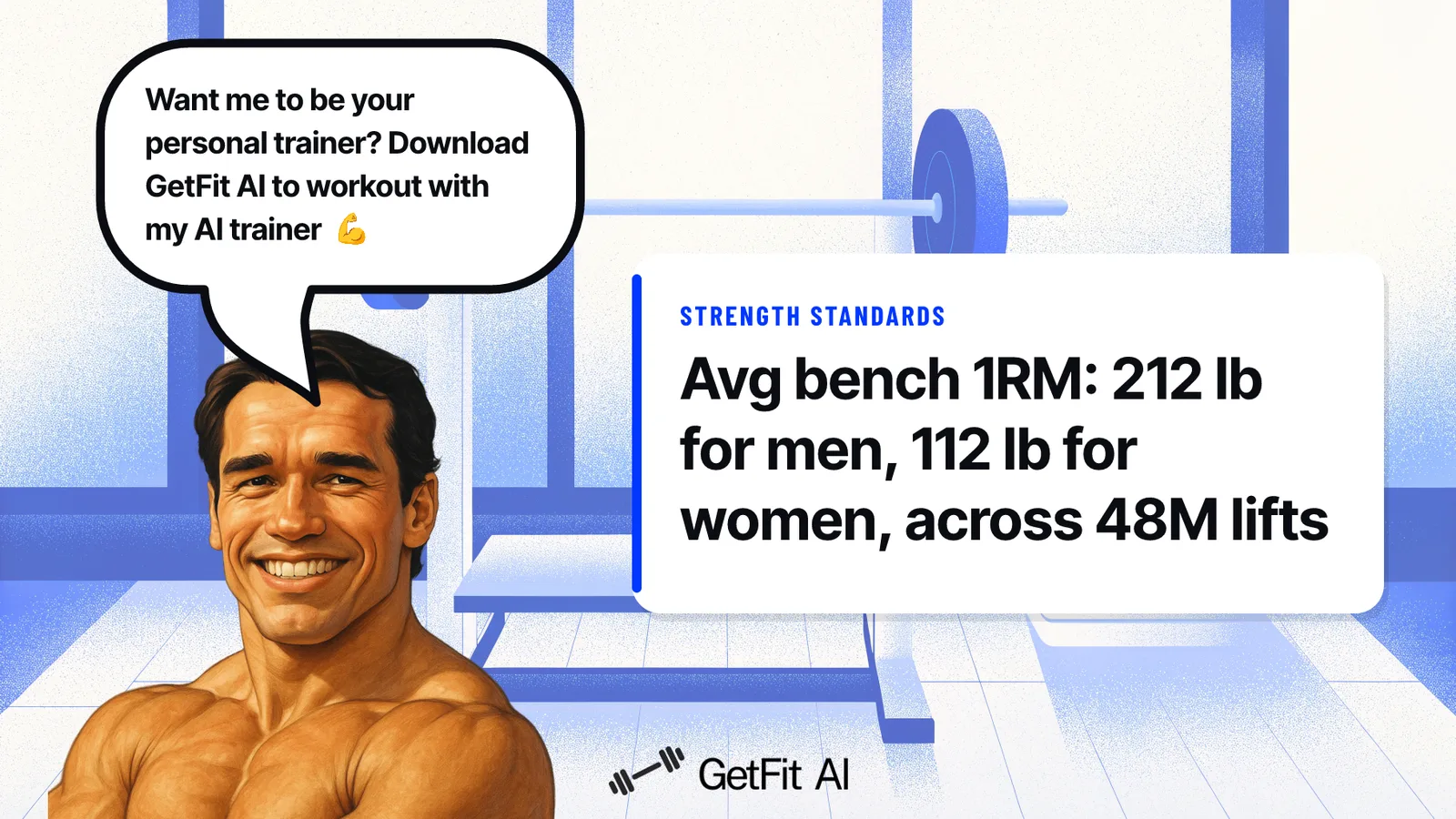
According to Strength Level’s 2024 data, compiled from over 48 million recorded lifts, the average bench press one-rep max is 212 lb for men and 112 lb for women. Those two numbers alone should tell you something important: a single universal standard is already impossible before you factor in anything else.
The same source organizes bench press performance across five tiers, from Beginner through Elite, and none of those tiers mean the same thing for every person who hits them. A 135 lb bench press can represent a serious achievement or a modest warm-up depending entirely on who is lifting it.
As Marathon Handbook’s 2024 analysis makes clear, what counts as a good bench press is relative to three filters: sex, age, and bodyweight. Strip any one of those out and the number becomes almost meaningless. A 200 lb man in his mid-20s and a 130 lb woman in her 50s could both bench 135 lbs. One is performing well below average for their profile. The other is performing impressively above it. Knowing your number is step one, but a benchmark without a week-over-week progression plan is just a label. It tells you where you stand today; it does nothing about tomorrow.
Key takeaways
- A "good" bench press weight is not a universal number, it shifts based on your sex, age, and bodyweight, and ignoring any one of those three variables gives you a benchmark that doesn't apply to you.
- The average male bench press sits around 212 lbs; the average female bench press is roughly half that, a gap driven by physiology, not effort, which means comparing across sexes produces meaningless data.
- Strength peaks in the late 20s to early 30s, so a 185 lb lift at 27 and a 185 lb lift at 47 carry completely different ceilings and require completely different training responses.
- Absolute weight on the bar lies, the bodyweight multiplier (your max divided by your bodyweight) is the only number that tells you where you actually stand relative to your own frame.
- The five strength tiers (beginner through elite) are defined as much by training age and program structure as by the weight lifted; most lifters stall inside the novice tier because they never move to a structured program.
- Knowing your tier label without a weekly plan attached to it is a verdict, not a direction, progressive overload only works when the load, volume, and timing decisions are made correctly and consistently, week over week.
- GetFit AI's Structured Training closes that gap by delivering workouts as a coherent program progression, not random exercises, so the benchmark you calculate today has a concrete, sequenced path moving it forward.
Bench Press Standards by Sex: What Men and Women Can Realistically Expect to Lift
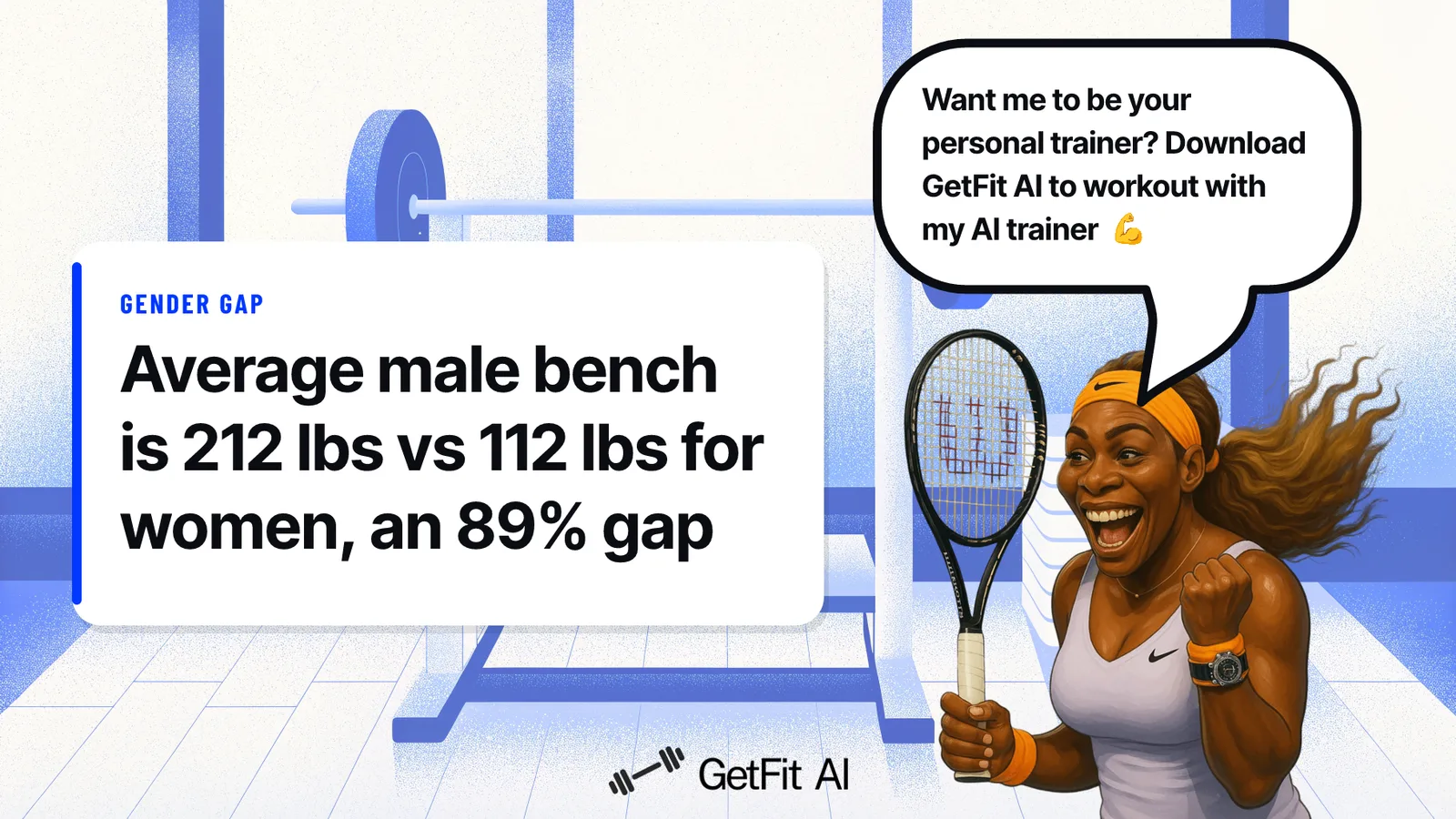
Strength standards for bench press split along sex lines more sharply than most gym-goers expect, and that gap has nothing to do with effort. According to Strength Level’s data, the average male bench press sits around 212 lbs while the average female bench press sits around 112 lbs, a difference of roughly 89%. Understanding why that gap exists, and where you fall within your own tier, changes how you read every number in the table below.
Why Men and Women Have Different Starting Baselines, Not Different Work Ethics
The physiological explanation is straightforward. Men carry a higher proportion of upper-body muscle mass relative to total bodyweight, driven primarily by testosterone’s effect on muscle fiber density and cross-sectional area. This is a baseline condition that exists before either person touches a barbell.
A woman who trains with the same consistency, volume, and intensity as a man of equal bodyweight will still produce a lower absolute number because her starting architecture is different. Comparing across sexes without adjusting for that baseline produces a false picture of where someone actually stands.
One of the most common struggles beginners face is falling behind a program that was never built for where they actually started. When a plan doesn’t adapt to the individual, people don’t gradually improve; they quietly quit, usually before week four. This is why a structured, adaptive approach matters from the very first session. GetFit AI’s Athlete-Style Custom Workout Plans are designed around this exact problem: the plan adapts to you rather than expecting you to catch up to it, removing the most common reason beginners abandon progress before it compounds. Structured training is most beneficial precisely when someone has previously struggled with consistency due to lack of program structure, and it begins working from the first workout session, shaping both each individual session and the overall training arc.
Male Bench Press Standards by Experience Tier
According to ExRx.net Bench Press Strength Standards’ bench press strength standards, male lifters in the 18-39 age range using a 198 lb bodyweight reference show the following approximate benchmarks: Beginner near 135 lbs, Novice near 175 lbs, Intermediate near 215 lbs, Advanced near 290 lbs, and Elite near 360 lbs.
These numbers shift with bodyweight. A 150 lb man reaches each tier at lower absolute weights. A 220 lb man reaches them higher. The tier is the meaningful unit. Knowing your tier also gives you a concrete, honest target, the kind of specific marker that keeps training purposeful past the initial motivation spike.
Accountability compounds that purposefulness. GetFit AI’s friends, challenges, and leaderboards are most beneficial once a user has connected with at least one friend in the app, and they function as the retention layer that keeps users training past week three, the window when most beginners stall. Having a workout partner who is also using GetFit AI amplifies this effect, turning a solo lift into a shared benchmark.
Female Bench Press Standards by Experience Tier
Using the same five-tier framework from Strength Level’s standards, women pressing at a 132 lb bodyweight reference land approximately here: Beginner near 50 lbs, Novice near 65 lbs, Intermediate near 85 lbs, Advanced near 115 lbs, and Elite near 145 lbs.
A woman pressing her bodyweight sits at an advanced tier by any credible standard. That is the equivalent relative achievement to a mid-sized man pressing well above 200 lbs, a milestone that would draw attention in any commercial gym. Reaching that tier is a matter of a plan that keeps adapting as you improve, session after session, so the program never outpaces the person following it.
GetFit AI’s Premium plans are built to support exactly that kind of long-arc progress: the Premium Weekly Subscription is available at $1.99 per week, the Premium Monthly Subscription at $4.99 per month, and the Premium Yearly Subscription at $49.99 per year, structured options that let you commit at whatever level matches where you are right now, with the adaptive programming in place from your very first session.
Related Reading
- Best Fitness Apps
- How Many Pull Ups Should I Be Able To Do
- Average Grip Strength Male
- Average Bench Press
- How Much Does A Bench Press Bar Weigh
- Average Male Bench Press
- How Much Can The Average Man Bench Press
- Grip Strength Chart
- Symmetric Strength
- Bench Press Standards
Bench Press Standards by Age: How the Numbers Shift From Your 20s to Your 50s
Your bench press number only tells part of the story. The part that actually matters is whether that number is appropriate for your age, because the standards shift meaningfully across decades, and holding yourself to the wrong benchmark leads either to misplaced confidence or unnecessary discouragement. This section breaks down how strength expectations change from your 20s through your 50s, why your late 20s to early 30s represent a critical window to build relative strength, and what the actual numbers look like for men and women across age groups.
Peak Strength Window
Your bench press doesn’t exist in a vacuum. A 185-pound lift means something very different at 27 than it does at 47, and treating those two lifters as if they’re working toward the same ceiling is how younger lifters get complacent and older lifters get discouraged. Age is one of the three variables that actually determines whether your bench press is where it should be.
Peak strength for most people lands in the late 20s to early 30s. That’s the window where testosterone, muscle fiber density, and recovery capacity converge at their highest combined output. If you’re 25 to 30 right now, you’re not just building toward your peak; you’re approaching it faster than it feels.
One thing that matters more than most lifters realize at this stage: relative strength. A 242-pound bench press on a 143-pound frame is the kind of number that turns heads, and rightly so, because it signals that absolute load isn’t the goal. Strength-to-bodyweight ratio is the benchmark that holds up across age groups, and chasing it early sets you up to stay competitive with your own standards as the decades accumulate. GetFit AI’s Athlete-Style Custom Workout Plans are built around exactly this principle, tracking your progress relative to your bodyweight from the first workout session so you’re always benchmarking against a standard that’s honest about where you actually are.
Age-Segmented Bench Press Standards for Men and Women
The table below draws from ExRx.net Bench Press Strength Standards and Strength Level’s data, using bodyweight-relative multipliers at the intermediate tier as the reference point.
Men: Ages 20-29, roughly 1.0-1.5× bodyweight. Ages 30-39, slightly below that upper range. Ages 40-49, approximately 0.85-1.2× bodyweight. Ages 50-59, approximately 0.75-1.1× bodyweight.
Women: Standards scale lower across all age groups due to upper-body muscle mass distribution, with intermediate-tier lifters in their 20s typically pressing 0.5-0.75× bodyweight and that range compressing gradually through the 40s and 50s.
A 28-year-old male at 175 pounds hitting 195 pounds on bench sits comfortably at intermediate. A 45-year-old male at the same bodyweight hitting 165 pounds is also at intermediate. Different absolute numbers. Same relative achievement.
There’s an important caveat at the upper end of these ranges: lifters who push aggressively toward 2× bodyweight presses, especially without balanced structural programming, face a meaningful shoulder injury risk that compounds with age. Raw strength without structural support is a long-term liability, and that risk becomes harder to manage the deeper into your 30s and 40s you go. GetFit AI’s Structured Training addresses this directly, building support and accessory work into the program arc across each workout session, not just the headline lifts.
What the Decade-by-Decade Decline Actually Looks Like
Strength doesn’t fall off a cliff. It erodes. Strength Level’s data and broader research consistently show upper-body strength declines roughly 10-15% per decade after age 30, with the rate accelerating modestly after age 50, though consistent training meaningfully slows that trajectory at every age.
The word consistent is doing a lot of work in that sentence. Lifters who’ve spent 8 or more years across mixed disciplines, strength training, team sports, endurance work, calisthenics, frequently find that varied, interrupted training histories make bench press milestones stubbornly hard to crack as they age. The physiology hasn’t failed them; the programming continuity has. This is exactly where GetFit AI’s Structured Training is most beneficial: for lifters whose consistency has been undermined by the absence of a coherent program structure, the Athlete-Style Custom Workout Plans provide a through-line that fragmented training histories never could, active from the first workout session, and built to evolve with you across the full program arc.
For lifters who want an added layer of accountability past the early weeks, GetFit AI’s friends, challenges, and leaderboards feature keeps the competitive signal alive, most effective once you’ve connected with at least one friend or workout partner also using the app, and consistently the mechanism that keeps users training past week three, when motivation alone tends to run out.
Bench Press Standards by Body Weight: How Much Should You Actually Be Lifting?
Strip away the universal “225 club” mythology, and a simpler truth emerges: the bar weight that makes a 135 lb lifter elite makes a 250 lb lifter a beginner. Absolute numbers lie. The bodyweight multiplier tells the truth.
Absolute numbers lie. The bodyweight multiplier tells the truth.
The Bodyweight Multiplier Framework
The multiplier framework is straightforward. Take your bench press max, divide it by your bodyweight, and you get a ratio that places you on a universal scale regardless of your size. The tiers work like this: beginners lift roughly 0.5x their bodyweight, intermediate lifters hit around 1.0x bodyweight, advanced lifters reach 1.5x, and elite lifters push 2.0x or beyond. A 160 lb person benching 160 lbs is genuinely intermediate. A 220 lb person benching the same 160 lbs is still a beginner. Same bar. Very different stories.
Raw lb comparisons quietly mislead people. A lifter who hits a plate milestone and feels strong may be performing below their own bodyweight multiplier for their experience level and never realize it because the gym culture around them celebrates the absolute number, not the ratio.
One of the most disorienting experiences beginners face is meeting a higher-tier standard in one movement, say, reaching a bodyweight bench press, while still falling below lower-tier standards in related pulling or pressing movements. The multiplier framework gives you an honest coordinate: this is where you actually stand on the bench. From there, a structured program can map the gaps. GetFit AI’s Athlete-Style Custom Workout Plans are built around exactly this, surfacing where your numbers genuinely sit across movements and building a training arc that closes the asymmetry, from the first workout session onward.
Technique is the other variable that absolute-number culture buries. Maintaining proper scapular retraction and depression throughout a heavy set, especially as fatigue accumulates across later reps, is one of the most common points of breakdown for lifters who are otherwise progressing on the multiplier scale. When structural factors like scoliosis are present, that challenge compounds further. Progress on a ratio chart built on compromised mechanics is fragile progress. During each workout session, GetFit AI’s Structured Training layer is designed to flag these form anchors as part of the overall program arc, not as a one-time cue buried in a warm-up.
The question “am I actually getting stronger, or just showing up?” is one we hear constantly, and the multiplier is the cleanest answer available. If your ratio is climbing, you are getting stronger. If your ratio is flat while your absolute numbers creep up only because your bodyweight is rising, that is a different signal entirely, and one worth acting on. GetFit AI tracks this continuously, which is why it functions as a retention layer that keeps users training past week three, the window where most lifters without program structure fall off.
Bodyweight Multiplier Standards Table
The figures below are drawn from Strength Level and StrengthLog, two of the most widely cited aggregators of real lifting data, covering real performance from first rep to elite territory for both men and women.
| Tier | Multiplier (Men) | Multiplier (Women) |
|---|---|---|
| Beginner | ~0.5x BW | ~0.35x BW |
| Novice | ~0.75x BW | ~0.5x BW |
| Intermediate | ~1.0x BW | ~0.65x BW |
| Advanced | ~1.5x BW | ~1.0x BW |
| Elite | ~2.0x BW+ | ~1.3x BW+ |
Women’s upper-body muscle mass distribution differs structurally from men’s, which is why the multipliers sit lower across every tier. That is a starting point for calibration.
Plate Milestones Decoded
The three numbers gym culture treats as universal checkpoints mean very different things depending on the person holding the bar. The 225 lb “plate club” that dominates gym-floor conversation sits at advanced territory for most people by bodyweight: a 160 lb lifter reaching 225 lbs is pressing 1.4 times their bodyweight, firmly in the advanced range. And 315 lbs, three plates per side, represents elite-level performance for the vast majority of the lifting population regardless of bodyweight, as both Strength Level and StrengthLog data consistently confirm.
These milestones are worth chasing, but they are worth chasing on your own multiplier timeline, not the one gym culture assigns universally. When the weights stop moving, and they will, the answer is almost never “lift more.” It is usually a program variable: volume, frequency, technique anchor, or nutrition timing. GetFit AI is built to break that plateau by telling you specifically why progress stalled and what to change, informed by where your ratio sits on the tier scale and what the data says about lifters at your level who pushed through the same ceiling.
Beginner vs. Advanced Bench Press Strength Levels Explained, and How to Know Where You Actually Stand
Most lifters carry a mental picture of where they stand that does not match where they actually stand, and that gap quietly kills progress. The tiers covered here are defined by accumulated adaptation and training age, not just the number on the bar, which means knowing your real tier changes how you train, not just how you label yourself. GetFit AI uses this same framework to assign loads that actually drive results rather than loads that just feel familiar.
The Five Strength Tiers Decoded: What Beginner Through Elite Actually Means in Training-Age Terms
The five tiers, beginner, novice, intermediate, advanced, and elite, are defined by training age as much as by the weight on the bar. A beginner is typically someone with fewer than six months of consistent training; a novice has six to eighteen months but no structured program. Intermediate lifters have usually trained for one to three years with deliberate progression. Advanced and elite status represent multi-year commitments with periodized programming, and they are genuinely rare in any commercial gym population.
Here is the part most charts skip: the tiers describe accumulated adaptation, not raw numbers in isolation. A 185 lb man benching 135 lbs after three years of gym attendance is not an intermediate lifter. He is a beginner who showed up for three years without a plan.
Why Most Lifters Overestimate Their Tier and How That Misread Kills Progress
The overestimation problem is consistent and well-documented. Lifters who train without structured progression tend to benchmark themselves against the people around them rather than against population-level data, which skews perception upward. The result: someone who has been “going to the gym” for two years calls themselves intermediate, loads a weight that is too light to drive adaptation, and wonders why nothing changes.
Incorrect load selection is the core mechanism behind most plateaus. When you train below the threshold needed to create a new stimulus, your body has no reason to adapt.
The Tier Label Tells You Where You Are, Not How to Move Forward
The common assumption is that if you can see the standard, you know what you are working toward, and that is enough to make progress. According to a 2022 study published in Behavioral Sciences by Soekmawati, Nathan, Victor, and Tan, awareness of an aspirational benchmark explains only a partial variance in actual behavioral follow-through. Knowing the standard does not automatically produce the behaviors needed to reach it.
That is the core insight the benchmark alone cannot deliver: identifying the target is the start. The next step is a session-by-session plan that translates the tier label into specific weights, sets, and rep targets, week over week, rather than treating it as a one-time data point.
Related Reading
- Do Pull Ups Work Chest
- Grip Strength Norms
- Average Deadlift Weight
- 1 Rep Max Chart
- Average Male Deadlift
- Weightlifting Standards
- Average Bench Press Kg By Age
- Average Deadlift Weight Kg
How to Improve Your Bench Press: The Structured Steps That Actually Move the Number
Knowing what a good bench press weight looks like is only half the equation; the other half is building a repeatable system that actually moves it. Without structure, most lifters end up recycling the same weights and rep ranges session after session, removing the very stimulus the body needs to get stronger. The steps below break down the mechanics behind real progress, and where GetFit AI fits into making that progress visible and intentional.
1. Progressive Overload: The One Mechanic You Cannot Skip If You Want a Good Bench Press Weight
Progressive overload is the non-negotiable engine behind any bench press improvement. Without it, your body has zero reason to adapt. As Transparent Labs noted in 2025, lifters who train without a plan tend to repeat the same weights and rep ranges session after session, which removes the stimulus the body needs to grow stronger.
One of the most common traps beginners fall into is believing that simply loading more weight each session is the path to progress. It isn’t. A lifter who has been on a structured program for nearly a year and is sitting at 70 lbs is not failing. They may be progressing exactly as their body allows, but that experience of stalled numbers breeds real self-doubt.
The fix is a structured system, not sheer willpower. For true beginners, adding 5 lbs to the bar each session across 3 sets of 5 reps is a proven starting point. When session-by-session jumps stop working, shift to weekly increments.
The progression has to be tracked, not guessed, and that distinction matters enormously when months of effort are on the line.
This is where GetFit AI’s Athlete-Style Custom Workout Plans earn their place. Rather than leaving you to eyeball whether last Tuesday’s session was harder than today’s, the Structured Training layer built into GetFit AI tracks your program arc from the very first workout session, making overload visible and intentional across every session. Beginners who have previously struggled with consistency due to lack of program structure find this especially valuable: the plan removes the guesswork that quietly kills progress before the lifter ever realizes it. The result is what every lifter actually wants: concrete evidence that they are getting stronger, not just showing up.
2. The Optimal Sets, Reps, and Frequency Blueprint for a Stronger Bench Press
For most lifters chasing a good bench press weight, 3-4 working sets of 5-8 reps for strength or 3-4 sets of 8-12 reps for hypertrophy, performed 2-3 times per week, is the evidence-supported sweet spot. Frequency matters because the bench is a skill as much as a strength movement. The common mistake is doing too many junk sets at easy weights rather than pushing close to failure on fewer, quality sets.
3. Form Fundamentals That Unlock Weight: Foot Drive, Scapular Retraction, and Bar Path
Three technique cues separate lifters who keep adding weight from those who stall and get hurt. Driving your feet into the floor creates full-body tension that transfers force to the bar. Retracting and depressing your scapulae protects the shoulder joint and creates a stable pressing platform. A slight diagonal bar path, from lower chest to lockout, keeps the lift mechanically efficient. Skipping these doesn’t just slow progress; it causes the shoulder and pec injuries that end training cycles entirely.
4. Why a Structured Program Converts a Bench Press Benchmark Into Actual Progress
Knowing your current bench press number is only useful if you have a plan to move it. Winging workouts, choosing weights by feel, skipping deloads, ignoring rep targets, is the single most common reason intermediate lifters plateau for months. A structured program pre-decides your loading, volume, and progression rules so you never walk into the gym guessing. The tradeoff is that following a program requires discipline to resist going heavier on good days and lighter on bad ones.
5. Deload Weeks and Recovery Cycles: The Structured Step That Protects Long-Term Progress
Every effective bench press program builds in planned deload periods, typically one lighter week every four to six weeks, where volume and intensity drop intentionally. Without them, accumulated fatigue masks real strength gains and stalls progress just as reliably as skipping progressive overload. Lifters who treat every session as a max effort eventually hit a wall they cannot push through. The limitation: deloads feel counterproductive in the moment, which is why undisciplined trainees skip them and pay for it later.
Stop Guessing Your Next Set: How a Structured Plan Turns Your Bench Press Benchmark Into a Moving Target
The benchmark number sitting in your notes right now tells you where you stand, not where to go or how fast to get there. Knowing you can do twelve pull-ups, or three, or zero, is genuinely useful data, but data alone has never added a single rep to anyone’s max. What converts a benchmark into progress is a sequence of decisions made correctly, week after week: which sessions to push, which to hold back, when to add load, when to let the body absorb what it has already taken. Most people treat the benchmark as an endpoint, something to beat whenever motivation peaks, and then the number sits unchanged for months because no structured system exists to build on it between those moments.
That stagnation is more common than most coaches admit. Beginners following structured programs like Push/Pull/Legs frequently hit a wall not because they are lazy or weak, but because no one has told them which exercises are truly necessary, in what order, or how to sequence load increases across weeks. The result is a kind of purposeful-looking randomness: showing up consistently, working hard, and still sitting at the same bench press weight for months. We see this pattern regularly, a lifter stuck at the same number for the better part of a year despite regular attendance, simply because “try to lift a little heavier each session” turns out not to be a plan. It is a guess dressed up as one.
A tier label tells you where you stand today. It says nothing about what weight to load next Tuesday, how many sets to run, or when to push for more. That gap is where progress dies. As DB Fitness Challenge puts it: “Most people train without a plan. They do random workouts, try different things, and hope it works. That’s why progress is slow, or stops completely.” The benchmark is real information. Without structure behind it, it stays decorative.
The Missing Variable: How Week-Over-Week Progression Actually Moves Your Bench Press Max
Progressive overload is the non-negotiable mechanic. Add load, volume, or density in a controlled sequence, and your 1RM climbs. Skip the sequence, and the body stops adapting, often within weeks of beginning training. Beginner lifters can gain meaningful strength per session during linear progression, but only when sets, reps, and load increases are prescribed in advance, not guessed at the bar.
Here is the synthesis that benchmark charts consistently obscure: knowing your tier is the weakest possible predictor of whether you will still be training in 90 days, yet it is the only output most tools provide. Eighty percent of gym-goers quit within three months, the same window where beginner gains should be fastest and easiest. Behavioral research confirms that identifying with a standard does not automatically internalize the behaviors needed to reach it. The ones who stay have a session-by-session system that removes the guesswork and keeps them in the gym long enough for the number on the chart to actually move. Life also intervenes: work schedules, competing obligations, stretches where training has to shrink, and a rigid program that can’t survive a disruption will stall progress just as surely as no program at all.
How a Structured Training Plan Converts Your Benchmark Into a Week-by-Week Program
Most lifters handle progression by piecing together YouTube videos and hoping the sequence makes sense. The hidden cost of that approach is session-to-session inconsistency in load and volume, which is one of the primary reasons beginners fail to progress despite regular attendance. The problem is the absence of a system that tells you exactly what to do in the gym today, which exercises, how many sets, in what order, so that each session builds deliberately on the last.
Industry research consistently finds that this is the specific problem GetFit AI’s Athlete-Style Custom Workout Plans are built to solve. Rather than handing you a generic template to interpret on your own, GetFit AI generates a custom plan at onboarding, immediately, before your first session, so there is no gap between knowing your benchmark and knowing what to do about it. From the very first workout, every session arrives pre-loaded with the exercises, sets, and sequence your benchmark data called for. Across the overall training program arc, that structure compounds: each week’s prescription is informed by what the previous week produced, which is precisely how linear progression is supposed to work and almost never does when lifters are self-programming on the fly.
Equally important is what happens when confusion or uncertainty surfaces mid-program, which it will. Beginners following any new protocol regularly hit moments where the right move is unclear: is this weight too light to be useful, or too heavy to recover from? Should a missed session be made up or skipped? GetFit AI keeps expert guidance accessible in those moments so the answer to uncertainty isn’t guessing or abandoning the program entirely. Structured training in GetFit AI is most beneficial for users who have previously struggled with consistency due to lack of program structure, and it operates continuously, functioning as the retention layer that keeps users training past the three-week mark where dropout rates spike.
For those ready to put this infrastructure behind their benchmark, GetFit AI’s Premium plans start at $1.99 per week (Premium Weekly), with a $4.99/month Premium Monthly option and a $49.99/year Premium Yearly plan for the full commitment. The custom plan is waiting at the other side of setup, no gap between your benchmark and your next prescribed session.
Related Reading
- Average Deadlift Weight For Male
- Best Calisthenics Workout App
- Best Hiit Workout App
- Best Gym Workout App
- Best Workout Apps
- Best Free Workout Apps
Bench Press FAQs: Quick Answers to the Questions You’re Googling Mid-Workout
Four questions dominate every beginner’s first Google session, so here are the direct answers, grounded in data rather than gym-floor mythology.
“Beginners frequently get stuck at a specific bench press weight plateau (e.g. 40kg) and don’t know why they can’t progress, making this a top FAQ trigger mid-workout.”
— what we hear from beginner weightlifters
Is 225 lbs a Good Bench Press
Short answer: yes, but it is far rarer than gym culture suggests, and the distortion carries a second-order cost that most lifters never recognize. The perception that it is “average” comes from social media, where only people hitting big personal records tend to post, making exceptional lifts look routine. But the more dangerous effect is this: because that number feels culturally normal, intermediate lifters who target it are effectively targeting a milestone that sits at the advanced-to-elite range relative to their bodyweight, unless they are already a large-framed man.
5 times bodyweight, which lands squarely in the advanced tier. The cultural framing makes that number feel like a floor you should already be standing on, when it is actually a ceiling worth chasing. That gap between perception and reality is what systematically undervalues the real progress required and sets lifters up for the psychological frustration of feeling “still not average” long after they have built genuinely advanced strength.
How Much Should a 150 lb Man Bench Press
A 150 lb man at the beginner level should expect to bench somewhere between 95 and 135 lbs. Intermediate lifters at that bodyweight typically land between 150 and 175 lbs. These ranges align with bodyweight-relative standards used across major strength classification systems, where a true beginner sits near 0.65 times bodyweight and an intermediate sits near 1.0 to 1.1 times bodyweight, meaning a 150 lb man pressing 150 to 165 lbs has reached a genuinely intermediate standard by any major classification.
Next steps
If your bench press number has been sitting unchanged for months despite regular attendance, the path forward starts with treating that benchmark as a diagnostic gap, not a verdict. A standard built on bodyweight multipliers tells you the distance to the next tier. It cannot tell you whether the limiter is technique, volume, or programming, which is why most lifters walk back into the gym doing the exact same thing after checking a chart. Start with our AI fitness app.
Eighty percent of gym-goers quit within three months, the same window where beginner gains should be fastest. Behavioral research confirms that identifying with a standard does not automatically produce the behaviors needed to reach it. Those two facts point to the same conclusion: the missing variable is a session-by-session system that removes the guesswork before you ever unrack the bar.
Start with GetFit AI. A custom plan generates at onboarding, before your first session, so there is no gap between knowing your benchmark and knowing exactly what weight to load next Tuesday.
Frequently Asked Questions
Is 225 lbs a good bench press?
It depends entirely on your sex, age, and bodyweight, the three filters the post identifies as essential. For a 150 lb man in his 20s, 225 lbs is well into advanced territory. For a 220 lb man in the same age group, that same 225 lbs sits near the intermediate tier. The absolute number only becomes meaningful once you run it through the bodyweight multiplier for your specific profile.
Is 135 lbs a good bench press?
It can be an impressive achievement or a modest warm-up depending entirely on who is lifting it. For a 135 lb lifter, pressing 135 lbs represents a genuine intermediate milestone, a 1.0x bodyweight ratio. For a 220 lb lifter, that same 135 lbs sits below the beginner threshold. The post makes clear that a single universal verdict on 135 lbs is essentially meaningless without knowing the lifter’s bodyweight, sex, and age.
How much should a 150 lb man bench press?
According to the post, bodyweight multipliers are the most honest guide: a 150 lb man at the intermediate tier should be pressing around 1.0x his bodyweight, or roughly 150 lbs. Beginner territory starts near 0.5x bodyweight (about 75 lbs), advanced sits around 1.5x (about 225 lbs), and elite pushes 2.0x or beyond (300 lbs+). The post also notes that absolute tier thresholds shift lower for lighter men compared to the 198 lb bodyweight reference used in standard tables.
Does your bench press standard change as you get older?
Yes, meaningfully. Peak strength lands in the late 20s to early 30s, and upper-body strength declines roughly 10-15% per decade after age 30, with the rate accelerating modestly after 50. The post gives a concrete example: a 28-year-old male at 175 lbs hitting 195 lbs and a 45-year-old male at the same bodyweight hitting 165 lbs are both at the intermediate tier, different absolute numbers, same relative achievement.
What are the key factors that determine whether my bench press is actually good?
The post identifies three essential filters: sex, age, and bodyweight. Strip any one of them out and the number becomes almost meaningless. Beyond those three variables, the post also flags technique, specifically maintaining proper scapular retraction and depression under fatigue, as a factor that can make ratio-based progress fragile if the underlying mechanics are compromised.