How Many Pull Ups Should I Be Able To Do by Age
Most adults can’t do a single strict pull-up, and the benchmarks you’ve been measuring yourself against were never built for you. Here’s what the numbers actually mean, and where you genuinely stand.
Before you look up a pull-up standard, it helps to know where most people actually start. Not gym regulars. Not athletes. Just the average adult who walks up to a bar cold, grabs it, and pulls. The number is lower than almost anyone expects, and understanding that gap is what makes the benchmarks in this article useful rather than demoralizing. If you have been wondering whether your current rep count means something is wrong with you, an AI fitness trainer can put that number in context and suggest a structured next step based on your current rep count.
See our AI fitness app for how this works in practice. Most people assume a reasonably fit adult should knock out ten pull-ups without much effort. Broader population surveys consistently show that only 15 to 25 percent of the general population can complete even a single strict pull-up. That means the vast majority of untrained adults cannot do one rep.
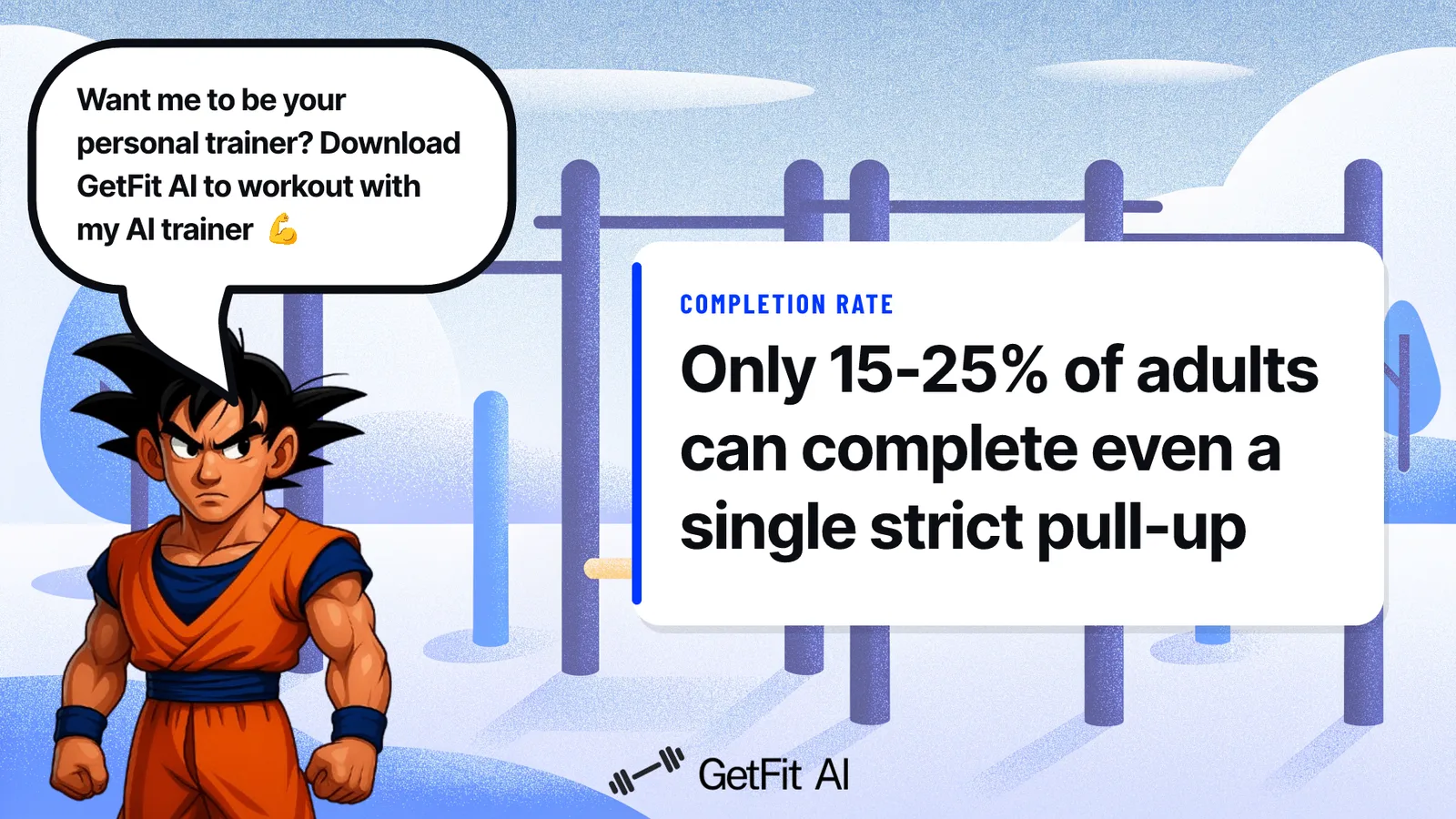
The person who can’t do a pull-up is the overwhelming majority. The gym mythology of “ten reps is easy” is built on survivorship bias: you’re comparing yourself to the subset of people who already train, not to the general population. Across the general adult population, most untrained adult men manage 0 to 2 strict pull-ups, and most untrained adult women manage zero.
Key takeaways
- The average untrained adult can do fewer pull-ups than almost anyone expects, knowing that baseline is what makes age-based benchmarks useful instead of demoralizing.
- Tiered standards exist for men and women across every fitness level, from untrained to elite, so you can locate your actual position rather than compare yourself to a gym highlight reel.
- Two people can train identically for six months and land at wildly different rep counts, body composition, scapular control, and grip mechanics explain the gap more than effort does.
- Three exercises, sequenced deliberately over eight to twelve weeks, are enough to get someone from zero pull-ups to their first clean rep, the list is short; the consistency requirement is not.
- Training to failure every session stalls progress fast because CNS fatigue accumulates faster than muscle recovery, leaving you depleted before the next session even starts.
- A pull-up standard tells you where you rank on a static snapshot, it cannot tell you whether to train or rest tomorrow, where your form breaks down, or whether you need more volume or more recovery.
- GetFit AI closes that gap by building a custom pull-up progression plan around your actual numbers and schedule, with an AI trainer available anytime to adjust the plan as your capacity changes.
Pull-Up Standards by Fitness Level and Age: The Benchmarks You’re Actually Searching For
Most pull-up standards floating around online are either vague, outdated, or built for competitive athletes with no relevance to where you actually stand. What follows cuts through that with tiered benchmarks for men and women across every fitness level, plus age-adjusted targets that account for how performance realistically shifts from your 20s through your 50s. Whether you’re logging your first dead-hang rep or chasing an elite number, these are the reference points worth measuring yourself against.
The Full Tiered Pull-Up Standards Table, Men and Women, Untrained to Elite
According to Ativafit’s 2026 benchmarks, the rep ranges break down like this across fitness levels:
“People feel that proposed pull-up and strength standards (12-15 strict pull-ups, 2.25× BW deadlift, etc.) are unrealistic for the average person, especially in a survival/prepping context.”
— what we hear from survival and prepping communities
| Fitness Level | Men (reps) | Women (reps) |
|---|---|---|
| Untrained | 0-2 | 0 |
| Beginner | 3-6 | 1-3 |
| Intermediate | 7-12 | 4-7 |
| Advanced | 13-20 | 8-11 |
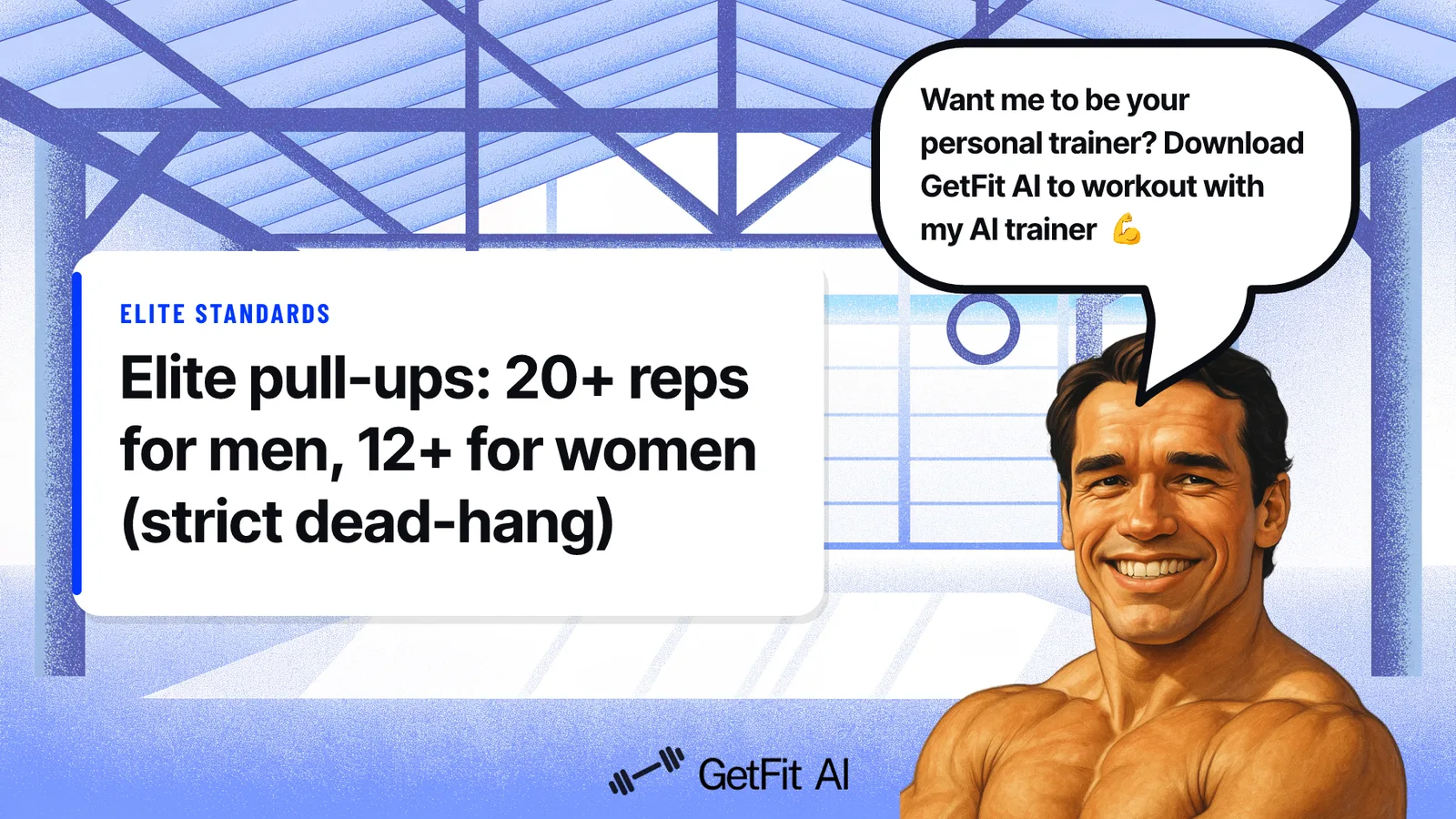
| Elite | 20+ | 12+ |
These are strict, dead-hang pull-ups. No kipping, no momentum. If you’re measuring yourself against this table, that distinction matters more than people admit.
How Pull-Up Standards Shift by Decade: What Good Actually Looks Like in Your 20s, 30s, 40s, and 50s
Peak performance lands in the 20s. According to Ativafit’s age-segmented data, men in their 20s can target 13-20 reps to hit the advanced tier. Men in their 30s see a modest but real drop, with intermediate becoming the realistic high-performance benchmark for most. By the 40s, landing in the solid intermediate range (7-12) represents genuinely strong relative performance. Men 50 and older benchmark well at beginner-to-intermediate levels, and that is physiology.
Women follow a parallel shift across the same decades. A woman in her 20s hitting 8-11 reps sits in the advanced tier. That same number in her 40s is exceptional. The tier you occupy means different things depending on which decade you’re in, and comparing yourself to a 22-year-old’s benchmark when you’re 38 is a reliable path to feeling worse about genuine progress.
The Practical Fitness Baseline Most People Should Actually Aim For First
Ativafit’s data sets a clear intermediate fitness baseline: 10-15 strict pull-ups for men and 3-8 for women. That range is the honest, practical target for someone who trains consistently but isn’t chasing elite performance.
For most people reading a pull-up standards article, intermediate is the right first destination. It’s the tier where real functional strength lives. A 32-year-old man doing 8 pull-ups sits solidly in intermediate territory, with a clear, measurable gap to the advanced threshold at 13 reps. That gap is a training problem, not a talent problem.
Is 20 Pull-Ups Good? What That Rep Count Actually Means by Fitness Level
Twenty pull-ups places a man firmly in the elite tier.
Related Reading
- Best Fitness Apps
- Average Grip Strength Male
- Average Bench Press
- How Much Does A Bench Press Bar Weigh
- Average Male Bench Press
- How Much Can The Average Man Bench Press
- Grip Strength Chart
- Symmetric Strength
- Bench Press Standards
What Actually Affects Pull-Up Performance: Beyond Just ‘Being Strong Enough’
Two people can train side by side for six months, eat the same meals, and show up with the same intensity, yet one walks away with 10 clean pull-ups and the other stalls at 4. That gap feels like a character verdict. It isn’t. The common assumption is that once you know how many pull-ups you should be able to do, you’ll know what to work toward and the reps will come, as if a target number is all that stands between you and the bar.
Pull-up performance factors go well beyond willpower. Body mass, arm length, and biological sex each impose hard physical constraints that effort alone cannot override. Understanding them doesn’t lower the bar; it tells you why your bar is exactly where it is.
Strength-to-Weight Ratio: The Primary Variable
Strength-to-weight ratio is the single biggest determinant of pull-up rep count. According to BULLBAR’s June 2024 analysis, a 150 lb person finds pull-ups measurably easier than a 250 lb person of the same height, even when absolute strength levels are similar, because there is simply less mass to move against gravity. The physics are indifferent to effort.
This is the frustration that heavier lifters feel when a lighter training partner breezes past them on the bar despite identical gym experience. It’s a load gap.
Long Arms: A Built-In Mechanical Disadvantage
Arm length compounds the problem. BULLBAR’s 2024 breakdown notes that longer arms create a greater range of motion per rep, meaning more total work is done every time you pull. Two people with identical pulling strength will produce different rep counts if one has a meaningfully larger wingspan.
Men vs. Women: Anatomy, Not Ambition
The gender gap in pull-up standards reflects biology, not effort. In BULLBAR (2024), men possess roughly 40% more upper-body muscle mass than women, a figure corroborated by a 2013 study in the International Journal of Sports Physical Therapy.
Key takeaway: Strength-to-weight ratio, arm length, and biological sex all impose hard physical limits on pull-up rep counts; effort alone cannot override them.
What to Do If You Can’t Do a Single Pull-Up Yet: The Progression Path That Actually Works
Three exercises stand between you and your first pull-up. Not thirty. Not a gym membership upgrade. Just three movements, sequenced deliberately, repeated consistently across eight to twelve weeks, and according to BULLBAR’s June progression guide, that window is realistic for most beginners who train with structure rather than hope.
But here is the claim worth stating plainly before you touch a bar: the conventional beginner progression only works when it targets your specific weak link, and because grip strength, scapular stability, and lat recruitment each fail independently, following a generic sequence without diagnosing your personal bottleneck can keep you stuck at zero reps for months. Grip strength, scapular stability, and lat recruitment each fail independently, so the fastest path to a first pull-up is identifying which neuromuscular pattern is missing and building volume around that gap.
Dead Hangs First: The Grip and Shoulder Foundation You Can’t Skip
Dead hangs are not a warm-up filler. They are the entry point. Gripping the bar and holding your full bodyweight, even passively, builds the grip endurance and scapular stability that every pulling movement demands. Without that foundation, your hands give out before your lats ever get a real training stimulus, and the set ends early for the wrong reason.
Here is how to progress through dead hangs before moving on:
-
Start with several sets of short holds, resting fully between sets.
-
Progress to longer holds until hangs feel controlled.
-
Move on only once scapular stability feels solid overhead.
BULLBAR’s research confirms that dead hangs establish the shoulder stability required before any pulling movement can be attempted. Skipping them delays the first rep. If hangs are where you consistently fail, that is diagnostic information: grip and scapular control are your bottleneck, and no amount of row volume will fix it.
Bodyweight Rows: Your Primary Strength Builder When the Bar Is Still Out of Reach
Progress to bodyweight rows once your hangs feel controlled. The setup is simple: a bar set at hip height, body angled underneath it, heels on the floor. You pull your chest to the bar, lower slowly, repeat.
These are not a consolation prize. BULLBAR identifies bodyweight rows as the primary strength-builder for beginners, training the lats and biceps through a horizontal pulling pattern that directly bridges the gap to a vertical pull. Steepen your body angle to make them harder as you get stronger. Aim for multiple sets of moderate reps, and treat the last few reps of each set as genuinely difficult.
Related Reading
- Do Pull Ups Work Chest
- Grip Strength Norms
- Average Deadlift Weight
- 1 Rep Max Chart
- Average Male Deadlift
- Good Bench Press Weight
- Weightlifting Standards
- Average Bench Press Kg By Age
- Average Deadlift Weight Kg
How Many Sets and Reps of Pull-Ups Should You Do to Actually Improve?
Grinding out pull-ups to failure every session feels productive. It is not.
Why “Do As Many As You Can” Stalls Progress Fast
The instinct makes sense: if you want more reps, push for more reps. But training to failure every session spikes central nervous system fatigue faster than your muscles can recover. The result is a body that shows up to the next session already depleted, which means the quality of every set drops, total weekly volume drops, and the rep count stops moving.
This is one of the most common traps beginners fall into: logging the same number week after week, convinced they just need to “push harder,” when the actual fix is the opposite. And the confusion runs deeper than effort. Many people genuinely don’t know whether their current volume is actually enough to drive improvement, or whether they should be training for strength, hypertrophy, or endurance in the first place. Without clear answers to those questions, even hard work spins in place.
The core insight here is this: your pull-up max is a test, not a training strategy. The actual drivers of improvement are total weekly pulling volume distributed across multiple sessions and sets pushed close enough to failure to force adaptation, but not so close that recovery collapses. Most people do neither: they treat every session as a performance test, stop well short of failure, and then wonder why their number hasn’t moved in months. Frequency and proximity to failure are the two variables that actually move the needle; rep-count goals set neither.
your pull-up max is a test, not a training strategy, the actual drivers of improvement are total weekly pulling volume distributed across multiple sessions and sets pushed close enough to failure to force adaptation, but not so close that recovery collapses.
According to Schoenfeld et al. ‘Loading Recommendations for Muscle Strength, Hypertrophy, and Local Endurance: A Re-Examination of the Repetition Continuum’, Sports, proximity to failure matters, but sets that stop short of absolute failure by one or two reps still drive meaningful strength adaptation while preserving your ability to train again in 48 hours. More quality sets across the week beats one all-out session every time.
This is exactly the kind of decision GetFit AI’s Athlete-Style Custom Workout Plans are built to remove from your plate. Instead of walking into the gym wondering which exercises to do, how many sets, and in what order, GetFit AI’s structured training gives you a precise daily prescription, exercise selection, set-and-rep targets, and session sequencing, derived from your current ability tier and your goal (strength, hypertrophy, or endurance). Structured training is most valuable precisely when a lack of program structure has caused you to stall or quit before, and it kicks in from your very first workout session.
Set-and-Rep Prescriptions by Current Ability Tier
Your starting point determines the structure.
If you can do 3 to 5 reps, aim for 4 to 5 sets of 2 to 3 reps per session, stopping well before your limit. This low-rep, multi-set approach protects recovery while still accumulating the pulling volume that beginners, who often have no roadmap for where to start, need most. If you are in the 6 to 10 rep range, 4 sets of 4 to 6 reps with 90-second rest periods gives you enough volume to drive adaptation without burying recovery. At 10 or more reps, shift toward 3 to 4 sets of 6 to 8 reps and focus on controlled tempo rather than raw rep counts. The goal at every tier is the same: accumulate quality pulling volume, not exhaustion.
GetFit AI’s workout execution and logging features make this structure actionable in real time. During each session, you log your sets and reps as you go, which means the app tracks whether your weekly pulling volume is actually moving in the right direction, not just whether you felt tired afterward. That ongoing visibility across the overall training program arc is what separates structured progression from guesswork.
The Reps-in-Reserve Rule
Leaving one or two reps in the tank is not going easy. Schoenfeld et al. ‘Loading Recommendations for Muscle Strength, Hypertrophy, and Local Endurance: A Re-Examination of the Repetition Continuum’, Sports confirm that stopping 1 to 2 reps short of failure produces strength and hypertrophy outcomes statistically comparable to training to absolute failure, while keeping recovery intact so you can hit the bar again in 48 hours. Additional evidence from Schoenfeld et al. in Sports Medicine - Open reinforces that volume accumulated across multiple quality sessions, rather than a single maximal effort, is the more reliable driver of long-term pulling strength.
The practical takeaway: end every working set thinking I had one more in me. That discipline, applied consistently across every session and logged in GetFit AI so you can see the volume accumulate, is what finally moves the number.
Why Knowing Your Pull-Up Number Still Won’t Move the Needle, and What Actually Does
A pull-up standard tells you your position on a static snapshot. It cannot tell you whether to train tomorrow or rest, whether your scapular depression is failing at rep four, or whether you need more volume or more recovery. Knowing a fitness target without a daily actionable prescription tied to it causes most people to stall and eventually abandon their training entirely. The number feels like progress. It is not.
From Pull-Up Standard to Pull-Up Progress: Why You Need a System, Not Just a Number
The gap is structural. A benchmark is a photograph; a pull-up progression system is a film reel that keeps shooting every session, adjusting frame by frame. Research consistently shows that structured progressive overload, where load, volume, and intensity shift session by session in response to actual performance, produces measurably better strength gains than ad-hoc training. Hitting six reps, checking the intermediate benchmark, feeling satisfied, and repeating the same session for three weeks is not a plan. It is a plateau with good intentions attached.
How to Close the Gap Between Your Current Pull-Up Count and Your Target
Across the market, the 20% of gym-goers who actually improve share one structural trait: they follow a system that tells them exactly what to do next every day. An AI fitness app like GetFit AI converts a static benchmark into a living, adaptive training plan, adjusting volume, exercise selection, and session intensity based on what you actually did last time, so the program evolves with your performance rather than staying frozen at the rep count you logged on day one.
Related Reading
- Average Deadlift Weight For Male
- Best Calisthenics Workout App
- Best Hiit Workout App
- Best Gym Workout App
- Best Workout Apps
- Best Free Workout Apps
Next steps
If looking up a pull-up standard left you knowing where you rank but with no idea what to do at the bar tomorrow, the path forward starts with recognizing that a benchmark is a photograph, not a film reel. It tells you the destination. It gives you nothing about the route. Start with our AI fitness app.
Two findings from this article make that gap concrete. First, because grip strength, scapular stability, and lat recruitment each fail independently, following a generic progression without identifying your personal bottleneck can keep you stuck at zero reps for months while the actual problem goes unaddressed. Second, because total weekly pulling volume and proximity to failure are the variables that actually drive adaptation, treating every session as a performance test rather than a structured training stimulus is why most people’s rep count stops moving. Taken together, those two points point to the same conclusion: you need a plan built around your specific numbers, not borrowed from someone else’s results.
Start by building that plan through the AI fitness app. After a short onboarding, you get a specific daily prescription, including movement selection, set and rep targets, and progression triggers, generated before your first session so you walk in with a plan already in hand, not a blank page.
Frequently Asked Questions
Why are pull-ups so hard even for people who work out regularly?
Pull-up performance is driven primarily by your strength-to-weight ratio, the more mass you have to move against gravity, the harder each rep becomes, regardless of how strong you are in absolute terms. Arm length compounds this: longer arms mean a greater range of motion per rep, so more total work is done every single pull. These are hard physical constraints that effort alone cannot override.
Is it normal to not be able to do a single pull-up?
Yes, it’s actually the statistical norm. Only 15 to 25 percent of the general population can complete even one strict pull-up, which means the vast majority of untrained adults cannot do a single rep. Most untrained adult men manage 0 to 2 strict pull-ups, and most untrained adult women manage zero.
How many pull-ups should I be able to do for my age?
Peak performance lands in your 20s, where the advanced tier for men is 13-20 reps and for women is 8-11 reps. In your 30s, intermediate becomes the realistic high-performance benchmark for most men. By your 40s, landing in the solid intermediate range of 7-12 reps represents genuinely strong relative performance, and men 50 and older benchmark well at beginner-to-intermediate levels, the tier you occupy means different things depending on which decade you’re in.
Why does my pull-up count stay the same no matter how hard I try?
Training to failure every session is the most common culprit, it spikes central nervous system fatigue faster than your muscles can recover, so the quality of every subsequent set drops and total weekly volume drops with it. Research from Schoenfeld et al. confirms that stopping 1 to 2 reps short of absolute failure produces comparable strength and hypertrophy outcomes while keeping recovery intact, and that volume accumulated across multiple quality sessions is a more reliable driver of long-term pulling strength than a single all-out effort.
What’s a realistic first pull-up goal if I currently can’t do one?
According to BULLBAR’s 2024 progression research, most beginners who train with structure rather than hope can achieve their first pull-up within an eight-to-twelve week window using three deliberately sequenced exercises: dead hangs to build grip endurance and scapular stability, bodyweight rows as the primary strength-builder, and then progressing to the bar itself. The key is diagnosing your specific weak link, grip strength, scapular stability, and lat recruitment each fail independently, rather than following a generic sequence that doesn’t target your personal bottleneck.







