Average Deadlift Weight Standards by Age, Sex, and Level
The average deadlift number you found online was not built for you. Here is how to find the standard that actually matches your weight, experience, and goals.
Most people searching for deadlift numbers want a simple answer: am I normal, or am I behind? The common assumption is that knowing the number on the chart is enough. Once they see where they should be, they’ll figure out how to get there on their own. The headline figures look clean enough. According to Strength Level’s 2024 database, the average deadlift 1RM sits at 340 lb for men and 200 lb for women. Write those down, compare them to your last pull, and you have your verdict. Except you don’t. See our AI fitness app for how this works in practice.
“I’m unsure what ‘average’ or ‘intermediate’ deadlift weight actually means for my specific body weight, age, and training background. It really highlights the core measurement confusion around these standards.”
— what we hear from weightlifters and fitness enthusiasts
Those figures come from nearly 23 million logged lifts recorded since 2014, as reported by Strength Level (2024). That sounds like a broad, representative sample.
It isn’t. Every lift in that dataset was submitted by someone who actively tracks their training, which is a very specific kind of person. Not the guy who deadlifts occasionally between cardio sessions. Not the woman who tried it twice and went back to the cable machines. Active, motivated, data-logging lifters only. Strength Level (2024) acknowledges that the dataset excludes the untrained and casual gym-going population entirely.
The result is an average that reflects dedicated athletes, then gets presented to beginners as a universal standard. That gap between who generated the number and who reads it is where the confusion starts. Deadlift capacity varies significantly by body weight, sex, and experience level. Strength Level breaks standards down across all three dimensions precisely because a single blended average is too coarse to be useful for any individual. A 140 lb woman and a 220 lb man are not competing against the same benchmark, even if they train with identical frequency and intent.
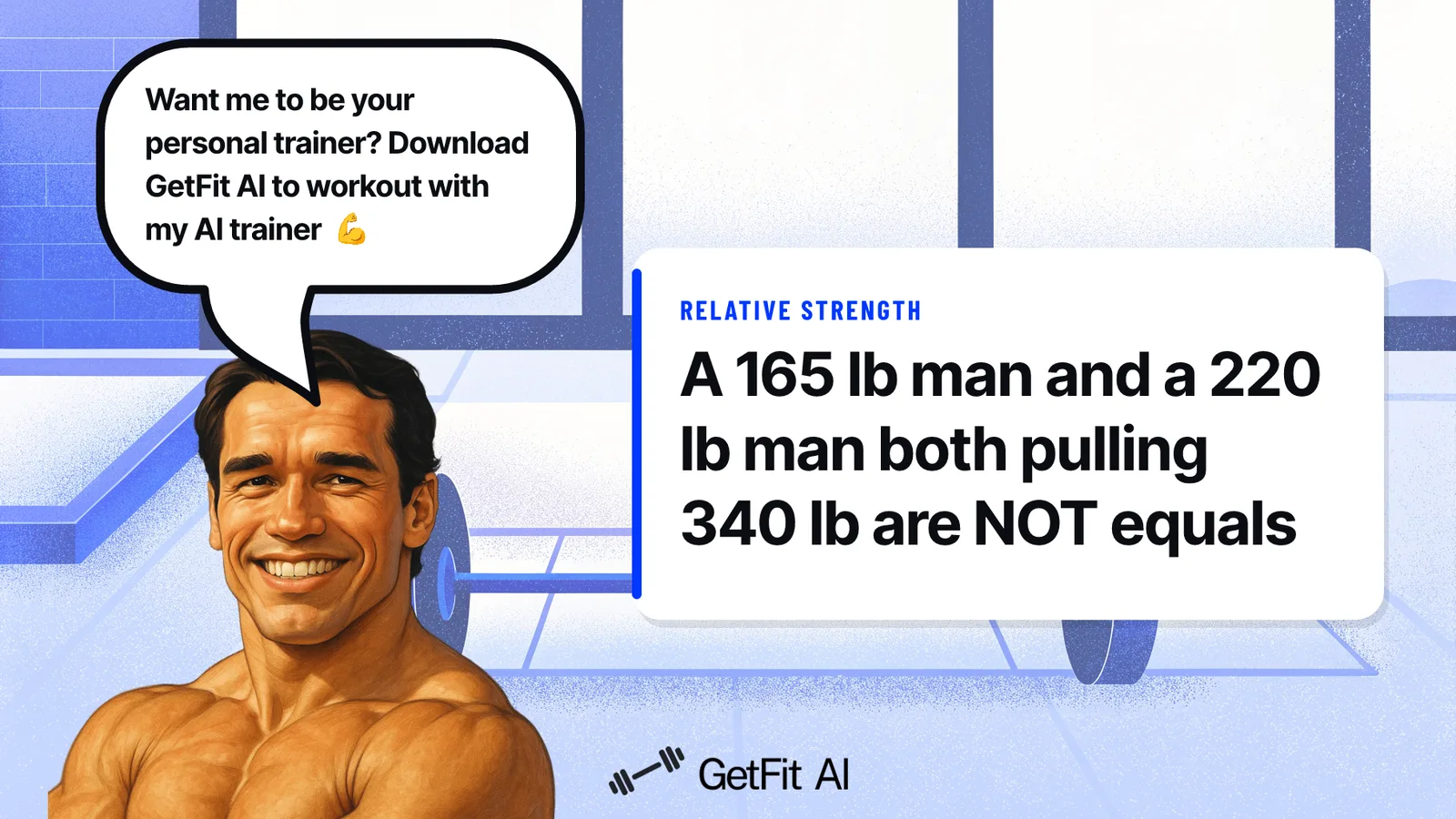
Dimension 2: Body Weight A 340 lb average means almost nothing without knowing the body weight of the person who pulled it. Strength Level’s (2024) own classification tables make this explicit: a 165 lb man lifting 340 lb is performing at roughly an intermediate level, while a 220 lb man lifting the same weight is classified as a novice. The absolute number is identical. The relative standard differs. This is why every serious strength framework, from Symmetric Strength to the older Rippetoe tables, anchors its classifications to body weight multiples rather than raw poundage.
Collapsing all of that into a single headline figure strips out the one variable that most directly determines whether a given lift represents genuine progress or an easy baseline cleared without meaningful effort.
Dimension 3: Training Age The third variable the headline figure ignores is how long someone has been training, and it is arguably the most consequential one for setting realistic short-term targets. A lifter six months into their first structured program operates under entirely different physiological constraints than someone with four years of consistent pulling behind them. Strength Level (2024) separates its classifications into five tiers, beginner, novice, intermediate, advanced, and elite, precisely because the rate of strength development is not linear and the gap between tiers widens substantially as training age increases.
A beginner male at 185 lb body weight might be expected to pull around 185 to 225 lb after their first few months of training. That same lifter at two years in, assuming consistent programming and adequate recovery, should be approaching 315 to 365 lb to sit at an intermediate classification.
The numbers are not arbitrary. They reflect the documented curve of neuromuscular adaptation, where early gains come quickly from motor learning and later gains require accumulated volume, progressive overload, and time under tension measured in years rather than weeks. Presenting a single average to a six-month lifter and a three-year lifter simultaneously produces two completely different errors: the beginner feels discouraged by a standard they are not yet physiologically equipped to meet, while the experienced lifter may feel falsely comfortable sitting at a number that represents underperformance relative to their actual training history.
Key takeaways
- The average deadlift 1RM sits at 340 lb for men and 200 lb for women, but that number is meaningless without knowing the lifter's bodyweight, age, and experience level.
- Bodyweight multipliers are more useful than raw pound tables: a 185 lb deadlift signals something completely different on a 130 lb frame versus a 220 lb frame.
- Experience tier matters more than the headline average, the gap between a beginner and an intermediate lifter is often larger than the gap between intermediate and advanced.
- Peak strength typically lands in the mid-20s, but age-adjusted standards show that meaningful progress is achievable well into your 40s and 50s with the right programming.
- Stalling at the same deadlift for months is almost never a willpower problem, it's a planning problem caused by training without structured load, frequency, or progression adjustments.
- GetFit AI's Structured Training closes that gap by delivering workouts as a coherent program progression, not random exercises, so every session is telling you exactly what to do next to move up the chart.
Related Reading
- Best Fitness Apps
- How Many Pull Ups Should I Be Able To Do
- Average Grip Strength Male
- Average Bench Press
- How Much Does A Bench Press Bar Weigh
- Average Male Bench Press
- How Much Can The Average Man Bench Press
- Grip Strength Chart
- Symmetric Strength
- Bench Press Standards
Deadlift Standards by Sex: Men vs. Women Benchmarks Across Every Level
Deadlift standards look very different depending on whether you are male or female, and raw pound targets alone rarely tell you where you actually stand. This section uses bodyweight multipliers to give you benchmarks that apply regardless of your size, so you can place yourself on the spectrum from beginner to advanced without needing to find a table built for someone your exact weight. Understanding where you fall also makes it easier to identify when a structured program, rather than random effort, is what your progress actually needs.
Why Bodyweight Multipliers Beat Raw Pound Tables for Both Sexes
Raw pound tables have a fundamental flaw: a 185 lb lift means something completely different depending on whether the person holding the bar weighs 130 pounds or 220 pounds. Bodyweight multipliers fix that instantly, turning any deadlift number into a self-applicable signal rather than an abstract figure you have to mentally translate every time you look at a chart.
According to BarBend’s deadlift standards, the intermediate male standard is 1.50-1.75 times bodyweight and the intermediate female standard is 1.25 times bodyweight. Those ratios travel with you regardless of what you weigh. A raw pound table anchored to a 170 lb man tells a 145 lb man almost nothing useful. A multiplier tells everyone exactly where they stand the moment they do the division.
One of the most common frustrations among lifters we work with at GetFit AI is hitting an extended plateau, the weights stop moving and it is genuinely unclear what to change. That uncertainty is where a structured training system earns its keep. GetFit AI’s Athlete-Style Custom Workout Plans are most beneficial for lifters who have previously struggled with consistency due to lack of program structure, and they engage from the very first workout session, adjusting across the overall training program arc so the plan evolves as your numbers do. When plateaus appear, the program surfaces the specific variables, volume, frequency, loading pattern, that need to change, rather than leaving you to guess.
Men’s Deadlift Standards by Level: From 0.75x to 3x Bodyweight
BarBend places beginner men at roughly their bodyweight or slightly below, which works out to approximately 135 to 175 lb for a 170 lb man. Novice territory sits around 1.25 times bodyweight, putting a 170 lb man near 215 lb. That 225 lb pull is solidly novice, which surprises a lot of lifters who assume two plates is a meaningful milestone.
Intermediate men land at 1.5 to 1.75 times bodyweight, roughly 255 to 300 lb for that same reference body. Advanced lifters clear 2.0 times bodyweight, and elite or competitive lifters reach 2.25 to 3.0 times bodyweight or beyond. Strength Level’s database of nearly 23 million logged lifts reports the average deadlift across all male users at 340 lb, a figure that aligns closely with the upper intermediate range. Critically, that 340 lb headline is the average of self-reported lifts from people already motivated enough to track their training, so a casual gym-goer who falls short of it is measuring themselves against a self-selected pool of consistent, engaged lifters.
Consistency past the early weeks is where most lifters quietly drop off. GetFit AI’s friends, challenges, and leaderboards feature addresses this directly, it is most powerful once you have connected with at least one friend in the app, and it functions as the retention layer that keeps users training past week three, precisely the window when novelty fades and accountability becomes the deciding factor.
Women’s Deadlift Standards by Level: From 0.5x to 2.5x Bodyweight
Beginner women start at 0.5 to 0.75 times bodyweight. For a 140 lb woman, that is approximately 85 to 115 lb. A 140 lb woman pulling 95 lb is right at the beginner standard, not behind it. BarBend corroborates this range, citing beginner female standards beginning at roughly 0.5 times bodyweight, a benchmark that makes clear how often beginners underestimate how much progress they have already made.
For lifters at any of these levels who want a structured path from one standard to the next, GetFit AI’s Athlete-Style Custom Workout Plans provide session-by-session guidance from day one. Plans are available under the Premium Weekly Subscription at $1.99 per week, the Premium Monthly Subscription at $4.99 per month, or the Premium Yearly Subscription at $49.99 per year, so structured training is accessible at whatever commitment level makes sense right now.
Deadlift Standards by Experience Level: Beginner to Elite Progression
The tier system built by strength researchers gives you that precise language, and it cuts through the vague “I’ve been going for a while” self-assessment faster than any mirror check. One of the most consistent struggles lifters face is finding the standards in the first place. The benchmarks exist across multiple sources, but without a consolidated, authoritative reference, progress feels subjective and self-assessed by feel rather than fact. Gym time logged and strength earned are two different things, and that gap is what keeps a lifter training for a year while their deadlift sits completely unmoved.
Knowing your tier tells you where you stand; it doesn’t explain why the number stopped moving or what it will take to push it to the next level. That’s the plateau problem, and it is the most important question this section exists to answer: why did the weight stop moving, and what specifically needs to change?
Untrained to Beginner: What the Bar Feels Like Before Your Nervous System Adapts
The untrained stage is shorter than most people expect. According to Strength Level’s deadlift standards, an untrained male lifter typically pulls below bodyweight, while an untrained female lifter pulls well under that. The gains in the first four to eight weeks are almost entirely neurological, not muscular. You’re not building new tissue yet; you’re teaching your brain to coordinate what you already have.
This is precisely where lack of program structure does the most damage. Lifters who show up without a defined progression plan repeat sessions that feel productive but aren’t, and the nervous system adaptation that should take six to eight weeks stretches indefinitely. GetFit AI’s Athlete-Style Custom Workout Plans engage from the first workout session, structuring the exact stimulus your nervous system needs at this stage rather than leaving you to guess whether today’s pull was harder than last week’s.
Novice Standards: 1.25-1.5x Bodyweight for Men, 1.0x for Women
Crossing into novice territory is the first benchmark that actually means something. The critical word is progressive. A lifter who has attended the gym for six months but repeated the same session each week is still functionally untrained by this definition, regardless of how long their membership has been active.
A lifter who has attended the gym for six months but repeated the same session each week is still functionally untrained by this definition, regardless of how long their membership has been active.
This is a pattern we see consistently among beginners: attendance is high, but structured progression is absent, so the bar number never moves and the lifter can’t articulate why. GetFit AI’s Structured Training addresses this directly within each workout session and across the overall training program arc, so the path from untrained to novice is a planned climb rather than an accidental one. Add a friend or workout partner also using GetFit AI and the app’s challenges and leaderboards layer in accountability that keeps training consistent past the point where most self-directed lifters stall.
Intermediate Territory: Is 225 lb a Good Deadlift, and Where Does 300 lb Actually Land?
225 lb is a genuine milestone. For an average adult male around 180 pounds, Strength Level classifies 225 lb as solidly novice, sitting at approximately 1.25 times bodyweight. But 300 pounds is where the conversation shifts. At that weight, a 180-pound male is pulling roughly 1.67 times bodyweight, placing him in intermediate territory by BarBend’s framework.
The frustration at this stage is real and specific: many lifters grind toward the four-plate standard, the number culturally associated with serious intermediate pulling, for years without crossing it, and without understanding what is holding them back. That confusion is a plateau, not a ceiling. The answer is almost never “pull more often.”
It is usually a structural gap in programming: weak posterior chain accessory work, stalled hip hinge mechanics, or a loading progression that stopped providing a novel stimulus months ago. GetFit AI’s Athlete-Style Custom Workout Plans are built to surface exactly these gaps, diagnosing why the weight stopped moving and restructuring the program to push it to the next level, which is the single most valuable thing a training tool can do once raw motivation is no longer enough to drive the bar upward. The Reference Strength Level for each stage makes that diagnosis concrete, giving both the lifter and the program a shared, objective target to train toward.
Deadlift Standards by Age: How Strength Benchmarks Shift Across Your Lifetime
Age shapes every number on a deadlift standards chart, yet it accounts for less than half of what those numbers actually mean.
The more useful question is what someone your age, at your experience level, should realistically be chasing. Most charts stop at the first question.
Peak Strength Window
Research on competitive powerlifters consistently places peak absolute strength between the mid-20s and early 30s, with performance beginning a measurable decline after 35. This shows up in the structure of age-adjusted standards across every major benchmarking dataset. If you are 25 to 30 right now, you are sitting inside the window where your body’s capacity to build and express maximal strength is at its highest. That window closes gradually, not all at once, but it does close.
Age-Segmented Deadlift Benchmarks for Men and Women: Teens Through 50s+
Bodyweight-relative targets shift meaningfully by experience tier. Beginner men target approximately their bodyweight; intermediate men target 1.5 to 1.75 times bodyweight; advanced men reach 2.0 times bodyweight or above. Women’s targets sit at approximately 0.75 times bodyweight at beginner, 1.25 times bodyweight at intermediate, and 1.5 times bodyweight at advanced. Age-adjusted versions of these numbers apply a scaling factor as lifters move through their 40s and 50s, reflecting natural physiological change rather than failure.
Experience Level Overrides Age: A 45-Year-Old Beginner vs. a 45-Year-Old Intermediate
A beginner and an intermediate at the same age and bodyweight are benchmarked against meaningfully different targets. A 45-year-old man who has trained for two years is a different lifter than one who has trained for twelve, even if the age column matches.
Training age compounds.
Recovery capacity, motor patterns, and the methods most likely to move the number all differ substantially between them.
Related Reading
- Do Pull Ups Work Chest
- Grip Strength Norms
- 1 Rep Max Chart
- Average Male Deadlift
- Good Bench Press Weight
- Weightlifting Standards
- Average Bench Press Kg By Age
- Average Deadlift Weight Kg
Factors That Affect Your Deadlift: Body Weight, Build, and Equipment
Bodyweight is the multiplier that turns a ratio into a real number on the plates, and heavier lifters carry a structural advantage that shows up immediately in any strength standard built around bodyweight multiples.
Deadlift strength standards scale directly with bodyweight because heavier lifters carry more muscle mass and move more absolute load at every experience tier. An intermediate classification at a lighter bodyweight corresponds to roughly 210 lb on the bar, while the same intermediate tier at 200 lb sits around 300 lb. That is a 90 lb gap between two lifters at identical experience levels, driven entirely by bodyweight. Comparing your raw total to someone else’s without accounting for bodyweight is like comparing race times without noting the course elevation.
This is also where program design starts to matter beyond the obvious. Lifters attempting to build a serious deadlift while also maintaining running volume face a compounding version of this problem: heavy deadlifts and squats deplete the legs needed for running, and the fatigue transfer between the two disciplines is the critical limiting factor. Managing that transfer requires a plan that adjusts to how you are recovering, not one that assumes every training week looks the same. GetFit AI’s athlete-style custom workout plans are built around exactly this principle: structured training that adapts to you rather than a fixed schedule you eventually fall behind on and quit.
Longer Arms Relative to Torso Create Real Mechanical Advantage
Anthropometry is a primary mechanical factor in deadlift performance. Lifters with longer arms relative to their torso length have a shorter range of motion and a more favorable bar path, giving them a structural leverage advantage that exists completely independent of training age. A lifter with long arms and a short torso covers less vertical distance on every rep. That is geometry.
This matters because two novice lifters can follow identical programs for six months and land at different totals, with arm-to-torso ratio quietly explaining most of the gap. Knowing your leverages does not change them, but it does stop you from chasing someone else’s number as if it were your own ceiling. GetFit AI’s athlete-style custom workout plans are designed to account for individual starting points from the first workout session, giving each user a structured training arc calibrated to where they actually are, not where a generic program assumes they should be.
Mixed Grip, Straps, and a Belt Are Measurable Variables
These are not accessories. They are inputs that shift your expressed maximum in concrete ways. Switching from double-overhand to a mixed grip alone can add 10 to 20 lb to a working set by eliminating the weak-link rotation that causes bar roll.
Lifting straps remove grip fatigue from the equation entirely, allowing the posterior chain to express its true ceiling. A lifting belt increases intra-abdominal pressure, and belted lifting measurably raises the weight a lifter can pull compared to raw, beltless attempts. BarBend similarly distinguishes equipment conditions when presenting pull standards, reinforcing that the setup you use is a legitimate variable in any honest comparison.
If you are comparing your beltless, double-overhand total to someone else’s belted, strapped pull, the comparison is not meaningful.
One underappreciated reason lifters abandon progress tracking altogether is that they fall behind on their program, lose the thread of what they were measuring and why, and stop showing up. GetFit AI addresses this directly: structured training delivered through athlete-style custom workout plans, available from the first session, and sustained across the overall training arc, so the plan adapts to you rather than waiting for you to catch up to it. For users who also have a training partner, connecting with at least one friend inside the app unlocks challenges and leaderboards that function as the retention layer keeping users training past the point where most people quit.
How to Improve Your Deadlift: Why a Structured Plan Beats Guessing Every Time
The common assumption among beginner lifters is that knowing the number on the chart is enough. Once they see where they should be, they’ll figure out how to get there on their own. That assumption is the exact trap that keeps most beginners pulling the same weight for months, wondering why the number on the bar refuses to move.
Why “Just Pull More” Is the Most Common Deadlift Plateau Trap
Showing up consistently feels like progress. You’re tired after every session. You’re sore the next morning. It must be working. Early strength improvements are driven largely by your nervous system learning to recruit muscle fibers, not by actual muscle growth. That adaptation window closes faster than most lifters expect. After that, repeating the same session at the same weight gives your body no reason to change.
A lifter who has pulled 185 lb for eight consecutive weeks with no program hasn’t trained for eight weeks. They’ve trained one week, eight times.
The Variables a Real Program Manages That Guesswork Ignores: Overload, Frequency, Accessories
Progressive overload is the mechanism that moves your deadlift up. For beginners, coaching consensus points to adding a modest increment each week on the deadlift, small enough to stay safe, large enough to force adaptation. Without a program tracking that increment, most lifters add weight only when they feel confident, which is rarely, and skip it when they feel tired, which is often.
Accessory work compounds the problem. Romanian deadlifts and rack pulls have meaningful carryover to your conventional deadlift one-rep max because they target the specific segments where most lifters lose position: the hip hinge and the lockout. Skipping accessories because they feel optional is how a training gap becomes a permanent ceiling.
Sets, Reps, and Goals: Why the Right Prescription Depends on Which Tier You’re In. The research genuinely points in different directions depending on your goal.
Related Reading
- Average Deadlift Weight For Male
- Best Calisthenics Workout App
- Best Hiit Workout App
- Best Gym Workout App
- Best Workout Apps
- Best Free Workout Apps
Knowing Your Standard Is Step One: Here’s What Moves the Number
Pulling the same weight session after session is not a training problem. It is a planning problem, and the chart you just read cannot fix it on its own.
Why Deadlift Plateaus Are a Planning Problem, Not a Willpower Problem
The pattern is familiar: a lifter looks up the standard for their age and bodyweight, feels a jolt of motivation, and then walks into the gym and does exactly what they did last Tuesday. As breakdowns of training plateaus consistently show, most lifters stall not because they lack drive, but because they keep repeating the same workouts without structured progression. The body adapts to a fixed stimulus and stops responding. Motivation does not override biology.
There is a compounding cost here that most people miss. Newbie gains, the fastest strength window most lifters will ever have, are finite, and burning through them without a deliberate progressive-overload plan is a cost most lifters don’t realize until it’s too late. A lifter who spends that window without a deliberate progressive-overload plan arrives at their first real plateau with no structural habit of programming in place.
There is a subtler problem underneath the programming gap that deserves honest acknowledgment: many beginners are not fully confident they are performing the movement correctly in the first place. A lifter who is unsure whether their back position is right on the deadlift will not push load aggressively, and should not, because they have no baseline for self-assessment. This is a feedback gap, and it compounds the plateau problem: without confidence in form and without a structured plan, a beginner stalls on two fronts simultaneously.
GetFit AI’s Athlete-Style Custom Workout Plans are most beneficial precisely when a user has previously struggled with consistency due to lack of program structure, and they begin delivering that structure from the very first workout session, giving the lifter a concrete prescription rather than a blank slate.
The Specific Variables a Structured Program Addresses That Winging It Never Does
Unstructured training leaves four critical variables unmanaged: load progression, weekly volume, rest periods, and accessory work. A lifter who “just deadlifts” ignores Romanian deadlifts, rack pulls, and the specific rep ranges that drive strength versus hypertrophy. What most experienced coaches and programmers observe is that breaking a plateau requires periodized programming that systematically varies volume and intensity in response to the lifter’s current level. Knowing a target number is not a substitute for a plan that tells you what to pull next session.
GetFit AI addresses this across two layers. The workout-level layer delivers structured guidance during each session, managing progression rep by rep. The program-arc layer tracks the overall training trajectory, so volume and intensity shift in the way Carbon Performance describes, systematically and in response to where the lifter actually is. The social layer, friends, challenges, and leaderboards, adds a retention dimension that is most effective after connecting with at least one friend in the app, and it is the element that keeps users training consistently past the critical week-three drop-off point where unstructured programs most often collapse.
It is also worth being honest: if you have previously stalled from lack of structure, no program, no progression scheme, no accessory plan, that is precisely the condition where a structured plan pays off most. A lifter with a clear weekly prescription sidesteps the plateau entirely; one without it tends to repeat it. GetFit AI’s Premium plans are available at $1.99 per week, $4.99 per month, or $49.99 per year, entry points designed so that the cost of a structured program does not become its own barrier to starting one.
Next steps
If your deadlift has stalled at the same number for weeks despite consistent effort, the path forward starts with recognizing that a chart standard is not a training plan. Knowing your tier tells you where you stand. It does not tell you what to pull next session, which accessories to add, or when to increase the load.
The newbie gains window is finite, lasting roughly 6 to 12 months, and burning through it without a structured progressive-overload plan means arriving at your first real plateau with no programming habit in place. That makes the gap to your standard genuinely harder to close, not just slower. Separately, form breakdown and programming stagnation are two distinct limiting factors that compound each other, and applying the wrong fix to either one (more reps at the same weight, or heavier weight with unresolved technique gaps) increases injury risk without moving the number. Together, those two realities point to the same action: a session-by-session plan that manages load, volume, and accessory work from the first workout, and adjusts as your numbers do.
Start with a structured program through the AI fitness app that converts the standard you just looked up into a day-by-day prescription covering load progression, accessories, and intensity variation. After your first session, the plan adjusts across your full training arc so the bar has an actual reason to move each week.
Frequently Asked Questions
What counts as a good deadlift?
A good deadlift depends on your bodyweight and experience level rather than a single number. Using bodyweight multipliers, intermediate men land at 1.5 to 1.75 times bodyweight and intermediate women at 1.25 times bodyweight, hitting those ratios is a reliable signal you have moved past the beginner stage and into genuinely solid pulling territory.
Is 225 lb a good deadlift, or is it more of a beginner number?
For an average adult male around 180 pounds, 225 lb is solidly novice, sitting at approximately 1.25 times bodyweight by Strength Level’s classification. It is a real milestone worth acknowledging, but it is not intermediate territory; that shift begins closer to 300 lb, where the same lifter is pulling roughly 1.67 times bodyweight.
Is a 300 lb deadlift impressive?
Yes, for a 180-pound male, 300 lb places him at roughly 1.67 times bodyweight, which lands squarely in intermediate territory by BarBend’s framework. That puts him well ahead of the beginner and novice ranges, so it is a genuinely meaningful number, not just a casual gym pull.
How do deadlift benchmarks change as you get older?
Peak absolute strength falls between the mid-20s and early 30s, with a measurable decline beginning after 35. Age-adjusted standards apply a scaling factor through the 40s and 50s to reflect natural physiological change, but experience level still overrides age, a 45-year-old with two years of training and one with twelve years are benchmarked against meaningfully different targets even when age and bodyweight match.
How much does bodyweight affect what you should be able to deadlift?
Bodyweight has a direct effect: an intermediate-level lifter at 140 lb is expected to pull around 210 lb, while an intermediate at 200 lb is expected to pull around 300 lb, a 90 lb gap between two lifters at the exact same experience tier. This is why bodyweight multipliers are more useful than raw pound tables, since the ratio travels with you no matter what you weigh.