How Much Can the Average Man Bench Press by Age and Weight

Most men guess wrong about where their bench press stands. Here is what 48 million logged lifts, real bodyweight standards, and decade-by-decade data actually show.
Most guys assume their bench press is somewhere around average, maybe a little above. That assumption is more humbling to examine, and more useful, than most men expect. The average untrained adult male can bench press somewhere in the range of 135 pounds for a one-rep max. That figure represents a man with some incidental physical activity in his background, not a complete beginner. The number is a population midpoint. See our AI fitness app for how this works in practice.
The floor sits lower. A completely sedentary man with no lifting history and no physical labor in his background may start closer to 100 to 115 pounds, sometimes under 100, before any structured training begins. The gap between 100 and 135 reflects starting conditions, not effort. A flat number like 135 lb obscures something important: bodyweight changes everything. A 160 lb man and a 220 lb man are not competing against the same fixed standard.
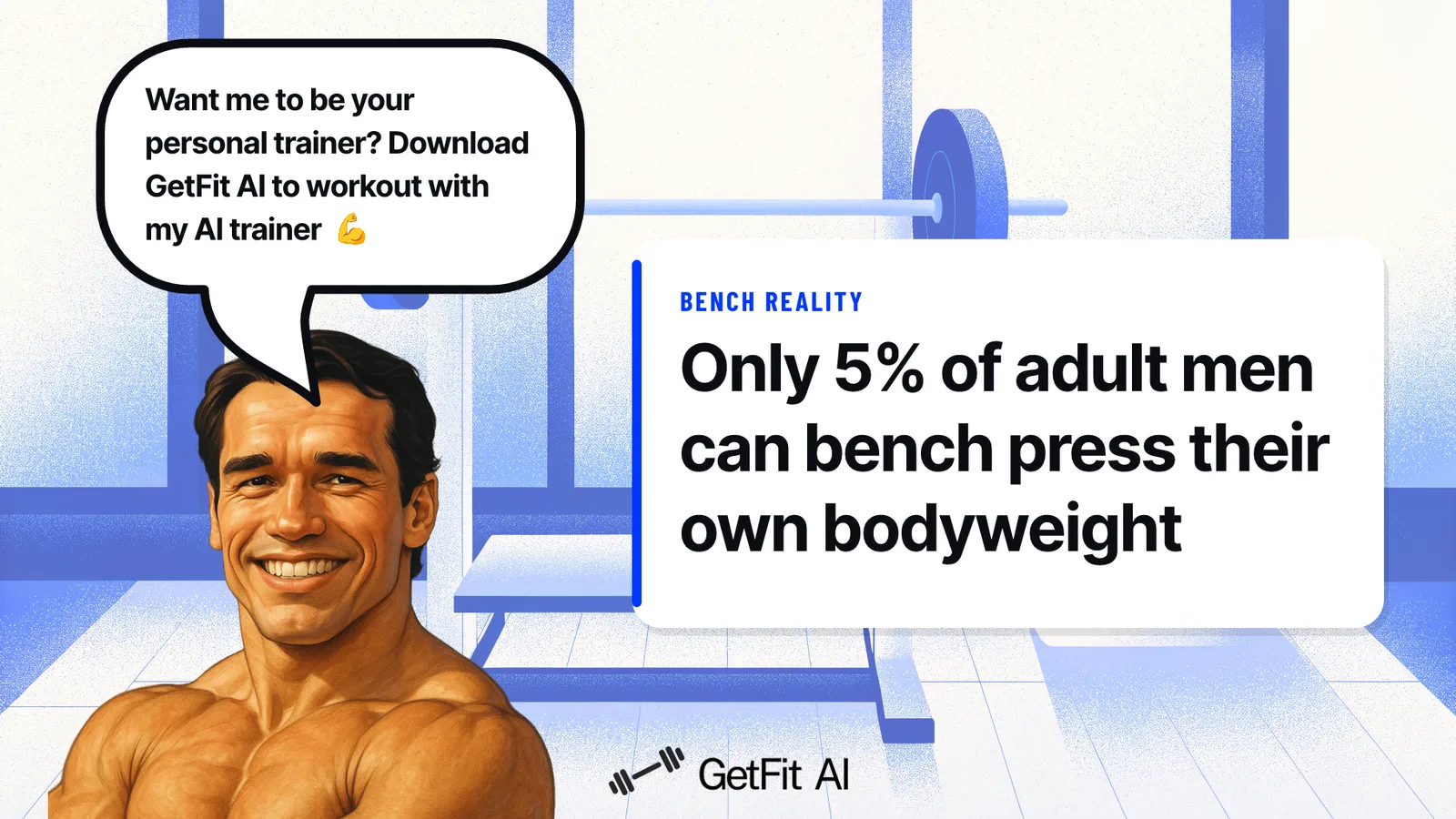
A striking data point that surfaces consistently across the fitness industry: only around 5 percent of American adult males can bench press their own bodyweight. That means the vast majority of men who train regularly never clear a benchmark that sounds, on paper, entirely reachable. The obstacle is not physical capacity.
Key takeaways
- The average untrained adult male bench presses around 135 lbs for a one-rep max, not the 185-225 most guys quietly assume they're near.
- Body weight changes the standard entirely: a 165 lb man and a 220 lb man are measured against different baselines, so raw numbers without a bodyweight ratio are nearly meaningless.
- Strength peaks between the mid-20s and early 40s, the window is real, and what you build inside it compounds differently than what you chase after it.
- Six experience tiers separate a first-time lifter from an advanced one, and most men stall between novice and intermediate not from lack of effort but from lack of structure.
- Knowing you're below the novice standard and then returning to the same weight, same exercises, same order doesn't close the gap, it just names it.
- GetFit AI closes that structure gap by building a custom training plan around your numbers and your goals, in your favorite athlete's style, with an AI trainer available to adjust it anytime.
Average Bench Press by Body Weight: How Much Should You Actually Be Lifting?
Raw bench press numbers mean nothing without body weight in the equation, and most standard comparisons skip that context entirely. This section breaks down what nearly 49 million logged lifts actually show about how bench press strength scales across different body weights and experience levels, from untrained through elite. If you have ever wondered whether your number is genuinely strong for your size or just strong on paper, this is where that question gets a real answer.
Why Body Weight Is the Denominator That Changes Everything
Body weight affects bench press standards directly because muscle force production scales with lean mass, limb length, and structural frame size. A heavier man carries more total tissue to move, but also more muscle potential to move it with. This is why bench press strength standards scale with body weight across every experience tier, from untrained through elite. Comparing raw totals across different body weights produces a false read every time.
What 49 Million Logged Lifts Show About Average Bench Press by Body Weight
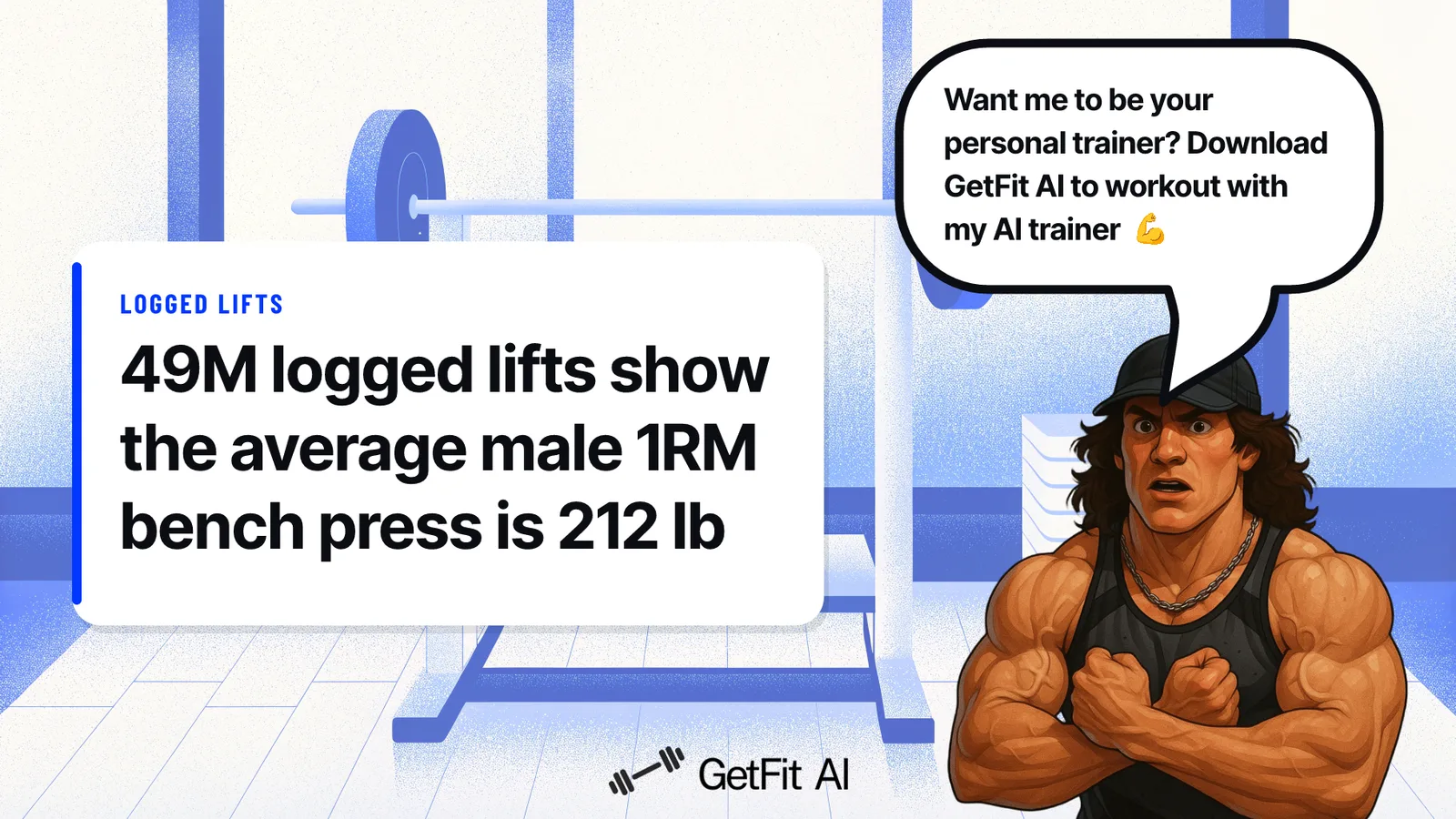
According to Strength Level’s 2024 database, built from 48,718,584 logged lifts since 2014, the average bench press for men is 96 kg (roughly 212 lb) for a one-rep max. That figure shifts substantially once body weight enters the equation. A 150 lb man and a 220 lb man are measured against completely different baselines, and treating the same raw number as equally good or equally poor for both is how progress gets misread for months.
Bench Press Standards Table by Bodyweight and Experience Tier
The table below uses real Strength Level 2024 data. No figures are estimated or interpolated.
For a 198 to 200 lb male specifically, Strength Level’s 2024 standards place untrained at 100 to 135 lb, novice at 145 to 175 lb, intermediate at 195 to 225 lb, and advanced at 255 to 290 lb. A man sitting at 185 lb on the bar could be a strong novice or a weak intermediate depending entirely on what he weighs.
Intermediate Bench Press Standards by Body Weight
Intermediate level requires a meaningful step above the novice threshold. For most men, the intermediate target sits noticeably above their own body weight, according to Strength Level. For most men in this weight range, that translates to a concrete target that sits meaningfully above their own body weight, a specific figure best looked up against their exact bodyweight on Strength Level’s standards table.
Related Reading
- Best Fitness Apps
- How Many Pull Ups Should I Be Able To Do
- Average Grip Strength Male
- Average Bench Press
- How Much Does A Bench Press Bar Weigh
- Average Male Bench Press
- Grip Strength Chart
- Symmetric Strength
- Bench Press Standards
Average Bench Press by Age: When Strength Peaks and What Happens After
The window you’re training in right now matters more than most gym-goers realize. Muscle strength and mass peak in early adulthood, with most exercise science sources pointing to the period roughly spanning the mid-20s through early 40s as the highest-leverage window for building upper-body strength. What you do inside that window doesn’t just affect this year’s bench press number; it sets the ceiling for every decade after it.
Bench Press Strength Peaks Between Ages 25 and 44: What the Data Actually Shows
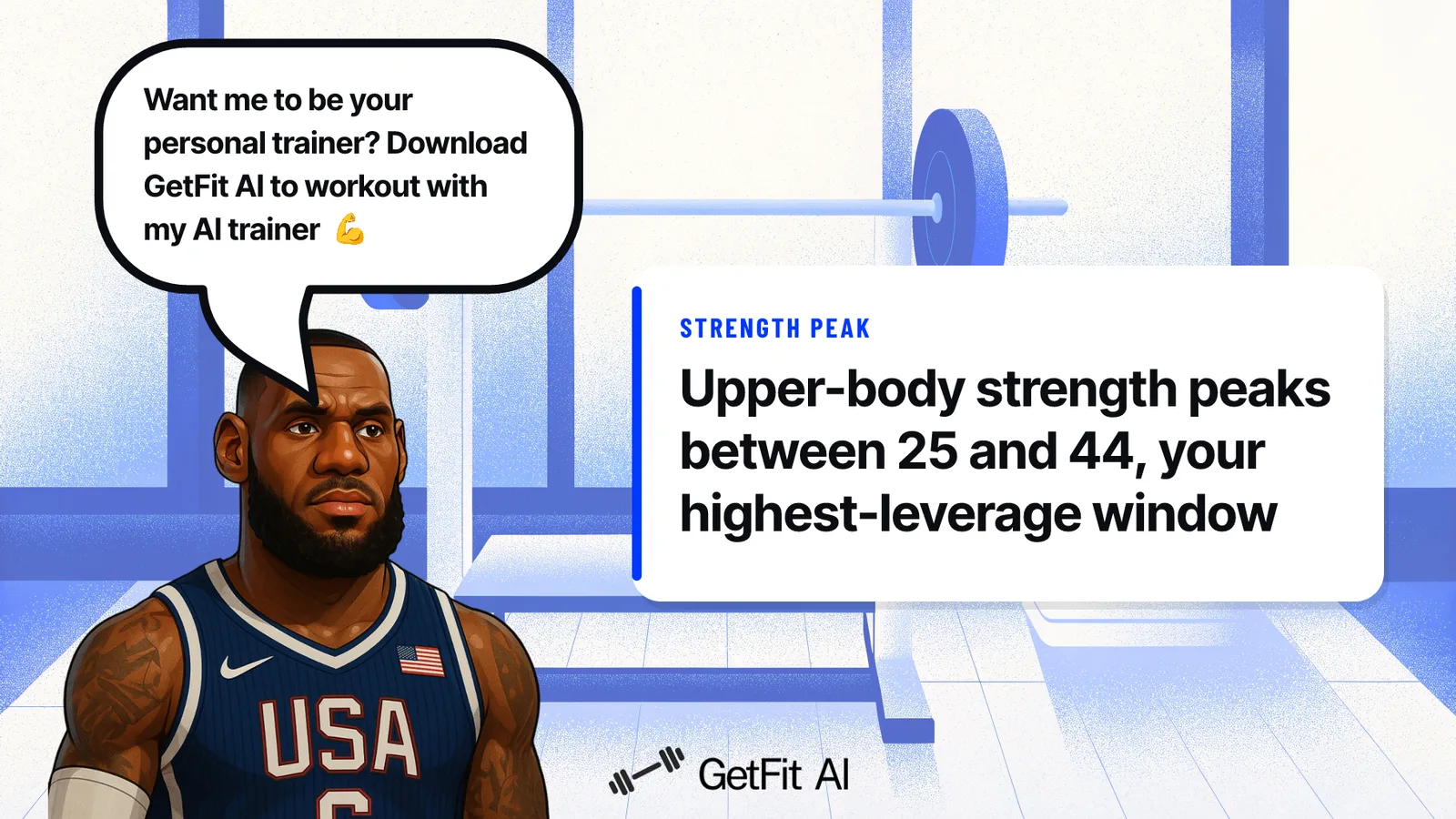
Upper-body strength peaks between ages 25 and 44. That’s the consistent finding across the broader exercise science field, which identifies this range as the period when the body’s capacity for muscle adaptation is at its highest. Testosterone levels are favorable, recovery is faster, and the neuromuscular system responds to progressive overload more efficiently than it will at 50 or 60. A 29-year-old who has been going to the gym for a year but hasn’t moved his bench press isn’t just behind on effort. He’s inside the most productive strength-building window of his entire life, and he’s spending it on repetition instead of progression.
How Average Bench Press Numbers Drop Decade by Decade After the Mid-40s
After approximately age 40-45, men begin to experience a gradual loss of muscle mass and strength, sarcopenia, with the rate of decline accelerating after the mid-40s when training is not structured and progressive. Longitudinal tracking of untrained men shows that they begin losing a meaningful share of peak strength per year after 40, with the rate accelerating further as decades pass. Compounded across a decade, the total loss is substantial.
The practical result: a man who benches a solid working weight in his mid-30s and trains inconsistently without progressive overload could realistically find himself pressing significantly less by his mid-50s, because he never built a structural base during the years when building it was cheapest.
Why Trained Men Over 50 Still Out-Lift Untrained Men in Their 30s
Across the market of long-term training outcomes, men who follow a structured resistance-training program retain significantly more strength capacity as they age compared to untrained or inconsistently training peers. A 52-year-old who trained with a progressive plan through his 30s and 40s can realistically retain a substantially higher proportion of his peak strength than an untrained peer.
Key takeaway: Structured resistance training meaningfully attenuates age-related strength loss; trained older men retain a substantially greater proportion of their peak strength compared to far steeper declines in sedentary populations.
Bench Press Standards by Experience Level, and What the Average Trained Lifter Actually Hits
Six experience tiers separate the man who just touched a barbell for the first time from the one warming up with what most gyms consider a serious working weight. Understanding where those tiers sit, and what actually moves a lifter between them, is the difference between training with a target and training in circles.
The Six Experience Tiers Explained: From Untrained Baseline to the Statistically Rare Elite
According to Strength Level’s database, which draws on over 48 million logged lifts, bench press performance for men is classified across six tiers:
-
Untrained
-
Beginner
-
Novice
-
Intermediate
-
Advanced
-
Elite
Each tier is anchored to a percentage-of-bodyweight expectation, not a flat number. An untrained man typically presses a meaningful fraction of his bodyweight for a one-rep max. A beginner clears that initial threshold and works toward roughly his own bodyweight on the bar. A novice lifter sits just above that mark, intermediate lifters push meaningfully beyond it, and advanced and elite lifters reach substantially higher multiples, with each tier anchored to Strength Level’s database of over 48 million logged lifts rather than flat pound targets.
One thing those tier labels do not capture is how non-linearly real lifters move through them. A beginner can sometimes hit a higher-tier standard on one lift while failing a lower-tier standard on a related movement. The ordering of benchmarks does not always mirror how individual athletes actually develop. That is not a flaw in the data; it is a feature of human anatomy.
A lifter dealing with structural asymmetries, uneven shoulder loading, or compromised scapular stability will hit a ceiling on bench press that has nothing to do with effort or consistency and everything to do with mechanics that a flat percentage target cannot see. This is precisely where training like the athlete you follow, with a structured plan built around your actual starting point rather than a population average, makes the tier framework useful rather than discouraging. GetFit AI’s Athlete-Style Custom Workout Plans account for where you are on day one and build the program arc from there, so the tiers become checkpoints rather than judgments.
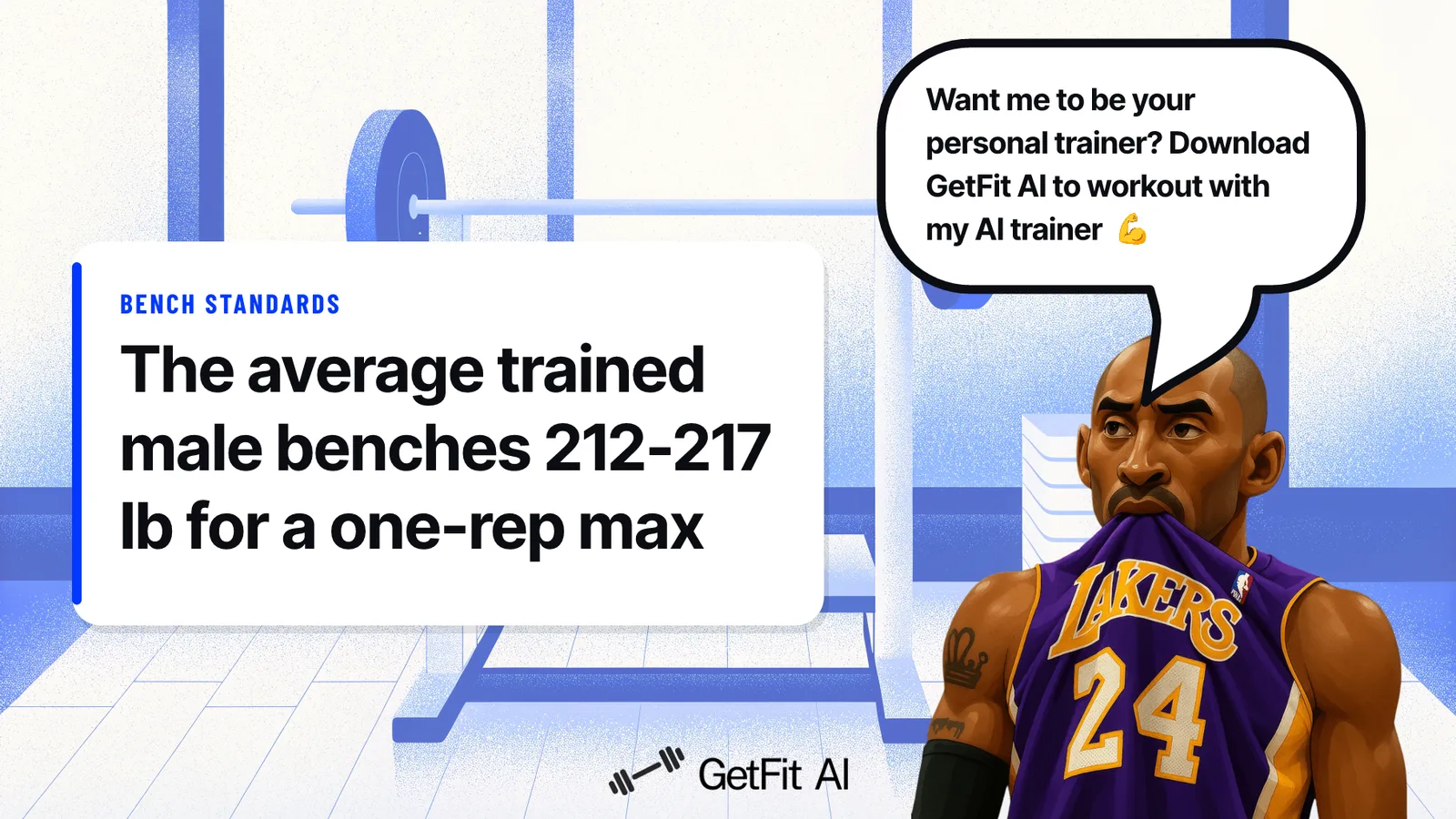
What the Average Trained Man Actually Benches: The 212-217 lb Benchmark Explained
The trained-male average lands between 212 and 217 pounds for a one-rep max, a figure corroborated by both Strength Level’s 2024 standards and RitFit Sports’ analysis. For a 185 to 190 lb man, that number sits comfortably in the intermediate tier. It is the honest midpoint for men who train consistently and with structure.
Key takeaway: The 212-217 lb trained-male average reflects men who followed a plan, not men who simply showed up.
The 212-217 lb trained-male average reflects men who followed a plan, not men who simply showed up.
Nutrition is the other half of that equation that averages erase entirely. A lifter can follow a sound program and still stall because the training is not supported by what he eats. Sorting out nutrition so the training shows, knowing what to eat to hit a strength goal, and tracking it without doing the math manually, is what separates the man who moves through the tiers from the one who hovers at the same number for two years.
GetFit AI addresses this directly: the platform is built to tell you exactly what to eat to hit your goal and to handle the tracking so you do not have to. Pair that with the structured workout programming available from the first session, and the 212-217 lb benchmark becomes a milestone with a clear path to it.
Is 135 lb a Respectable Bench Press?
Yes, but only if you just started.
For a man with no lifting history, 135 lb is a reasonable starting point. According to Strength Level, it places most men squarely in the beginner tier, which is exactly where it should place them, and that is not an insult. The problem is training without a structure that knows where to take you next. Beginners who have previously struggled with consistency because they lacked program structure are the exact lifter GetFit AI’s Structured Training is built for. It engages from the first workout session and sustains across the full training arc, which is the period most lifters abandon before adaptation has a chance to compound.
Related Reading
- Do Pull Ups Work Chest
- Grip Strength Norms
- Average Deadlift Weight
- 1 Rep Max Chart
- Average Male Deadlift
- Good Bench Press Weight
- Weightlifting Standards
- Average Bench Press Kg By Age
- Average Deadlift Weight Kg
How to Improve Your Bench Press, and Why Most Men Are Still Stuck at the Same Weight
Showing up is not the problem. The common assumption among beginner lifters in their mid-to-late twenties with no structured plan is that if they keep showing up and try a little harder each session, their bench press will eventually go up on its own. The real issue is what happens, or rather what doesn’t happen, between sessions: no planned weight increase, no tracked sets, no system that tells your body it needs to adapt. That gap is why so many men find themselves loading the same plates month after month, stuck at 147 lb for reps, unable to maintain consistent rep counts across sessions, genuinely confused about why nothing is moving. It is the clearest symptom of training without structure, and it is more common than most beginners realize.
“Men plateau on bench press for months at relatively low weights (e.g. 147 lbs for reps) and feel stuck, even after consistent training.”
— what we hear from male fitness enthusiasts
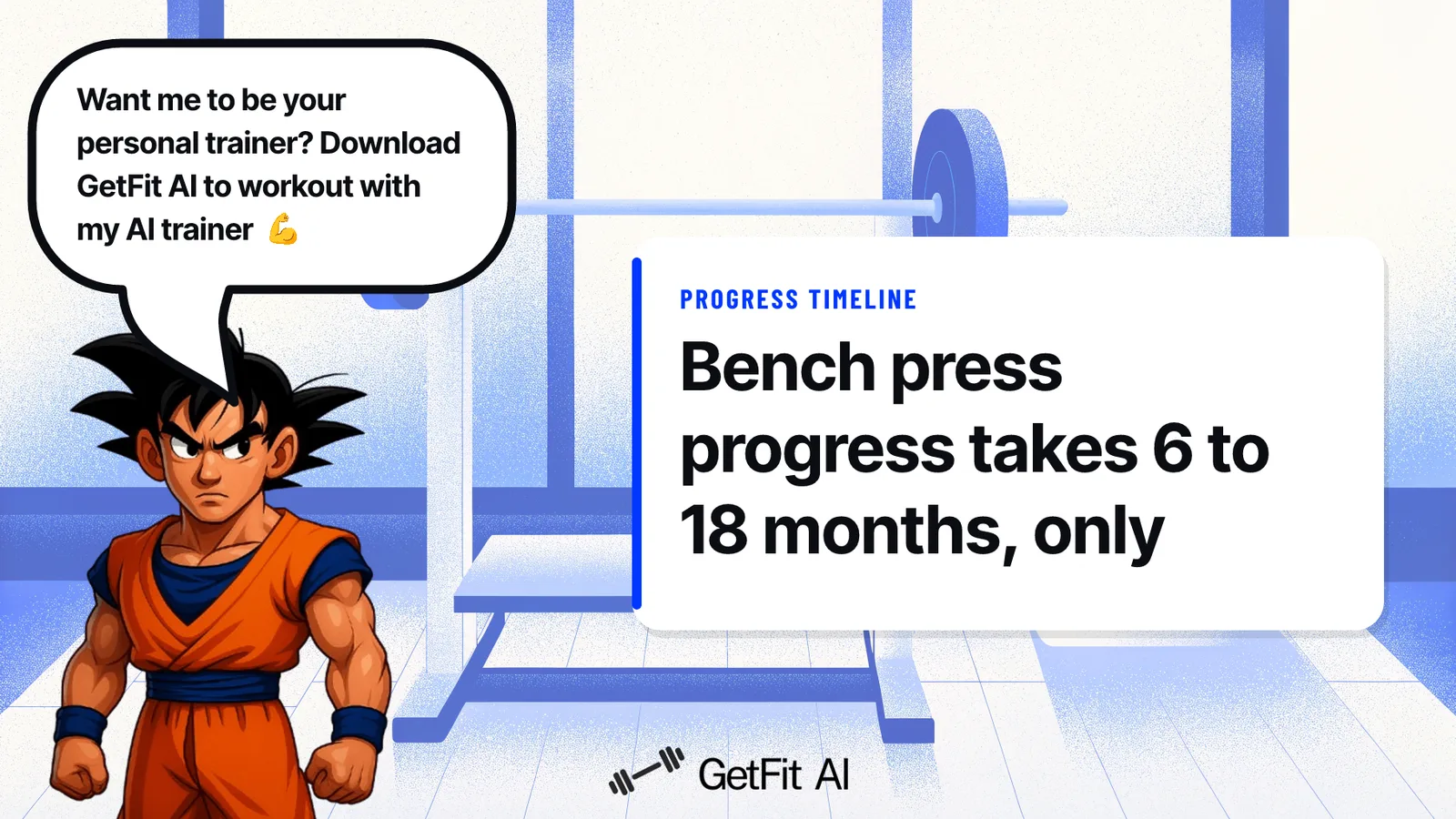
Novice to Intermediate Takes 6 to 18 Months, But Only With Structured, Progressive Overload
Progress from novice to intermediate bench press takes 6 to 18 months of structured, progressive training, not simply consistent gym attendance. According to Fittux, that timeline assumes deliberate programming, not just showing up. Most men don’t have any of that in place. The lifters we see stuck longest are those who previously struggled with consistency precisely because they had no program structure to anchor their training: no clear targets for the session, no progression logic from one week to the next, and no feedback telling them whether they are actually moving forward.
This is where GetFit AI’s Athlete-Style Custom Workout Plans address the problem directly. From the first workout session, the plan dictates what to lift, how many sets, and when to add load, so the body receives an actual stimulus to respond to rather than a repeated exposure to the same stress it has already adapted to. GetFit AI is most beneficial for men who have previously struggled with consistency due to lack of program structure, because the plan removes the decision fatigue that quietly kills progress. The body only adapts when it is forced to. Without a structured plan that adds load or volume on a schedule, there is simply no stimulus to respond to.
Foot Drive, Scapular Retraction, and Grip Width
Proper technique, specifically foot drive, scapular retraction, and grip width, can increase bench press capacity immediately, before any new strength is built. Here is what each adjustment actually does:
-
Planting the feet and driving them into the floor recruits the entire posterior chain, creating a stable base that transfers force more efficiently.
-
Pulling the shoulder blades together and down before unracking the bar shortens the range of motion and protects the shoulder joint.
-
A man stuck at 155 lb for eight months often discovers that adjusting grip width and actively retracting the scapula adds measurable pounds to his working set on the same day.
Industry research found that scapular retraction positioning significantly increased bench press performance in trained men compared to a protracted position, without any change in absolute strength. That is not a small detail.
GetFit AI coaches technique cues during each workout session, not just across the overall program arc, so these adjustments are flagged in real time rather than discovered months later by accident. For lifters who do not have access to or budget for a human personal trainer, the majority of beginners in this market, that in-session guidance is the closest functional equivalent to having an expert watching your set.
Sets, Reps, and Progression Models Are the Actual Levers
Research on weekly training volume consistently points to a meaningful number of sets per muscle group, distributed across sessions, as the effective range for hypertrophy and strength gains. The structured training inside GetFit AI is built around this kind of evidence-based volume distribution, applied to your specific starting point rather than a generic template.
One underrated accelerant: accountability to another person. GetFit AI’s friends, challenges, and leaderboards create a social layer that activates after connecting with at least one friend in the app, and it functions as the retention mechanism that keeps users training past week three, which is precisely when most unstructured programs fall apart. Men who have a workout partner also using GetFit AI benefit most from this feature, as shared challenges create external stakes that make skipping a session costlier than completing it. That social pressure, combined with a plan that tells you exactly what to do when you walk in, closes the two gaps that explain why so many beginners plateau at the same weight for months on end:
-
Structure: no clear targets, no progression logic, and no feedback telling you whether you are actually moving forward.
-
Accountability: no external stakes and no one to answer to when you skip a session.
GetFit AI’s Premium Weekly Subscription is available at $1.99 per week, the Premium Monthly Subscription at $4.99 per month, and the Premium Yearly Subscription at $49.99 per year. All three tiers include the full structured training system and social features, making the cost-per-session lower than virtually any alternative for someone who lacks a personal trainer.
Related Reading
- Average Deadlift Weight For Male
- Best Calisthenics Workout App
- Best Hiit Workout App
- Best Gym Workout App
- Best Workout Apps
- Best Free Workout Apps
Why Knowing Your Bench Press Average Is Only Half the Answer: The Other Half Is a Plan
Knowing where you sit against the averages is useful, but it does not move the bar. The real work starts when you close the gap between having a benchmark and having a structure that actually drives progress week over week. That structure is what this section breaks down.
The Benchmark Gap vs. The Execution Gap
The gap between where you are and where you want to be is a structure problem. A 27-year-old who confirms he is below the novice standard, feels the sting of that, and then returns to the same three exercises in the same order at the same weight has not closed any gap. He has labeled it. Knowing the target does not generate the sets, the progression model, or the weekly load increases that would move the number.
Why Unstructured Gym Attendance Stalls Progress
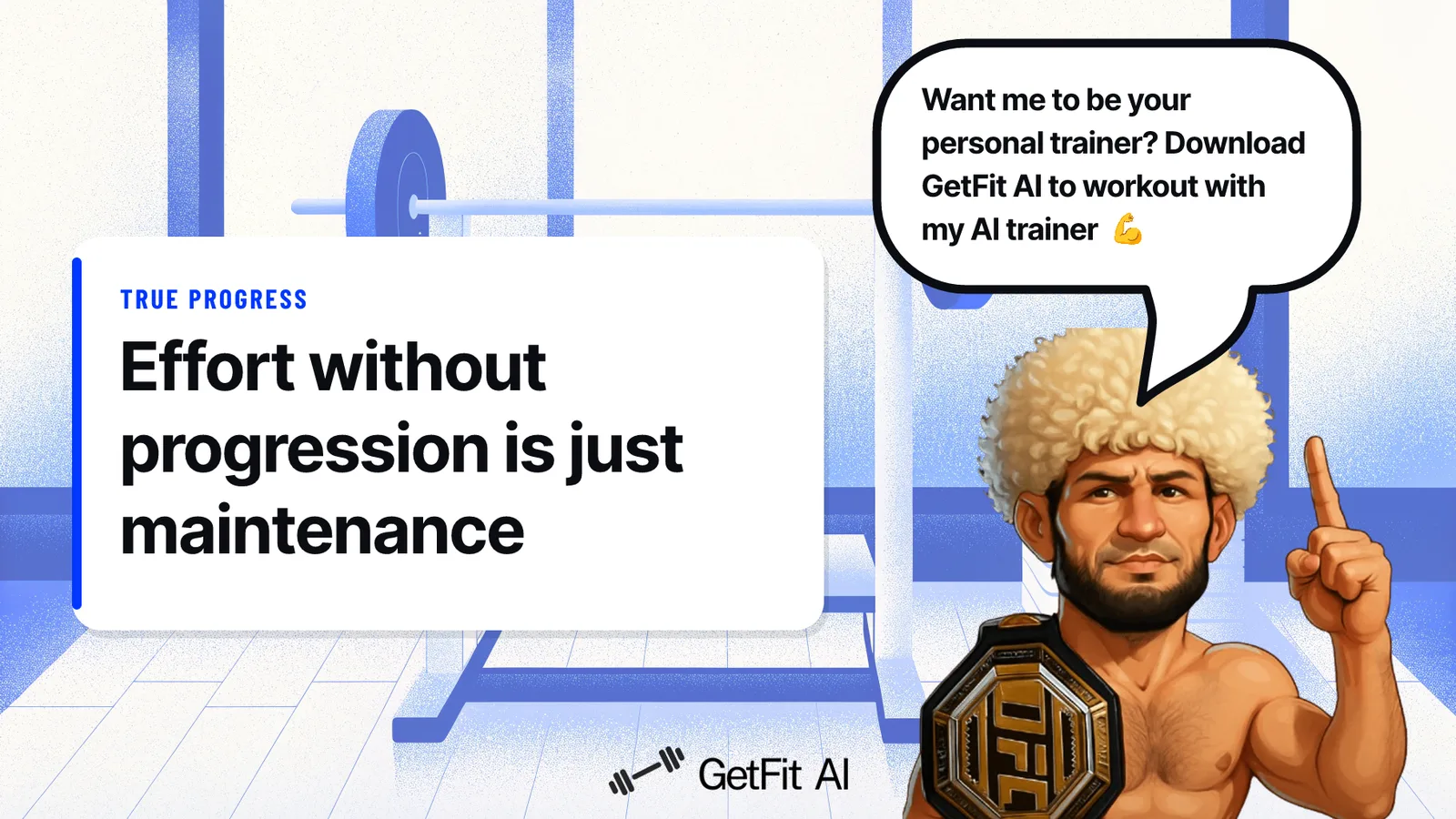
The core synthesis here is this: experience tiers in bench press are descriptions of how long your body needs to recover and therefore how complex a plan you require. Recovery capacity, not time in the gym, defines experience level. The pattern is consistent: lifters focus on lifting heavier each session without a structured plan behind it, so the effort is real but the stimulus never changes. Industry research on periodisation strategies found that repeating the same stimulus without structured variation leads to stalled adaptation in recreational athletes. The body stops responding because it has already adapted to exactly what you keep asking it to do.
Effort without progression is just maintenance.
What a Structured Plan Actually Looks Like
A progressive workout plan specifies which exercises run in which order, how many sets and reps at what load, and when that load increases. Those are not preferences. They are the levers.
A man benchmarking himself against intermediate standards without ever having used structured progressive overload is measuring himself against an outcome his current training method is biologically incapable of producing. His nervous system and muscle fibers have never received the right sequence of stimuli to push past their current ceiling. Time in the gym does not equal training age when the stimulus stays flat.
Next steps
If your bench press has flatlined after months of consistent training, the path forward starts with recognizing that attendance without progressive overload is physiologically equivalent to having no plan at all. Start with our AI fitness app.
The body-weight-relative standards make this concrete: a 198 lb man who has trained for six months and sits near the untrained threshold of 100 to 135 lb is not behind on effort, he is behind on stimulus. The 212 lb trained-male average is not a mystery number; it reflects men who followed structured, progressive programs, not men who simply showed up more often. Those two facts point to the same next step: a plan that tells your body something new is being asked of it, session by session, week by week.
Start with GetFit AI, where the onboarding quiz maps your body weight, age, and current training history to a structured program built around your actual tier, not the population average. From the first session, the plan specifies what to lift, how many sets, and when to add load, so the gap between where you are and the intermediate standard becomes a sequence, not a guess.
Frequently Asked Questions
What can the average untrained man bench press?
The average untrained adult male can bench press somewhere in the range of 135 pounds for a one-rep max, though a completely sedentary man with no lifting history may start closer to 100 to 115 pounds before any structured training begins. That 135 lb figure represents a population midpoint for men with some incidental physical activity in their background, not a floor.
Is 135 lb a respectable bench press?
For a man with no lifting history, 135 lb is a reasonable starting point, according to Strength Level, it places most men squarely in the beginner tier, which is exactly where it should. The issue is not where you start; it is whether you have a structure that knows where to take you next.
What does the average man bench press once he’s actually been training?
The trained-male average lands between 212 and 217 pounds for a one-rep max, a figure corroborated by both Strength Level’s 2024 standards and RitFit Sports’ analysis. For a 185 to 190 lb man, that number sits comfortably in the intermediate tier and reflects men who followed a plan, not just men who showed up.
How long does it take to go from novice to intermediate on bench press?
Progress from novice to intermediate bench press takes 6 to 18 months of structured, progressive training, not simply consistent gym attendance. That timeline assumes deliberate programming with clear targets, progression logic from week to week, and feedback on whether you are actually moving forward.
Does bench press technique actually make a measurable difference in how much you can lift?
Yes, proper technique, specifically foot drive, scapular retraction, and grip width, can increase bench press capacity immediately before any new strength is built. A man stuck at the same weight for months often discovers that adjusting grip width and actively retracting the scapula adds measurable pounds to his working set on the same day.







