Average Male Deadlift Standards by Weight and Age (2026)
That widely cited 340 lb average only counts men who already train. Here is what the number actually means, where you fall on the tier map, and why bodyweight changes everything.
The average male deadlift sits at roughly 340 to 350 lbs (154 to 159 kg) for a one-rep max. That is the number you will find cited across strength tracking platforms, and it holds up under scrutiny. It comes with a catch that most articles bury in a footnote, though: that figure only describes trained, intermediate lifters who actively log their lifts. It says almost nothing about the broader male population. See our AI fitness app for how this works in practice.
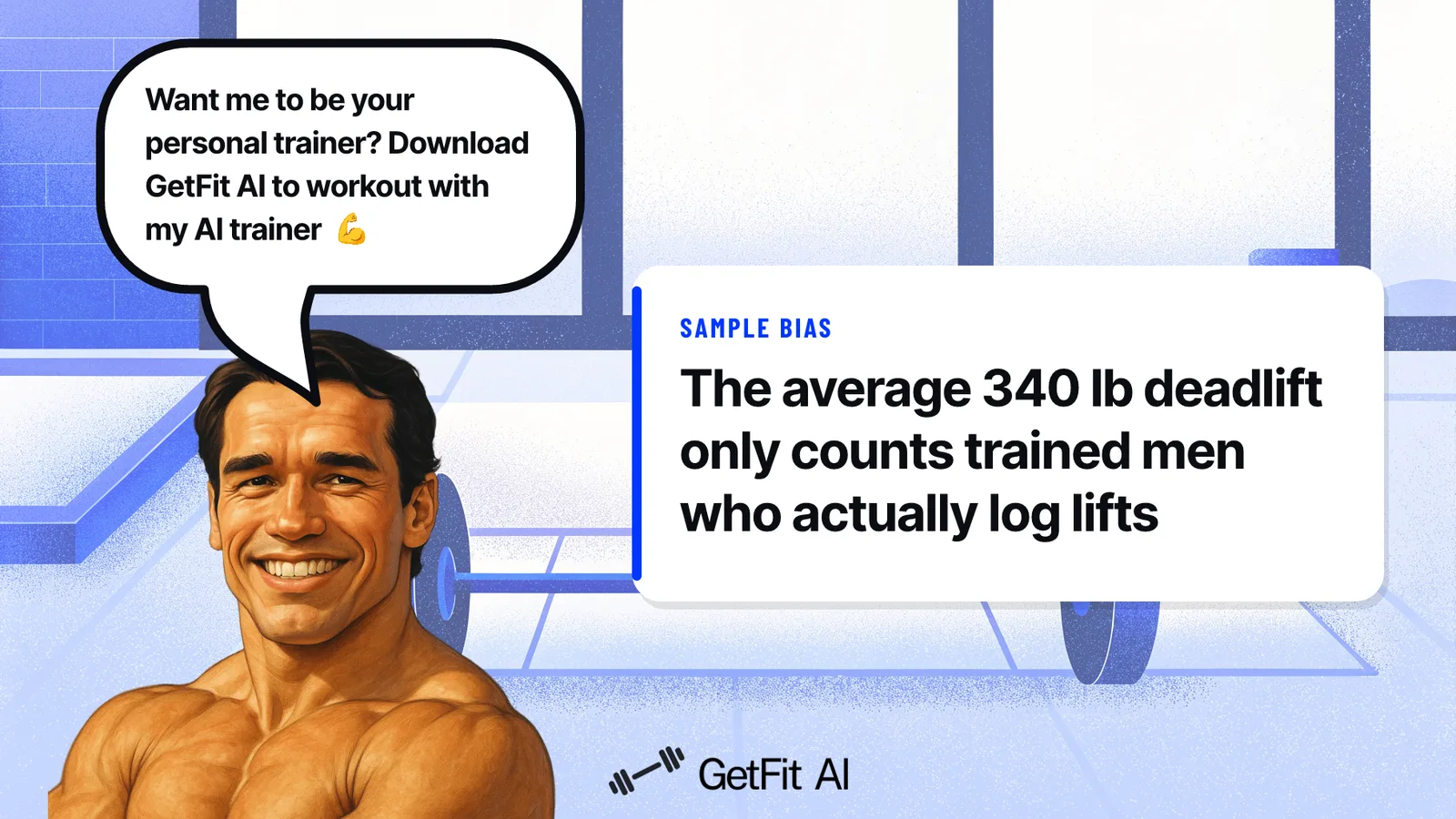
According to Strength Level’s 2024 database, the average male deadlift 1RM is 340 lbs (154 kg), drawn from nearly 23 million logged lifts recorded since 2014. Gravitus’s 2024 calculator benchmarks the intermediate standard at 340 to 350 lbs, corroborating the figure independently. Both sources segment by experience level and bodyweight, so the consensus is not a guess. It is a pattern extracted from millions of real pulls.
Here is the problem. That 340 lb figure counts trained men who show up, track their lifts, and follow some kind of program. It does not count the man who has never touched a barbell.
A 200-lb man walking into a gym for the first time might pull well under bodyweight on his first attempt. A 200-lb intermediate lifter pulls around 350 lbs. Same bodyweight, wildly different number.
Most men never deadlift with any regularity, which means published averages are structurally skewed toward the most active slice of the population. The moment you include all men, the true population average drops sharply. Knowing that distinction changes whether that figure should feel like a ceiling or a distant target.
Key takeaways
- The average male deadlift sits at roughly 340-350 lbs (154-159 kg) for a one-rep max, a number derived from nearly 23 million logged lifts, not gym folklore.
- Bodyweight multipliers are a more honest benchmark than absolute numbers: a 225 lb man and a 165 lb man pulling the same plate count are not at the same relative strength level.
- Peak deadlift strength lands between ages 25 and 35, but the drop-off after that is slower than most lifters assume, age is a modifier, not a ceiling.
- Most men stall not because of genetics or effort, but because knowing a benchmark tells you nothing about what to load next Tuesday or how to add weight the week after.
- The gap between 'intermediate' and 'advanced' on any strength chart is almost always a programming gap, not a physical one, random effort against a fixed target produces a plateau, not progress.
- GetFit AI's Structured Training closes that gap by delivering workouts as a coherent program progression, not random exercises, so every session builds on the last instead of resetting it.
Deadlift Standards by Experience Level: From Beginner to Elite
Pull up the Strength Level deadlift standards page and you’ll find something most gym-goers never bother to check: every tier in the five-level classification system carries a specific 1RM number, derived from nearly 23 million logged lifts recorded since 2014. That’s not motivational labeling. That’s a dataset large enough to tell you exactly where you stand today and exactly how far the next rung is.
The Five-Tier Classification Table: Exact 1RM Values for a 200-lb Male
According to Strength Level’s 2024 standards, the deadlift strength tiers for a typical 200-pound adult male break down as follows:
| Tier | 1RM (lbs) | 1RM (kg) |
|---|---|---|
| Beginner | 199.8 lbs | 90.6 kg |
| Novice | 269.7 lbs | 122.3 kg |
| Intermediate | 349.7 lbs | 158.6 kg |
| Advanced | 429.6 lbs | 194.9 kg |
| Elite | 539.5 lbs | 244.7 kg |
These thresholds are percentile cutoffs calculated from real training logs. No calculator required: find your current 1RM, match the row, and you have your tier.
One of the most common struggles beginners face is not knowing whether their current performance is competitive or far below where it should be. Pulling 10-12 reps at a modest weight feels productive in the moment, but without a concrete benchmark it’s impossible to know whether that effort is closing the gap or just spinning wheels. The table above removes that ambiguity immediately. That’s exactly the kind of clarity GetFit AI is built to deliver, from the first workout session, the app’s Athlete-Style Custom Workout Plans place your numbers inside a structured program arc, so every session is oriented toward a specific tier target rather than a vague sense of “getting stronger.”
What Each Tier Actually Means in Plain English: Training Age, Not Gym Attendance
The tier labels track training age, not how many months you’ve paid for a gym membership. Strength Level defines Beginner as someone with no prior structured training, Novice as a few months of consistent work, Intermediate as one to two years of dedicated lifting, Advanced as a multi-year committed lifter, and Elite as a competitive strength athlete. A guy who has been going to the gym casually for three months and pulls 245 lbs is squarely Novice. Exactly where the data predicts he’d be.
Attendance and training age are different things. Four years of showing up without a structured plan can leave a lifter pulling numbers that belong to someone six months in, and that gap hits hard when it finally becomes visible. A 6’2”, 187-lb lifter with four years of aesthetics-focused training who discovers his Romanian deadlift sits at roughly the Novice threshold has a program-structure problem. Aesthetics work and strength work are different stimuli, and the standards table doesn’t grade on a curve for motivation.
This is precisely where Structured Training inside GetFit AI pays off. It is most beneficial for lifters who have previously struggled with consistency due to a lack of program structure, and it works during each individual workout session and across the overall training program arc. You aren’t just logging sets; you are executing a plan designed to move your tier number in a predictable direction.
Where 315 lb, 405 lb, and 495 lb Fall on the Tier Map
315 lbs sits comfortably between Novice (269.7 lbs) and Intermediate (349.7 lbs) for a 200-lb male. It’s a meaningful milestone, but it’s not the ceiling gym lore sometimes implies for recreational lifters who train with any consistency. Here the data exposes a flaw in how most men encounter deadlift benchmarks online: the widely cited average reflects people who were already tracking and logging their lifts, a self-selected group skewed toward the committed end of the spectrum.
A second gap the tier map reveals is a form problem that often goes undiagnosed at beginner weights. When a lifter is working at very light loads, form breakdown under heavier weights cannot be assessed, the load isn’t sufficient to expose the weak links in the kinetic chain. The practical consequence is that a beginner can build months of motor patterns that look fine at light weight and collapse the moment the bar gets meaningful. GetFit AI’s Athlete-Style Custom Workout Plans are structured to progress load deliberately so that form is tested progressively rather than discovered catastrophically at a one-rep-max attempt.
Accountability is the retention layer that keeps lifters training past the critical week-three drop-off point, the window when most unstructured programs fall apart. GetFit AI’s Friends, challenges, and leaderboards features are most powerful once a user has connected with at least one friend in the app, and most beneficial when a workout partner is also using GetFit AI. Knowing that a training partner can see your tier progression on a shared leaderboard turns an abstract benchmark number into a live social commitment. According to Stronger, framing strength in relation to clear standards is one of the most reliable ways to sustain long-term training motivation, and pairing that clarity with a social accountability layer compounds the effect.
GetFit AI is available as a Premium Weekly Subscription at $1.99/week, a Premium Monthly Subscription at $4.99/month, or a Premium Yearly Subscription at $49.99/year, giving lifters the flexibility to commit at whatever level matches where they are in their training journey right now.
Related Reading
- Best Fitness Apps
- How Many Pull Ups Should I Be Able To Do
- Average Grip Strength Male
- Average Bench Press
- How Much Does A Bench Press Bar Weigh
- Average Male Bench Press
- How Much Can The Average Man Bench Press
- Grip Strength Chart
- Symmetric Strength
- Bench Press Standards
Deadlift Strength Standards by Bodyweight: The Multiplier Method
Absolute deadlift numbers pulled from generic charts can quietly send your training in the wrong direction, because a target that looks identical for two lifters can represent entirely different levels of strength once bodyweight enters the picture. The multiplier method fixes that by anchoring every benchmark to your own body, so the standard you are chasing is actually calibrated to you. GetFit AI applies this same logic when setting your targets, which is why understanding how multipliers work is the foundation for everything the deadlift standards in this section are built on.
Why Absolute Deadlift Numbers Lie, and Bodyweight Multipliers Don’t
Bodyweight multipliers expose a trap hidden inside absolute-number comparisons, and it is a trap more beginners fall into than you might expect. One of the most persistent points of confusion we see among new lifters is whether a benchmark like “a 4-plate deadlift for intermediate” refers to an absolute weight or a bodyweight-relative number. It is not a trivial question. The answer changes your entire training target.
People are confused about whether strength standards like “4 plate deadlift for intermediate” are based on absolute weight or bodyweight-relative multipliers, which points to a gap in understanding the multiplier method.
Level’s deadlift standards, a 315 lb pull represents over 2x bodyweight for a 150 lb man, placing him firmly in the intermediate-to-advanced tier. That exact same 315 lb pull from a heavier man represents a much lower bodyweight ratio, potentially marking him as a novice. Two lifters. One number. Opposite conclusions. Without anchoring your target to your own bodyweight, the benchmark you find online does not just fall short of useful, it actively misdirects your training effort by measuring you against a standard that was never calibrated to your body.
The same confusion extends beyond the barbell. Beginners who cross-train with sandbags or other implements often find there are no bodyweight-relative frameworks applied to those movements the way there are for the deadlift. The multiplier method is the bridge that makes any loaded movement objectively comparable, and it starts here.
The 1.5x Rule: The First Honest Milestone Every Casual Lifter Should Clear
1.5x bodyweight is the first real checkpoint for anyone who trains regularly but has not yet committed to a serious strength program. Strength standards commonly classify a 1.5x bodyweight pull as a meaningful intermediate milestone, meaning a lifter with a solid base of consistent training should be pulling here. For a 175 lb man, that is 262 lb. For a 200 lb man, it is 300 lb. These are the floor of competence, the point where your deadlift becomes a foundation.
Reaching 1.5x is also where competition with people you actually know starts to mean something. GetFit AI’s friends, challenges, and leaderboards feature is most powerful once you have at least one friend in the app, because a measurable multiplier milestone like 1.5x gives you a real, objective line to race toward together. Beating a friend to 1.5x bodyweight is a cleaner victory than arguing over whose absolute number is bigger.
The 2x Rule: The Target That Separates Intermediate Lifters from the Crowd
By widely used strength standards, 2x bodyweight sits at an advanced classification, typically requiring multiple years of dedicated, structured training. A 175 lb man needs 350 lb. A 200 lb man needs 400 lb. Lifters who reach this milestone consistently report it taking many years of purposeful progression, not just regular attendance.
The gap between 1.5x and 2x is not a matter of effort. It is a matter of having a plan that actually sequences the load week over week. This is where a lack of program structure becomes the real obstacle. Lifters who have previously struggled with consistency because they were improvising session to session rarely close this gap, not because they lack work ethic, but because random effort does not accumulate into structured adaptation. GetFit AI’s Athlete-Style Custom Workout Plans address this from the first workout session, sequencing load across both each individual session and the full training program arc so that every week of work is building toward a defined multiplier target rather than disappearing into noise.
What the Multipliers Look Like Across Weight Classes.
| Bodyweight |
|---|
Average Deadlift Standards by Age: How Strength Changes Over Time
Your age is not a footnote to your deadlift numbers; it is a core part of what those numbers actually mean. A 315-pound pull looks different on a 28-year-old than it does on a 48-year-old, because the biological conditions producing that lift are fundamentally different. Understanding where you fall within the peak strength window, and how hormonal and recovery factors shift across each decade, is what turns a raw number into a training signal GetFit AI can actually use.
Peak Strength Window: Ages 25 to 35
Peak strength performance occurs in the early to mid-30s, before age-related changes to neural and hormonal processes begin reducing muscular output. Broader strength research places the wider window at 25 to 35, with noticeable performance drops appearing after 40.
During that 10-year band, your nervous system fires most efficiently, testosterone sits at its career high, and recovery between heavy sessions is fastest. A 28-year-old at 185 lbs of bodyweight sitting just below the Intermediate threshold for his weight class, but he is also in the exact window where structured training would push him past it quickest.
Age-Adjusted Standards: 25 vs. 45
The single-number average for a trained male collapses a wide biological spread into one misleading figure. Strength Level’s community data shows deadlift performance declining meaningfully across each decade of adult life, with the 40 to 49 age band pulling noticeably less than the 25 to 34 band at every experience tier. Calling both men “intermediate” at 350 lbs treats the younger lifter as ordinary and the older lifter as unremarkable, when the older lifter is outperforming his biology.
The Hormonal and Recovery Factors That Reshape Deadlift Capacity After 40. Testosterone declines gradually each year after age 30, and that rate compounds.
Related Reading
- Do Pull Ups Work Chest
- Grip Strength Norms
- Average Deadlift Weight
- 1 Rep Max Chart
- Good Bench Press Weight
- Weightlifting Standards
- Average Bench Press Kg By Age
- Average Deadlift Weight Kg
Why Most Men Stall at Their Current Deadlift: The Plan Gap
Knowing the average deadlift gives you a number to chase, but a number alone does not tell you how to train tomorrow. Most men stall not because they lack effort or motivation, but because they have no structured route between where they are now and where they want to be. That plan gap is what this section breaks down, along with the two specific loading mistakes that keep the same weight on the bar session after session.
The Benchmark Is Not a Program
The common assumption is: “Once I know what the average is, I can just try harder and I’ll get there eventually.” A number tells you where the bar is set for other people. It says nothing about what you should load today, how many sets to pull, or when to add weight next week.
That gap between “knowing the standard” and “having a plan” is exactly where most men get stuck. According to Arnold’s Pump Club (2025), 48% of people who intend to exercise never follow through, and the consistent exercisers aren’t more motivated. This gap between intention and action is well-documented: research found that 57% of people not doing adequate physical activity still had strong intentions to exercise, confirming that motivation alone doesn’t translate into consistent behaviour.
They’ve simply removed the friction before they walk in.
The benchmark gives you a destination. Without a structured plan, you have no route.
Two Failure Modes That Keep the Same Weight on the Bar
The first is under-caution. A lifter pulls 245 lbs, learns the intermediate standard sits around 315 to 350 lbs, and loads 250 the next session because the gap feels too large to close quickly. No real progression logic. Just a vague sense of “I should probably add something.”
The second is ego-loading. The same lifter jumps to that load cold, without building the posterior chain strength to support it. Injury risk spikes sharply when load jumps outpace structural preparation, and a pulled lower back doesn’t just hurt, it ends the training block entirely. Both failure modes share the same root cause: no prescribed load target, no weekly progression rule, no system.
Why the Standard Becomes a Ceiling
Most lifters treat the benchmark as a finish line rather than a checkpoint. Once they hit it, progress stalls, not because they’ve reached their physical limit, but because the benchmark never told them what to do next. A number without a progression system attached to it is just a number.
A number without a progression system attached to it is just a number.
Related Reading
- Average Deadlift Weight For Male
- Best Calisthenics Workout App
- Best Hiit Workout App
- Best Gym Workout App
- Best Workout Apps
- Best Free Workout Apps
How to Actually Beat Your Deadlift Benchmark: Structured Progression vs. Guessing
A benchmark without a plan is just a number on a screen. The gap between knowing your deadlift standard and actually beating it comes down to one thing: what you load on the bar next Tuesday, and the Tuesday after that. Nearly half of all people who intend to exercise never follow through, not because they lack desire, but because intention without a pre-built, decision-eliminating system collapses under friction. The gap between knowing your deadlift benchmark and closing it is a systems gap, and structured linear progression exists to close it by automating every decision before you touch the bar.
What a Real Progression Plan Actually Contains
Most lifters treat a deadlift session like a mood. They walk in, feel out the bar, and pull whatever seems reasonable. A real deadlift progression plan works the opposite way. A structured plan prescribes exact sets, reps, and load increases before the lifter touches the bar, with weight added every session. The weight to pull on Tuesday is not a guess. It is already written down.
That specificity is what separates progress from performance theater. Effort without a prescribed increment doesn’t just stall; it actively reinforces the habit of showing up without progressing.
The 5-10 lb Weekly Add: Beginner Linear Progression
Beginners hold a genuine advantage most experienced lifters would trade anything for. Under a standard linear progression model, beginners can add a meaningful fixed increment per session on lower-body lifts like the deadlift. Held consistently, that compounds fast. A lifter who applies consistent weekly increments from a modest starting weight can reach a meaningful beginner milestone in a matter of weeks. That is not optimism. That is arithmetic applied to a structured training program.
The Deload Trigger Most Lifters Ignore
The GZCLP protocol includes a built-in stall response that most unstructured lifters never use. When a lifter fails to complete the prescribed reps across multiple sessions, the protocol calls for a deliberate weight reduction before continuing to progress, a reset that preserves long-term momentum rather than grinding against a wall.
Next steps
If you found the average and still walked back into the gym doing the same thing, the path forward starts with replacing the scoreboard with a system. A number without a load prescription attached to it is just a number. Start with our AI fitness app.
The survivorship filter built into the widely cited 340 lb average means most men are chasing a ceiling set by the people who never quit, not a reflection of where a typical male actually stands. Comparing yourself to that figure without anchoring it to your bodyweight compounds the problem: the same 315 lb pull marks one lifter as advanced and another as a novice, depending on their weight class. Both problems point to the same solution: a structured plan that tells you exactly what to load next session, not a benchmark you stare at between sets.
Start with GetFit AI, which builds progressive overload into every session from your first workout so the number you just looked up becomes a target you are actively closing on, not a scoreboard you revisit six months later with the same result.
Frequently Asked Questions
Is 340 lbs really the average male deadlift, or does that number include everyone?
That figure only reflects trained, intermediate lifters who actively log their lifts, not the general male population. Because most men never deadlift with any regularity, the true population average drops sharply the moment untrained men are included. The 340 lb number is best read as an intermediate benchmark, not a population-wide average.
How does age affect what deadlift numbers I should expect from myself?
Peak strength performance occurs roughly between ages 25 and 35, when the nervous system fires most efficiently, testosterone is at its career high, and recovery between heavy sessions is fastest. After 40, hormonal and recovery factors shift enough to slow adaptation, meaning a 45-year-old pulling at an intermediate level is actually outperforming his biology in a way a 28-year-old at the same weight is not. Treating both as equally “intermediate” understates the older lifter’s achievement.
Why does my bodyweight matter so much when comparing my deadlift to a benchmark?
Absolute numbers are misleading without a bodyweight anchor, a 315 lb pull represents over 2x bodyweight for a 150 lb man, placing him in the intermediate-to-advanced tier, while that same pull from a heavier man may only mark him as a novice. Two lifters, one number, opposite conclusions. Bodyweight multipliers are the more honest comparison: 1.5x bodyweight is the first meaningful intermediate checkpoint, and 2x bodyweight marks an advanced standard that typically takes multiple years of structured training to reach.
What’s actually stopping most men from adding weight to the bar over time?
The post identifies two specific failure modes: under-caution, where a lifter adds only a token amount because the gap to the next tier feels too large, and ego-loading, where a lifter jumps to a heavy target weight without building the posterior chain strength to support it safely. Both share the same root cause, no prescribed load target, no weekly progression rule, and no system to sequence adaptation over time.
If I’ve been going to the gym for a few years but my deadlift is still low, what does that say about my training?
The post is direct on this: training age tracks structured training, not gym attendance. Four years of showing up without a structured program can leave a lifter pulling numbers that belong to someone six months in. The example given is a lifter with four years of aesthetics-focused training whose deadlift sits near the Novice threshold, not a work-ethic problem, but a program-structure problem, because aesthetics work and strength work are not the same stimulus.