Average Grip Strength Male by Age: Charts & What They Mean

Your grip strength number is not a gym curiosity. It is a clinical signal tied to longevity, and most men have no idea where they actually stand.
Grip strength sits at a strange crossroads: most men treat it as a novelty number, something to glance at and forget. The common assumption is that knowing your average is enough, just keep showing up and it’ll improve over time. The reality is that researchers, clinicians, and sports medicine specialists have spent decades studying it precisely because it tells them something far more useful than how hard you can shake a hand. See our AI fitness app for how this works in practice.
“Many people are unaware that grip strength is a measurable, trackable number with real health implications; they don’t know what their number is or why it matters.”
— what we hear from health and fitness enthusiasts
According to a 2011 population-based study in BMC Research Notes by Massy-Westropp et al., grip strength was used as a proxy for overall musculoskeletal health across a community cohort, not just as a measure of hand fitness. That framing matters. It shifts the number from gym curiosity to genuine health signal. Grip strength measures the peak isometric force your hand, wrist, and forearm muscles can produce together, according to the Shirley Ryan AbilityLab RehabMeasures Database (2024). But clinicians interpret it as a window into your broader neuromuscular system, because the same motor pathways that drive a hard squeeze also govern how your body recruits muscle under load across compound movements. A weak grip rarely travels alone.
The tool researchers use is a handheld dynamometer, a calibrated device that converts your squeeze into a precise kilogram or pound reading. Massy-Westropp et al. (2011) used this exact instrument to build population-level normative data from a large longitudinal cohort of adults aged 18 and over drawn from industry research. That study confirmed that grip benchmarks come from epidemiological research, not gym populations, which is why the numbers carry clinical weight. Average male grip strength varies meaningfully across adult age groups, based on that normative data, peaking in the 30s and declining progressively through each subsequent decade.
Key takeaways
- Grip strength peaks for men in their 30s, according to NHANES normative data, after that, the trajectory is a slow decline that training can slow but not ignore.
- A low grip score isn't a grip problem. It's a signal that your neuromuscular system hasn't received a reason to adapt, which usually means load, volume, or structure hasn't changed in months.
- Grip strength is a validated clinical biomarker, researchers use it to predict cardiovascular risk, all-cause mortality, and functional decline decades before symptoms appear.
- The chart is only useful if your test method matches the one that produced the norms. Most gym-floor grip tests don't, which means most men are comparing apples to guesses.
- Showing up consistently without progressive overload produces a flatline grip score. A July 2025 network meta-analysis confirms structured programming, not volume alone, drives measurable strength gains.
- GetFit AI closes the gap between knowing your number and moving it: the app builds a custom training plan in your favorite athlete's style and gives you anytime access to an AI trainer who can adjust it when the number stalls.
Average Grip Strength by Age Chart for Men: The Full Breakdown
Grip strength doesn’t decline on a smooth, predictable curve, and knowing exactly where your decade sits changes how you interpret a single test number. The NHANES normative data, cross-validated by a separate population-based dataset, gives you the most reliable age-matched benchmarks available outside a clinical setting, covering every decade from your twenties through 80 and beyond. One detail that consistently catches lifters off guard is how far the all-ages population mean sits below what most gym-goers expect, which makes reading the right row of the table more important than it might seem.
The NHANES Normative Table: Exact Ranges by Decade
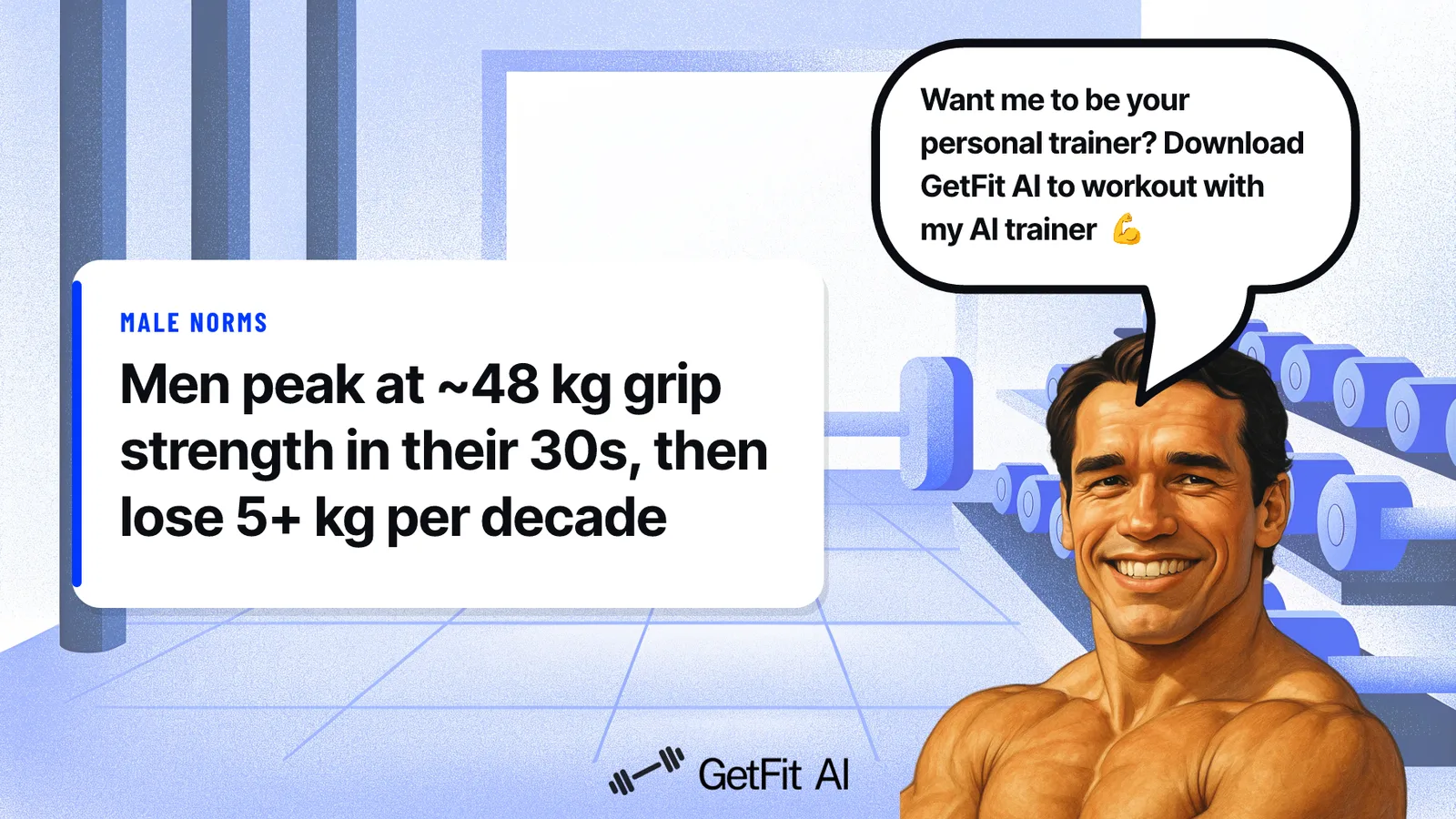
Grip strength peaks for men in the 30 to 39 age group, where NHANES normative data records the highest mean grip scores across all adult decades. The table below converts the NHANES-sourced ranges into both units so you can locate your score without doing any math.
| Age Band | Range (kg) | Range (lbs) | Mean (kg) |
|---|---|---|---|
| 20-29 | 40-56 kg | 88-123 lbs | ~46 kg |
| 30-39 | 41-57 kg | 90-126 lbs | ~48 kg |
| 40-49 | 39-55 kg | 86-121 lbs | ~45 kg |
| 50-59 | 35-51 kg | 77-112 lbs | ~41 kg |
| 60-69 | 30-45 kg | 66-99 lbs | ~37 kg |
| 70-79 | 26-40 kg | 57-88 lbs | ~32 kg |
| 80+ | below 30 kg | below 66 lbs | ~25 kg |
These ranges are independently cross-validated by BMC Research Notes, Hand Grip Strength: age and gender stratified normative data in a population-based study (Massy-Westropp et al.), a population-based study that stratified normative grip data by both age and gender across community-dwelling adults. Two independent, population-scale datasets pointing to the same numbers is about as solid a benchmark as you will find outside a clinical trial.
One number that tends to distort men’s self-assessment: the all-ages population mean for adult men lands lower than most gym-goers assume, often surprising lifters who benchmark themselves against elite athletes rather than the general population. That figure looks embarrassingly low next to elite combat athletes, and it should make you curious rather than defeated. The benchmark exists to tell you where the general population sits, not to define your ceiling.
Peak and Decline: Why Your Late 20s Are the High-Water Mark
Grip strength peaks sharply in the late 20s to mid-30s, then holds relatively stable into the early 40s before erosion accelerates. Longitudinal research consistently documents a meaningful annual decline in grip force after age 40 in men who are not training deliberately for it. That decline sounds small until you consider the cumulative effect: compounded over a decade, even a modest annual rate of muscle loss adds up to a substantial reduction in strength without ever noticing a single bad day in the gym.
The NHANES data makes this concrete. The mean drops from 48 kg in the 30s to 41 kg in the 50s, a loss of about 7 kg across two decades. That is a measurable, trackable signal. The Massy-Westropp et al. population-based study reinforces the same trajectory, showing consistent age-related decline across both sexes with the steepest drop beginning in the fifth decade.
Deliberate, structured training separates men who follow that decline curve from men who don’t. GetFit AI’s Athlete-Style Custom Workout Plans are designed precisely for this: they give you a program arc that builds grip-relevant pulling and carrying strength across sessions, not just a random collection of exercises. Men who have previously struggled with consistency because they lacked program structure tend to see the clearest gains, because the structure removes the friction of deciding what to do next from the very first session.
Nutrition is the other lever most men underestimate. Whether your goal is to put on the lean mass that supports grip force output or to lean out without sacrificing the strength you have already built, GetFit AI can tell you exactly what to eat to get there, not generic macros, but targeted guidance aligned to your training load.
How to Read Your Score Against the Table
Find your age band. Locate your dominant-hand score in kilograms or pounds. If you land in the lower third of your band’s range, you are below the population midpoint for men your age. If you land above the top of the range, you are outperforming most of your cohort.
A practical obstacle worth naming: dynamometers are absent from commercial gyms, which makes self-assessment harder than it should be. If your facility doesn’t have one, a calibrated handheld dynamometer is inexpensive enough to own, and the test itself takes under two minutes. GetFit AI’s free workout routines include grip-focused training you can start tracking progress against immediately, even before you have a baseline number, so you are building in the right direction while you sort out measurement.
One honest limitation of the table itself: the NHANES ranges are population norms drawn from general community samples, not competitive or highly trained populations. If you have spent years under a structured program, you may already outpace the upper band for your age. That is a meaningful result, but it does not mean the table is broken. It means you are an outlier in the right direction. The Massy-Westropp et al. normative dataset, further supported by the NIH Toolbox project’s standardized grip assessment protocols, offers an additional reference point if you want to triangulate your score across more than one population sample.
GetFit AI’s structured training programs are available across multiple subscription tiers, including weekly, monthly, and yearly options, so the structured programming is accessible regardless of where someone is in their commitment arc. The social layer, friends, challenges, and leaderboards, is most valuable once you have connected with at least one training partner also using the app; that accountability layer is what keeps most users training consistently past the critical third week.
Related Reading
- Best Fitness Apps
- How Many Pull Ups Should I Be Able To Do
- Average Bench Press
- How Much Does A Bench Press Bar Weigh
- Average Male Bench Press
- How Much Can The Average Man Bench Press
- Grip Strength Chart
- Symmetric Strength
- Bench Press Standards
How Grip Strength Affects Your Health and Longevity: What the Research Actually Shows
Most people treat grip strength as a gym metric and nothing more. The research positions it differently: as a validated clinical signal that reflects how well your entire musculoskeletal system is functioning, with direct implications for long-term health outcomes that go well beyond what you can lift. Knowing what that evidence actually shows is what separates tracking a number from knowing what to do with it.
Grip Strength as a Validated Clinical Biomarker
The common assumption among beginner lifters, typically in their mid-20s to early 30s, training without a structured plan and with little attention to nutrition, is that knowing their average grip strength is enough, and that it will naturally improve over time just by showing up. That assumption is wrong, and the clinical evidence makes clear why it matters.
Grip strength matters for health because it is one of the most reliable proxies your body offers for overall musculoskeletal function. According to the EWGSOP2 (European Working Group on Sarcopenia in Older People 2), ‘Sarcopenia: revised European consensus on definition and diagnosis’, Age and Ageing, low grip strength is now ranked as the primary indicator of probable sarcopenia, sitting above muscle mass itself in the diagnostic hierarchy. That repositioning matters: strength predicts adverse outcomes more reliably than volume of muscle tissue alone.
A dynamometer reading captures how well your nervous system recruits muscle fibers under load. It reflects neuromuscular integrity, not just forearm bulk. That is why clinicians use it as a frontline screen rather than ordering an MRI every time they suspect accelerated muscle loss. And it is why shoulder-injured beginners, who instinctively gravitate toward low-risk movements like dead hangs to rebuild upper-body capacity, are already, even without knowing it, addressing exactly this system. Grip and shoulder health are expressions of the same neuromuscular chain the EWGSOP2 framework is designed to protect.
One pattern we see consistently with beginners at this stage: training effort is there, but nutrition is working against the adaptation. Sorting out eating so that training finally shows up in the numbers, grip, strength, body composition, is not a lifestyle bonus. It is the missing lever, and it belongs inside the same structured program as the workouts themselves.
Below 27 kg (60 lbs): the Clinical Sarcopenia Threshold
27 kg is the number. The EWGSOP2 consensus sets the cutoff for probable sarcopenia in men at less than 27 kg. Fall below it and you have crossed a threshold that clinicians use to flag accelerated muscle deterioration. A man in his early 40s sitting at 28 kg is one bad training block away from that line, and most have no idea they are that close.
The threshold also has real-world range implications. Research from the ELSI-Brazil Study (Lima et al., Cadernos de Saúde Pública) found that applying the EWGSOP2 cut-off of less than 27 kg flagged 10.6% of adults aged 50 and older as having probable sarcopenia. When a higher threshold was applied, that figure quadrupled to 40.1%. The chosen number changes everything about who gets identified as at risk.
This is precisely where a lack of program structure becomes a compounding liability. Beginners who have previously struggled with consistency, skipping sessions, rotating randomly between exercises, never progressing a program long enough to measure change, are the ones most likely to discover they have quietly drifted toward that threshold. GetFit AI’s Athlete-Style Custom Workout Plans address this from the first workout session, building a structured training arc that creates the progressive overload grip strength actually requires, rather than the random accumulation of effort that leaves the neuromuscular system under-challenged.
Structured training is most beneficial precisely for users who have struggled with consistency due to lack of program structure, and the program architecture is designed to maintain that structure across each individual session and the broader training trajectory.
What Low Grip Strength Actually Predicts
The EWGSOP2 framework treats low grip strength as a reliable early signal for a cluster of downstream health risks beyond muscle loss. Muscle loss with age is a well-established driver of frailty and falls, and grip strength is one of the few markers you can measure directly, repeatedly, and without clinical equipment. Multiple industry sources have linked grip force below population norms to elevated cardiovascular risk, and longitudinal work in older adult cohorts consistently shows that men who fall below age-adjusted grip thresholds report higher rates of functional limitation, slower recovery from illness, and reduced overall quality-of-life scores in the years that follow.
The number on the dynamometer is not predicting how hard you shake hands. It is signaling how well your neuromuscular system is holding together under the accumulated load of daily life, and whether the training and nutrition structure you have in place is actually defending that system over time.
The number on the dynamometer is not predicting how hard you shake hands.
How to Measure Your Grip Strength Accurately, and What to Do With the Result
The grip strength chart is only as useful as the method that produced the number you’re comparing against it, and most men never consider this. Walk into any gym and ask someone how they tested their grip, and you’ll hear answers ranging from “I held a plate for as long as I could” to “I just know my deadlift is strong.” Neither produces a score that maps to population norms. Neither tells you where you actually stand.
The Standardized Dynamometer Protocol
The test itself is simple, but the conditions are precise. According to the Shirley Ryan AbilityLab RehabMeasures Database (2023), the subject sits with the elbow flexed at 90 degrees, forearm in neutral position, wrist between 0 and 30 degrees of dorsiflexion. The dominant hand squeezes a calibrated dynamometer (typically a Jamar model) for three trials, and the peak reading is recorded. That score, and only that score, is comparable to the normative age charts.
Why Elbow Angle and Trial Count Matter
Change the elbow angle and the muscles contributing to the squeeze shift. Skip the three-trial average and you lose the reliability buffer that accounts for warm-up effects and momentary fatigue. The Shirley Ryan AbilityLab data is direct on this point: without consistent administration conditions, same device, same posture, same trial count, score changes across sessions cannot be distinguished from changes in testing conditions. You are measuring noise.
Gym Alternatives and the One Thing They Can’t Give You
Dead hangs and plate pinches build grip endurance and pain tolerance. What they cannot do, per the Shirley Ryan AbilityLab RehabMeasures Database (2023), is produce a score that maps to normative clinical data. Because population benchmarks were generated under standardized dynamometer conditions, a timed dead hang or a plate pinch gives you no comparable number, only a rough sense of relative endurance. Both exercises have real training value; neither replaces a calibrated test when the goal is knowing where you stand against age-matched norms.
Related Reading
- Do Pull Ups Work Chest
- Grip Strength Norms
- Average Deadlift Weight
- 1 Rep Max Chart
- Average Male Deadlift
- Good Bench Press Weight
- Weightlifting Standards
- Average Bench Press Kg By Age
- Average Deadlift Weight Kg
How to Improve Grip Strength: Why Random Gym Sessions Won’t Move the Number
Knowing where you stand against average grip strength numbers is only half the problem. The other half is understanding why the training most guys are already doing will never move that number, no matter how often they show up. What follows breaks down the specific reasons unstructured gym sessions entrench a plateau rather than break one, and what actually has to change.
Why the “Same Three Machines” Routine Produces a Flatline Grip Score
The cable row, the lat pulldown, the assisted pull-up machine. Most guys rotate through the same three stations every week, adding nothing, changing nothing. The problem isn’t the exercises.
It’s that the load never changes, so the neuromuscular system never receives a reason to adapt. According to a July 2025 network meta-analysis in Frontiers in Physiology, Optimal dose of resistance training to improve handgrip strength in older adults with sarcopenia: a systematic review and Bayesian model-based network meta-analysis, the specific dose variables of resistance training, frequency, load progression, and modality, are the active ingredients that drive grip improvement, not effort or attendance alone. Unstructured training doesn’t just stall progress.
It actively cements a ceiling.
Consistent gym attendance can entrench a plateau. The neuromuscular system adapts quickly to a repeated stimulus, then stops responding. After that baseline adaptation, showing up without a structured grip strength training plan confirms the ceiling is permanent. One of the most common hidden limiting factors we see isn’t a weak lat or a lagging bicep. It’s grip. Lifters plateau on deadlifts and rows for months and blame the target muscle, never suspecting their hands are the actual bottleneck.
There’s also an injury dimension that gets almost no attention at the beginner stage: tendons recover significantly slower than muscles. Hands can feel completely fine after a session while the tendons are accumulating load they haven’t absorbed yet. Ramping up grip work too fast, especially without a structured plan governing the progression, is one of the most reliable paths to tendonitis and the kind of stubborn inflammation that stalls training for weeks. Knowing what to do and at what rate to increase it isn’t optional. It’s the difference between building grip and injuring it.
That’s exactly where GetFit AI’s Athlete-Style Custom Workout Plans and Structured Training layer intervene. From the very first workout session, the plan tells you which exercises to do, how many sets, and in what order, so you’re never standing in the gym guessing what comes next, and you’re never self-prescribing a load jump your tendons aren’t ready for. If the station you need is taken, you can swap an exercise on the fly without losing the structure of the session. The program arc handles the progression; you handle the execution.
The Four Movement Categories That Actually Drive Grip Gains
These four categories create the specific mechanical demands the forearm and hand musculature need to grow stronger:
-
Dead hangs
-
Fat-grip pulling variations
-
Plate pinches
Each targets a distinct grip demand: crush strength, support strength, pinch strength, and wrist stability. Training only one, or none, leaves most of the adaptation potential untouched. Grip strength exercises need to be sequenced across all four categories to produce a measurable score change.
Most beginners don’t think about their hands at all when planning a fitness routine. Grip is invisible until it fails. GetFit AI’s structured plans surface grip work explicitly and sequence it across all four movement categories, removing the guesswork about where to start and ensuring no single demand goes untrained across the program arc.
Progressive Overload vs. Random Volume
The difference shows up clearly on a training log. A periodized log shows load increasing week over week, rest periods tightening, and grip-intensive movements rotating in at calculated intervals. A random log shows the same weights, the same machines, the same rep ranges, repeated indefinitely. “I’ve been stuck at the same weight for months” is the exact phrase that signals a progressive overload problem, not a biology problem. The structure is what separates training from exercise.
GetFit AI’s Structured Training is most beneficial precisely when a user has previously struggled with consistency due to lack of program structure, which is the norm for anyone who has spent time cycling through the same three machines without a plan. The friends, challenges, and leaderboards layer compounds this: after connecting with at least one friend in the app, the social accountability becomes the retention mechanism that keeps users training past week three, which is the exact window where unstructured routines tend to collapse back into habit.
For users who want to stay in the ecosystem across different budget windows, GetFit AI offers weekly, monthly, and yearly subscription options, so the structured programming is accessible regardless of where someone is in their commitment arc.
Grip Strength After 40: A Consistency Problem, Not a Biology Sentence
The Efficacy of 12-Week Handgrip Strength Training Program Amongst Older Adults: A Pilot Study, The Sport Journal found that a structured 12-week handgrip strength program produced measurable grip improvements in older adults, directly contradicting the assumption that age makes the number immovable. The Frontiers in Physiology network meta-analysis corroborates this: physical activity level, and specifically whether that activity applies progressive overload across time, is the determining variable. Age sets the biological context; structured programming determines the trajectory within it.
Related Reading
- Average Deadlift Weight For Male
- Best Calisthenics Workout App
- Best Hiit Workout App
- Best Gym Workout App
- Best Workout Apps
- Best Free Workout Apps
Stop Guessing in the Gym: Get a Plan That Actually Moves Your Numbers
Knowing where your grip strength lands on the chart is only useful if something changes because of it. This section covers the structural difference between having a number and having a plan built to move it, specifically why progressive, periodized programming is what converts a baseline score into actual improvement. That is the gap GetFit AI is designed to close.
The Chart Gave You a Gap, Here Is the Infrastructure That Closes It
Most guys who find their score below average walk back into the gym and do exactly what they did the week before. Same machines, same weights, same order. The effort is real. The structure is not. According to The Sport Journal’s 2025 pilot study, statistically significant grip strength improvements came from deliberate, periodized programming, not unstructured activity. Knowing your starting number is necessary but insufficient; the plan is the mechanism.
Why Week-Over-Week Progression Is the Actual Variable
The research design makes the point clearly: establish a baseline, apply a prescribed progressive plan, measure at a defined interval. That sequence is a research formality. It is the only sequence that converts a number on a chart into a real outcome. Random sessions do not accumulate. They reset.
What a Structured Grip-Relevant Program Looks Like in Practice
Grip strength responds to compound work you are likely already supposed to be doing. Deadlifts, rows, and farmer carries all transfer directly to grip, so a well-built full-body plan addresses the gap without a separate “grip day.” An AI fitness trainer app like GetFit AI generates a week-over-week progressive plan built around the movements that move grip numbers, deadlifts, loaded carries, and pulling variations, so every session applies a deliberate stimulus rather than repeating the same ceiling. That structure is most useful when you have a baseline score to track against.
Next steps
If your grip score is sitting on the chart with nowhere to go, the path forward starts with connecting that number to a structured, progressive plan. A population norm tells you where you stand today; it cannot tell you whether you are losing ground faster than your peers, or whether what you are calling “training” is quietly cementing a ceiling rather than raising it. Start with our AI fitness app.
The research on unstructured training is unambiguous: after an initial baseline adaptation, consistent gym attendance without progressive overload does not move grip strength forward, it entrains a plateau. At the same time, the clinical evidence shows that the dangerous zone is not always below the 27 kg sarcopenia threshold; it is the wide band between clinically low and population average, where a man feels fine, tests as normal, and receives no warning signal. Together, those two findings point to the same action: replace unstructured effort with a periodized program that applies deliberate, measurable overload from the first session forward, tracked against a real baseline.
Start with GetFit AI to get a custom, week-over-week progressive plan built around the compound and grip-specific movements the research points to. From the first session, the structure removes the guesswork, adjusts as you adapt, and gives your score somewhere to go.
Frequently Asked Questions
What is the clinical cut-off for low grip strength in men?
The EWGSOP2 consensus sets the threshold for probable sarcopenia in men at less than 27 kg. Falling below that number is not just a gym metric, it is a clinical flag for accelerated muscle deterioration that doctors use as a frontline diagnostic signal.
At what age does grip strength peak in men, and when does it start declining?
Grip strength peaks for men in the 30 to 39 age range, where NHANES normative data records the highest mean score of around 48 kg. The decline accelerates meaningfully after age 40, the mean drops to roughly 41 kg by the 50s, and longitudinal research documents a measurable annual loss in men who are not training deliberately for it.
How do I know if my grip strength is below average for my age?
Find your age band in the normative table and compare your dominant-hand dynamometer score. If your score falls in the lower third of your band’s range, you are below the population midpoint for men your age; if it exceeds the top of the range, you are outperforming most of your cohort.
Can I use a dead hang or plate pinch instead of a dynamometer to compare myself to the norms?
No, those exercises have real training value but cannot produce a score that maps to population norms. Because the normative age charts were generated under standardized dynamometer conditions (seated, elbow at 90 degrees, three trials), a timed dead hang or plate pinch gives you only a rough sense of relative endurance, not a comparable benchmark.
Is grip strength decline with age inevitable, or can training slow it down?
Training is the key variable that separates men who follow the decline curve from men who don’t. The post is explicit that deliberate, structured training, rather than random effort, is what creates the progressive overload grip strength actually requires to hold ground against age-related loss.







