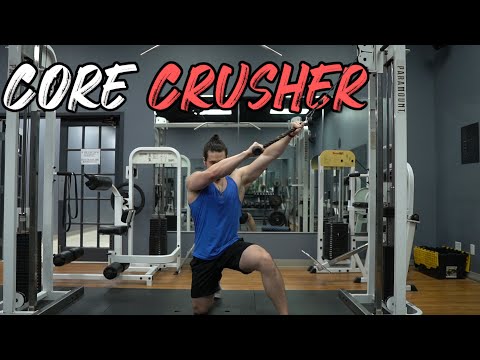
Tall Kneeling Cable Chop Overview
The tall kneeling cable chop builds your obliques, the muscles on the sides of your belly. It also works your abs, shoulders, and lats. You kneel tall on both knees beside a cable machine. You set the cable up high. Then you pull the handle down and across your body in a chopping motion. Kneeling takes your legs out of the move. That makes your core do all the work. This move builds a strong, steady middle. It is good for people who already lift weights. It teaches your core to resist twisting. Use the tall kneeling cable chop on core day. It also warms up your body well. It fits into any workout.
What Is The Point of the Tall Kneeling Cable Chop?
The tall kneeling cable chop builds explosive rotational power and strengthens your core. It targets your obliques while teaching your body to transfer force through your midsection.
How To Do The Tall Kneeling Cable Chop
- Set a cable pulley to a high position and attach a handle or rope. Kneel tall on both knees beside the machine, roughly perpendicular to the cable, with your hips fully extended and your torso upright.
- Grab the handle with both hands and position yourself so the cable is taut when your arms reach up toward the high anchor. Your inside arm will be closer to the stack.
- Brace your core hard and squeeze your glutes so your hips stay stacked under your shoulders. This tall kneeling position removes your legs and forces your trunk to do the work.
- Start with your arms extended up and across toward the pulley, feeling a stretch through your torso on the cable side.
- Pull the cable down and across your body in a chopping motion toward your opposite hip. Rotate through your trunk, driving from your obliques, while keeping your hips square and stable.
- Finish with your hands down by the far hip and your torso rotated, keeping your arms fairly straight so the core, not the arms, does the work.
- Pause briefly at the end position and feel the obliques fully contracted. Do not let your lower back arch or your hips twist.
- Return the cable back up and across under control, resisting the pull the whole way rather than letting it yank you back. Fight the cable's tension throughout the return.
- Complete all your reps on one side, then switch your kneeling orientation to work the other side. Most people train this in the 8 to 15 rep range per side for 2 to 4 sets, keeping the tempo controlled.
Tall Kneeling Cable Chop Form Tips
- Kneel tall with your hips straight, not sitting back.
- Keep your core tight through the whole move.
- Twist from your belly muscles, not your arms.
- Pull the cable down and across to your opposite hip.
- Keep your arms fairly straight and steady.
- Move slowly and with control both ways.
- Breathe out as you chop down. Breathe in as you return.
- Fight the cable pull on the way back.
- Keep your shoulders down and relaxed.
- Face sideways to the cable the whole set.
Common Mistakes to Avoid for the Tall Kneeling Cable Chop
- Yanking the cable with your arms instead of your core. If you bend and pull with the elbows, the chop becomes an arm exercise and the obliques barely fire. Keep your arms fairly straight and drive the motion by rotating your trunk.
- Letting the hips twist and open up. When your hips spin along with your torso, you lose the anti-rotation and oblique work that make this valuable. Squeeze your glutes and keep your pelvis square while only your upper trunk rotates.
- Collapsing at the hips or sitting back on your heels. Sinking into your heels turns off the glutes and lets your posture fold. Stay tall with your hips fully extended and stacked under your shoulders.
- Arching the lower back to move the weight. Overextending the lumbar spine to help the chop strains the back and cheats the abs. Keep your ribs down and your core braced so the movement stays in the trunk.
- Going too heavy and losing control. Ego weight forces you to heave with the whole body and drop the strict rotation. Pick a load light enough that your obliques clearly drive the chop.
- Rushing the return phase. Letting the cable snap your arms back up wastes the eccentric and can pull you off balance. Resist the pull and control the return every rep.
- Not rotating far enough through the trunk. A tiny turn keeps the movement in the arms and shoulders and skips the oblique work. Rotate your ribcage fully toward the opposite hip while keeping the hips square.
- Holding your breath through the chop. Locking your breath spikes pressure and makes the tall kneeling position wobbly. Exhale as you chop down and breathe in as you return.
- Setting up too close to or too far from the pulley. Wrong distance kills the tension at one end of the range or drags you off your knees. Position yourself so the cable stays taut through the full chop.
- Losing your balance and shifting your knees. Wobbling around means your core is not stabilizing and your reps get sloppy. Widen your knees slightly for a stable base and keep your midsection tight.
- Doing more reps or effort on your stronger side. Rotational imbalances show up fast in posture and sport, so uneven work builds a real problem. Match the reps and control on both sides.
- Treating it as a pure strength move rather than control. Chasing a heavy cable stack misses the point, which is trunk stability and clean rotation. Prioritize crisp, controlled reps over load.
Tall Kneeling Cable Chop Workout Tips
- Think of this as core control, not a big pulling exercise. The value is in stabilizing your hips while your trunk rotates against the cable, which builds real anti-rotation strength.
- Keep your arms straight and rotate from the trunk. Long arms turn the cable into a lever your obliques must control, so the core does the work instead of the shoulders.
- Squeeze your glutes to lock the hips. A hard glute contraction keeps your pelvis square and stacked, which is what separates a good chop from a full-body twist.
- Stay tall through the whole set. Keeping your hips extended and torso upright challenges your core to hold posture while it rotates, which carries over to sport and lifting.
- Use a controlled tempo on both directions. Owning the return, not just the chop, doubles the useful work and keeps you balanced on your knees.
- Program it as a core accessory on any day. It fits well at the end of a lower-body or full-body session when you want rotational and anti-rotation work.
- Keep the reps moderate, around 8 to 15 per side. This is a control exercise, so quality rotation beats a heavy stack and sloppy form.
- Progress with small weight jumps or a slower tempo. Steady overload on a stability move means adding just enough load that your form still holds.
- Widen your knees for a more stable base. A slightly wider kneeling stance keeps you from wobbling so you can focus on the trunk rotation.
- Match your work on both sides. Rotational training exposes imbalances quickly, so give each side equal reps and effort.
- Try the reverse motion, a low-to-high lift, for variety. Chopping down and lifting up hit the obliques through different angles and round out your rotational strength.
- Brace as if someone might push you sideways. That mental cue turns on the deep core muscles that keep your spine safe under rotation.
- Film a set from the front. Video quickly reveals hips that twist or a back that arches, which are hard to feel in the moment.
- Use it to build athletic power. Chopping, swinging, and rotational sports all draw on this exact pattern, so clean reps here transfer to the field.
- Pair it with anti-rotation holds like the Pallof press. Training rotation and resisting rotation together builds a complete, resilient core.
- Keep the load honest and the motion crisp. This is a coordination and stability lift, so a lighter cable moved perfectly beats a heavy one that turns into a heave.








Questions & Comments
Be the first to ask a question about this exercise.