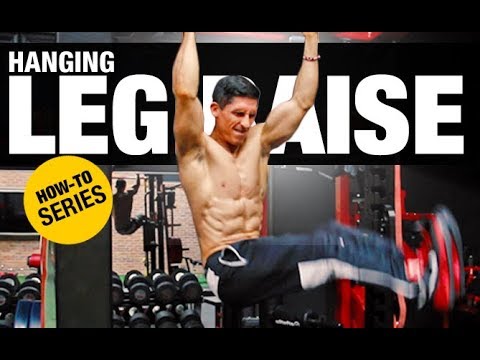
Hanging Knee Tuck Overview
The hanging knee tuck is a pull move for your belly. You hang from a pull-up bar. It works your abs the most. The abs are the muscles on the front of your belly. It also works your hip flexors and your forearms. The hip flexors are the muscles at the front of your hips. You pull your knees up while you hang. The hanging knee tuck is good for lifters with some practice. It builds strong abs and a solid core. It also builds a strong grip. A strong core helps every other lift you do. It fits well at the end of a workout. You can add it to any core day. All you need is a bar to hang from.
What Is The Point of the Hanging Knee Tuck?
The hanging knee tuck exercise builds strong abs and hip flexors while hanging from a bar. It targets your core harder than basic crunches and builds functional strength.
How To Do The Hanging Knee Tuck
- Reach up and grab a pull-up bar with an overhand grip about shoulder-width apart. Hang with your arms fully extended and pull your shoulders down and back so you are not just dangling from loose joints.
- Engage your shoulders and lats to create a stable hang. This active hang protects your shoulders and gives your core a solid base to work from.
- Set your core before you move. Take a breath, brace your abs, and let your legs hang together with a slight bend in the knees.
- Initiate the movement by curling your pelvis up and crunching your abs, not just lifting your legs. The goal is to bring your knees toward your chest by rounding your lower back slightly, which is what fires the abs.
- Pull your knees up toward your chest in one smooth, controlled motion. Think about tucking your hips under, not just raising your thighs, so the abs do the work instead of the hip flexors.
- Hold the top position for 1 to 2 seconds and squeeze your abs hard. This pause kills any swing and forces the muscle to actually work.
- Lower your legs back down slowly under control over 2 to 3 seconds until you return to a full hang. Resist the urge to just drop your legs.
- Keep your body from swinging by staying tight through the core and lats. If you start swinging, pause and reset rather than kipping through reps.
- Repeat for your target reps, usually 8 to 15 per set for 3 to 4 sets. Add reps or a light dumbbell between your feet once bodyweight feels easy.
Hanging Knee Tuck Form Tips
- Hang with your arms straight. Keep your shoulders active, not loose.
- Pull your knees up with your abs. Do not swing them up.
- Curl your hips up a little at the top. This works your abs more.
- Move slowly the whole time. Do not use a swing.
- Hold at the top for a second to feel the squeeze.
- Lower your legs slowly and with control.
- Keep your core tight the whole set.
- Breathe out as you pull up. Breathe in as you lower.
- Keep your body from swinging front to back.
Common Mistakes to Avoid for the Hanging Knee Tuck
- Swinging your body to generate momentum. Using a kip or pendulum swing lets your body throw your legs up instead of your abs lifting them. Stay tight through your lats and core, and pause at the bottom if you need to kill the swing.
- Only lifting with your hip flexors. Raising your knees by hinging at the hips without curling your pelvis leaves the abs barely working. Focus on tucking your hips under and rounding your lower back slightly so the abs drive the movement.
- Dropping your legs fast on the way down. Letting your legs fall wastes the eccentric, which is prime muscle-building time for the abs. Lower under control over 2 to 3 seconds on every rep.
- Hanging with loose, passive shoulders. A dead hang with slack shoulders stresses the joint and gives your core no stable base. Pull your shoulders down and engage your lats to create an active, protected hang.
- Cutting the range of motion short. Barely lifting your knees keeps the abs from fully contracting. Pull your knees high enough to feel a strong crunch and hold at the top.
- Rushing through reps. Blasting through fast repetitions relies on momentum and skips the muscle tension. Slow the tempo down so the abs control every inch of the movement.
- Not pausing at the top. Skipping the squeeze at the top means you miss the peak contraction. Hold for 1 to 2 seconds and flex your abs hard before lowering.
- Holding your breath the whole set. Poor breathing weakens your brace and lets your form fall apart. Exhale as you crunch up and inhale on the way down to keep your core tight.
- Straining your neck by cranking it forward. Jutting your head to help lift puts stress on your neck and does nothing for your abs. Keep your head neutral and let the core do the work.
- Gripping so weakly you fall off before the abs tire. If your grip gives out first, you never fully fatigue the target muscle. Use straps or build grip strength so your abs are the limiting factor.
- Adding weight before you own bodyweight. Clamping a dumbbell between your feet while your form is shaky just reinforces bad patterns. Earn clean, controlled bodyweight reps first, then add small amounts of load.
Hanging Knee Tuck Workout Tips
- Think about curling your pelvis up, not just lifting your legs. Tucking your hips under is the cue that shifts the work from your hip flexors to your abs, which is the whole point of the movement.
- Create an active hang by pulling your shoulders down and engaging your lats. This protects your shoulders and gives your core a stable platform to work against.
- Pause and squeeze at the top for 1 to 2 seconds. That peak contraction kills momentum and makes the abs do all the work.
- Control the lowering phase over 2 to 3 seconds. The eccentric builds a lot of core strength, so resist your legs down instead of dropping them.
- Kill any swinging by staying tight. If you start to pendulum, pause at the bottom and reset, because a swinging body means momentum is doing the lifting.
- Program this as a core builder on almost any training day. It doubles as grip work since you are hanging the whole time.
- For growth and strength, aim for 3 to 4 sets in the 8 to 15 rep range. Once bodyweight feels easy, progress to keep challenging the abs.
- Progress by adding reps, slowing the tempo, or holding a light dumbbell between your feet. Progressive overload works on abs just like any other muscle.
- Advance toward hanging leg raises over time. Straightening your legs increases the lever and makes the abs work much harder.
- Use lifting straps if your grip gives out before your abs. That keeps the abs as the limiting factor so you can actually train them to fatigue.
- Keep your movement smooth and controlled, never jerky. Smooth reps keep constant tension on the abs and protect your shoulders.
- Film your set from the side to check for swinging. A quick video shows whether you are cheating with momentum far better than it feels mid-set.
- Breathe out hard as you crunch up. A strong exhale helps your abs contract fully and keeps your core braced.
- Do not train abs to failure every session. Leaving a rep in reserve keeps your form clean and protects your lower back and shoulders.
- Keep your neck relaxed and neutral. Let the abs curl your body up rather than straining your head forward.
- Be consistent. A strong, visible core comes from steady, controlled work plus good nutrition, not from one heroic session.








Questions & Comments
Be the first to ask a question about this exercise.