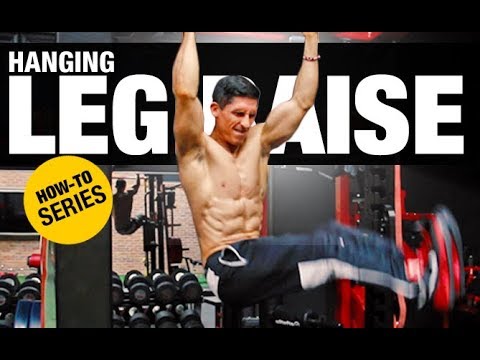
Hanging Leg Raise Overview
The hanging leg raise builds strong lower abs. It works your abs most, the muscles on the front of your belly. It also works your hip flexors and forearms. Your hip flexors are at the top of your thighs. You hang from a pull-up bar and lift your legs up. Your grip holds you the whole time. The hanging leg raise is a tough ab move. Your body weight makes it hard. It builds real core strength and a strong grip. It is a good pick once your core is ready. Use the hanging leg raise on core day. Do it at the end of your workout. Try to lift with no swinging.
What Is The Point of the Hanging Leg Raise?
The hanging leg raise builds serious core strength and muscle. It targets your abs harder than most floor exercises and improves grip strength too.
How To Do The Hanging Leg Raise
- Grab a pull-up bar with an overhand grip about shoulder width apart and hang with your arms straight. Engage your shoulders by pulling them down slightly so you are not just dangling from loose joints.
- Set your body in a stable hang and squeeze your shoulder blades to create tension. This active hang protects your shoulders and gives your core a solid anchor to work against.
- Brace your core and tilt your pelvis slightly so you start from a strong position. This posterior tilt is what shifts the work from your hip flexors toward your abs.
- Take a breath and begin lifting your legs by curling your pelvis up first, not just swinging your legs. The initiation should feel like your abs are rolling your hips toward your ribs.
- Raise your straight legs up until they are at least parallel to the floor. Keep the movement controlled and think about crunching your abs rather than only bending at the hips.
- Hold the top position for a second and squeeze your abs hard. The higher you curl, the more the abs work, so aim to bring your legs up and slightly toward you at the top.
- Lower your legs slowly and under control back to the hanging position, taking about two to three seconds. Resisting the descent is where a lot of the ab work happens.
- Come to a full, still hang before the next rep so you do not build a swing. Keep your body from rocking and repeat for 8 to 15 controlled reps.
Hanging Leg Raise Form Tips
- Keep your shoulders pulled down and tight. Do not just dangle.
- Lift your legs with your abs, not a swing.
- Keep your legs straight if you can.
- Raise them at least to level with the floor.
- Squeeze your abs hard at the top.
- Lower your legs slowly. No dropping.
- Keep your body still. Stop the swing.
- Grip the bar firm the whole time.
- Breathe out as you lift. Breathe in as you lower.
Common Mistakes to Avoid for the Hanging Leg Raise
- Swinging the body to fling the legs up. Using a pendulum swing lets momentum do the work and takes the abs out of the movement. Come to a dead hang between reps and lift your legs with control so the abs, not momentum, do the lifting.
- Only bending at the hips. If you just raise straight legs from the hip joint, your hip flexors dominate and the abs barely fire. Curl your pelvis up toward your ribs first so the abs actually flex the spine.
- Not lifting high enough. Stopping with the legs well below parallel keeps the abs from fully working. Raise your legs to at least parallel, and higher if you can, to get real abdominal contraction.
- Hanging with loose shoulders. Dangling from relaxed shoulders stresses the joint and gives your core nothing to anchor against. Pull your shoulders down and engage your lats to create a stable, active hang.
- Rushing the lowering phase. Letting your legs drop fast wastes the eccentric and feeds a swing. Lower over two to three seconds under control to keep tension on the abs and stay stable.
- Straining the grip until the core quits early. If your hands give out before your abs, you cut the set short. Build your grip over time or use straps so you can train the abs to true fatigue.
- Craning the neck forward. Poking your head to watch your legs strains the neck without helping the abs. Keep your head neutral and let your abs curl your pelvis up.
- Holding your breath through the reps. Locking your breath makes it harder to fully contract the abs and can spike your pressure. Breathe out as you raise your legs and in as you lower.
- Bending the knees to cheat when tired. Tucking your knees makes the movement much easier and reduces the ab work if you are supposed to keep legs straight. If you must bend to finish, treat it as a scaled version, not a full rep.
- Building a swing across reps. Letting each rep add a little momentum turns the set into a rocking motion. Reset to a still hang before every rep to keep the abs in charge.
- Losing the pelvic tilt. Reaching an arched, hips forward hang at the bottom hands the work back to the hip flexors. Keep a slight posterior tilt so the abs stay engaged throughout.
Hanging Leg Raise Workout Tips
- Use the hanging leg raise to load the lower abs and train them through a big range. Hanging lets your abs work against gravity from a full stretch, which builds real strength and definition.
- Curl your pelvis up first, then lift the legs. Leading with a posterior pelvic tilt shifts the work from your hip flexors onto your abs, which is the whole trick to this exercise.
- Come to a dead hang between reps. Killing the swing forces the abs to start each rep from a stopped position and stops momentum from doing the work.
- Emphasize a slow, controlled eccentric. Lower your legs over two to three seconds, since resisting the descent is a major part of the ab work and keeps you from swinging.
- Scale to bent knee raises if straight legs are too hard. Tucking your knees shortens the lever and lets you build strength until you can control straight legs.
- Use lifting straps once your grip becomes the weak link. When your hands fail before your abs, straps let you push the core to true fatigue.
- Aim to lift higher over time. Bringing your legs above parallel and toward the bar increases the ab contraction, so make more height a progression goal.
- Program hanging leg raises on core or pull days. They pair naturally with your bar work since you are already gripping a bar, and they complement crunch style movements.
- Keep the reps in the 8 to 15 range. Controlled reps in this range build the abs better than a high rep swinging set that leans on momentum.
- Add a pause at the top for extra difficulty. Holding your legs up for a second at peak contraction removes any momentum and deepens the ab work.
- Engage your shoulders and lats in the hang. An active hang protects your shoulders and gives your core a firm anchor, which makes every rep more stable.
- Progress to weighted or toes to bar versions. Holding a light dumbbell between your feet or bringing your toes all the way to the bar adds serious challenge once bodyweight is easy.
- Film yourself from the side. It is hard to feel a swing or a hip flexor dominant pattern, and video shows whether your pelvis is really curling up.
- Pair leg raises with an anti extension exercise like planks. Raises hit the flexing job of the abs, and together with bracing work you build a complete, strong midsection.
- Do not chase visible abs through training alone. This exercise builds the muscle, but seeing your abs still depends on getting lean through your diet.
- Stay patient and consistent. Hanging leg raises are humbling at first, but steady practice builds impressive core strength and control over the months.








Questions & Comments
Be the first to ask a question about this exercise.