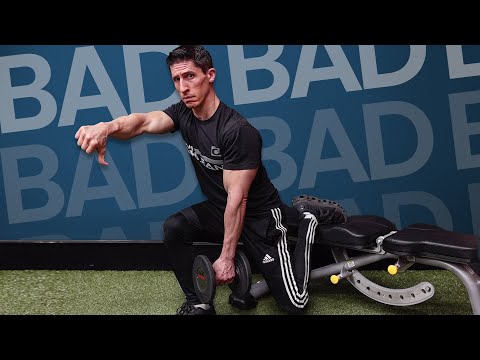
Bench One Leg Dumbbell Squat Overview
The bench one leg dumbbell squat is a single-leg move. It builds your glutes, the muscles in your butt. It also builds your quads, on the front of your thighs. Your hamstrings and belly help too. You hold a dumbbell in each hand at your sides. Your back foot rests on a bench behind you. This move builds strong, even legs and better balance. It trains one leg at a time. That fixes gaps between your left and right side. The dumbbells at your sides are easy to hold and control. The bench one leg dumbbell squat fits well on a leg day. Use it after your main squats. It works best with a weight you can handle for medium reps.
What Is The Point of the Bench One Leg Dumbbell Squat?
Bench one leg dumbbell squat builds single-leg strength and balance. It targets your glutes and quads while fixing muscle imbalances between legs.
How To Do The Bench One Leg Dumbbell Squat
- Stand a couple of feet in front of a bench holding a dumbbell in each hand at your sides. Reach one foot back and rest the top or ball of it on the bench behind you.
- Set your feet so most of your weight sits over your front leg and your front foot is planted flat. Keep the dumbbells hanging naturally at your sides.
- Stand tall, brace your core, and take a breath into your belly. Find your balance before you begin the descent.
- Lower straight down by bending your front knee and letting your back knee drop toward the floor. Keep your front shin close to vertical so the knee tracks over your mid-foot.
- Control the descent for about two seconds until your front thigh is roughly parallel to the floor. You should feel a strong stretch through the front glute and quad.
- Keep your weight in the front heel and mid-foot, and do not let the front knee cave inward. The back leg is there for balance, not for pushing.
- Drive up through your front heel to return to standing, keeping your torso tall and the dumbbells steady at your sides. Squeeze the front glute at the top.
- Keep your core braced and your chest proud throughout so you stay balanced and upright. Reset your breath between reps if you need to.
- Finish all reps on that leg, then switch. This unilateral builder works well in the 8 to 12 rep range for 3 to 4 sets per leg.
Bench One Leg Dumbbell Squat Form Tips
- Keep your chest up and your torso tall.
- Let the dumbbells hang straight down at your sides.
- Keep most of your weight on your front foot.
- Lower straight down, not forward.
- Keep your front knee over your foot.
- Push through your front heel to rise.
- Move slow on the way down.
- Brace your belly to stay steady.
- Breathe in as you lower. Breathe out as you stand.
Common Mistakes to Avoid for the Bench One Leg Dumbbell Squat
- Letting the front knee cave inward. Knee valgus stresses the joint and switches off the glute you want to train. Push the knee out in line with your toes and grip the floor with your front foot to keep it tracking cleanly.
- Setting the bench too close or too far. Too close jams your knee forward, and too far overstretches the front and strains the hip. Adjust your distance so your back knee drops straight down and your front shin stays near vertical.
- Pushing off the back foot. The rear leg is a kickstand for balance, not a driver, and pressing through it robs the front leg. Keep about 80 percent of your weight in the front heel and let the front leg do the work.
- Leaning your chest too far forward. Folding forward shifts load to your lower back and turns the squat into a hinge. Keep your torso tall with your ribs stacked over your hips throughout.
- Cutting the depth short. Half reps train only a small slice of range and skip the deep stretch where growth happens. Lower until your front thigh is about parallel, going as deep as your balance and mobility allow.
- Bouncing at the bottom. Dropping fast and rebounding off the stretch steals tension and stresses the knee. Control a two second descent and stand up smoothly under your own power.
- Rushing reps and losing balance. Speeding through a single-leg lift with dumbbells invites a stumble. Keep the tempo deliberate and settle your balance on each rep.
- Using dumbbells so heavy your form breaks. Ego loading a balance-demanding lift wrecks your knee tracking and posture. Pick a weight you can control for every rep, then add small jumps over time.
- Holding your breath the whole set. A lost brace leaves your spine soft and hurts your stability. Breathe in and brace before you descend, then exhale as you drive up.
- Letting the dumbbells swing. Swinging weights throw off your balance and add momentum you do not want. Keep them hanging quietly at your sides throughout the rep.
- Training your strong leg harder. Favoring your dominant side builds a visible imbalance over time. Start with your weaker leg and match its reps on the stronger side.
Bench One Leg Dumbbell Squat Workout Tips
- Keep your front shin close to vertical. This spares the knee and shifts more load onto the glute, which is a big part of the target.
- Drive up through your front heel. Heel pressure is your signal that the glute and quad are working rather than your toes and knee.
- Let the dumbbells hang quietly at your sides. Steady weights keep your balance clean and your core free to stabilize.
- Use a controlled two second descent. The slow eccentric keeps tension on the muscle and builds more size than dropping fast.
- Add a pause at the bottom on some sets. A dead-stop kills momentum and makes the front leg do all the work standing up.
- Squeeze the front glute hard at the top. Chasing that contraction sharpens the mind-muscle connection that grows the glutes.
- Program this after your main leg lifts for 3 to 4 sets of 8 to 12 per leg, when your legs are warm but not fried.
- Start with your weaker leg and match its reps. This is how you close a left-right strength gap over time.
- Loading with dumbbells keeps the weight low and easy to bail on. If you lose balance you can simply set them down, which makes this a great option to push close to failure safely.
- Fix your gaze on a spot a few feet ahead. A steady focal point calms the balance demand so you can push the muscle hard instead of fighting to stay upright.
- Progress with small dumbbell jumps you can actually control. Steady overload beats big ego leaps on a single-leg lift, and it keeps your knee tracking honest.
- Film a set from the side now and then. Video reveals knee cave and forward lean far better than how the rep felt in the moment.
- Set the bench height so your back knee clears comfortably. A bench too high tips you forward and cramps the position.
- Do not chase failure every set. Leaving a rep in reserve keeps your form and balance clean.
- Pair it with a hip thrust or bridge. Hitting the glutes stretched and shortened rounds out the whole muscle.
- Be patient with single-leg progress. Balance and strength build over months, so keep showing up and adding small doses of load.








Questions & Comments
Be the first to ask a question about this exercise.