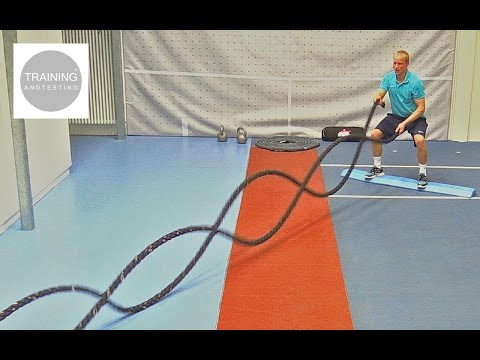
Alternating Waves with Kneeling Get Ups Battle Ropes Overview
The alternating waves with kneeling get ups battle ropes is a full body move. You make waves with heavy ropes while kneeling. Then you stand up and kneel back down. It works your shoulders the most. It also works your abs, your glutes, and your quads. The glutes are your butt muscles. The quads are the muscles on the front of your thighs. You need two battle ropes and floor space. This move builds strong shoulders and a strong heart. It mixes fast arm work with getting up and down. It is a hard, advanced move. It is best once you know the basic rope wave. Use it near the end of a workout for a big finish. It also works well in a fast circuit.
What Is The Point of the Alternating Waves with Kneeling Get Ups Battle Ropes?
The alternating waves with kneeling get ups battle ropes exercise builds explosive shoulder power while torching your core and legs. It combines cardio and strength training.
How To Do The Alternating Waves with Kneeling Get Ups Battle Ropes
- Anchor your battle ropes around a solid post and back away until the ropes are almost straight with just a little slack. Kneel down on both knees on a pad, hips tall, and take one rope end in each hand with a firm neutral grip.
- Set your posture before you move. Stack your shoulders over your hips, brace your abs as if bracing for a light punch, and tuck your chin so your spine stays long and neutral.
- Start the alternating waves by driving one arm down hard while the other snaps up, then reversing fast. The power comes from your shoulders and lats punching the rope, not from your wrists flicking.
- Keep the waves fast and even for 10 to 15 reps per arm. Breathe in short, sharp bursts and keep your torso quiet so the ropes take the load, not your lower back.
- Drop the ropes and step one foot forward flat on the floor to begin the kneeling get up. Drive through that lead heel and stand up tall without letting your front knee cave inward.
- Once you are fully upright, reverse the pattern under control. Step back down to the same knee, then the other, returning to your tall kneeling base rather than flopping down.
- Pick the rope ends back up, reset your brace, and fire off your next round of alternating waves. Alternate which foot leads the get up each round so both legs share the work.
- Move with intent but never rush the transitions. This is a conditioning and stability piece, so smooth, controlled get ups matter as much as fast waves.
- Keep your core locked the entire set so your spine does not twist or sag when you are tired. Think of your trunk as a stiff cylinder that simply moves through space.
- Work in timed rounds of 20 to 40 seconds for 3 to 5 sets, resting until your breathing settles. Stop the set the moment your form gets sloppy, because sloppy reps here teach bad patterns.
Alternating Waves with Kneeling Get Ups Battle Ropes Form Tips
- Sit tall on your knees. Do not slump your back.
- Keep your belly tight the whole time. This guards your lower back.
- Make small, fast waves. The power comes from your shoulders.
- Keep both arms moving. One goes up as the other goes down.
- Stand up in one smooth push. Do not fall forward.
- Step down slowly on the way back to your knees.
- Breathe out on hard effort. Keep breathing during the waves.
- Keep your shoulders down, away from your ears.
- Look straight ahead. Keep your neck in line with your back.
Common Mistakes to Avoid for the Alternating Waves with Kneeling Get Ups Battle Ropes
- Flicking the waves from your wrists instead of your whole arm. When you only snap the wrists the rope barely moves and your shoulders never get loaded, so you lose the conditioning stimulus. Drive the waves from your shoulders and lats with big, committed punches down and up.
- Letting your lower back arch and sag during the waves. A soft trunk lets the rope yank your spine around and can leave your back sore instead of your shoulders smoked. Brace your abs hard and keep your ribs stacked over your pelvis the whole time.
- Rushing the kneeling get up and standing with a caving knee. When the front knee dives inward under fatigue you load the joint in a weak position and risk the ligaments. Drive through the whole foot and actively push that knee out in line with your toes.
- Flopping back down to the kneeling position instead of controlling the descent. Dropping your weight onto your knees beats up the joints and wastes the eccentric part of the get up. Lower yourself with control, one knee at a time, keeping tension through your legs and core.
- Holding your breath through the waves. Bracing does not mean freezing your breath, and holding it makes you dizzy and forces an early stop. Use short, rhythmic breaths that match your wave tempo so you can keep the pace honest.
- Going too heavy or too thick on the rope for your level. An oversized rope you cannot move fast turns the drill into a slow grind and kills the metabolic effect. Pick a rope you can wave with real speed for the full work period.
- Twisting your torso with every wave. If your shoulders rotate side to side you leak power and put a shearing load on your spine. Keep your chest square to the anchor and let only your arms move through the wave pattern.
- Standing too far from or too close to the anchor. Too much slack drops rope tension and the waves die, while too little pulls you off balance during get ups. Set your distance so the ropes are nearly straight with a small amount of give.
- Letting the waves die during the transition. Many people go soft on the ropes as they think ahead to the get up, which breaks the continuous demand this drill is built on. Keep the waves crisp right up until you set the ropes down.
- Neglecting to alternate your lead leg on the get ups. Always leading with the same foot builds a strength and coordination gap between sides over time. Switch the lead foot each round so both legs learn the pattern equally.
- Choosing a work period longer than your form can hold. Grinding out 60 sloppy seconds trains poor movement and raises your injury risk when you are gassed. Cap the round where your technique is still sharp and build duration slowly.
Alternating Waves with Kneeling Get Ups Battle Ropes Workout Tips
- Treat this as a full body conditioning tool, not an isolation move. The waves smoke your shoulders and lungs while the get ups load your legs and core, so it fits best in metabolic finishers or circuit work.
- Anchor the rope to something genuinely immovable like a rack upright or a heavy sled. A shifting anchor changes your rope tension mid set and makes the waves inconsistent and frustrating.
- Match your wave speed to the work period you chose. For short 20 second rounds go all out, and for longer 40 second rounds settle into a fast but sustainable rhythm you can hold.
- Keep your abs braced from the first rep to the last. A stiff trunk protects your spine and gives your arms a stable base to punch the rope from, which instantly makes the waves feel more powerful.
- Alternate your lead foot on every get up so both legs share the load. Most people have a preferred side that quietly takes over, and over weeks that builds a real strength gap you can feel.
- Use a pad or soft surface under your knees. Beating your kneecaps into a hard floor rep after rep adds needless soreness and can make you shy away from the movement.
- Program it in short bursts for 3 to 5 rounds with full recovery between. This is a high output drill, so trying to do it for straight minutes just turns it into slow, junk conditioning.
- Think of your torso as a rigid cylinder that travels up and down. Keeping the trunk quiet stops energy leaks and keeps the stress on the muscles you are trying to train.
- Film a round from the side now and then. Fatigue hides technique breakdown, and a quick video shows you a sagging back or caving knee that you cannot feel in the moment.
- Build the get up pattern first without the ropes if you are new to it. Grooving a clean stand up and kneel down means you can add the rope chaos later without your form falling apart.
- Pair fast, aggressive waves with slow, deliberate get ups. That contrast trains both power endurance and controlled strength in the same set, which is the whole point of the combo.
- Keep short, rhythmic breaths going the entire time. Steady breathing feeds your working muscles and stops the early gas out that comes from holding your breath while you brace.
- Progress by adding rounds or a few seconds before you add rope thickness. Small, steady jumps in work capacity beat big leaps that wreck your form and leave you overreached.
- Use this on conditioning days or at the end of an upper body session. It is a fantastic way to spike your heart rate and challenge stability once your heavy pressing and pulling is done.
- Stay tall through your hips in the kneeling position. Sitting back onto your heels rounds your spine and robs the waves of the stable base they need.
- Stop the round the instant your speed or posture falls off a cliff. The goal is quality output under fatigue, and grinding past that point only rehearses bad habits.
- Respect that this is an advanced piece. If the combined demand overwhelms your form, split it into waves and get ups separately for a few weeks, then bring them back together.








Questions & Comments
Be the first to ask a question about this exercise.