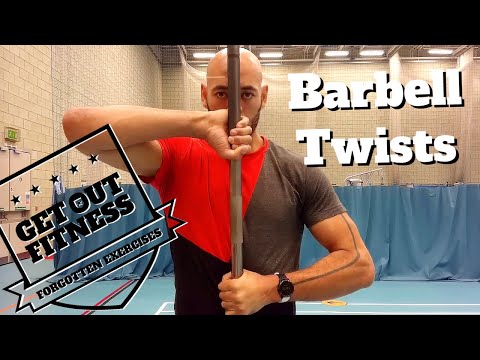
Standing Barbell Twist Overview
The standing barbell twist is a rotation move for your core. It works your obliques. Those are the muscles on the sides of your waist. It also uses your abs and shoulders a little. You hold a barbell across your upper back. That is all the gear you need. This move helps you turn your body with power. A strong twist helps in sports and daily life. It is good for lifters who know the basics. Use it near the end of your core work. Keep the weight light and move with control. The standing barbell twist builds a firm, athletic waist.
What Is The Point of the Standing Barbell Twist?
The standing barbell twist targets your obliques and core. It builds rotational strength and helps create a defined waistline while improving athletic power.
How To Do The Standing Barbell Twist
- Set an empty or lightly loaded barbell across your upper back the way you would for a high-bar squat. Rest it on the meat of your traps, not on your neck, and grip out wide so the bar stays pinned.
- Stand with your feet about shoulder-width apart, toes pointing straight ahead or slightly out. Soften your knees a touch so you are not locked out and rigid.
- Before you move, brace your core hard. Take a breath into your belly, tighten your abs like you are about to be poked, and lock your hips so they face forward the entire set.
- Rotate your torso slowly to the right, turning through your mid-back and obliques rather than yanking the bar. Go only as far as you can while keeping your hips still and pointing forward.
- Feel the stretch and tension build in the opposite oblique as you reach the end of your comfortable range. Do not force extra range by throwing the bar.
- Return smoothly to center under control, keeping tension the whole way. Never let the bar whip you back to the middle using momentum.
- Rotate to the left with the same slow, controlled motion, again keeping your hips and legs quiet. The lower body stays as a fixed base.
- Alternate sides each rep, breathing out as you rotate and staying tall through your spine. Keep your chest up so you do not round forward.
- Aim for a controlled tempo, around 2 seconds out and 2 seconds back, for roughly 10 to 15 reps per side. This is a movement you own with control, never one you fling.
Standing Barbell Twist Form Tips
- Keep your hips facing forward. Only your upper body turns.
- Move slow and smooth. Fast twists can strain your back.
- Hold your belly tight the whole set. This guards your spine.
- Keep the bar snug on your upper back. Do not let it roll.
- Turn only as far as feels easy. Do not force the stretch.
- Keep your knees soft, not locked. This helps you stay steady.
- Breathe out as you twist. Breathe in as you return.
- Stand tall with your chest up. Do not slump forward.
- Keep both feet flat on the floor. Do not let your heels lift.
Common Mistakes to Avoid for the Standing Barbell Twist
- Loading the bar too heavy. This is a rotational core drill, not a strength lift, and a heavy bar tempts you to swing and throw your spine around under load. Keep it light, often just the empty bar, so your obliques do the turning and your lower back stays safe.
- Rotating from your lower back instead of your mid-spine. Your lumbar spine is built for stability, not twisting, so grinding rotation out of it is how people tweak a disc. Turn through your thoracic spine and obliques and keep the lower back braced and quiet.
- Letting your hips swing with your torso. If your hips turn too, you remove the obliques from the equation and just spin your whole body as one block. Lock your hips forward like headlights that never move and let only your upper body rotate against them.
- Using momentum to fling the bar side to side. A fast whip feels productive but it loads your joints at the end range and takes tension off the muscle. Slow every rep down and control both the turn out and the return to center.
- Losing your brace between reps. The moment your core goes soft, your spine takes the load instead of your abs, especially at the turnaround. Keep your belly tight and your ribs down from the first rep to the last.
- Twisting too far too fast. Chasing a bigger range before you have the control leads to strained obliques and cranky facet joints in the spine. Build your range slowly over weeks and stop where your form stays clean.
- Standing with locked, rigid knees. Fully locked knees push all the rotational shear into your spine and hips. Keep a soft bend so your body can absorb the motion and stay balanced.
- Letting the chest cave and the back round. A rounded upper back under a twisting load is a weak, exposed position for your spine. Stay tall, chest up, and think about rotating around a long straight axis.
- Holding your breath the whole set. A locked breath spikes pressure and leaves you dizzy, and it usually means your brace is passive rather than active. Breathe out gently as you rotate and reset your air at center.
- Rushing through reps to hit a number. Speed here just trains momentum, not your core. Treat each rep as a deliberate rotation you can stop and hold at any point.
- Placing the bar on your neck instead of your traps. A bar riding your cervical spine is uncomfortable and unsafe when you rotate. Set it low across the shelf of your upper traps and grip out to keep it locked in place.
Standing Barbell Twist Workout Tips
- Start with just the bar or even a broomstick until your rotation is smooth and pain-free. This is a control drill first, and rushing to add weight only teaches you to compensate with your lower back.
- Think about turning around a fixed vertical axis running down through your spine. Picturing that pole keeps you rotating cleanly instead of leaning and swaying off to the side.
- Keep your hips as still as a mannequin. The whole point is training the obliques to rotate the trunk against a locked pelvis, which is exactly how you produce and resist twisting force in sport.
- Use a slow tempo, roughly 2 seconds out and 2 seconds back. Time under tension is what makes the obliques work here, since the load itself is light.
- Squeeze the oblique on the side you are turning toward at the end of each rep. Chasing that mind-muscle connection turns a mindless twist into real, targeted training.
- Exhale as you rotate away from center. Blowing air out helps you brace harder and keeps your core pressure in check.
- Keep your ribs pulled down toward your hips throughout. A flared ribcage lets the motion leak into your lower back and kills oblique tension.
- Program this as accessory or finisher work, not a main lift. Two to three sets of 10 to 15 controlled reps per side is plenty alongside your bigger movements.
- If you feel it in your lower back rather than your sides, stop and reset. That is almost always a sign you are rotating from the lumbar spine or letting your hips swing.
- Try a brief pause at your end range for a few reps. Pausing kills momentum and forces the obliques to hold tension in a lengthened position.
- Progress by adding range and reps before you add load. Better rotational control is a safer and more useful goal here than a heavier bar.
- Film yourself from the front now and then. A quick video instantly shows whether your hips are cheating or staying locked, which is hard to feel in the moment.
- Pair this with anti-rotation work like Pallof presses for a well-rounded core. Training both creating and resisting rotation builds a trunk that transfers to real life.
- Keep your neck relaxed and eyes forward or gently following the turn. Cranking your head around adds strain without adding any benefit.
- Warm up your spine with some bodyweight twists first. Grooving the pattern light gets the joints moving before you add even a bar.
- Stay patient and consistent. Rotational strength and control build slowly, but they pay off in a more resilient trunk and better power transfer in almost every athletic movement.








Questions & Comments
Be the first to ask a question about this exercise.