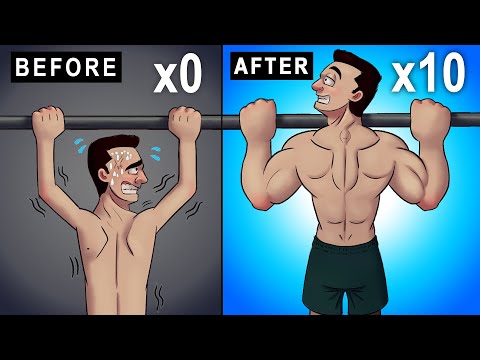
Pull Up Overview
The pull up is a strong pull move for your back. It works your lats, the wide muscles on the sides of your back. It also works your middle back and your biceps. Your biceps are the muscles on the front of your arms. You only need a pull-up bar. You lift your whole body up with your arms. The pull up builds a wide, strong back. It also makes your arms and grip tough. It is a harder move, so it suits people past the beginner stage. Put it near the start of your back day. It is one of the best moves for real pulling strength.
What Is The Point of the Pull Up?
Pull ups build serious upper body strength and create that wide, powerful back look. They work multiple muscle groups at once for maximum muscle development.
How To Do The Pull Up
- Reach up and grab the bar with your hands a bit wider than shoulder-width and your palms facing away from you. Take a full grip with your thumbs wrapped, and squeeze the bar hard.
- Hang from the bar with your arms fully extended. Before you pull, set your shoulders by pulling them down away from your ears, like you are tucking them into your back pockets.
- Take a breath and brace your core. Squeeze your glutes and tighten your legs so your whole body is one solid unit that does not swing.
- Begin the pull by driving your elbows down and back toward the floor. Think about pulling your elbows into your ribs rather than just yanking with your arms.
- Keep pulling smoothly until your chin clears the bar. Your chest should rise toward the bar and your shoulder blades should pull down and together at the top.
- Pause for a brief beat at the top and squeeze your back muscles hard. Do not let your shoulders shrug up toward your ears here.
- Lower yourself down slowly and under control, aiming for a 2 to 3 second descent. Fight gravity the whole way rather than just dropping.
- Finish at a full hang with your arms straight and your shoulders still packed, ready for the next rep. Keep your body from swinging between reps.
- Do as many clean reps as you can, usually in the 5 to 12 range for 3 to 4 sets, and stop the set when your form breaks down.
Pull Up Form Tips
- Start from a full hang with straight arms. This gives a full range.
- Pull your shoulders down before you pull up. Do not shrug at the start.
- Drive your elbows down and back. Think elbows, not hands.
- Keep your core tight. This stops your body from swinging.
- Lift your chest toward the bar. Lead with your chest, not your chin.
- Get your chin over the bar on each rep. Do not do half reps.
- Lower slowly to a straight-arm hang. The slow part builds muscle.
- Keep your legs still and calm. Do not kick to help.
- Breathe out as you rise. Breathe in as you lower.
Common Mistakes to Avoid for the Pull Up
- Using a kip or a swing to get up. Throwing your hips and legs to generate momentum takes the work off your lats and can strain your shoulders. Keep your body still and let your back muscles pull you up under control.
- Not starting from a full hang. Beginning with bent arms robs you of the hardest and most valuable part of the range at the bottom. Straighten your arms fully between reps and own that dead-hang start.
- Failing to set the shoulders before pulling. If you pull with your shoulders shrugged up by your ears, you load the joint instead of the lats and put it at risk. Pull your shoulder blades down first, then start the rep.
- Only pulling with the arms. When you think about bending your elbows, your biceps take over and your back stays lazy. Cue driving the elbows down and back so the lats lead the movement.
- Cutting the chin-over-bar short. Stopping when your eyes reach the bar means you never finish the rep or fully squeeze your back. Pull until your chin clearly clears the bar every time.
- Dropping down fast. Letting yourself fall wastes the eccentric, which is one of the best parts of the rep for building strength and size. Lower with a slow, controlled 2 to 3 second descent.
- Craning the neck to reach the bar. Jutting your chin forward to clear the bar strains your neck and hides a rep you did not really finish. Keep your neck neutral and let your chest rise to meet the bar instead.
- Flaring into an extreme wide grip for ego. Going far too wide shortens your range and stresses the shoulders without building more back. Keep the grip just outside shoulder-width where you are strong and safe.
- Holding your breath the entire set. Locking your breath for many reps spikes pressure and leaves you gassed. Brace at the bottom, then breathe through your reps in a controlled rhythm.
- Letting the legs swing between reps. A swinging body forces you to re-stabilize and leaks power out of each pull. Squeeze your glutes and brace your core so you hang like a plank.
- Adding weight before you own bodyweight. Strapping on plates when your clean reps are still shaky just reinforces sloppy form. Build solid full-range bodyweight reps first, then load small and slow.
- Grinding out ugly partial reps at the end. Half reps with a swing at the finish teach bad patterns and raise injury risk. End the set when your full range disappears and save the rest for next time.
Pull Up Workout Tips
- Think about driving your elbows down toward the floor rather than pulling your chin to the bar. That cue shifts the work onto your lats, which is what makes a pull-up a back builder.
- Set your shoulders before every rep by packing them down and back. Starting from a strong, stable shoulder both protects the joint and makes you pull harder.
- Squeeze the bar as hard as you can. A crushing grip sends tension up the arm that stabilizes the shoulder and can instantly make your reps feel stronger.
- Use a slow eccentric of 2 to 3 seconds on the way down. The lowering phase builds a huge amount of strength, so never just drop off the bar.
- If you cannot do a full pull-up yet, train the negative. Jump to the top and lower yourself as slowly as possible, since owning the descent builds the strength to pull up.
- Use a resistance band or an assisted machine to bridge the gap. Both let you train the full range with real intent while you get stronger.
- Pause briefly at the top and squeeze your back. That hold kills any swing and teaches your lats to finish the rep.
- Keep your whole body tight like a hollow plank. Bracing your core and squeezing your glutes stops the swing and lets you pull from a solid base.
- Program pull-ups early in a pull or back day when you are fresh. They are demanding, so you want your best energy on them.
- For strength, work low reps with added weight once bodyweight is easy. For size and endurance, chase higher clean reps and more sets.
- Add weight slowly with a belt or a light dumbbell once you can do solid reps. Small jumps you can control are progressive overload done right.
- Vary your grip width now and then. A slightly narrower or neutral grip can be easier on cranky shoulders while still hitting the lats.
- Film a set from the side. Video shows swing and range far better than how the reps feel while you grind them out.
- Grease the groove by doing a few easy reps often through the day. Frequent submaximal practice builds the pattern and the strength fast.
- Do not train every set to failure. Leaving a rep in the tank keeps your form clean and helps you add reps week to week.
- Protect your shoulders by never bouncing out of the bottom. A controlled start from a dead hang is safer and stronger than a jerky rebound.
- Be patient with progress. Pull-ups are a strength-to-bodyweight test, so getting leaner and stronger both move the needle over time.








Questions & Comments
Be the first to ask a question about this exercise.