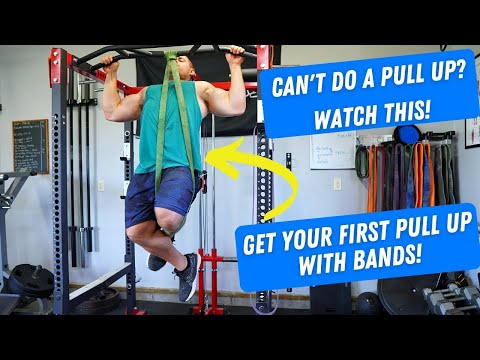
Resistance Banded Chin Up from Foot Overview
The resistance banded chin up from foot builds a strong back. It works your lats most. Your lats are the big wing muscles on the sides of your back. It also works your biceps and middle back. You use a resistance band looped over a pull-up bar. You put one foot in the band. The band helps lift your weight. This move is great for beginners. It helps you learn the chin-up. The band makes each rep easier. So you can build strength safely. Use it on back day or pull day. Over time, use a lighter band. Soon you may not need the band at all.
What Is The Point of the Resistance Banded Chin Up from Foot?
The resistance banded chin up from foot exercise builds lat strength and improves pull-up ability. It lets you practice chin-up form while getting assistance from the band.
How To Do The Resistance Banded Chin Up from Foot
- Loop a resistance band securely over a pull-up bar so it hangs down in front of you. This band assistance is what makes the chin-up accessible, giving you a boost at the bottom where the movement is hardest, so pick a band that helps without doing all the work.
- Reach up and grab the bar with an underhand grip, palms facing you and hands about shoulder width apart. The underhand grip brings your biceps into the movement alongside your lats, which is what defines a chin-up.
- Place one foot into the bottom loop of the band so it can support part of your weight. Keep your other leg tucked or crossed behind so your body stays steady and does not swing.
- Hang with your arms fully extended and your core braced, with the band stretched and ready to assist. This dead hang is your starting position, and starting from a full stretch trains the whole range.
- Set your shoulders by pulling your shoulder blades down and back, away from your ears. This engages the lats and protects your shoulders, so make it a habit before every pull.
- Take a breath, brace, and pull yourself up by driving your elbows down and back toward your ribs. Think about pulling your chest to the bar rather than just yanking with your arms, and let the band help through the bottom.
- Keep pulling smoothly until your chin clears the bar and your upper chest is close to it. Squeeze your lats and biceps hard at the top rather than just scraping your chin over.
- Pause for a beat at the top with your shoulder blades pulled together, feeling your back working. Do not rush past this peak contraction.
- Lower yourself slowly and under control back to a full dead hang over about two to three seconds, resisting the assistance from the band. Keep your body from swinging, and aim for 6 to 12 controlled reps for 3 to 4 sets, using a thinner band as you get stronger.
Resistance Banded Chin Up from Foot Form Tips
- Grab the bar with an underhand grip.
- Start from a full hang with straight arms.
- Keep your core tight and body still.
- Drive your elbows down and back.
- Pull until your chin clears the bar.
- Squeeze your lats at the top.
- Lower slow with control every rep.
- Keep your shoulders down, away from your ears.
- Breathe out as you pull up.
Common Mistakes to Avoid for the Resistance Banded Chin Up from Foot
- Using a band so thick it does all the work. If the band launches you to the top, you are not building much strength and the movement becomes a rebound rather than a pull. Pick a band that assists just enough to get clean reps, then move to a thinner one as you get stronger.
- Not starting from a full dead hang. Keeping your arms bent at the bottom robs you of the stretch and the hardest part of the range. Let your arms fully straighten between reps so you train the lats and biceps through their whole length.
- Pulling with your arms instead of your back. Focusing on your hands makes the biceps do everything while the lats stay quiet. Drive your elbows down and back and picture pulling your chest to the bar so your back leads the movement.
- Swinging your body for momentum. Kicking your free leg or swaying to get up turns a strength move into a cheat and takes the load off your muscles. Keep your free leg tucked and your core tight so the band and your back do the work, not momentum.
- Shrugging your shoulders up at the bottom. Letting your shoulders ride up leaves the joint in a weak, exposed spot and disengages the lats. Set your shoulder blades down and back before every pull and hold that position.
- Only pulling halfway up. Stopping before your chin clears the bar cheats you out of the top squeeze where your back and biceps work hardest. Pull until your chin is over the bar and your chest is near it, then squeeze.
- Dropping fast on the way down. Falling back into the hang wastes the eccentric, which is a huge muscle builder, especially when you are still developing pull strength. Lower under control over two to three seconds and resist the band the whole way.
- Placing your foot poorly in the band. If the band is not secure under your foot it can slip and snap, which is startling and can cause a fall. Set your foot firmly in the loop and test the tension before you commit to a rep.
- Craning your neck to clear the bar. Throwing your head back to get your chin over strains your neck and hides an incomplete rep. Keep your neck neutral and bring your chest to the bar instead of leading with your face.
- Flaring your elbows out wide. Chicken-winged elbows put your shoulders in a vulnerable spot and reduce lat drive. Keep the elbows tracking down and slightly in toward your body so the pull stays strong and safe.
- Sticking with the same band forever. Never reducing the assistance means you never get closer to an unassisted chin-up. Drop to a thinner band as soon as your reps get easy so you keep progressing toward bodyweight.
- Letting form fall apart to grind extra reps. Once you start swinging and barely clearing the bar, those junk reps do little and raise injury risk. Stop the set when strict form goes and build clean reps over time.
Resistance Banded Chin Up from Foot Workout Tips
- Use the band as a stepping stone to full chin-ups. It gives you the most help at the bottom where the movement is hardest, letting you train the full range while you build strength.
- Pick the thinnest band that lets you finish your reps. Too much help stalls your progress, so use just enough assistance to grind out clean reps with good form.
- Start every rep from a full dead hang. The bottom stretch is the hardest and most valuable part, so resist the urge to cut it short even with the band helping.
- Lead the pull with your elbows, not your hands. Driving the elbows down and back toward your ribs turns the lats on far better than thinking about your arms.
- Set your shoulder blades down and back first. That scapular set protects the joint and engages the lats, so make it the first move of every rep.
- Lower yourself slowly, over two to three seconds. A controlled negative builds strength fast and is one of the best ways to progress toward an unassisted chin-up.
- Keep your free leg tucked and your core tight. A stable body kills the swing and makes sure the band and your back do the work instead of momentum.
- Squeeze your lats and biceps at the top. Pausing with your chest near the bar and your shoulder blades together makes your back work far harder than just clearing your chin.
- Progress by moving to a lighter band over time. Each step down in band thickness brings you closer to a full bodyweight chin-up, which is the goal.
- Program chin-ups early in your back workout. When you are fresh you get more quality reps, and they carry over to every other pulling movement you do.
- Secure your foot firmly in the band loop. A snug foot placement keeps the band from slipping and snapping, so test the tension before you pull.
- Use the underhand grip to bring your biceps in. The chin-up grip lets your biceps assist your lats, which is helpful while you are still building pulling strength.
- Think chest to bar, not chin over bar. Reaching for chest contact drives a fuller range and a bigger squeeze than just scraping your chin across.
- Do a few frequent, submaximal sets each week. Practicing the movement often builds the skill and strength of the chin-up faster than one brutal weekly session.
- Do not chase junk reps at the end of a set. Once your form breaks and you swing, stop, because clean reps build your back and sloppy ones invite injury.
- Be patient and track your band progress. Moving from a thick band to a thin one to bodyweight takes time, but each step is real, measurable progress worth celebrating.








Questions & Comments
Be the first to ask a question about this exercise.