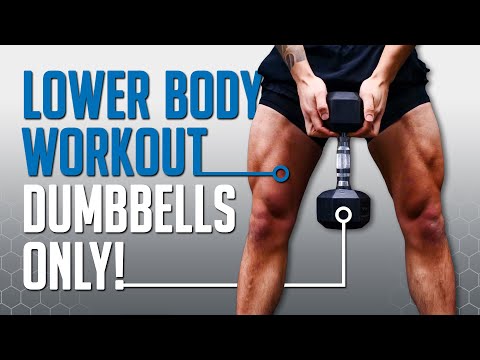
Dumbbell Squat Overview
The dumbbell squat is a simple lower-body move. You hold a dumbbell in each hand and squat down. It mainly works your quads, the muscles on the front of your thighs. It also works your glutes, hamstrings, and calves. The glutes are your butt muscles. The hamstrings are the back of your thighs. You just need two dumbbells and floor space. The dumbbell squat is great for beginners. It teaches you how to squat with good form. It builds strong legs and a strong core. The weights are easy to hold and easy to drop if needed. Use it early in a leg workout. It also works well in a full-body routine at home or the gym.
What Is The Point of the Dumbbell Squat?
The dumbbell squat builds strong quads, glutes, and hamstrings while improving lower body power. It's perfect for building muscle and burning calories in one move.
How To Do The Dumbbell Squat
- Grab a dumbbell in each hand and let them hang at your sides with your arms straight and relaxed. Stand with your feet about shoulder-width apart and your toes turned out just slightly. The dumbbells act as your load, so let your hands simply be hooks.
- Set your posture before you descend. Lift your chest, pull your shoulders back and down, and brace your core so your torso stays tall through the whole rep. A proud chest keeps you from folding forward.
- Take a big breath into your belly and hold it to build pressure around your spine. This brace is what keeps your back solid, so refill your air at the top of each rep.
- Begin the squat by pushing your hips back and bending your knees at the same time, as if you are sitting into a chair behind you. Let the dumbbells travel straight down close to your body.
- Lower under control until your thighs reach about parallel to the floor, or as deep as you can go while keeping your heels flat and your back neutral. Aim for a smooth 2 to 3 second descent.
- Keep your knees tracking in line with your toes the whole way down. They should push out slightly, not cave inward, which keeps the load on your quads and glutes and protects the joint.
- Drive up by pushing your whole foot into the floor, leading with your chest and keeping the dumbbells close. Breathe out through the hardest part of the rep as you stand.
- Finish tall and squeeze your glutes at the top without leaning back or overarching. Reset your brave and your breath, then flow into the next rep. Most people build well here in the 8 to 15 rep range for 3 to 4 sets.
Dumbbell Squat Form Tips
- Keep your chest up the whole time. A dropped chest rounds your back.
- Push your hips back first, then bend your knees. This protects your knees.
- Keep your weight on your heels and mid-foot. Do not tip onto your toes.
- Keep your knees in line with your toes. Do not let them fall inward.
- Lower down slowly and with control. Do not drop fast.
- Keep the dumbbells close to your sides. This keeps you balanced.
- Look straight ahead. Keep your neck in line with your back.
- Breathe in as you lower. Breathe out as you stand.
- Keep your belly tight from start to finish. This holds your spine steady.
Common Mistakes to Avoid for the Dumbbell Squat
- Letting your heels lift off the floor. When you rock onto your toes you lose your base and dump the load onto your knees. Keep your whole foot planted and drive through your heels and midfoot so the big muscles do the work.
- Caving the knees inward on the way up. Knees that collapse toward each other stress the ligaments and waste power from your hips. Cue yourself to push your knees out in line with your toes, especially as you fight out of the bottom.
- Rounding the lower back at the bottom. If your hips tuck under and your spine rounds, you put your discs under real strain. Stop at the depth where you can hold a neutral back and build your mobility over time.
- Folding your chest toward the floor. Leaning too far forward turns a squat into a good morning and loads your low back instead of your legs. Keep your chest up and think about staying tall from the crown of your head.
- Squatting too shallow. Cutting the depth to quarter squats builds strength in only a small range and shortchanges your glutes. Go to at least parallel if your mobility allows, since depth is where the growth lives.
- Bouncing out of the bottom. Dropping fast and rebounding off your joints steals tension from the muscles and risks a tweak. Control the descent and pause briefly at the bottom so your legs, not your tendons, drive the lift.
- Holding your breath the wrong way or not at all. Squatting without a brace leaves your spine unsupported under load. Take a big breath at the top, hold it through the rep, and exhale as you pass the hardest point.
- Letting the dumbbells drift forward. When the weights swing out in front of you they pull your torso down and forward. Keep them hanging straight down close to your legs so the load stays over your midfoot.
- Looking up hard at the ceiling. Cranking your neck back to look up puts your cervical spine in a bad spot and can throw off your balance. Keep your gaze on a point a few feet ahead so your neck stays neutral.
- Setting your stance too narrow. A very narrow stance limits your depth and crowds your hips. Start around shoulder width and adjust until you can hit depth comfortably with your heels down.
- Rushing the reps and losing tension. Blasting through reps with no control means momentum does the work, not your muscles. Own each rep with a deliberate tempo so every one counts toward growth.
Dumbbell Squat Workout Tips
- Think about spreading the floor apart with your feet. This external rotation cue fires your glutes and keeps your knees tracking over your toes for a stronger, safer squat.
- Use the dumbbell squat as a joint-friendly entry to squatting. The load sits at your sides instead of on your spine, so it is gentle on the back while still hammering your legs.
- Control the lowering phase for 2 to 3 seconds. A slow eccentric keeps your muscles under tension longer, and time under tension is a proven driver of growth.
- Try a one to two second pause at the bottom on some sets. Pausing kills the bounce and forces your quads and glutes to start the lift from a dead stop with no momentum.
- Elevate your heels on small plates if your ankles are tight. Raising the heels lets you squat deeper and more upright, keeping the tension on your quads.
- For size, live in the 8 to 15 rep range across 3 to 4 sets. For a bit more strength focus, drop to 6 to 8 reps with heavier dumbbells.
- Add weight gradually as reps get easy. Progressive overload is the engine of progress, so nudge the load up in small steps once you own your current numbers.
- Squeeze your glutes hard at the top of each rep without leaning back. That deliberate contraction builds the mind-muscle connection and finishes the hip extension fully.
- Keep the dumbbells light enough that your grip does not fail before your legs. If your hands give out first, use straps so your legs get the full workload they need.
- Film your set from the side now and then. Video shows whether you are hitting depth and keeping your back neutral far better than how the set feels in the moment.
- Superset dumbbell squats with a hinge like Romanian deadlifts. Pairing a squat pattern with a hinge builds balanced, strong legs from every angle.
- Program them early in your leg day while you are fresh. Squats are demanding, so tackle them before isolation work when your focus and energy are highest.
- Do not chase failure on every set. Leaving a rep or two in reserve keeps your form clean and lets you recover to train hard again soon.
- Widen or narrow your stance to shift the emphasis. A slightly wider stance with toes out hits the glutes and inner thighs more, while a closer stance targets the quads.
- Keep your core braced the whole set, not just on the hard reps. A tight trunk protects your spine and makes every rep feel more solid and powerful.
- Stay consistent week to week. Legs respond to steady, progressive work over months, so show up, add a little, and let the results stack up.








Questions & Comments
Be the first to ask a question about this exercise.