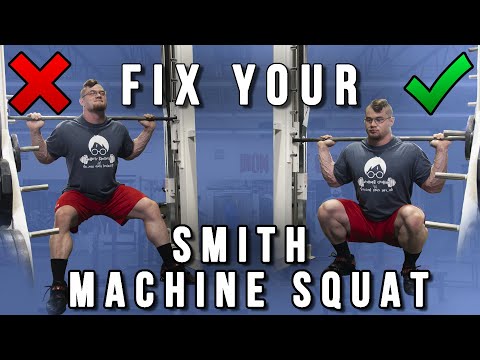
Feet Forward Smith Machine Squat Overview
The feet forward smith machine squat is a leg move on a fixed bar. You set your feet out in front of your body. The bar rests on your upper back and runs on rails. It works your quads, the big muscles on the front of your thighs. It also works your glutes, hamstrings, and abs. You need a smith machine and weight plates. The feet forward stance loads your quads more. The rails keep you steady so you can push hard. This feet forward smith machine squat is good for most lifters. It fits well on leg days. Use it to build strong, big legs. Start light and learn the foot spot first.
What Is The Point of the Feet Forward Smith Machine Squat?
The feet forward smith machine squat targets your quads harder than regular squats. It builds bigger, stronger legs while keeping your back safer.
How To Do The Feet Forward Smith Machine Squat
- Set the Smith machine bar to about chest height and load your plates. The fixed vertical path is what lets you place your feet forward safely, so this setup is the whole reason the variation works.
- Step under the bar and rest it across your upper back, not your neck, with your hands gripping evenly on both sides. Pull your shoulder blades together to build a shelf of muscle for the bar to sit on.
- Position your feet 12 to 18 inches forward of the bar, roughly shoulder-width apart. This forward stance shifts the load toward your quads and lets you sit down more vertically than a normal squat.
- Brace your core hard and take a big breath into your belly. With the bar on rails you still need a tight trunk to protect your spine and stay stacked under the load.
- Unlatch the bar and begin lowering by bending your knees, letting them travel forward over your toes. Because your feet are out front, you can drop straight down and keep constant tension on the quads.
- Descend under control to about parallel, where your thighs are level with the floor, keeping your chest up and your back braced. Aim for a smooth 2 to 3 second lowering rather than dropping fast.
- Feel your quads stretch and load at the bottom. Do not bounce or let your knees cave inward, and keep your heels planted so the drive comes from the right place.
- Drive through your heels and mid-foot to stand back up, pushing the floor away and extending your knees and hips together. Breathe out through the hardest part of the rep.
- Stop just short of locking your knees at the top to keep tension on the quads, then start the next rep. Work in the 8 to 15 rep range for quad growth, and re-latch the bar safely when you finish.
Feet Forward Smith Machine Squat Form Tips
- Keep your feet out in front the whole set.
- Keep your chest up and your back tall.
- Drive through your heels to stand up.
- Brace your abs before each rep.
- Lower down slow and with control.
- Keep your knees in line with your feet.
- Go deep enough that your thighs reach level.
- Breathe in on the way down. Breathe out as you stand.
- Keep your whole back flat on the bar.
Common Mistakes to Avoid for the Feet Forward Smith Machine Squat
- Placing your feet too far forward. Pushing your feet way out in front turns the movement into an awkward leaning slide and puts real shear stress on your knees and lower back. Keep your feet a sensible 12 to 18 inches forward so you can still drive through your heels and hit a strong parallel.
- Letting your knees cave inward on the way up. When your knees collapse toward each other under load, it stresses the joint and leaks power out of your drive. Cue yourself to spread the floor and push your knees out in line with your toes throughout the rep.
- Coming up onto your toes. Rolling forward onto the balls of your feet takes your heels off the floor and dumps the load onto your knees. Keep your whole foot planted, especially your heels, and think about driving the floor away as you stand.
- Cutting the depth short. Stopping high above parallel only trains a small slice of the range and shortchanges your quads. Lower until your thighs are at least parallel, as long as your knees and back stay healthy, to get the full benefit.
- Dropping fast and bouncing out of the bottom. Crashing down and rebounding uses momentum instead of muscle and can jar your knees. Control a 2 to 3 second descent and reverse smoothly out of the bottom under your own power.
- Losing your core brace. Relaxing your trunk because the machine guides the bar leaves your spine unsupported under load. Take a big breath and brace hard before each rep, keeping that tension the whole way down and up.
- Leaning your torso too far forward. Folding at the hips shifts the work off your quads and onto your lower back, defeating the point of the forward stance. Keep your chest tall and let the near-vertical torso keep the tension on the quads where you want it.
- Resting the bar on your neck instead of your upper back. Setting the bar too high puts it on your spine and can dig in painfully under load. Rack it across the meaty shelf of your upper back with your shoulder blades pulled together.
- Going too heavy too soon. The forward foot position and quad emphasis mean you cannot load it like a normal squat without form breaking down. Pick a weight you can control through a full range, then add small jumps over time.
- Letting your heels drift or shift mid-set. If your feet creep out of position, your knee and hip angles change and the load moves off target. Set your feet deliberately at the start and keep them planted in the same spot for every rep.
- Relying on the rails to stay upright. Leaning into or hanging off the bar path fools you into a position you could never hold with free weights and stresses your joints. Stay stacked and balanced under the bar as if it were free, using the rails only for the guided path.
- Forgetting to re-latch the bar at the end. Bailing a Smith squat without hooking the bar can drop the load on you. Rotate the bar into the safety hooks at the top before you step out from under it.
Feet Forward Smith Machine Squat Workout Tips
- Use the forward foot position to hammer your quads. Setting your feet out front lets you drop straight down and keep constant tension on the quads, which makes this a great option when you want to target the fronts of your legs.
- Take advantage of the guided path to push hard safely. Because the bar cannot tip forward or back, you can chase near-failure on your quads with less worry about balancing, especially when training alone.
- Keep your whole foot planted and drive through your heels. Even with your feet forward, pushing through your heels and mid-foot keeps the load off your knees and puts it into the big muscles of your legs.
- Control the eccentric on every rep. A 2 to 3 second lowering keeps your quads under tension longer and builds more muscle than dropping into the bottom and bouncing up.
- Live in the 8 to 15 rep range for growth. Quads respond well to moderate to higher reps under good tension, so 3 to 4 hard sets in that range is a solid muscle-building plan.
- Experiment with foot placement to find your sweet spot. Small changes in how far forward and how wide your feet sit shift the emphasis, so play with position until you feel your quads working hardest.
- Program it as a quad-focused accessory. Use it after your main squat or leg press to add targeted quad volume, since the machine lets you isolate them without much stabilizing demand.
- Chase the mind-muscle connection in your quads. Think about your thighs driving you up out of the bottom rather than just moving the bar, which helps you feel and build the target muscle.
- Add a pause at the bottom for a few sets. A one to two second pause at parallel kills the bounce and forces your quads to do all the work off the bottom.
- Progress with small, steady jumps. Add a little weight or a rep or two over time rather than big leaps, because controlled progressive overload is what keeps your quads growing.
- Keep your torso tall to stay quad-dominant. Letting your chest fold forward shifts work to your back, so cue an upright torso to keep the tension where the variation intends.
- Try higher-rep burnout sets to finish legs. Because the guided bar makes it safer to grind, a high-rep set at the end of your workout can torch the quads once your heavy work is done.
- Do not let your knees cave. Actively push your knees out over your toes on every rep to protect the joint and keep your drive strong.
- Film a set from the side and front. Video shows whether you are rolling onto your toes, caving your knees, or leaning forward far better than the rep feels in the moment.
- Warm up your knees and hips first. A few lighter sets and some easy mobility work prime the joints for the deep, quad-loaded bottom position.
- Use it if free squats bother your balance or back. The fixed path can be a friendlier way to load your quads for lifters who struggle to stay upright under a barbell.
- Do not skip proper depth to chase weight. Loading the bar heavy and cutting the range short cheats your quads, so keep the weight honest and hit parallel on every rep.








Questions & Comments
Be the first to ask a question about this exercise.