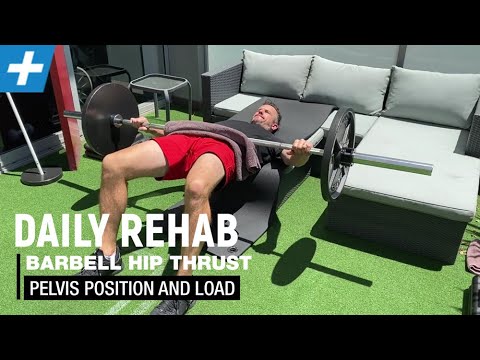
Barbell Hip Thrust Overview
The barbell hip thrust is a strong glute move. You sit against a bench and push your hips up with a barbell. It mainly works your glutes, your butt muscles. It also works your hamstrings, the back of your thighs. You need a barbell and a bench. A pad on the bar helps your hips feel better. The barbell hip thrust builds big, strong glutes. Strong glutes help you run, jump, and lift. They also keep your back and hips healthy. It is an intermediate move. Use it on a leg day or a glute day. Do it after squats or on its own. The barbell hip thrust lets you load your glutes hard and safe.
What Is The Point of the Barbell Hip Thrust?
The barbell hip thrust builds powerful glutes and strong hamstrings. It's the best move for bigger glutes and explosive hip power.
How To Do The Barbell Hip Thrust
- Sit on the floor with your upper back resting against the side of a flat bench and your legs extended. Roll a loaded barbell over your hips, using a pad on the bar to protect your hip bones. Set your feet flat, about shoulder-width apart.
- Position your feet so that when you thrust up, your shins end up roughly vertical. Your upper back should rest on the bench around the bottom of your shoulder blades. This is your setup.
- Grip the bar to keep it steady over your hips and tuck your chin slightly so your gaze stays forward. Brace your core with a big breath before you drive.
- Push through your heels and squeeze your glutes to drive your hips up toward the ceiling. Keep the bar moving straight up as your hips rise.
- Lift until your hips are fully extended and your body forms a straight line from your knees to your shoulders. Do not overarch your lower back to push higher, since the height comes from your glutes.
- Squeeze your glutes as hard as you can at the top and hold for about one second. This peak contraction is the whole point of the movement, so make it count.
- Keep your shins vertical and your knees tracking over your feet at the top, not caving in. Your ribs should stay down rather than flaring up.
- Lower the barbell back down slowly and under control until your hips are just above the floor. Reset your brace and repeat. Most people build well here in the 8 to 15 rep range for 3 to 4 sets.
Barbell Hip Thrust Form Tips
- Rest your upper back on the bench edge. This sets your hinge point.
- Drive through your heels, not your toes. This wakes up your glutes.
- Push your hips up to a straight line from knees to shoulders.
- Squeeze your glutes hard at the top. Hold for a beat.
- Tuck your chin a little. Keep your ribs down, not flared.
- Do not overarch your lower back at the top. Squeeze your glutes instead.
- Lower the bar slowly and with control. Do not drop it.
- Keep your shins about straight up and down at the top.
- Breathe out as you lift. Breathe in as you lower.
Common Mistakes to Avoid for the Barbell Hip Thrust
- Overarching your lower back at the top. Cranking your lumbar spine to push higher shifts the work off your glutes and onto your low back. Drive the height from your glutes, keep your ribs down, and stop at a straight knee-to-shoulder line.
- Pushing through your toes instead of your heels. Driving off the balls of your feet pulls your quads into the movement and reduces glute work. Keep your weight in your heels so your glutes do the driving.
- Not achieving full hip extension. Stopping short of the top leaves the peak glute contraction on the table. Drive all the way up until your hips are fully extended and squeeze hard at the top.
- Setting your feet in the wrong position. Feet too close or too far out change your shin angle and reduce glute activation. Position them so your shins end up vertical at the top of the thrust.
- Placing the bench too high or too low on your back. The wrong bench contact point cramps the movement and can strain your back. Rest the bottom of your shoulder blades on the bench so your torso pivots freely.
- Rushing the reps with no control. Bouncing the bar up and down turns a glute builder into a momentum drill. Control the lowering phase and squeeze at the top so the muscle does the work.
- Skipping the squeeze at the top. Blowing through the top position robs you of the peak contraction where the glutes work hardest. Hold for about a second and truly squeeze before lowering.
- Letting your knees cave inward. Knees that collapse toward each other take tension off the glutes and stress the joint. Push your knees out in line with your feet as you drive up.
- Cranking your neck back to look up. Throwing your head back strains your neck and can arch your back. Tuck your chin slightly and keep your gaze forward so your spine stays neutral.
- Using too much weight before you own the movement. Ego loading forces you to arch and cheat, which cuts glute activation. Pick a weight you can drive to full extension with a hard squeeze on every rep.
- Not bracing your core. A loose trunk lets your low back take over and lets your ribs flare. Brace hard with a big breath so your torso stays stable and your glutes do the work.
Barbell Hip Thrust Workout Tips
- Focus on squeezing your glutes as hard as possible at the top. The hip thrust is one of the best glute builders, and that peak contraction is where the magic happens.
- Keep your shins vertical at the top by setting your feet correctly. This foot position maximizes glute activation and keeps the load off your quads and knees.
- Keep your ribs down and your core braced throughout. This stops your lower back from taking over and keeps the tension squarely on your glutes.
- Use a barbell pad or a folded towel on the bar. Protecting your hip bones lets you focus on driving hard instead of fighting the discomfort of the bar.
- Control the lowering phase over 2 to 3 seconds. A slow eccentric keeps your glutes under tension longer, which is a reliable driver of growth.
- Try a pause at the top for a second or two on some sets. Holding at full extension with a hard squeeze forces the glutes to work at their most contracted position.
- The hip thrust was popularized by Bret Contreras, who built much of his work around glute training. Use it as your main move when building bigger, stronger glutes.
- Go heavy over time with progressive overload. The glutes are a strong muscle group and respond well to load, so add weight steadily as you get stronger.
- For size, work in the 8 to 15 rep range for 3 to 4 sets. You can also push higher reps effectively since the glutes handle volume well.
- Keep your gaze forward and chin tucked. A neutral neck keeps your spine in a safe line and helps you feel the glutes rather than arching your back.
- Push your knees out in line with your feet as you drive. This keeps the glutes engaged and protects your knees from caving in.
- Try single-leg or banded variations for variety. A band around your knees or a single-leg version adds a different challenge and targets the glutes from new angles.
- Program hip thrusts as a main glute movement on lower body day. They pair well with squats and hinges for complete lower body development.
- Film your set from the side to check your extension and back position. Video shows whether you are reaching full lockout without overarching.
- Do not train to failure on every set. Leaving a rep or two in reserve keeps your form clean and helps you recover for your next session.
- Be consistent and progress steadily. Strong glutes come from months of heavy, well-executed hip thrusts with a hard squeeze every rep.








Questions & Comments
Be the first to ask a question about this exercise.