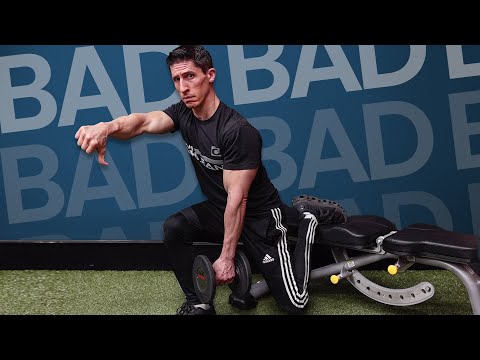
Single Leg Squat from Bench Overview
The single leg squat from bench is a hard leg move. It works your quads. The quads are the big muscles on the front of your thighs. It also works your glutes, hamstrings, and calves. The glutes are your butt muscles. You need a sturdy bench. You stand on one leg and squat down. The single leg squat from bench builds strong single-leg power. It also builds balance and control. It trains one leg at a time. So it fixes weak sides. It is a good step toward a full pistol squat. Use it on leg day. Do it while you are fresh and strong.
What Is The Point of the Single Leg Squat from Bench?
The single leg squat from bench builds serious leg strength and fixes muscle imbalances. It challenges your balance while making your quads and glutes work harder than regular squats.
How To Do The Single Leg Squat from Bench
- Set up a bench or sturdy box at about knee height and stand on top of it on one leg. Let your other leg hang off the side so it has room to travel down as you descend.
- Stand tall on your working leg with your chest up and your core braced. Extend your arms out in front of you for balance, which acts as a counterweight as you lower.
- Shift your weight into the heel of your standing leg and set your foot flat and stable. Take a breath and brace your midsection before you begin the descent.
- Begin the squat by pushing your hips back and bending your standing knee to lower yourself down. Let your non-working leg reach down toward the floor beside the bench as you sink.
- Keep your standing knee tracking in line with your foot and do not let it cave inward. Lower as far as you can control with good form, ideally until your standing thigh nears parallel.
- Keep your chest up and your torso leaning slightly forward to stay balanced over your foot. Feel your quad and glute loading hard at the bottom of the rep.
- Drive up through your standing heel to push yourself back to the top. Squeeze your glute and stand tall, keeping your balance centered over the working leg.
- Finish all your reps on one leg before switching to the other side. Aim for 6 to 12 reps per leg, and start with your weaker side to keep both legs even.
Single Leg Squat from Bench Form Tips
- Keep your chest up and your core tight.
- Push your hips back a little as you lower.
- Keep your standing knee in line with your foot.
- Drive up through your heel, not your toes.
- Move slowly. Do not drop or bounce.
- Reach your arms out to help your balance.
- Lower only as far as you can control.
- Breathe in as you lower. Breathe out as you rise.
- Keep your standing foot flat the whole time.
Common Mistakes to Avoid for the Single Leg Squat from Bench
- Letting your standing knee cave inward. When the knee collapses toward the midline it loses safe tracking and stresses the joint. Push your knee out in line with your foot and drive through your heel to keep it aligned.
- Not pushing your hips back as you descend. Dropping straight down sends your knee far forward and overloads the joint. Sit your hips back and lean your torso slightly forward so the glute shares the load with the quad.
- Rushing the descent and losing control. A fast drop wrecks your balance and turns a strength move into an uncontrolled fall. Lower slowly and deliberately so your muscles manage the whole range.
- Putting your weight in your toes. Shifting onto the ball of your foot pushes your knee forward and makes you unstable. Keep your weight in your heel and mid-foot for a strong, balanced base.
- Using a bench that is too high too soon. A high box demands a deep single-leg squat that may be beyond your current strength. Start with a lower height you can control and progress deeper as you get stronger.
- Cutting the range of motion short. Only dipping a few inches builds strength in a tiny range and skips the hard part. Lower as deep as you can control, ideally to near parallel, on every rep.
- Uneven reps between legs. Favoring your stronger leg over time builds a real imbalance you can see and feel. Start with your weaker leg and match the reps exactly on the stronger side.
- Letting your torso collapse or round forward. Folding at the spine to reach depth loads your lower back instead of your leg. Keep your chest up and hinge from the hips with a flat back.
- Bouncing at the bottom to rebound up. A quick bounce uses momentum and skips the hardest, most productive part of the rep. Pause briefly at the bottom and drive up with your own strength.
- Not using your arms for balance. Keeping your arms pinned makes staying upright much harder on one leg. Reach your arms out in front as a counterweight to help you stay centered.
- Holding your breath and losing your brace. Going breathless makes you shaky and unstable on a demanding single-leg move. Brace before you descend and breathe out as you drive up.
Single Leg Squat from Bench Workout Tips
- Push your hips back and lean slightly forward as you descend. This loads your glutes along with your quads and keeps you balanced over your foot.
- Keep your standing knee tracking over your foot. Driving the knee out in line with your toes protects the joint and keeps your form solid.
- Reach your arms out front as a counterweight. Extending your arms helps you stay upright and centered over your working leg.
- Start with a lower bench and progress the height. A manageable box lets you build strength and depth before chasing a full single-leg squat.
- Keep your weight in your heel and mid-foot. A grounded heel gives you a stable base and keeps your knee from drifting forward.
- Start every set with your weaker leg. Letting the weaker side set the rep count keeps both legs balanced over time.
- Aim for 6 to 12 reps per leg for three or four sets. This range builds single-leg strength and balance while keeping your form clean.
- Pause briefly at the bottom to kill momentum. A short controlled hold forces your muscles to start each rep from a dead stop.
- Use it to build toward a full pistol squat. Training single-leg strength from a bench develops the control you need for harder variations.
- Control the descent for two to three seconds. Owning the eccentric builds strength and sharpens your balance on one leg.
- Hold a light dumbbell for balance or added load. A small counterweight held in front can actually make balancing easier while adding resistance.
- Keep your chest up and core braced throughout. Good posture keeps the load on your leg and protects your lower back.
- Program it as a main or accessory leg exercise. It works as a primary single-leg builder or as extra volume after squats.
- Squeeze your glute as you stand back up. Finishing each rep with a glute contraction reinforces the mind-muscle connection.
- Film yourself from the side occasionally. A quick video reveals knee cave and torso collapse that are hard to feel in the moment.
- Be patient and consistent with single-leg work. Balance and strength improve steadily, and the carryover to squats and athletics is well worth it.








Questions & Comments
Be the first to ask a question about this exercise.