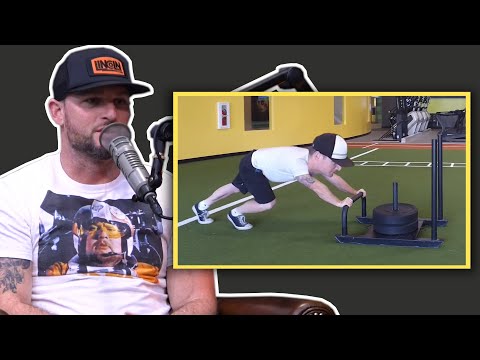
Sled Push Overview
The sled push is a full lower body move. You push a loaded sled across the floor. It builds your quads, the muscles on the front of your thighs. It also works your glutes, calves, and triceps. The calves are your lower leg muscles. You load a sled with weight plates and push it. This move is good once you have some training. It builds leg power and gets you out of breath. It is easy on your joints too. The sled push makes your legs strong and your heart fit. Do it at the end of leg day. It also works great as a conditioning drill. Push hard for short distances.
What Is The Point of the Sled Push?
The sled push builds raw power and burns calories fast. It works your entire lower body while building functional strength you can use in real life.
How To Do The Sled Push
- Load the sled with an appropriate weight and set up at the handles or uprights. Grip the poles firmly, whether high near the top or low depending on the sled and your goal.
- Position your body at roughly a 45 degree forward lean with your arms straight and your core braced. Your body should form a strong line from your heels through your head, ready to drive forward.
- Set one foot forward and the other back, up on the ball of your foot, so you are ready to explode into the first step. Keep your chest down and your eyes a few feet ahead.
- Drive through your legs and push the sled forward, extending your hips and knees hard against the resistance. Think about pushing the floor away behind you with each step.
- Take short, powerful, choppy steps rather than long strides. Short steps keep you in a strong pushing position and let you keep constant force on the sled.
- Keep your arms straight and your core tight so the force from your legs transfers straight into the sled. Do not let your hips pop up or your back round as you fatigue.
- Maintain the forward lean and drive continuously for your target distance. Keep your breathing rhythmic and your steps quick and strong.
- Once you hit the target distance, stop, rest, and reset for the next push. Reload or reset the sled and repeat.
- For most goals, push for distances of around 20 to 40 meters for three to six sets. Go heavier and shorter for strength and power, or lighter and longer for conditioning.
Sled Push Form Tips
- Lean forward at about 45 degrees.
- Keep your arms straight the whole way.
- Take short, quick, powerful steps.
- Drive through your whole foot into the floor.
- Keep your core tight and your back flat.
- Hold your head in line with your back.
- Keep pushing steady. Do not stop mid-run.
- Breathe in a steady rhythm. Do not hold your breath.
- Keep your hips low and driving forward.
Common Mistakes to Avoid for the Sled Push
- Standing too upright with no forward lean. Pushing while standing tall wastes your leg drive and puts the load on your arms and back. Get into a strong 45 degree lean so your legs can drive the sled with real power.
- Taking long, bounding strides. Big steps put you in a weak position between drives and let the sled stall. Use short, choppy, powerful steps that keep constant force on the sled.
- Letting the hips pop up and the back round. When fatigue hits and your hips rise, your body angle collapses and your lower back takes strain. Keep your core braced and hold your strong line from heels to head.
- Bending the arms and pushing with the upper body. Soft, bending arms leak the force your legs generate before it reaches the sled. Keep your arms straight and rigid so leg power transfers directly into the push.
- Going too heavy to move well. Overloading the sled turns a powerful drive into a slow grind where your form falls apart. Match the weight to your goal so you can keep driving with quick, strong steps.
- Holding your breath through the whole push. Locking your air on a demanding effort spikes pressure and leaves you gassed early. Breathe rhythmically with your steps so you can sustain the drive.
- Losing core tension mid-push. When your brace goes soft, force leaks out through a floppy midsection and your spine loses support. Keep your abs tight the whole way so power flows straight from legs to sled.
- Only pushing at one intensity. Always going heavy or always going light limits what the sled can do for you. Vary the load and distance to train power, strength, and conditioning as your goals demand.
- Letting the sled stop between steps. Allowing the sled to stall means you have to overcome static friction again and again, which wastes energy. Keep continuous pressure so the sled never fully stops until you do.
- Looking straight down at your feet. Dropping your head too far rounds your neck and back and hurts your position. Keep your eyes a few feet ahead to hold a strong spine and forward line.
- Skipping a proper warm-up. Jumping into heavy pushes cold risks tweaking your hips, knees, or back on a high-force move. Warm up your legs and do a light push or two before loading up.
Sled Push Workout Tips
- Use the sled to build leg drive and power with almost no eccentric. Because you are only pushing, there is little muscle-damaging lowering phase, so you can train hard and recover fast.
- Keep your steps short, quick, and powerful. Choppy steps keep you in a strong pushing angle and maintain constant force, which is far more effective than long lunging strides.
- Vary the load to change the goal. Heavy and short builds strength and power, while lighter and longer turns the sled into brutal conditioning, so pick the setup that matches your day.
- Program sled pushes at the end of a leg day or as standalone conditioning. Their low eccentric stress means they add hard leg work without wrecking your recovery for the next session.
- Hold a strong 45 degree lean and rigid arms. That body position is what lets your legs, not your upper body, drive the sled with maximum force.
- Keep your core braced the whole push. A tight midsection transfers leg power straight into the sled and protects your lower back from the constant load.
- Use the sled to train conditioning without the joint pounding of running. It builds a big engine and strong legs while being far kinder to your knees than sprinting on hard ground.
- Drive continuously so the sled never stalls. Keeping it moving avoids fighting static friction on every step and keeps your effort efficient.
- Push for distances around 20 to 40 meters for three to six sets. Adjust the distance and rest based on whether you want power, strength, or conditioning.
- Warm up your legs and hips before loading heavy. A few light pushes groove the pattern and protect your joints on this high-force move.
- Try alternating heavy strength pushes with light sprint pushes. Mixing intensities in one session builds both raw power and conditioning and keeps training fun.
- Keep your eyes a few feet ahead, not down at your feet. A neutral head keeps your spine long and your pushing line strong.
- Use the sled for athletes to build acceleration and drive. The low, powerful push closely mimics the drive phase of a sprint and carries over to field sports.
- Progress by adding weight or distance over time. Progressive overload works here too, so nudge the load or the distance up as you get stronger and better conditioned.
- Rest fully between heavy power pushes. If your goal is speed and power, long rest keeps each push explosive rather than turning it into a slow grind.
- Embrace how humbling it is and keep coming back. The sled exposes weak conditioning fast, so consistent work over weeks builds a serious engine and strong legs.








Questions & Comments
Be the first to ask a question about this exercise.