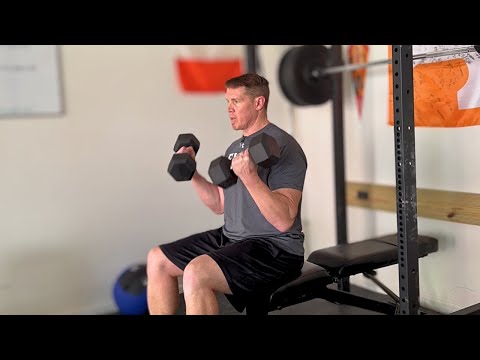
Seated Dumbbell Curl Overview
The seated dumbbell curl builds bigger, stronger arms. It works your biceps, the muscles on the front of your upper arm. Your forearms help too. You sit on a bench and hold a dumbbell in each hand. The seat stops you from swinging. That makes your biceps do all the work. This curl is simple and safe. It is great for new lifters. It teaches you to feel the muscle work. It builds arm size and a strong grip. It fits well at the end of an arm or pull day. The seated dumbbell curl is a classic move for good reason.
What Is The Point of the Seated Dumbbell Curl?
The seated dumbbell curl builds bigger, stronger biceps while giving you better control than standing curls. Perfect for targeting each arm separately.
How To Do The Seated Dumbbell Curl
- Sit on a bench with your back straight and your feet planted flat on the floor. Hold a dumbbell in each hand with your arms hanging at your sides and your palms facing your thighs.
- Set your shoulders down and back and keep your chest tall. Sitting removes the temptation to swing your body, so use that stable base to your advantage.
- Brace your core lightly and pin your upper arms against your sides. Your elbows should stay in one spot the whole set, acting like a hinge that only your forearm moves around.
- Begin curling one or both dumbbells up by bending at the elbow. As you rise, rotate your wrist so your palm turns up to face your shoulder, which is called supination and fires the bicep harder.
- Keep the movement smooth and slow, taking about one to two seconds to lift. Do not let momentum or a body swing throw the weight up for you.
- Squeeze your biceps hard at the very top and hold for a beat. That peak contraction is where a lot of the growth happens, so make it count.
- Lower the dumbbells back down slowly, taking two to three seconds, until your arms are almost straight. The lowering phase builds as much muscle as the lift, so never just drop the weight.
- Keep a slight bend at the bottom to hold tension on the bicep, then start the next rep. Repeat for 8 to 15 reps, keeping every rep controlled from top to bottom.
Seated Dumbbell Curl Form Tips
- Keep your elbows pinned to your sides. They should not drift forward.
- Move only at your elbow. Your upper arm stays still.
- Sit tall with a straight back. Do not lean back to lift.
- Squeeze your biceps hard at the top. Feel them work.
- Lower slow for two to three seconds. Do not drop the weights.
- Straighten your arms fully at the bottom. Use the full range.
- Breathe out as you curl up. Breathe in as you lower.
- Keep your wrists straight. Do not let them bend back.
- Keep your feet flat and still. This gives you a solid base.
Common Mistakes to Avoid for the Seated Dumbbell Curl
- Swinging your body to heave the weight up. Even seated, people rock their torso back to fling the dumbbells, which hands the work to momentum instead of the biceps. Sit tall, keep your back against nothing but your own bracing, and move only your forearms.
- Letting your elbows drift forward as you curl. When the elbow slides ahead of your body the front delt takes over and the bicep gets a break. Pin your upper arms to your sides and keep the elbow fixed like a hinge the whole set.
- Dropping the weight fast on the way down. Rushing the lowering phase throws away the eccentric, which is one of the biggest muscle builders in the whole rep. Fight gravity and take a slow two to three second descent every time.
- Cutting the range of motion short. Half reps that never straighten the arm or never reach the top only train a sliver of the bicep. Lower until your arm is nearly straight and curl all the way to a hard squeeze.
- Skipping the wrist rotation. Curling with your palm already up leaves out supination, which is a key job of the bicep. Start with palms neutral and turn them up as you rise to fully fire the muscle.
- Going too heavy and losing all control. Ego weight turns clean curls into a full-body swing and beats up your elbows. Pick a load you can lift smoothly for all your reps and add weight slowly over time.
- Shrugging your shoulders up at the top. When the shoulders ride up to help, tension leaks off the biceps and onto the traps. Keep your shoulders pinned down and back so the biceps stay loaded through the whole curl.
- Not squeezing at the top. Simply touching the top and dropping back down skips the peak contraction where a lot of the growth lives. Pause for a beat and squeeze the bicep hard before you lower.
- Bouncing out of the bottom. Using a rebound at the bottom to launch the next rep robs the muscle of tension and strains the elbow tendon. Come to a controlled stop with a slight bend and start the next rep clean.
- Curling both arms unevenly. One arm often finishes first and starts cheating for the other, quietly building an imbalance. Match your reps and effort side to side, or alternate so each arm gets equal honest work.
- Holding your breath and clenching everywhere. Turning a curl into a straining grind wastes energy and spikes your blood pressure. Breathe out as you lift and keep the effort focused on the working arm.
Seated Dumbbell Curl Workout Tips
- Use the seated position to kill momentum. Sitting takes away the leg drive and torso swing that people lean on, so the biceps have nowhere to hide.
- Keep your elbows pinned to your sides. When the upper arm stays still the elbow works as a clean hinge and every bit of the curl loads the bicep.
- Supinate as you lift. Starting with palms neutral and turning them up as you rise adds a hard squeeze to the bicep, which is one of its main jobs.
- Slow down the lowering phase. A controlled two to three second descent keeps tension on the muscle and builds more size than dropping the weight.
- Pause and squeeze at the top. A one second hold at peak contraction is a simple trick that adds real quality to every rep.
- Chase the mind-muscle connection. Think about squeezing the bicep to move the weight rather than just bending your arm, since feeling the target muscle work is a proven way to grow it.
- Try alternating arms for extra focus. Curling one side at a time lets you pour full attention into each bicep and match effort side to side.
- Keep a slight bend at the bottom. Stopping just short of fully locked out keeps constant tension on the muscle instead of resting it on the joint.
- Program curls after your big pulls. Do rows and pulldowns first, then finish with curls when the biceps are the star of the show and already warm.
- Use a rep range around 8 to 15. Biceps respond well to moderate reps, so three or four sets in that range for a few weekly sessions works great.
- Add weight in small steps. Progressive overload for arms means a small dumbbell jump or an extra clean rep, not a big leap that ruins your form.
- Try an incline version to change the stretch. Curling on an incline bench pulls the arms behind the body and loads the long head of the bicep harder.
- Do not train to failure every set. Leaving a rep in the tank on most sets keeps your form crisp and your elbows happy over the long run.
- Watch your ego on the last few reps. If your torso starts rocking, the set is basically done, so stop or drop the weight rather than swinging.
- Keep your wrists neutral and strong. A floppy wrist leaks force and can ache, so hold the dumbbell firm without cranking it back.
- Use a full range on every rep. Straighten near the bottom and curl to a full squeeze, since partials leave growth on the table.
- Be consistent over months. Biceps are small and grow slowly, so steady progressive work beats one occasional brutal arm day.








Questions & Comments
Be the first to ask a question about this exercise.