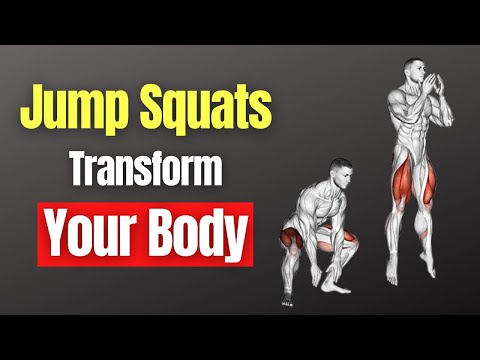
Prisoner Jump Squat Overview
The prisoner jump squat is a bodyweight power move. It works your quads, the big muscles on the front of your thighs. It also fires your glutes, calves, and hamstrings. Your glutes are your butt muscles. Your calves are the muscles on the back of your lower legs. You put your hands behind your head the whole time. That is where the name comes from. You need no equipment at all. This move builds fast, springy legs. The jump makes your muscles work with speed and power. Hands behind your head force you to stay tall and use your legs. It suits people who already know a basic squat. Use it in a warm-up or as fast finisher. Do quick sets of 8 to 15 jumps.
What Is The Point of the Prisoner Jump Squat?
The prisoner jump squat builds explosive leg power and burns serious calories. This move hits your quads hard while boosting your heart rate fast.
How To Do The Prisoner Jump Squat
- Stand with your feet about shoulder-width apart and your toes turned out slightly. Lace your fingers behind your head so your elbows point wide, like you are under arrest, and pull your chest tall.
- Set your core before you move by taking a breath into your belly and bracing. Keeping your hands behind your head removes your arm swing, so your legs and core have to do all the work.
- Push your hips back and bend your knees to lower into a squat. Keep your chest up and your elbows wide, and do not let the hand position pull your head forward.
- Descend until your thighs are about parallel to the floor, keeping your weight in your midfoot and heels. Your knees should track out over your toes, not cave inward.
- From the bottom, explode straight up and jump as high as you can. Drive through the whole foot and finish by extending your hips, knees, and ankles all at once.
- Keep your hands locked behind your head the entire time. Do not let them fly forward to help you jump, since the point is to make your lower body generate the power.
- Spot your landing and touch down softly on the balls of your feet, then roll to flat. Bend your knees and hips to absorb the impact like a shock absorber rather than landing stiff.
- Flow straight into the next rep by sinking back into the squat as you land. Aim for smooth, controlled sets of 8 to 15 reps, stopping when your jumps lose height or your form gets sloppy.
Prisoner Jump Squat Form Tips
- Keep your chest up tall the whole time.
- Keep your hands locked behind your head. Do not drop them.
- Push your hips back first, then bend your knees.
- Land soft and quiet on the balls of your feet.
- Bend your knees when you land to soak the shock.
- Push your knees out over your toes, not inward.
- Breathe in on the way down. Breathe out as you jump.
- Jump straight up, not forward or back.
- Keep your core tight to hold your body steady.
Common Mistakes to Avoid for the Prisoner Jump Squat
- Landing stiff-legged with locked knees. Coming down hard on straight legs sends the impact into your knees and spine instead of your muscles, which is how you get sore joints and worse. Land soft on the balls of your feet and immediately bend your knees and hips to soak up the force.
- Letting the knees cave inward on the jump or landing. When your knees collapse toward each other, you leak power and load the joint sideways, which it is not built to handle. Cue your knees to push out over your toes on both the drive and the landing.
- Cutting the squat depth short before each jump. A shallow quarter squat gives your legs less range to build force, so you jump lower and get less out of the movement. Sink to about parallel every rep so your quads and glutes actually load up.
- Letting the hands come forward to help you jump. The whole reason for the prisoner position is to take your arm swing away and force your legs to do the work. If your hands drift, you are cheating yourself, so keep them pinned behind your head.
- Rounding the upper back and pulling the head down. The hands behind the head tempt you to yank your neck forward, which rounds your spine under a jumping load. Keep your elbows wide, chest proud, and neck neutral throughout.
- Rushing reps and losing all control. Bouncing frantically from rep to rep turns a power exercise into sloppy cardio and raises your injury risk. Reset your posture and balance for a beat before each jump so every rep is crisp.
- Not bracing the core between reps. Without a braced trunk, the landing jolts your lower back and you lose your upright posture. Take a quick breath and brace before you launch and again as you land.
- Landing with your weight on your heels or toes only. A heel-heavy landing jars your spine and a toe-only landing rolls your ankles. Aim to land balls first and settle into the midfoot with your weight centered.
- Going for max reps when your jumps have died. Once your jump height drops, you are just grinding fatigue and drilling bad landing mechanics. End the set when the pop leaves your legs rather than chasing a number.
- Doing them on a hard, unforgiving surface with no cushioning. Repeated landings on concrete beat up your joints over time. Use a rubber gym floor or a padded surface, and keep your landings quiet and controlled.
- Holding your breath through the whole set. Bracing is good, but never breathing turns you dizzy and weak by the back half of the set. Breathe out on the jump and in as you reset so you stay powered up.
Prisoner Jump Squat Workout Tips
- Treat every landing as its own skill. Landing soft and quiet on the balls of your feet, then bending to absorb, protects your joints far more than how high you jump.
- Chase height, not just reps. Prisoner jump squats build explosive power, so a few crisp, maximal jumps beat a long set of tired little hops.
- Keep your elbows pulled wide the entire set. Wide elbows keep your chest tall and stop the hand position from rounding your upper back under the jumping load.
- Use these as a power or conditioning finisher, not your main strength lift. They pair well after heavier squats when your legs are warm but not fried.
- Start with 3 to 4 sets of 8 to 12 clean reps. Quality over quantity is the rule, so stop each set the moment your jumps lose their pop.
- Brace your core before every jump like you are about to be nudged. A stiff trunk keeps your landings safe and transfers leg power up through your body.
- Land with your knees pushing out over your toes. Training that outward knee track under fatigue carries straight over to safer squats, sprints, and cutting on the field.
- Progress by adding jump height or reps before you ever add load. Because there is no external weight, improving your explosiveness and control is the overload here.
- If you want more challenge, slow the descent then jump fast. A controlled lower into an explosive jump builds the stretch-shortening reflex that makes you more powerful.
- Keep the surface friendly. A rubber floor or thin mat saves your knees and ankles from the pounding a bare concrete floor delivers over many reps.
- Watch your fatigue closely. Plyometrics like this are taxing on your nervous system, so two or three quality sessions a week is plenty for most people.
- Use them to warm up your explosiveness before sprints or a heavy lower day. A few sub-maximal jump squats prime your fast-twitch fibers and sharpen your landing.
- Keep your head neutral and pick a spot ahead of you. Staring straight ahead stops you from craning your neck up or tucking your chin under the load.
- If your knees or ankles feel cranky, scale back to regular jump squats or bodyweight squats. There is no shame in earning the right to jump before you load up the volume.
- Breathe in a rhythm with the movement. Exhale as you explode up and inhale as you sink into the next rep so you stay sharp deep into the set.
- Stay patient and consistent. Explosive power is built over weeks of clean, controlled jumps, so protect your landings and the height will come.








Questions & Comments
Be the first to ask a question about this exercise.