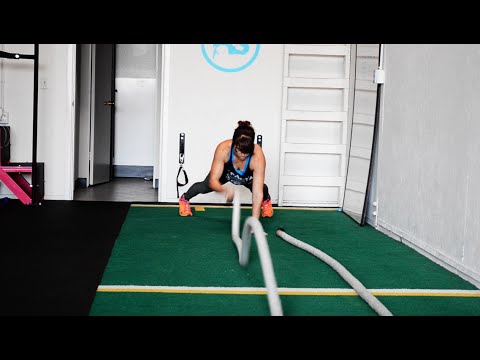
Reverse Lunge with Alternating Waves Battle Ropes Overview
The reverse lunge with alternating waves battle ropes mixes a leg hold and arm waves. It works your quads, the big muscles on the front of your thighs. Your glutes and shoulders help too. The glutes are your butt muscles. You hold one battle rope handle in each hand. You drop into a lunge, then wave the ropes up and down fast. This move builds leg strength and gets your heart pumping. Holding the lunge makes your legs work hard while your arms move. It builds stamina and grit at the same time. The reverse lunge with alternating waves battle ropes fits well in a conditioning day. Use it near the end of a workout for a strong burn. It challenges your legs, shoulders, and lungs all at once.
What Is The Point of the Reverse Lunge with Alternating Waves Battle Ropes?
The reverse lunge with alternating waves battle ropes exercise builds leg power while torching calories. It combines lower body strength with cardio for a killer full-body workout.
How To Do The Reverse Lunge with Alternating Waves Battle Ropes
- Stand with your feet about hip-width apart, holding one battle rope handle in each hand with a firm neutral grip. Set your feet so you have room to lunge without stepping on the ropes.
- Brace your core, keep your chest up, and let your arms hang with a slight bend. Take up any slack so the ropes are ready to move.
- Step your right foot back into a reverse lunge, lowering both knees toward roughly 90 degrees while keeping your torso upright. Hold this lunge as your stable base.
- From the bottom of the lunge, start alternating waves by driving one arm down as the other comes up. Keep the waves fast, short, and rhythmic.
- Perform 8 to 10 waves per arm while holding the lunge steady. Your legs stay locked in position while your upper body does the work.
- Keep your core braced so the waves do not rock your torso or collapse the lunge. The trunk is what ties the top and bottom together.
- Push through your front heel to stand back up under control, letting the ropes settle for a beat. Reset your posture tall and stable.
- Repeat the sequence stepping back with your left leg. Alternate sides for a set number of rounds or a work interval, around 30 to 45 seconds, for 3 to 5 rounds.
Reverse Lunge with Alternating Waves Battle Ropes Form Tips
- Hold the lunge steady while your arms wave.
- Keep your torso upright, not leaning forward.
- Lower until both knees reach about 90 degrees.
- Wave the ropes with fast, even arm moves.
- Keep your core tight the whole time.
- Breathe in a steady, quick rhythm. Do not hold your breath.
- Keep your front knee over your foot.
- Push through your front heel to stand.
- Keep your shoulders down and loose while you wave.
Common Mistakes to Avoid for the Reverse Lunge with Alternating Waves Battle Ropes
- Letting the lunge collapse while you wave the ropes. When your legs give out, your torso pitches forward and the whole drill falls apart. Set a solid lunge first and hold it rock steady while the arms work.
- Letting the front knee cave inward. A knee that drops in stresses the joint and weakens your base. Drive it out over your toes and keep it there through the hold.
- Waving only from the shoulders with stiff arms. Moving just the shoulders tires them fast and kills your power. Snap the waves from your whole arm and let a little core and hip drive in.
- Rounding your back under fatigue. As the ropes burn you out, it is tempting to hunch. Keep your chest up and your core braced so your spine stays safe.
- Rising onto the ball of the front foot. Lifting the heel wrecks your base and shifts load to the knee. Root the whole foot and stay grounded through the heel.
- Making shallow, lazy lunges. A tiny knee bend dodges the leg work that makes this more than a rope drill. Sink your back knee toward the floor and hold real depth.
- Standing up early because the arms tire. Cutting the lunge short to escape the burn shortchanges the legs. Finish your waves in the hold, then rise with control.
- Holding your breath during the waves. Locking the breath spikes pressure and gasses you out fast. Breathe in a quick, steady rhythm with the wave tempo.
- Working one side far harder than the other. Favoring your strong leg builds an imbalance over rounds. Match your lunge depth and wave effort on both sides.
- Going so fast your form falls apart. Chasing speed with sloppy mechanics teaches bad patterns and risks injury. Keep the waves sharp but never at the cost of the lunge.
- Gripping the ropes so tight your forearms die first. A death grip burns out your hands before the target muscles. Hold firmly but let the arms stay loose enough to move.
Reverse Lunge with Alternating Waves Battle Ropes Workout Tips
- Warm up your legs, shoulders, and grip before you start. A short primer makes the combined hold and waves feel controlled rather than frantic.
- Lock in a stable lunge first, then add the waves on top. A steady base lets your upper body work hard without your legs quitting.
- Drive the waves from your whole arm, not just your shoulders. Involving the back and a little hip drive gives you more power and stamina.
- Keep your front knee tracking over your toes during the hold. Good alignment protects the joint while your legs work isometrically.
- Brace your core hard to link the lunge and the waves. A tight trunk stops the ropes from rocking you out of position.
- This is a conditioning and power-endurance move, so train it in intervals. Work 30 to 45 seconds hard, rest, and repeat for 3 to 5 rounds.
- Push through your front heel to stand back up. Heel drive loads the quads and glutes and keeps you balanced.
- The isometric lunge hold builds single-leg strength and stability while the waves tax your metabolic system. You get muscle endurance and a strong finisher in one.
- Match effort and depth on both legs. Even work keeps your stronger side from taking over and creating an imbalance.
- Keep the waves short and fast for intensity, or bigger and slower for more shoulder work. Adjust the wave style to your goal for the day.
- Breathe in a steady rhythm with your waves. Controlled breathing keeps you working longer before you gas out.
- Program it at the end of a leg or full-body session as a finisher. It leaves you smoked without needing heavy loading.
- Film a round to check your lunge depth and knee tracking. Video catches the collapse that creeps in as you tire.
- Progress by adding time, rounds, or thicker or longer ropes. Small increases in work capacity are how you build conditioning over time.
- Great for athletes who need to produce power while holding a braced position. The mix of stability and output carries over to real sport.
- When your form starts to break, end the round. Stopping sharp beats grinding out ugly reps that teach bad habits.








Questions & Comments
Be the first to ask a question about this exercise.