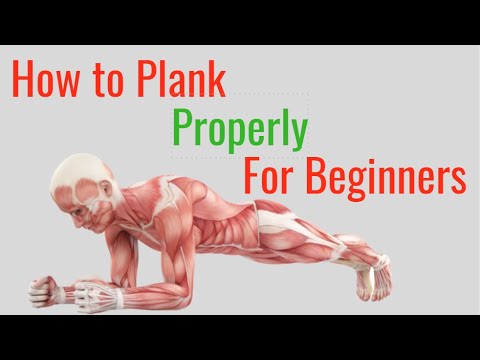
Plank Overview
The plank is a still hold for your core. Your core is the ring of muscles around your middle. It works your abs the most. Your abs are the muscles on the front of your belly. The plank also works your shoulders and glutes. You need no equipment. You just use your body and the floor. The plank builds a strong, steady middle. It teaches your core to hold your body firm. This helps your posture and your bigger lifts. The plank is great for beginners. You can do it at home with no gear. It fits well in a warm-up or at the end of a workout.
What Is The Point of the Plank?
The plank exercise builds core strength and stability while working your entire midsection. It teaches your body to hold proper alignment under tension.
How To Do The Plank
- Start face down and set your forearms on the ground with your elbows directly under your shoulders. Your forearms can point straight ahead or you can clasp your hands, whichever feels stable.
- Extend your legs behind you and rise onto your toes so only your forearms and toes support you. Set your feet about hip width for a stable base.
- Line your body up in one straight line from your head to your heels. There should be no sag in your hips and no piking up toward the ceiling.
- Brace your core as if you are about to take a light punch to the stomach. This full midsection tension is what turns a plank from a passive hold into real training.
- Squeeze your glutes and gently tuck your pelvis so your lower back stays flat, not arched. This protects your spine and keeps the work on your abs.
- Pull your shoulder blades slightly apart and press the floor away so your upper back does not collapse. Keep your neck long and your gaze at the floor just ahead of your hands.
- Breathe slowly and steadily through the hold rather than holding your breath. Staying tight while you breathe is part of the skill.
- Hold the position for 20 to 60 seconds, or as long as you can keep a perfect line. The moment your hips sag, the set is effectively over.
- Lower your knees to the ground under control to finish, then rest before your next round. Chase longer, cleaner holds over time rather than sloppy extra seconds.
Plank Form Tips
- Set your elbows right under your shoulders.
- Make your body one straight line from head to heels.
- Keep your belly tight the whole hold.
- Squeeze your glutes to hold your hips level.
- Keep your neck long. Look down at the floor.
- Do not let your hips sag toward the floor.
- Do not lift your hips up into a peak.
- Breathe slow and steady. Do not hold your breath.
- Press your forearms into the floor for a stronger hold.
Common Mistakes to Avoid for the Plank
- Letting your hips sag toward the floor. A drooping midsection means your core has stopped bracing and your lower back is now taking the load. The instant your hips drop, either re-tighten or end the set, because sagging reps do nothing but strain your spine.
- Piking your hips up toward the ceiling. Lifting the hips high makes the plank easier by taking tension off your abs. Keep your body in one straight line from head to heels so the core actually works.
- Holding your breath the whole time. Bracing does not mean freezing your lungs, and breath holding spikes pressure and cuts your hold short. Breathe slowly and steadily behind a tight core.
- Placing your elbows too far forward or back. Elbows out of line with your shoulders change the leverage and strain the joints. Set them directly under your shoulders for a strong, safe base.
- Letting your upper back round and collapse. When the shoulder blades cave together and your chest sinks, your posture breaks down. Press the floor away and keep your upper back active and broad.
- Craning your neck to look up. Lifting your head puts strain on your neck and pulls your body out of line. Keep your neck long and your eyes on the floor just ahead of you.
- Just watching the clock instead of bracing hard. A long, loose plank builds far less than a shorter one done with a rock-solid brace. Make every second a maximal core contraction, not a passive wait.
- Forgetting to squeeze your glutes. Lazy glutes let your pelvis tip and your lower back arch. Squeeze them to lock your pelvis in a safe, neutral position.
- Chasing extreme hold times at the cost of form. Grinding out several minutes with a sagging body trains bad positions and your back. Once your form breaks, the useful work is done.
- Letting your pelvis tilt into an arch. An anterior tilt drops your belly and overextends your spine. Gently tuck your pelvis so your lower back stays flat.
- Spreading your feet too wide or too narrow without reason. A random stance changes the challenge and can feel unstable. Set your feet about hip width for a consistent, honest hold.
Plank Workout Tips
- Treat the plank as an active brace, not a passive hang. Squeezing everything as hard as you can for a shorter time beats a long, loose hold every time.
- Brace as if bracing for a punch to the gut. That 360 degree tension teaches your core to stiffen the way it must during heavy squats and deadlifts.
- Keep a straight line from your head to your heels. If your hips sag or pike, fix the line before you worry about adding time.
- Squeeze your glutes throughout the hold. A tight lower half locks your pelvis and keeps your lower back safe and flat.
- Breathe slowly and steadily behind the brace. Learning to breathe under tension carries directly over to your bigger lifts.
- Program planks at the end of a session as core finishing work. They build the trunk stability that protects your spine when you load up elsewhere.
- Progress by adding a few seconds or making the plank harder, not just piling on minutes. Long-lever planks, feet elevated, or added weight all raise the challenge intelligently.
- Aim for quality holds of 20 to 60 seconds for several rounds. Once you can hold a perfect two minute plank, add difficulty rather than more time.
- Try a weighted plank with a plate on your back once bodyweight is easy. Adding load is simple progressive overload for your core.
- Keep your shoulder blades slightly spread by pressing the floor away. This protraction keeps your upper back strong and stops it from collapsing.
- Use the RKC-style plank cue of squeezing everything at once. Contracting your abs, glutes, and quads hard turns a mild hold into a serious challenge.
- Film yourself from the side to check your line. Video reveals hip sag and pike that you cannot feel while holding.
- Do not let the plank replace dynamic core work entirely. Pair it with movements like anti-rotation and carries for a well-rounded midsection.
- Keep your neck neutral with your gaze just ahead of your hands. A long neck protects your cervical spine and keeps you in line.
- Stop the set when your form breaks, not when you are simply uncomfortable. The last clean second is worth more than ten sloppy ones.
- Be consistent and the carryover shows up fast. A strong plank brace makes almost every other lift feel more stable within weeks.








Questions & Comments
Be the first to ask a question about this exercise.