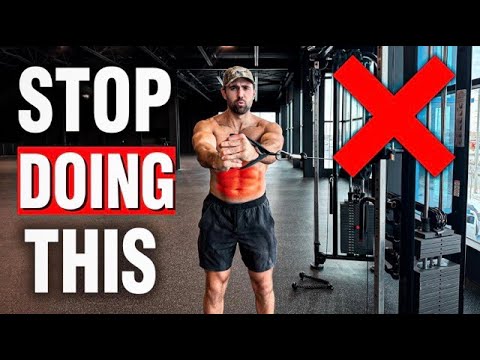
Pallof Press with Rotation Overview
The pallof press with rotation builds a strong, stable core. You press a cable handle out and rotate your torso. It mainly works your obliques. Your obliques are the muscles on the sides of your belly. It also works your abs and shoulders. You need a cable machine set at chest height. This move teaches your core to resist and control twist. That keeps your spine safe in sports and lifts. It builds a solid midsection without any crunching. The pallof press with rotation fits well in a core workout. Do it after your big lifts. Anyone who wants a stronger core can use it.
What Is The Point of the Pallof Press with Rotation?
The pallof press with rotation exercise builds core strength and fights rotation. It trains your abs to stay stable while adding a twist to work your obliques harder.
How To Do The Pallof Press with Rotation
- Set the cable to roughly chest height and grab the handle with both hands, interlacing your fingers around it. Stand side-on to the machine so the cable runs across your body.
- Step away from the stack until there is real tension on the cable, then set your feet about shoulder-width apart with your knees slightly bent. That tension is what your core has to resist, so do not stand too close.
- Bring the handle to the center of your chest and set your posture tall. Brace your abs, tuck your ribs down, and squeeze your glutes so your torso is locked and stable.
- Press the handle straight out from your chest until your arms are fully extended. The cable will try to twist you toward the machine, and your job is to stay square and not let it.
- With your arms long, slowly rotate your torso away from the machine, turning through your midsection rather than just your arms. Keep your hips facing forward and let the rotation come from your trunk.
- Rotate only as far as you can control without your hips swinging or your lower back arching. Feel your obliques work hard to both create and control the twist.
- Rotate smoothly back to center with the same control, keeping your arms extended and your core braced. Do not let the cable snap you back.
- Pull the handle back in to your chest under control to finish the rep. Keep your shoulders down and your breathing steady the whole time.
- Complete all your reps on one side, usually 8 to 12 per side, then turn around and repeat facing the other way so both sides get equal work.
Pallof Press with Rotation Form Tips
- Brace your belly hard before you press. A tight core is the whole point.
- Press the handle straight out from your chest. Keep it in line with your body.
- Do not let the cable twist you toward the machine. Fight to stay square.
- Rotate from your waist, not your arms. Turn your whole torso.
- Keep your arms straight when you rotate. Bent arms shorten the move.
- Move slow and smooth. This is a control move, not a speed move.
- Keep your hips facing forward. Only your upper body should turn.
- Breathe out as you press and rotate. Stay braced the whole time.
- Stand tall with a flat back. Do not lean or slump.
Common Mistakes to Avoid for the Pallof Press with Rotation
- Standing too close to the stack. Without enough distance there is barely any tension, so your core never has to work against the twist. Step out until the cable is genuinely pulling you before you start pressing.
- Rotating from your arms instead of your trunk. Swinging just the handle around while your torso stays still turns this into a shoulder move and skips the obliques entirely. Keep your arms fixed and rotate through your midsection.
- Letting your hips swing open. When your hips turn along with your torso you lose the anti-rotation challenge that makes this drill valuable. Keep your hips squared forward and let only your trunk rotate over them.
- Arching your lower back during the press. A flared ribcage and arched spine means you have stopped bracing and are leaking force through your lower back. Tuck your ribs down and keep your abs tight the whole rep.
- Rushing through the reps. Speeding up lets momentum do the work and hides how much control you actually lack. Move slowly and deliberately so your obliques handle every inch of the rotation.
- Rotating too far and losing control. Cranking past your stable range just shifts stress to the spine and dumps the tension off your core. Rotate only as far as you can own with your hips staying put.
- Shrugging your shoulders during the press. Letting your shoulders creep toward your ears wastes tension and stresses your neck. Keep your shoulders packed down and away from your ears.
- Holding your breath the whole set. Locking your breath makes you rigid in the wrong way and cuts your reps short. Breathe steadily and brace on the exhale as you press and rotate.
- Doing uneven reps on each side. Skimping on your weaker side lets an imbalance grow, since the core is easy to favor without noticing. Match your reps and effort on both sides, and lead with the weaker one.
- Using too much weight. Overloading forces you to twist your whole body just to move the handle, which defeats the anti-rotation purpose. Pick a load light enough that your torso, not momentum, controls the movement.
- Bending or collapsing at the waist. Leaning sideways toward or away from the machine takes the work off your obliques. Stay tall and stacked so the challenge stays in your core.
Pallof Press with Rotation Workout Tips
- Think of this as an anti-rotation and rotation drill in one. You resist the cable's pull on the press and then control a deliberate twist, which trains the obliques to both brace and produce rotation, exactly what they do in sport.
- Set your ribs down and glutes tight before every rep. That stacked, braced position is what lets your core resist the cable instead of your spine bending to it.
- Move slowly and deliberately. Rotational core work rewards control, and slow reps expose whether your trunk or just your arms are doing the job.
- Keep your hips squared forward the whole time. Locking the hips forces the rotation to come from your midsection, which is where you want it.
- Adjust the challenge by stepping farther from the stack. More distance means more tension, so you can dial the difficulty without changing plates.
- Match your reps and effort on both sides. Most people have a stronger, more coordinated side, and even work keeps a real imbalance from creeping in over time.
- Program it two or three times a week as core accessory work. It fits well at the end of a session in the 8 to 12 rep range per side for a few sets.
- Exhale as you press and rotate out. A hard exhale ties into your deep core brace and helps you stay stable through the twist.
- Keep your arms fixed and long through the rotation. Imagine your hands are locked to your sternum so the turn has to come from your trunk.
- Use it to build carryover to sport. Throwing, swinging, and change of direction all rely on controlled rotation, and this drill trains exactly that pattern.
- Pause briefly at full extension and rotation. A short hold at end range makes the obliques work harder to control the position.
- Progress by adding weight only once your form is airtight. Clean control at a lighter load beats heavy reps where your hips swing and your back arches.
- Try a half-kneeling version to remove the legs from the equation. Kneeling makes it harder to cheat with your hips and forces the core to do more.
- Keep your neck and shoulders relaxed. Tension should live in your trunk, not creep up into your traps and neck.
- Pair it with planks and carries for a well-rounded core. Together they train bracing, anti-rotation, and rotation for a trunk that is strong in every direction.
- Stay patient and precise. Rotational strength builds through quality reps over time, so favor control over chasing a heavier stack.








Questions & Comments
Be the first to ask a question about this exercise.