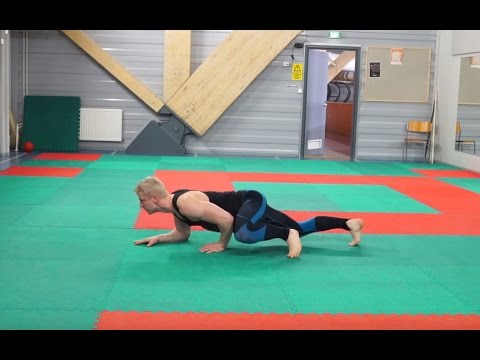
Lateral Hand Walk Push Up Overview
The lateral hand walk push-up is a bodyweight chest move. It works your chest, shoulders, and triceps. Your triceps are the muscles on the back of your arms. Your abs help hold your body steady. You need no equipment. You just need floor space and your body. This move adds a side step to a normal push-up. That step makes your core and shoulders work harder. It builds pressing strength and body control. The lateral hand walk push-up is best for people who can already do clean push-ups. It fits on a push day or a core day. It also works well in a bodyweight workout at home.
What Is The Point of the Lateral Hand Walk Push Up?
The lateral hand walk push up combines a standard push up with side-to-side movement. It builds chest strength while challenging your core stability and coordination.
How To Do The Lateral Hand Walk Push Up
- Start in a standard push up position with your hands under your shoulders, your body in a straight line from head to heels, and your core braced. Set your feet about hip width apart.
- Take a breath and brace, then lower your chest toward the floor by bending your elbows to about 45 degrees from your body. Keep your body rigid, no sagging hips.
- Touch your chest lightly to the floor, or come as low as you can control, then press back up to the top by driving through your palms.
- At the top, walk your right hand one step out to the right. Follow it by moving your left hand over to return to a shoulder-width push up position, now shifted to the right.
- Reset your body in a straight line and brace again. Perform another full push up in this new position.
- After that push up, walk your hands back to the left, right hand leading or left hand leading, until you return to where you started.
- Do another push up there, then continue alternating the lateral walk after each push up. Keep your hips level and your core tight during the hand walks, since that is when people sag or twist.
- Move deliberately and keep your feet pivoting slightly as needed so your body stays aligned. Do not let your lower back arch or your hips rock side to side.
- Continue for 8 to 12 total push ups, or a set distance across the floor, for 3 to 4 sets.
Lateral Hand Walk Push Up Form Tips
- Keep your body in one straight line. Do not let your hips sag.
- Keep your belly braced the whole time. This keeps you steady.
- Lower your chest close to the floor. Full range works more muscle.
- Keep your hands under your shoulders when you press.
- Tuck your elbows a little. Do not flare them straight out.
- Take small, controlled steps when you walk your hands.
- Breathe in as you lower. Breathe out as you press up.
- Keep your neck in line with your back. Look at the floor.
- Move slowly. Do not rush the walk or the push-up.
Common Mistakes to Avoid for the Lateral Hand Walk Push Up
- Letting your hips sag during the hand walks. When you shift your hands, it is easy to lose core tension and let your hips drop, which strains your lower back. Keep your core braced and your body in a straight plank the entire time, including during the walks.
- Flaring your elbows straight out on the push ups. A 90 degree flare stresses the shoulders and weakens your press. Keep your elbows tucked to around 45 degrees so the load stays on your chest and triceps.
- Twisting or rocking your hips as you walk your hands. Letting your body rotate side to side wastes energy and takes the challenge off your core. Move your hands while keeping your hips square and level, resisting the urge to twist.
- Cutting the push up range short. Stopping halfway down only trains a slice of the movement and cheats your chest. Lower your chest all the way to the floor, or as low as you can control, on every push up.
- Rushing the hand walks and losing control. Slapping your hands out quickly makes you unstable and sloppy. Move each hand deliberately and reset your position before the next push up.
- Letting your head drop or crane forward. Dropping your head breaks your straight line and strains your neck. Keep your neck neutral and your gaze at the floor just ahead of your hands.
- Placing your hands too far apart after the walk. If your hands end up too wide, your shoulders take extra stress and your press weakens. Return to a shoulder-width position before pressing.
- Holding your breath through the sequence. Locking your breath makes you rigid and lightheaded and often leads to a sagging plank. Exhale as you press up and breathe in on the way down and during the walks.
- Letting your lower back arch. An arched back under a plank load stresses the spine and shows your core has quit. Squeeze your glutes and brace to keep a flat, neutral back.
- Only walking well in one direction. It is common to move smoothly to your dominant side and get sloppy going the other way. Give both directions equal focus so your core and shoulders develop evenly.
- Going too fast to keep good push up form. Chasing speed across the floor makes every push up worse. Slow down and treat each push up as its own clean rep.
Lateral Hand Walk Push Up Workout Tips
- Keep your body in one rigid line from head to heels the whole time. Bracing hard through the walks is what turns this into a serious core and shoulder challenge on top of a chest exercise.
- Keep your elbows tucked to around 45 degrees on the push ups. This protects your shoulders and keeps your chest and triceps doing the work.
- Move your hands deliberately, not in a rush. Controlled hand walks keep you stable and force your core to resist the shift in your base.
- Lower your chest all the way to the floor each push up. A full range builds more chest and makes each rep count.
- Squeeze your glutes to keep your hips from sagging. A tight lower body helps your core hold the plank steady during the walks.
- Give both directions equal attention. Walking to your weaker side cleanly builds balanced strength and control on both sides.
- Program this on push days or as a bodyweight conditioning finisher. It trains the chest while adding a shoulder stability and core demand that a plain push up does not.
- Keep your neck neutral with your gaze just ahead of your hands. This maintains your straight line and keeps your neck happy.
- Scale it by dropping to your knees if your form breaks. Keeping the plank clean on your knees beats grinding out sloppy full reps.
- Make it harder by adding more walk steps between push ups. More lateral distance means more time under core tension and shoulder stability work.
- Exhale as you press and stay braced through the walks. Steady breathing behind a tight core keeps your plank from collapsing.
- Chase the mind-muscle connection with your chest on the presses. Thinking about your chest driving the push up gets more out of each rep.
- Use this to build shoulder stability that carries to other pressing. The constant repositioning teaches your shoulders to stay strong and stable under load.
- Keep the reps clean rather than chasing a high count. Quality push ups with a steady plank beat a sloppy race across the floor.
- Do not train to failure with breaking form. When your hips start to sag or twist, end the set and reset.
- Stay consistent and your core and shoulders get noticeably sturdier. This kind of stability work quietly improves every pressing lift you do.








Questions & Comments
Be the first to ask a question about this exercise.