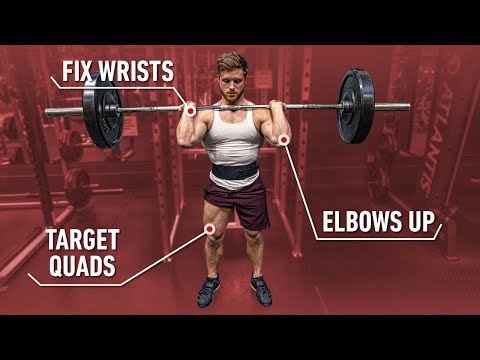
Front Squat Overview
The front squat works your quads. Your quads are the big muscles on the front of your thighs. You hold a barbell on the front of your shoulders. Then you squat down and stand back up. It also works your glutes, hamstrings, and calves. You need a barbell and a rack. The front squat builds strong legs and a tall, proud posture. The front bar keeps your chest up. This works your quads hard and spares your back. It fits on leg day. Start light and learn the bar hold first. Put it early while you are fresh.
What Is The Point of the Front Squat?
The front squat builds massive quad strength while improving your posture. It hits your legs harder than back squats and teaches you to stay upright.
How To Do The Front Squat
- Set the barbell in a rack at about chest height and load your weight. Step up to the bar and get ready to take it on the front of your shoulders.
- Cross your arms into an X and place the bar on your front delts, resting it on the meat of your shoulders. Alternatively, use a clean grip with fingers under the bar and elbows high.
- Whichever grip you use, drive your elbows up high so your upper arms are near parallel to the floor. High elbows keep the bar from rolling forward off your shoulders.
- Unrack the bar, step back, and set your feet shoulder-width apart with your toes slightly turned out. Brace your core hard and take a big breath.
- Begin the descent by pushing your hips back slightly and bending your knees. Keep your torso as upright as you can, which is the whole point of the front squat.
- Lower until your thighs are at least parallel to the floor or deeper if your mobility allows. Keep your chest tall and your elbows high the entire way down.
- Drive through your heels and midfoot to stand back up. Push your knees out and keep your torso upright rather than letting your chest fold forward.
- Keep your elbows up through the whole rep, since dropping them tips the bar forward and collapses your posture. Breathe out through the hardest part of the rise.
- Finish standing tall and reset your brace for the next rep. The front squat builds the quads well in the 5 to 10 rep range for 3 to 5 sets.
Front Squat Form Tips
- Rest the bar on your front shoulders, not your neck.
- Keep your elbows up high the whole time.
- Keep your chest tall and proud.
- Push your hips back and bend your knees to squat.
- Lower until your thighs are at least parallel.
- Drive through your heels to stand up.
- Keep your belly tight to protect your back.
- Point your toes out a little for balance.
- Breathe in as you lower. Breathe out as you rise.
Common Mistakes to Avoid for the Front Squat
- Letting your elbows drop. When your elbows fall, the bar rolls forward off your shoulders and pulls your chest down into a dangerous forward lean. Drive your elbows up high and keep them there for the whole rep.
- Rounding your upper back. A hunched thoracic spine under a front-loaded bar tips you forward and strains your back. Keep your chest up and your upper back tight so you stay upright.
- Squatting with your chest folding forward. Leaning too far forward turns the front squat into a good morning and dumps the load onto your lower back. Keep your torso as vertical as possible with high elbows.
- Going too heavy too soon. Ego weight collapses your posture and forces your elbows down. Build the front squat gradually with loads you can hold in a tall, braced position.
- Rising onto your toes. Shifting your weight forward onto the balls of your feet makes you unstable and loads the knees badly. Drive through your heels and midfoot to stay balanced.
- Cutting the depth short. Stopping high robs the quads of a full range and builds strength in only a short arc. Descend to at least parallel while keeping your torso upright.
- Not bracing hard enough. A weak core lets your midsection collapse under the front load. Take a big breath and brace your abs tightly before each descent.
- Letting the knees cave inward. Knees collapsing in put uneven stress on the joint and leak power. Push your knees out in line with your toes throughout the squat.
- Using a grip you cannot hold. If your wrists or shoulders lack the mobility for a clean grip, the bar shifts and your form falls apart. Use the crossed-arm grip or work on mobility until you can hold the bar securely.
- Bouncing hard out of the bottom. Slamming into the bottom and bouncing risks the knees and spine. Descend under control and drive up smoothly from the hole.
- Holding your breath for multiple reps. Locking your air across reps leaves you dizzy under a heavy bar. Reset your breath and brace at the top before each rep.
Front Squat Workout Tips
- Keep your elbows up and driving high. High elbows keep the bar on your shoulders and your torso upright, which is the whole key to the front squat.
- Stay as upright as you can. The vertical torso is what shifts the load onto your quads and off your lower back.
- Brace your core hard before every rep. A strong brace supports the front-loaded bar and protects your spine.
- Drive through your heels and midfoot. Keeping your weight back keeps you balanced and loads the quads properly.
- Use the crossed-arm grip if your wrists are tight. It lets you keep high elbows without needing the mobility a clean grip demands.
- Program it as a main quad builder on leg day. The front squat hammers the quads and core while being easier on the lower back than back squats.
- Aim for 5 to 10 reps for 3 to 5 sets. The demanding position suits moderate reps where you can hold your posture.
- Work on ankle and wrist mobility. Better mobility lets you sit deep and hold the bar securely, unlocking the full benefit of the lift.
- Push your knees out on the way up. Tracking the knees over the toes keeps the joint safe and helps you drive out of the hole.
- Add weight in small steps as your form holds. Progressive overload builds the quads, but only if your elbows stay high and your torso stays tall.
- Great carryover to the clean and overhead work. The front rack position built here translates directly to Olympic lifting.
- Film yourself from the side. Video quickly shows dropping elbows or a forward-folding torso that are hard to feel mid-set.
- Do not let a heavy bar wreck your posture. If your elbows collapse, the weight is too heavy to build the quads the way this lift should.
- Use straps looped over the bar as a grip alternative. If a clean grip hurts your wrists, holding straps can give you a secure hold with high elbows.
- Squeeze your upper back tight to build a shelf. A tight thoracic spine keeps the bar stable and your chest up.
- Warm up thoroughly before loading heavy. A few lighter sets groove the position and prepare your knees and core for the front load.








Questions & Comments
Be the first to ask a question about this exercise.