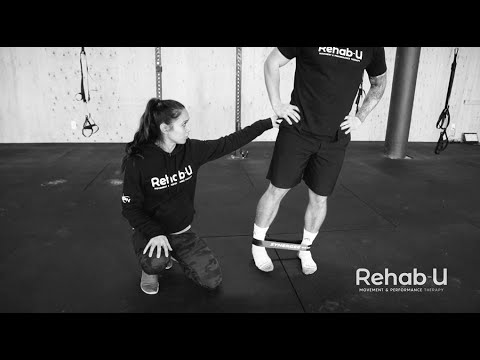
Diagonal Band Walk Overview
The diagonal band walk is a moving glute exercise with a band. You loop a band around your legs and step out at an angle. It works your glutes, your butt muscles. It also works your quads and core. All you need is a resistance band. It is a great warm-up move. This move wakes up and strengthens your glutes. The band pushes back as you step, so your muscles fight it. Stepping at an angle hits the side glutes well. This helps your hips stay strong and stable. It fits well before leg days as a warm-up. The diagonal band walk is easy for beginners.
What Is The Point of the Diagonal Band Walk?
The diagonal band walk exercise builds stronger glutes while working your core stability. It targets your butt muscles from different angles than regular squats.
How To Do The Diagonal Band Walk
- Place a resistance band around your ankles, or just above your knees for less tension. Stand with your feet about hip width apart so the band already has a little tension on it.
- Set a slight bend in your knees and drop into a quarter squat athletic stance. Put your hands on your hips or clasp them in front of your chest for balance, and keep your chest up.
- Brace your core and set your glutes so the band tension is felt in the sides of your hips. This move targets the glutes, especially the glute medius that stabilizes your hips.
- Step diagonally forward and out with your right foot, driving the knee out against the band. Keep the tension in the band the whole time and do not let your knees cave inward.
- Bring your left foot to meet the right in a controlled step, keeping the band tension and your athletic stance. Do not let your feet click together and lose all the band tension.
- Keep your steps deliberate and controlled rather than fast and sloppy. Your hips should stay low and level, and your torso should stay upright and quiet.
- Continue stepping diagonally for 10 to 12 steps in one direction, feeling the burn build in the sides of your glutes. Keep constant tension on the band throughout.
- Then reverse and perform the diagonal band walk in the opposite direction to work both sides evenly. This is a great glute activation and warm up drill, so do 2 to 3 rounds each way.
Diagonal Band Walk Form Tips
- Keep a slight bend in your knees the whole time.
- Keep tension in the band with every step.
- Step out at an angle, not straight ahead.
- Keep your feet about hip-width or wider.
- Keep your core tight and chest up.
- Take slow, controlled steps.
- Do not let your knees cave inward.
- Keep your steps even on both sides.
- Stay low in a small squat stance.
Common Mistakes to Avoid for the Diagonal Band Walk
- Letting your knees cave inward. The whole point of the band is to make you push your knees out against it, so letting them collapse in defeats the exercise and can strain the joint. Actively drive your knees out to keep tension on the glutes the entire time.
- Standing too upright. Losing your athletic quarter squat stance and standing tall reduces the glute tension and turns it into a casual walk. Sink into a slight squat and keep your hips low to keep the glutes loaded.
- Letting the band go slack between steps. If your feet come all the way together the band loses tension and the glutes get a rest each step. Keep your feet at least hip width apart so the band stays loaded throughout.
- Taking fast, sloppy steps. Rushing turns the drill into a bouncy shuffle that uses momentum instead of controlled glute work. Slow down and make each step deliberate so the sides of your hips do the work.
- Using a band that is too heavy. Too strong a band makes your knees cave and your form fall apart. Pick a band you can walk against while keeping your knees pushed out and your stance solid.
- Rocking the torso side to side. Swaying your upper body to help drive each step shifts work off the glutes and onto momentum. Keep your torso upright and quiet and let your hips do the moving.
- Placing the band poorly. A band that sits too loose or slides around gives inconsistent tension. Position it snugly around your ankles or just above your knees so the resistance stays steady.
- Not feeling it in the glutes. If you feel this mostly in your quads or hip flexors, you are standing too tall or not pushing the knees out. Sink lower and consciously drive the knees out to shift the work to the glute medius.
- Only working one direction. Walking diagonally one way and skipping the other builds an imbalance between sides. Always reverse and walk back the other way to train both hips evenly.
- Letting your hips rise and fall. Bobbing up and down with each step breaks the constant tension and reduces the glute work. Keep your hips at a steady low height throughout the walk.
- Forgetting to brace your core. A loose trunk lets your torso sway and your hips shift. Brace your core to keep your torso stable and your steps controlled.
Diagonal Band Walk Workout Tips
- Drive your knees out against the band. Pushing the knees outward is what fires the glute medius, the muscle that stabilizes your hips, so make that outward pressure the focus of every single step.
- Stay in an athletic quarter squat. Sinking your hips low and keeping them there loads the glutes far more than walking upright, so hold that low stance throughout the drill.
- Keep constant tension on the band. Never letting your feet click together maintains steady load on the glutes, which is what makes this simple move so effective for activation.
- Use it as a warm up before leg day. Diagonal band walks wake up and switch on the glutes, so a few rounds before squats or deadlifts can help you recruit them better in your main lifts.
- Move slowly and deliberately. Controlled steps keep the tension on the glutes and stop momentum from taking over, so resist the urge to shuffle quickly through the reps.
- Feel the burn in the sides of your hips. If you feel it in your quads, sink lower and push the knees out more to shift the work to the glute medius where it belongs.
- Work both directions evenly. Always reverse and walk the other way so both hips get equal work and you do not build a side to side imbalance.
- Adjust band placement for difficulty. A band above the knees is easier while a band around the ankles increases the challenge, giving you a simple way to progress over time.
- Keep your torso upright and quiet. A stable, still upper body ensures the movement comes from your hips and not from swaying momentum.
- Use it for hip and knee health. Strong glute medius muscles help keep your knees tracking properly, so this drill supports better knee alignment in all your lower body work.
- Progress with a stronger band. As the glutes get stronger, move to a thicker band to keep challenging them, since progressive overload applies even to activation work.
- Brace your core throughout. A tight trunk keeps your torso stable and your steps controlled, which keeps the tension squarely on the glutes.
- Keep your hips level and steady. Avoiding any bobbing up and down maintains the constant tension that makes the glutes work the whole time.
- Add it to a glute finisher. Beyond warming up, band walks make a great burnout at the end of a leg session to fully fatigue the glutes.
- Try different step patterns. Mixing diagonal, lateral, and forward and back band walks hits the glutes from several angles for more complete hip development.
- Keep your reps and rounds consistent. Doing 2 to 3 rounds of 10 to 12 steps each way, session after session, builds the glute strength and endurance that carries over to bigger lifts.
- Be patient with glute activation. Learning to truly fire your glutes takes practice, so use this drill regularly and your mind muscle connection to the glutes will steadily improve.








Questions & Comments
Be the first to ask a question about this exercise.