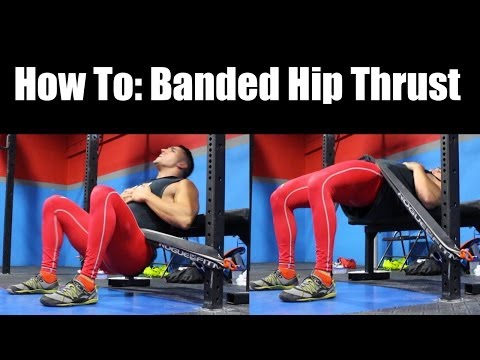
Banded Hip Thruster Overview
The banded hip thruster is a glute move. It works your glutes. The glutes are your butt muscles. It also works your hamstrings. The hamstrings are on the back of your thighs. You need a resistance band around your thighs. You lie on your back and drive your hips up. The banded hip thruster is great for beginners. The band makes your glutes work harder. It teaches you to squeeze your butt. You can do it at home with just a band. It fits well in a warm-up or on leg day. It also helps wake up lazy glutes.
What Is The Point of the Banded Hip Thruster?
The banded hip thruster builds stronger, rounder glutes while adding resistance band tension. Perfect for targeting your butt muscles at home.
How To Do The Banded Hip Thruster
- Loop a resistance band around both thighs, sitting it just above your knees. Lie on your back with your knees bent and your feet flat on the floor about hip width apart, heels a comfortable distance from your butt.
- Set your arms out to your sides for a bit of stability and press your lower back gently into the floor. Take a breath and brace your core so your ribs stay down and your spine stays neutral.
- Push your knees out slightly against the band before you even move. This pre-tension wakes up your glutes and stops your knees from caving in once you start driving up.
- Drive through your heels and squeeze your glutes to lift your hips toward the ceiling. Push against the band the whole way up so your knees stay tracking over your feet, not collapsing inward.
- Rise until your body forms a straight line from your shoulders to your knees. Do not overarch your lower back at the top, but finish the movement with your hips, not your spine.
- Squeeze your glutes hard at the top and hold for one to two seconds. This peak contraction is the whole point, so really try to crush your glutes together at the top.
- Lower your hips back down slowly under control, keeping tension in the band and your knees pushed out. Do not just drop, but resist gravity on the way down for a two second descent.
- Lightly touch your hips to the floor or stop just short to keep tension, then drive up again. Repeat for 15 to 25 reps, since bands and glutes both respond well to higher-rep sets.
Banded Hip Thruster Form Tips
- Push your knees out against the band the whole time.
- Squeeze your glutes hard at the top.
- Drive up through your heels, not your toes.
- Keep your core tight to protect your low back.
- Stop at the top when your body is straight.
- Do not arch your low back at the top.
- Lower with control. Do not drop your hips.
- Breathe out as you lift. Breathe in as you lower.
- Keep your chin tucked a little and your neck relaxed.
Common Mistakes to Avoid for the Banded Hip Thruster
- Letting your knees cave inward as you drive up. When your knees collapse toward each other, your glutes stop firing and the band goes slack, which defeats the purpose. Actively push your knees out against the band the whole rep so your glutes stay switched on.
- Overarching your lower back at the top. Cranking your spine into a big arch to gain height loads your lower back instead of your glutes. Finish the movement by squeezing your glutes and keeping a straight line from shoulders to knees, ribs tucked down.
- Pushing through your toes instead of your heels. Driving off the balls of your feet shifts the work toward your quads and reduces glute activation. Keep your weight in your heels so the glutes and hamstrings do the lifting.
- Not squeezing at the top of the rep. Rushing past the lockout means your glutes never get the peak contraction that makes this move effective. Pause for one to two seconds up top and consciously crush your glutes together.
- Placing your feet too far from your hips. When your heels are too far out, the movement drifts toward your hamstrings and your knee angle gets awkward. Set your feet so your shins are roughly vertical at the top of the thrust.
- Using a band that is too light to matter. A flimsy band gives almost no resistance and your glutes barely notice it. Pick a band that makes the top of every rep genuinely hard to hold while still letting you keep your knees out.
- Dropping your hips fast on the way down. Letting your hips crash down wastes the eccentric, which is a real part of building the glutes. Lower under control over about two seconds while keeping tension in the band.
- Losing band tension by letting the band slide. If the band rolls up or down your thighs, it stops pulling your knees in and your positioning falls apart. Seat it snugly just above your knees and reset it if it starts to creep.
- Holding your breath through the set. Going breathless on higher-rep glute work makes you lightheaded and lets your bracing slip. Breathe out as you thrust up and take a fresh breath at the bottom.
- Going too fast and bouncing off the floor. Speeding through with a bounce uses momentum and skips the hard part of each rep. Control the tempo, pause at the bottom, and make your glutes start every rep from a dead position.
- Ignoring the outward knee pressure at the bottom. Many people only push the band out at the top and let their knees drift in as they lower. Keep pressing out the entire rep so tension and glute activation never drop.
Banded Hip Thruster Workout Tips
- Push your knees out against the band on every rep. That outward pressure lights up your glutes and keeps your knees tracking safely over your feet.
- Drive through your heels, not your toes. Heel pressure puts the work squarely on your glutes and hamstrings instead of letting your quads take over.
- Squeeze hard at the top for one to two seconds. The peak contraction is where the glutes work hardest, so make that hold count on every rep.
- Keep your ribs down and avoid overarching. Finishing with your glutes rather than your lower back protects your spine and keeps the tension where it belongs.
- Use a band that makes the top genuinely hard. If holding the squeezed position is easy, size up so your glutes actually get challenged.
- Aim for higher reps, around 15 to 25 per set. Glutes and bands both respond well to this range, so chase a deep burn rather than heavy singles.
- Program it as a warm-up or a finisher. It primes the glutes before heavy hip thrusts and squats, or burns them out at the end of a lower-body session.
- Control the lowering phase for about two seconds. Owning the eccentric keeps constant tension and squeezes more growth out of each rep.
- Set the band snugly just above your knees. A well-placed band stays put and keeps pulling your knees inward so you have something to resist.
- Try a pause set to deepen the burn. Hold the top squeeze for three to five seconds on your last set to really fatigue the glutes.
- Perfect for training at home with minimal gear. A single band and the floor is all you need, which makes this an easy staple for busy weeks.
- Focus on the mind-muscle connection with your glutes. Thinking about squeezing the muscle rather than just lifting your hips noticeably improves activation.
- Add reps or a stronger band to progress over time. Progressive overload still applies, so make the movement harder as your glutes adapt.
- Keep pressing the band out at the bottom too. Maintaining outward tension the whole rep means your glute activation never drops between reps.
- Try single-leg or feet-elevated versions later. Once the basic move feels easy, these variations crank up the challenge for stronger glutes.
- Stay consistent for real glute development. Building the mind-muscle connection here carries straight over to your heavier hip hinge and squat work.








Questions & Comments
Be the first to ask a question about this exercise.