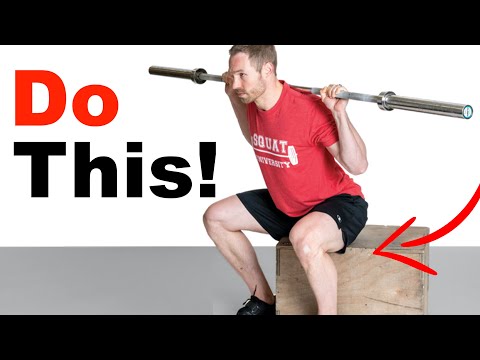
Band Resisted Box Squat Overview
The band resisted box squat is a leg move. You loop a resistance band around your hips. You anchor the band behind you at floor level. You stand in front of a box or bench. You squat back until you sit on the box. Then you stand up against the band. It works your glutes and quads the most. It also works your hamstrings and abs. You need a resistance band and a box or bench. This move builds strong hips and a powerful stand up. The band pulls your hips back. That teaches you to sit back the right way. The box sets your depth each rep. It is good for lifters with some practice. Use the band resisted box squat on a leg day or in a circuit.
What Is The Point of the Band Resisted Box Squat?
The band resisted box squat builds explosive power in your glutes and quads while teaching perfect squat form. The band adds resistance at the top where you're strongest.
How To Do The Band Resisted Box Squat
- Loop a resistance band around your hips and anchor the other end behind you at floor level, to something solid like a rack base. The band should pull your hips back and down.
- Stand about two to three feet in front of a box or bench set at roughly parallel height. Set your feet a bit wider than shoulder width with your toes turned slightly out.
- Step forward until the band is taut and pulling on your hips. Take a big breath, brace your core hard, and set your chest tall.
- Begin the squat by sitting your hips back toward the box against the band tension. The band helps teach the sit back pattern that makes box squats so effective.
- Lower under control, keeping your chest up and your shins fairly vertical. Let your hips lead the way back as you descend toward the box.
- Sit back until your glutes touch the box lightly. Do not crash down or fully relax, since you want to stay tight and controlled on the box.
- Pause briefly on the box while keeping your core braced and your back set. This dead stop builds starting strength from a stable position.
- Drive through your heels and stand up explosively against the band, which now pulls back on your hips. Squeeze your glutes hard as you extend at the top.
- Fully extend your hips at the top and feel the band tension peak there. Reset your brace before beginning the next rep.
- Work in the 5 to 10 rep range for 3 to 4 sets. Keep every rep to the same box height so your depth stays consistent.
Band Resisted Box Squat Form Tips
- Push your hips back to reach the box.
- Sit onto the box light. Do not crash down.
- Stay tight while you touch the box.
- Keep your chest up the whole time.
- Drive through your heels to stand.
- Squeeze your glutes hard at the top.
- Keep the band tension the whole rep.
- Keep your back flat, not rounded.
- Breathe out as you stand up.
Common Mistakes to Avoid for the Band Resisted Box Squat
- Crashing down onto the box. Dropping hard onto the box compresses your spine and jars your body, turning a good tool into a risk. Sit back under control and touch the box lightly while staying tight.
- Fully relaxing on the box and rocking to stand. Collapsing on the box and using a backward rock to rebound puts your lower back in a rounded, loaded spot. Stay braced on the box and drive up from a controlled dead stop.
- Losing your sit back and squatting straight down. If you bend your knees first instead of sitting your hips back, you miss the hip loading the band is teaching. Push your hips back into the band as you descend to the box.
- Not standing up hard against the band. The band is heaviest at the top, so a lazy lockout means you never fully load your glutes. Drive up explosively and squeeze your glutes to finish against the band.
- Setting the box at the wrong height. A box too high robs you of depth, and one too low can round you out at the bottom. Set it at about parallel or your target depth for a strong, safe position.
- Letting your chest drop as you sit back. If your torso caves toward the box, you shift the load to your lower back. Keep your chest up so your hips, not your spine, absorb the load.
- Anchoring the band too high or too loose. A band anchored high or without tension will not properly pull your hips back. Anchor it low and step out far enough that the band is genuinely taut.
- Rushing off the box without a real pause. Blowing through the box turns off the starting strength benefit of the dead stop. Pause briefly and tight, then explode up.
- Holding your breath across several reps. Never re breathing leaves you lightheaded and less braced. Take a fresh breath and re brace at the top before each rep.
- Letting your knees cave as you drive up. Under the band and off a dead stop, the knees tend to buckle in. Push your knees out over your toes as you leave the box.
- Using a band so strong it drags you backward. An overpowering band pulls you off balance and ruins your position. Choose a band that adds a real challenge at lockout without yanking you around.
Band Resisted Box Squat Workout Tips
- Use the box to teach a true sit back and consistent depth. Touching the same box every rep grooves a reliable pattern and takes the guesswork out of your squat depth.
- Sit your hips back into the band as you lower. The band reinforces the hip hinge that makes box squats so good for your posterior chain.
- Pause tight on the box and drive from a dead stop. Killing the stretch reflex builds starting strength that carries over to breaking heavy weights out of the hole.
- Stand up explosively against the band. Because the band is hardest at the top, a powerful lockout is where you build serious glute and hip strength.
- Touch the box lightly, never crash onto it. A soft touch keeps you tight and protects your spine, while a hard drop jars your body and ruins the rep.
- Keep your chest up as you sit back. Staying tall keeps the load in your hips and off your lower back throughout the movement.
- Set the box at about parallel or your target depth. That height enforces good depth without dumping you into a weak, rounded bottom.
- Anchor the band low and step out until it is taut. Proper low anchoring and tension is what makes the band pull your hips back the way you want.
- Squeeze your glutes hard at lockout. Finishing each rep with a strong glute contraction against the band builds powerful hip extension.
- Program it on lower body or glute focused days. It is excellent accessory work for teaching the hip hinge and building explosive standing power.
- Work in the 5 to 10 rep range for 3 to 4 sets. That range builds strength and lets you groove the sit back with clean reps.
- Push your knees out as you leave the box. Good knee tracking keeps the joint safe and lets you channel full power into standing.
- Film your sets from the side. A video confirms you are truly sitting back to the box and pausing rather than rocking and rebounding.
- Brace hard and re breathe at the top. A tight core protects your spine and gives you a stable base against the band.
- Pick a band that challenges lockout without dragging you back. The right band tests your finish while letting you keep your balance and form.
- Pair it with regular squats and hip hinges. Combining banded box squats with your main lifts builds strong, explosive hips over time.








Questions & Comments
Be the first to ask a question about this exercise.