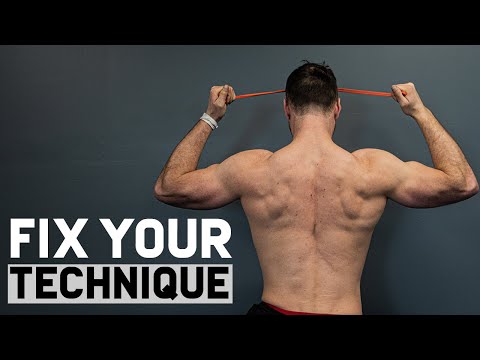
Band Face Pull Overview
The band face pull works your upper and middle back. It also works the back of your shoulders. You anchor a resistance band at chest height. You grab both ends and pull toward your face. Your elbows drive back as you pull. You need one resistance band and a place to anchor it. The band face pull is a great move for healthy shoulders. It fixes rounded posture from sitting. It balances out all your pressing moves. It suits beginners well. It fits as a warm-up or a finisher. Pull with your back and keep it smooth.
What Is The Point of the Band Face Pull?
The band face pull exercise strengthens your middle back and rear shoulders. It fixes forward head posture and builds better posture overall.
How To Do The Band Face Pull
- Anchor a resistance band at about chest or face height on a rack or sturdy post. Grab both ends of the band with an overhand grip, or loop the ends around your hands.
- Step back until there is real tension in the band with your arms extended straight ahead at shoulder height. Set your feet hip-width apart or in a slight stagger for stability.
- Set your shoulder blades down and back and brace your core. Take a breath before you pull.
- Pull the band toward your face by driving your elbows back and out to the sides, leading with the elbows rather than the hands.
- As you pull, separate your hands and rotate your shoulders so your knuckles end up pointing back and up, like a double biceps pose at the end.
- Bring the band to about eye or forehead level while squeezing your shoulder blades together hard. Aim the pull at your face, not your chest.
- Pause for a beat at the top and feel the rear delts and mid-back working. Keep your shoulders down, not shrugged up to your ears.
- Return to the start on a slow two to three second count, resisting the band as it pulls your arms back forward. Do not let it snap you.
- Keep light tension at the start rather than fully relaxing, then repeat. Aim for 15 to 20 reps for 3 sets, since this is a high-rep shoulder-health move.
Band Face Pull Form Tips
- Pull the band toward your face, not your chest.
- Drive your elbows back and out.
- Squeeze your shoulder blades together at the end.
- Keep your chest up and stand tall.
- Move slowly out and back. No snapping.
- Keep your wrists straight and firm.
- Do not shrug your shoulders up. Keep them down.
- Breathe out as you pull. Breathe in as you return.
- Keep your core tight so you do not lean back.
Common Mistakes to Avoid for the Band Face Pull
- Shrugging your shoulders up toward your ears. When your upper traps take over, your rear delts and external rotators stop doing the work. Keep your shoulders pulled down and back and drive the movement with your elbows.
- Using a band that is too heavy. Too much tension forces you to lean back, shrug, and yank just to finish, which wrecks the isolation. Pick a band you can pull to your face with clean external rotation for all your reps.
- Pulling to your chest instead of your face. Aiming low turns the face pull into a row and misses the rear delts and rotators. Pull the band toward your eyes or forehead and let your elbows stay high.
- Not externally rotating the shoulders. Skipping the finishing rotation, where your knuckles turn back and up, leaves out the rotator cuff work that makes this move so valuable for shoulder health. Rotate into that double biceps position at the end.
- Leading with your hands instead of your elbows. Pulling hands-first brings in the biceps and misses the target. Drive your elbows back and out so the rear delts and mid-back lead.
- Letting the band snap you forward. Releasing fast and letting the band recoil wastes the eccentric and can jerk your shoulders. Control a two to three second return on every rep.
- Leaning back to help. Using your bodyweight to pull the band by leaning away turns a shoulder move into a whole-body heave. Stay tall, brace your core, and keep the effort in your upper back.
- Cutting the range short. Stopping before your hands separate and reach your face leaves the rear delts short of a full contraction. Finish the pull fully with a hard shoulder-blade squeeze.
- Rushing the reps. Blasting through fast reduces tension on the small target muscles, which respond to control. Slow down and feel the rear delts and rotators work each rep.
- Setting the anchor too low or too high. An anchor far off face height changes the angle badly and reduces the rear-delt and rotator benefit. Set it around face or upper-chest height for the right line of pull.
- Not squeezing at the end. Treating the finish as a stopping point instead of a contraction wastes the best part of the move. Pinch your shoulder blades and hold the rotated position for a beat.
Band Face Pull Workout Tips
- Treat face pulls as premium shoulder insurance. They strengthen the rear delts, mid-traps, and rotator cuff, which balance out heavy pressing and help keep your shoulders healthy for the long haul.
- Finish every rep with external rotation. Turning your knuckles back and up at the end is what brings in the rotator cuff, and that rotation is the whole reason the face pull beats a plain row for shoulder health.
- Aim the pull at your face, not your chest. Keeping the elbows high and pulling toward your eyes targets the rear delts and rotators instead of turning it into a back row.
- Keep the reps high, usually 15 to 20. These small postural muscles thrive on volume and controlled work rather than heavy low-rep loading.
- Lead with your elbows. Driving the elbows back and out keeps the rear delts and mid-back working and keeps the biceps out of it.
- Program them liberally. Face pulls fit as a warm-up, a between-sets filler on push days, or a finisher on pull days, and they need almost no recovery.
- Control the eccentric to two or three seconds. Resisting the band on the return doubles the useful work and stops the band from doing the movement for you.
- Use them to counter desk and pressing posture. Regular face pulls pull your shoulders back where they belong, which helps both your posture and your bench and overhead numbers.
- Chase a hard squeeze at the top. The mind-muscle connection matters here because the muscles are small, so pinching the shoulder blades and holding for a beat pays off.
- Progress with a thicker band or a shorter grip. Both increase tension smoothly without needing a cable machine, which makes the band version easy to overload anywhere.
- Keep your shoulders down and neck long. If your traps and neck cramp, you are shrugging, so reset and drive the shoulders down before continuing.
- Pair them with band pull aparts for complete rear-shoulder work. Together they cover horizontal pulling and external rotation, the two things a healthy shoulder needs most.
- Set the anchor at face height. The right anchor height gives you the horizontal-to-slightly-upward line of pull that best targets the rear delts and rotators.
- Breathe out as you pull. Exhaling on the effort keeps your brace and lets you hold clean form deep into a high-rep set.
- Do them almost anywhere with a band. The portability makes face pulls a great travel or home movement for keeping your shoulders healthy when you cannot get to a cable.
- Stay consistent, since shoulder health is built over time. Doing face pulls a few times a week for months is what keeps your shoulders strong, balanced, and resilient.








Questions & Comments
Be the first to ask a question about this exercise.