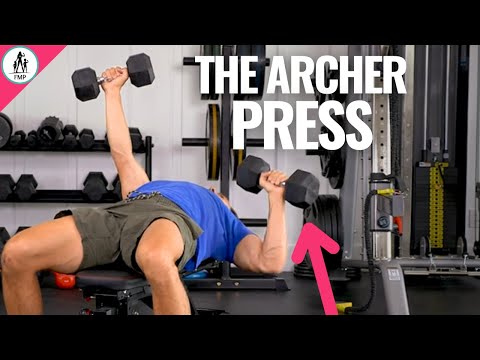
Alternate Dumbbell Bench Press High Start Overview
The alternate dumbbell bench press high start is a chest move. You lie back on a low incline bench. You start with both dumbbells down at your chest. You press one arm up at a time. It works your chest the most. It also uses your triceps and shoulders. Your triceps are the back of your arms. You need two dumbbells and an incline bench. Starting low means each rep begins from the hard stretched spot. This builds strength right where the press is toughest. Working one arm at a time keeps your core busy too. It fits well early or mid chest workout. Use a weight you can press with clean form.
What Is The Point of the Alternate Dumbbell Bench Press High Start?
The alternate dumbbell bench press high start builds chest strength one arm at a time. It fixes muscle imbalances and forces your core to work harder for stability.
How To Do The Alternate Dumbbell Bench Press High Start
- Set an adjustable bench to a 15 to 30 degree incline and grab two dumbbells. Sit down, kick them onto your thighs, and lie back to bring them into position.
- Start with both dumbbells at chest level, arms bent to about 90 degrees, elbows tucked at roughly 45 degrees from your body. This is the high start position both dumbbells share.
- Set your shoulder blades down and back and press them into the bench, building a stable base. Plant your feet flat and firm on the floor.
- Take a breath into your belly and brace your core so your torso stays tight. Keep both wrists stacked over your elbows.
- Press one dumbbell up in a smooth arc until your arm is nearly straight, while the other dumbbell stays down at chest level. Only one arm works at a time.
- Drive the dumbbell up and slightly inward over your chest, stopping just short of locking out to keep tension. Squeeze your chest at the top.
- Lower that dumbbell back to the chest-level start under control, matching a 2 to 3 second descent. Keep the resting arm braced in place the whole time.
- Now press the opposite dumbbell up in the same controlled arc while the first arm holds at chest level. Alternate sides on each rep.
- Keep your shoulder blades set and your core tight throughout, breathing out as you press. Aim for 8 to 12 reps per arm for 3 to 4 sets.
Alternate Dumbbell Bench Press High Start Form Tips
- Keep your shoulder blades pulled back and down.
- Start each rep with the dumbbell at chest level.
- Press up in a smooth arc, not straight out.
- Straighten your arm fully at the top.
- Keep the resting dumbbell steady at your chest.
- Keep your feet flat and your hips on the bench.
- Keep your wrists straight and strong.
- Breathe out as you press. Breathe in as you lower.
- Move slow and controlled on every rep.
Common Mistakes to Avoid for the Alternate Dumbbell Bench Press High Start
- Letting your shoulder blades roll forward. If you lose your scapular set as you press, you sacrifice your stable base and expose the shoulder joint. Pin your blades down and back into the bench and hold that position every rep.
- Flaring your elbows straight out to the sides. A 90 degree flare stresses the shoulder and weakens your press. Keep your elbows tucked to around 45 degrees so the load stays on your chest and triceps.
- Letting the resting arm drift or relax. The held dumbbell keeps constant tension and stabilizes you, so if it wanders you lose control and can strain that shoulder. Keep the non-working arm braced firmly at chest level.
- Setting the incline too steep. Past about 30 to 45 degrees the movement becomes an overhead press and your front delts take over. Keep the incline low to moderate to bias the upper chest.
- Bouncing the dumbbell off your chest. Using a bounce to start the press steals work from your muscles and risks the shoulder. Lower under control to a light touch and press with intent.
- Pressing in a straight vertical line. On an incline the dumbbell should travel up and slightly back over your chest. A purely vertical path leaves you weak and unstable at the bottom.
- Rushing the lowering phase. Dropping the dumbbell fast wastes the eccentric, which is prime muscle-building time. Control a 2 to 3 second descent on each rep.
- Cutting the range of motion short. Pressing only partway or not lowering to a full stretch trains a slice of the chest. Lower for a real stretch and press to a strong squeeze each rep.
- Losing your core brace as you alternate. Because one side is loaded at a time, a loose core lets your torso twist toward the working arm. Brace hard and keep your torso square through every rep.
- Going too heavy and losing control. Ego loading on a single-arm-at-a-time press wrecks your path and beats up your shoulders. Pick a weight you can control cleanly for all your reps.
- Letting your wrists bend back. A floppy, cocked wrist leaks power and strains the joint under load. Keep the dumbbell stacked over a straight wrist with your knuckles toward the ceiling.
Alternate Dumbbell Bench Press High Start Workout Tips
- Understand the value of holding one dumbbell while the other works. The isometric hold on the resting side keeps constant tension on that chest and doubles the time under load per set.
- Keep your shoulder blades pinned down and back throughout. A stable scapular base is safer and lets you press more weight.
- Keep your elbows tucked to about 45 degrees. That angle protects the shoulder and keeps the load on your chest and triceps.
- Press the dumbbell up and slightly inward. Following the natural incline path keeps you strong and stable at the bottom.
- Chase the mind-muscle connection with your upper chest. Thinking about squeezing the chest to move the dumbbell builds it faster than just pushing.
- Use a controlled 2 to 3 second lowering. A slow eccentric keeps tension on the chest and grows more muscle than dropping the weight.
- Program this on push or chest days when you are fresh. The alternating style adds core and stability demand, so it deserves good energy.
- Keep reps in the 8 to 12 range per arm for size. Drop the reps and add weight if you want to bias strength.
- Brace your core hard to resist the twist. Since only one arm is loaded at a time, a tight core keeps your torso square and your press clean.
- Add weight slowly over time. Small, controlled jumps drive progress far better than ego leaps that ruin your path.
- Use dumbbells for the bigger stretch they allow. Working each arm on its own lets your chest stretch more at the bottom than a barbell does.
- Film your set from the side to check your elbow position and path. Video shows flare and drift better than feel alone.
- Keep the resting arm actively braced, not lazy. That held tension is part of what makes this variation effective, so respect it.
- Warm up with lighter sets first. A couple of easy sets groove the path and prime your shoulders and chest.
- Do not train to failure every set. Leaving a rep in the tank keeps your form sharp and your shoulders healthy over time.
- Be patient with upper chest development. It is stubborn for most people, so consistent, controlled incline work over months is what finally builds it.








Questions & Comments
Be the first to ask a question about this exercise.