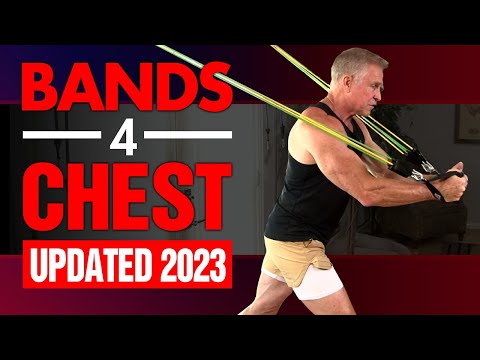
Band Chest Fly Overview
The band chest fly works your chest muscles. It also uses your shoulders as helpers. You need one resistance band and an anchor point. You hug your arms together in front of you. This move squeezes your chest with each rep. The band chest fly is great for beginners. It is easy on your joints. You can do it at home or at the gym. The band keeps steady tension on your chest. Use it after big pushing moves. It also works well as a burnout at the end of chest day.
What Is The Point of the Band Chest Fly?
The band chest fly exercise builds chest muscle width and creates that full, rounded chest look. It gives you constant tension through the entire movement.
How To Do The Band Chest Fly
- Anchor a resistance band at chest height to something solid behind you, like a rack upright or a sturdy door anchor. Test that it will not slip before you load it, because a band letting go under tension can snap back and hurt you.
- Grab a handle in each hand and step forward until you feel real tension with your arms out to the sides. Set your feet in a slight split stance for balance and brace your core so your torso does not get dragged around.
- Set your shoulder blades down and back before you start. This builds a stable base to press from and keeps the work on your chest instead of dumping it onto the front of your shoulders.
- Start with your arms open wide and out to the sides, elbows soft with a fixed slight bend. You should feel a stretch across the chest here, and that stretch is where a lot of the growth comes from.
- Bring your hands together in a wide hugging arc, like you are wrapping your arms around a big barrel. Lead with your upper arms and let your hands follow rather than pulling with your grip.
- Squeeze your chest hard as your hands meet in front of your sternum. Hold that peak for a full second and think about crushing your pecs together instead of just touching your hands.
- Keep that same soft elbow bend the whole way. If your elbows straighten and bend, you turn the fly into a pressing movement and steal tension off the chest.
- Open back up slowly over 2 to 3 seconds, resisting the band the entire way until you feel the stretch again. Do not let the band yank your arms back fast.
- Keep light tension at the stretched position and start the next rep without resting there. Most people build this best in the 12 to 20 rep range where the constant band tension really shines.
Band Chest Fly Form Tips
- Keep a small bend in your elbows the whole time. Do not lock them straight.
- Move your arms in a wide arc. Think of hugging a big tree.
- Keep your chest up and proud. Do not slump forward.
- Squeeze your chest at the front, not your hands.
- Breathe out as you bring your hands together.
- Lower slowly and feel the stretch. Do not rush back.
- Keep your shoulders down and back. Do not shrug them up.
- Stand tall and hold your core a little tight. This keeps you steady.
- Keep your wrists straight and firm. Do not let them bend.
Common Mistakes to Avoid for the Band Chest Fly
- Bending and straightening the elbows through the rep. When your elbows open and close, the fly quietly turns into a press and your triceps and front delts take over the work. Lock in one soft elbow angle at the start and keep it fixed the whole set so the chest stays loaded.
- Standing too close to the anchor. If you crowd the anchor point, the band goes slack near the top and you lose all tension exactly where you should be squeezing hardest. Step out until you feel resistance from the very first inch of the movement.
- Letting the shoulders roll forward at the finish. Rounding the shoulders in to reach the hands together shifts stress onto the joint and off the chest. Keep the shoulder blades set down and back and let the chest, not the shoulders, bring the hands together.
- Pulling with the hands and grip instead of the chest. When you focus on your hands, the arms rob the pecs of the work and you feel it everywhere but the target. Think about driving your upper arms together and let the hands just be the endpoint.
- Rushing the opening phase. Snapping the arms back fast wastes the eccentric, which is one of the most valuable muscle-building parts of the rep, and it stresses the shoulder at the stretch. Resist the band for a slow 2 to 3 second return every time.
- Going too heavy with the band tension. Overloading forces you to cut the range short and turn the movement into a jerky press. Pick a band you can control through a full wide arc so you actually get the stretch and the squeeze.
- Cutting the range of motion short. Stopping before your hands meet or not opening fully robs you of both the peak contraction and the stretch. Bring the hands all the way together and open until you feel a real stretch across the chest.
- Losing your core brace and getting pulled backward. A loose trunk lets the band drag your torso and leaks force out of the movement. Set a split stance, brace your abs, and stay rooted so all the tension goes into the pecs.
- Shrugging the shoulders up toward the ears. When the traps take over, the chest disengages and the neck gets cranky. Keep the shoulders pulled down away from your ears the entire set.
- Anchoring the band unsafely. A band that slips off a weak anchor can snap back into your face or hands with real force. Always test the anchor under load and use a proper door anchor or a solid fixed point.
- Holding your breath through hard reps. Bracing is good, but locking your breath the whole set spikes pressure and makes you dizzy. Breathe out as you squeeze the hands together and in as you open back up.
Band Chest Fly Workout Tips
- Face away from the anchor and let the band pull your arms open behind you. That stretch position under tension is where a fly builds the most chest, so respect it and do not cut it short.
- Chase the mind-muscle connection here. The band gives constant tension, so slow down and actually think about squeezing your pecs together rather than just moving your hands to the finish.
- Use a controlled 2 to 3 second opening phase on every rep. Resisting the band as your arms spread keeps the chest loaded and builds more than letting it snap back.
- Add a hard one second squeeze when your hands meet. Pausing in the fully contracted spot kills momentum and forces the pecs to do the work instead of your arms.
- Adjust the anchor height to hit different parts of the chest. Anchoring low and flying up targets the upper chest, while a high anchor flying down leans on the lower chest.
- Keep a fixed soft bend in your elbows the whole time. This is the single cue that keeps it a fly and not a press, so burn it into your setup.
- Run this in the 12 to 20 rep range for 3 to 4 sets. Bands reward higher reps because the tension is smooth and joint-friendly rather than a heavy dead weight.
- Program it as a finisher after your heavy presses. Your chest is already warm, and the fly polishes off the pecs with a stretch and squeeze that pressing does not fully give you.
- Progress by stepping further from the anchor or using a thicker band. Both add tension in a controlled way, which is progressive overload done with a band instead of plates.
- Try a couple of partial reps at the stretched end when you finish a set. These deep partials pile extra tension on the pecs in their lengthened position where growth tends to happen.
- Squeeze the handles firmly but keep the effort in your chest. A tight grip stabilizes the wrist, but the drive should still come from your pecs pulling your arms together.
- Keep your wrists straight and neutral, not bent back. A floppy wrist leaks force and can get sore, so line the knuckles up with the forearm.
- Film a set from the side now and then. A quick phone video shows whether your elbows are staying fixed and your range is full, which is hard to judge by feel alone.
- Use this on days you cannot get to a gym. A band and a solid anchor give you a genuine chest session anywhere, which keeps your training consistent.
- Do not train every set to failure. Leaving a rep in the tank keeps your form clean and lets you hit the target reps across all your sets.
- Be patient and add tension slowly. The chest responds to consistent quality work over months, so keep showing up and nudging the difficulty up bit by bit.








Questions & Comments
Be the first to ask a question about this exercise.