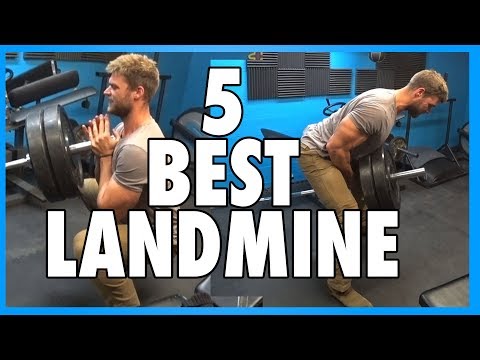
Single Arm Landmine Push Press Overview
The single arm landmine push press is a strong overhead move. One end of a barbell sits in a landmine holder. You hold the loaded end at your shoulder. You use your legs and arm to press it up. This works your shoulders. It also works your triceps and abs. The triceps are the back of your upper arm. You need a landmine setup and a barbell. This move is for intermediate lifters. The bar moves in an arc, which is easy on your shoulders. Using your legs helps you press more weight. This builds power and a strong core. Training one arm at a time fixes weak spots. You can do the single arm landmine push press on shoulder or push day.
What Is The Point of the Single Arm Landmine Push Press?
The single arm landmine push press builds explosive shoulder power while training your core stability. It's a killer move for athletes who want real-world strength.
How To Do The Single Arm Landmine Push Press
- Set up a barbell in a landmine attachment or wedge one end into a corner, then load the free end with weight. Stand facing the bar so the loaded end is at about shoulder height when you hold it.
- Pick up the loaded end with one hand and bring it to the front of your shoulder, elbow tucked and forearm roughly vertical. Step into a stable athletic stance with your feet about shoulder-width apart.
- Set your other hand on your hip or hold it out for balance, and square your hips and shoulders toward the bar. Brace your core hard, since a single-arm press challenges your trunk to resist twisting.
- Take a breath and get tight from your feet to your grip. The landmine's arc means you will press up and slightly forward, not straight overhead, which is easier on the shoulder.
- Dip slightly by bending your knees a few inches, keeping your torso upright. This is the push press dip that lets your legs help launch the weight.
- Drive powerfully through your legs and extend your hips, using that momentum to help press the bar up and forward in a smooth arc. The leg drive is what lets you handle more weight than a strict press.
- Finish by pressing the bar until your arm is fully extended, following the landmine's arc up and slightly across. Keep your core braced so your body does not lean or rotate.
- Lower the bar slowly and under control back to your shoulder, resisting the weight on the way down over about two to three seconds. Keep your elbow tucked as you receive it.
- Reset your stance and brace, complete all your reps on one side, then switch arms. The single arm landmine push press works well in the 6 to 10 rep range per side for 3 to 4 sets.
Single Arm Landmine Push Press Form Tips
- Brace your core hard the whole time. This protects your back.
- Dip your knees a little before you press. Use your legs.
- Press the bar up and slightly forward in an arc.
- Keep your chest up and your body tall.
- Do not lean back to press. Keep your ribs down.
- Lower the bar slowly to your shoulder.
- Breathe in as you dip. Breathe out as you press.
- Keep your wrist straight and strong.
- Keep your feet flat and planted.
Common Mistakes to Avoid for the Single Arm Landmine Push Press
- Letting your torso twist toward the working arm. A single-arm press wants to rotate you, and giving in to that twist stresses your spine and wastes force. Brace your core hard and resist any rotation so your hips and shoulders stay square.
- Using no leg drive at all. If you grind it up with just your shoulder, you miss the whole point of a push press and cut the weight you can handle. Dip with your knees and drive through your legs to launch the bar.
- Dipping too deep or too slow. A big, slow dip turns into a squat and kills the elastic power you want. Keep the dip shallow and snappy, just a few inches, then reverse fast.
- Pressing straight up instead of following the arc. The landmine moves in an arc, so forcing a vertical path fights the tool and can jar your shoulder. Let the bar travel up and slightly forward along its natural line.
- Overarching your lower back at the top. Leaning back to finish the press hyperextends your spine and puts your lower back at risk. Keep your ribs down and your core braced so you finish tall, not arched.
- Going too heavy for your stability. Loading past what your core can control forces you to twist, lean, and lose position. Choose a weight you can press with a square, stable trunk and build up over time.
- Letting your elbow flare wide at the start. A flared elbow puts the shoulder in a weaker, more stressed position. Keep the elbow tucked in front of your shoulder as you begin the drive.
- Rushing or dropping the eccentric. Letting the bar crash back to your shoulder wastes the lowering phase and can strain the joint. Control the descent for two to three seconds every rep.
- Not bracing before the dip. A loose core lets the load bend you sideways and leaks power. Take a breath and brace hard before you dip and drive.
- Staggering or shifting your feet each rep. An inconsistent base makes you unstable and changes your leverage rep to rep. Set a solid stance and keep it fixed through the whole set.
- Neglecting the non-working side of your core. Forgetting that the offset load hammers your obliques means you miss a big benefit and can move sloppily. Actively fight the load with your trunk on every rep.
- Mismatching effort between arms. Doing more or heavier reps on your stronger side quietly builds an imbalance. Match your reps and load on both arms and let your weaker side set the standard.
Single Arm Landmine Push Press Workout Tips
- Warm up your shoulders and core before loading up. A single-arm overhead press asks a lot of both, so priming them makes your working sets stronger and safer.
- Use the leg drive to move real weight. The push press lets your lower body help launch the bar, so you can overload the shoulder beyond a strict press.
- Treat this as an anti-rotation core exercise too. Fighting the twist of the offset load builds serious oblique and trunk strength alongside the shoulders.
- Keep the dip shallow and explosive. A quick few-inch dip stores elastic energy that helps drive the bar up powerfully.
- Follow the landmine's natural arc. Pressing up and slightly forward is easier on the shoulder than a strict vertical press, which makes this a joint-friendly option.
- Program it on a push or shoulder day. It works as a main pressing movement or a powerful accessory after heavy overhead work.
- Aim for 6 to 10 reps per side across 3 to 4 sets. This range balances strength and control for a stability-heavy movement.
- Brace your core as if bracing for a punch. A tight trunk stops the twist and gives your press a solid base to drive from.
- Control the eccentric for two to three seconds. Owning the lowering keeps tension on the shoulder and reinforces good positioning.
- Add weight in small steps over time. Steady progressive overload with a square, stable trunk beats loading up and twisting under the bar.
- Match your reps and effort on both arms. Let your weaker side set the rep count so you build balanced shoulders and a balanced core.
- Try a strict landmine press on some days. Removing the leg drive forces the shoulder to do all the work and builds pure pressing strength.
- Keep your ribs down at lockout. Finishing tall instead of arched protects your lower back and keeps the load on your shoulder.
- Film from the front to check for twisting. A quick video shows whether your trunk is staying square or rotating under the load.
- Do not train to failure every set. Leaving a rep in reserve keeps your form clean and your shoulders healthy.
- Be consistent and patient. Strong, stable shoulders and a rotation-resistant core are built over months of controlled work.








Questions & Comments
Be the first to ask a question about this exercise.