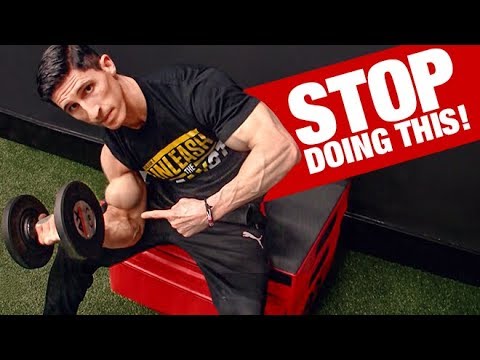
Reverse Concentration Curl Overview
The reverse concentration curl builds your biceps and forearms. It works your biceps, the muscles on the front of your arms. It also works your forearms hard. That is because you use an overhand grip. You need only a dumbbell and a bench. Bracing your elbow on your thigh stops all swinging. This makes your arm do clean, strict work. The overhand grip hits your forearms more than a normal curl. The reverse concentration curl suits lifters who know basic curls. Use it on an arm day to finish your arms. It builds strong, full arms.
What Is The Point of the Reverse Concentration Curl?
The reverse concentration curl targets your biceps with an overhand grip that hits the muscle differently than regular curls. It builds peak strength and size.
How To Do The Reverse Concentration Curl
- Sit on the end of a bench with your legs spread wide and your feet planted flat on the floor. Hold a dumbbell in your right hand using an overhand, pronated grip so your palm faces down.
- Rest the back of your right upper arm or elbow against the inside of your right thigh. Let your arm hang fully extended toward the floor.
- Set your torso with a slight forward lean and keep your chest up. Brace your core so you stay steady and do not rock.
- With your palm facing down and your wrist straight, this overhand grip shifts the work toward the outer bicep and the forearm muscles. Keep the wrist firm throughout.
- Take a breath and prepare to curl. Your upper arm stays pinned against your thigh, so only your forearm moves.
- Curl the weight up by flexing your bicep, keeping that reverse grip and a straight wrist. Drive the movement with your bicep and forearm, not by swinging.
- Bring the dumbbell up until your bicep is fully contracted, then squeeze hard at the top for a beat. Do not let your elbow drift off your thigh.
- Lower the weight slowly and under control back to full extension, taking about 2 to 3 seconds. Feel the stretch through your bicep and forearm at the bottom.
- Complete all your reps on the right arm, then switch the dumbbell to your left hand and repeat. Keep the reverse grip strict and your elbow pinned to your thigh, and work for around 10 to 15 controlled reps per arm.
Reverse Concentration Curl Form Tips
- Keep your elbow braced on your thigh. It should not move.
- Use an overhand grip the whole set. Your palm faces down.
- Curl only at your elbow. Your upper arm stays still.
- Keep your wrist straight and firm. Do not let it bend.
- Squeeze at the top. Feel your biceps and forearm work.
- Lower slow. Do not let the weight drop.
- Breathe out as you curl. Breathe in as you lower.
- Sit tall and steady. Do not lean to help lift.
- Move slow and controlled. No swinging.
Common Mistakes to Avoid for the Reverse Concentration Curl
- Swinging the weight up instead of curling it. Using body english and momentum takes the tension off your bicep and forearm and defeats the point of an isolation move. Keep your upper arm pinned to your thigh and lift with muscle alone.
- Letting your elbow drift off your thigh. When your elbow lifts away from your leg, you lose the strict isolation and let your shoulder help. Keep the back of your arm braced against your inner thigh the entire set.
- Going too heavy for the reverse grip. The overhand grip is much weaker than a normal curl, so a heavy dumbbell forces you to cheat and can strain your wrist. Drop the weight and use a load you can curl with a straight wrist and no swing.
- Letting your wrist bend or roll. A floppy, curling wrist under the pronated grip leaks force and strains the joint. Keep your wrist firm and straight so the load goes into your bicep and forearm.
- Cutting the range short at the bottom. Not fully extending skips the stretch and shortens your working range. Let your arm straighten out fully while keeping tension before you curl again.
- Dropping the weight on the way down. Failing to control the negative wastes the eccentric, which builds a lot of muscle. Lower for a controlled 2 to 3 seconds every rep.
- Skipping the squeeze at the top. Bouncing out of the top misses the peak contraction. Pause and squeeze your bicep hard at the top of each rep.
- Rushing through the reps. Fast reps ride momentum rather than tension. Slow every rep down so your bicep and forearm stay loaded through the whole range.
- Doing uneven reps on each arm. Favoring your stronger arm builds an imbalance over time. Match your reps and effort on both sides, and consider starting with your weaker arm.
- Rounding your back and slumping over. Collapsing your torso strains your lower back and throws off the movement. Keep a slight, supported forward lean with your chest up.
- Forgetting this hits the forearm and outer bicep. Treating it like a standard curl and expecting the same peak feel misses the point. Appreciate that the reverse grip biases the brachialis and forearm, which builds arm thickness and grip.
Reverse Concentration Curl Workout Tips
- Understand what the reverse grip does. The overhand, palm-down grip shifts work toward the brachialis under the bicep and the forearm extensors, which builds arm thickness and stronger grip.
- Keep your upper arm pinned to your thigh. Bracing the arm against your leg is what makes this a strict isolation exercise with no shoulder help.
- Use lighter weight than a normal curl. The reverse grip is weaker, so respect that and pick a load you can lift with a firm wrist and zero swing.
- Keep your wrist straight and firm. A stable wrist channels force into the target muscles and protects the joint under the pronated grip.
- Squeeze hard at the top of every rep. A strong peak contraction drives the mind-muscle connection with the bicep and brachialis.
- Control the negative for 2 to 3 seconds. Fighting the weight down loads the stretch and builds more muscle than dropping it.
- Match your reps on both arms and start with the weaker side. Single-arm work exposes imbalances, so let your weaker arm set the standard.
- Work in the 10 to 15 rep range for 3 to 4 sets per arm. Moderate reps with strict form suit this detail-oriented arm move.
- Program it as accessory arm work. It complements standard curls by hitting the brachialis and forearms, filling out the arm and boosting grip strength.
- Feel the stretch at the bottom, not just the squeeze at the top. Training both ends of the range builds a fuller, more complete arm.
- Try a brief pause at the top for some sets. Holding the contraction removes momentum and forces the muscle to work harder.
- Keep your torso steady with a slight supported lean. A stable trunk keeps the movement strict and your lower back safe.
- Progress with small load or rep increases over time. Even isolation moves respond to gradual overload, so nudge the difficulty up as it gets easy.
- Pair reverse-grip work with regular curls and hammer curls. Hitting the arm from different grips builds thickness the standard curl alone misses.
- Do not swing or let your elbow lift to grind out reps. If you have to cheat, the set is essentially done, so stop or drop the weight.
- Be consistent and patient. The brachialis and forearms grow slowly, but developing them adds real thickness to your arms and a stronger, more reliable grip.








Questions & Comments
Be the first to ask a question about this exercise.