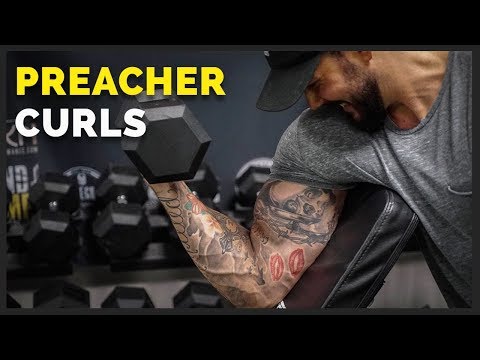
Preacher Curl Overview
The preacher curl builds your biceps. Your biceps are the muscles on the front of your upper arms. You sit at a preacher bench and rest your arms on the angled pad. Then you curl the weight up. You can use a barbell or two dumbbells. The pad stops you from swinging. This move also works your forearms. The preacher curl is great for strict, clean curls. The pad keeps your arms still so your biceps do the work. This move is good for intermediate lifters. It helps you feel the muscle work on every rep. Use it on an arm day or a pull day. Add it after your bigger pulling moves.
What Is The Point of the Preacher Curl?
The preacher curl exercise builds bigger, stronger biceps by isolating the muscle and removing momentum. It gives you that peak bicep shape and improves arm strength.
How To Do The Preacher Curl
- Set up at the preacher bench and adjust the seat so your armpits rest near the top of the angled pad. Sit with your chest against the pad and your upper arms lying flat on the slope.
- Grip a barbell or dumbbells with an underhand grip, hands about shoulder width apart. Let your arms hang straight down the pad so your biceps are already under tension at the bottom.
- Set your feet flat, brace your core, and keep your chest against the pad throughout. This position isolates the biceps by taking your shoulders and body swing out of the lift.
- Keep your wrists straight and curl the weight up by flexing your biceps. Move slowly and let the elbows stay pinned to the pad as the forearms rise.
- Curl until your forearms are roughly vertical and your biceps are fully contracted. Do not swing past that point or let your body help.
- Squeeze your biceps hard at the top and hold for about one second. This peak contraction is a big part of why the preacher curl builds the muscle so well.
- Lower the weight slowly back down the pad, taking two to three seconds. Resist the urge to let it drop, since the lowering phase builds a lot of size.
- Stop just short of a full, harsh elbow lockout at the bottom to keep tension on the biceps and protect the joint. Feel the stretch without dumping the load onto your tendons.
- Repeat for your target reps, usually 8 to 12, then lower the weight under control and set it down safely. Keep every rep smooth and honest.
Preacher Curl Form Tips
- Rest your chest and arms firm on the pad.
- Keep your wrists straight the whole time.
- Curl until your forearms point straight up.
- Squeeze your biceps hard at the top.
- Lower the weight slowly. Take about 2 seconds down.
- Keep your upper arms flat on the pad.
- Breathe out as you curl. Breathe in as you lower.
- Do not swing or bounce the weight.
- Keep a slight bend in your elbows at the bottom.
Common Mistakes to Avoid for the Preacher Curl
- Snapping your elbows fully straight and bouncing at the bottom. Slamming into a locked-out stretch under load stresses the biceps tendon and elbow, and it is a common cause of preacher-curl elbow pain. Stop just short of full extension and reverse under control instead of bouncing.
- Using momentum by heaving your body or the weight. Swinging cheats the biceps out of tension and can strain the elbow. Keep your chest glued to the pad and curl with the muscle, not a jerk.
- Going too heavy for a strict isolation lift. Ego loading forces bad form and beats up the elbow tendons on this exposed movement. Pick a weight you can curl cleanly and add small jumps over time.
- Letting your wrists curl or bend back. A bending wrist leaks force into your forearms and strains the joint. Keep your wrists straight so the work stays in the biceps.
- Cutting the range of motion short at the top. Doing half curls keeps the biceps from a full contraction. Curl until your forearms are vertical and squeeze at the top.
- Rushing the eccentric. Dropping the weight fast wastes the lowering phase, one of the best muscle-building parts of the rep. Lower over two to three seconds every time.
- Lifting your chest or elbows off the pad. If your arms come off the slope, you lose the isolation and let your shoulders help. Keep your chest and upper arms pinned to the pad throughout.
- Setting the seat at the wrong height. A poorly adjusted bench leaves your armpits off the pad and puts your shoulders in a bad spot. Set the seat so your armpits reach near the top of the pad.
- Only doing the top half of the movement. Avoiding the stretched bottom because it is hard leaves size on the table. Work the full range, including the lengthened position, unless your elbow says otherwise.
- Gripping too wide or too narrow for your elbows. An awkward grip width can nag the wrists and elbows. Set your hands about shoulder width where your joints feel comfortable.
- Holding your breath through the set. Breath holding spikes pressure and can leave you lightheaded. Breathe out as you curl up and in as you lower.
Preacher Curl Workout Tips
- Warm up your elbows and biceps with a light set first. The preacher position stretches the tendon hard at the bottom, so prime it before loading up.
- Chase the mind-muscle connection. Think about squeezing your biceps to move the weight rather than just lifting it, since feeling the target muscle work reliably builds it.
- Use a controlled two to three second eccentric. A slow lowering phase keeps tension on the biceps and builds more than dropping the weight.
- Stop just short of locking your elbows at the bottom. This protects the tendon and keeps constant tension on the muscle.
- Squeeze hard at the top for a full second. The peak contraction is a big reason the preacher curl builds the biceps so effectively.
- Keep your chest and upper arms pinned to the pad. That contact is what isolates the biceps and removes body swing.
- Program preacher curls after your heavier rowing or pulling on arm or back day. Your biceps are warm and this isolation finishes them off.
- For size, most lifters do best in the 8 to 12 rep range for 3 to 4 sets. The biceps respond well to controlled reps and a strong squeeze.
- Add weight slowly and only when your form holds. Small, steady jumps beat ego leaps, and that progressive overload is what drives long-term arm gains.
- Try dumbbells to work each arm on its own. Single-arm preacher curls expose and fix side-to-side imbalances a barbell can hide.
- Keep your wrists straight and firm. Stable wrists keep the load in the biceps and off your forearms and joints.
- Use an EZ bar if a straight bar bothers your wrists. The angled grip is easier on the joints while still hammering the biceps.
- Do not bounce out of the stretched bottom. Controlling the deep position safely is where a lot of the growth comes from.
- Try a slow negative or a partial-rep finisher at the end of a set. These intensity tricks add extra stimulus once your clean reps are done.
- Do not train to failure on every set. Leaving a rep or two in the tank protects your elbows and keeps your form sharp.
- Be patient with your arms. Biceps are stubborn for many lifters, so consistent, quality work over months is what adds real size.








Questions & Comments
Be the first to ask a question about this exercise.