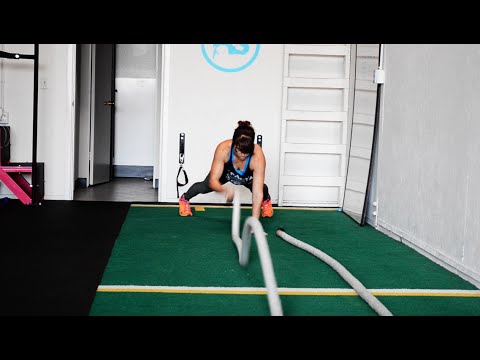
Lunge Jump with Alternating Waves Battle Ropes Overview
The lunge jump with alternating waves battle ropes is a hard, full-body move. It works your quads, the big muscles on the front of your thighs. It also uses your glutes, your butt muscles, and your shoulders. You need battle ropes for this move. You hold one heavy rope handle in each hand. This move builds power and gets your heart pumping. You jump between lunges while your arms whip the ropes. That means your legs and arms work at the same time. The lunge jump with alternating waves battle ropes is for advanced lifters. It fits well in a hard conditioning workout. Do it when you are fresh, not tired. It is a great finisher on a leg or full-body day.
What Is The Point of the Lunge Jump with Alternating Waves Battle Ropes?
The lunge jump with alternating waves battle ropes builds explosive leg power while torching calories. It combines cardio and strength for total body conditioning.
How To Do The Lunge Jump with Alternating Waves Battle Ropes
- Stand tall holding a battle rope handle in each hand, arms hanging at your sides with a firm but not white-knuckle grip. Set your feet hip-width and take a breath to brace your core before you move.
- Step one foot back into a split stance and lower into a lunge, keeping your front knee stacked over your ankle and your torso upright. Both knees should bend to roughly 90 degrees at the bottom.
- From the bottom of the lunge, drive hard through both legs and jump straight up, extending your hips and ankles explosively. This is a power move, so commit to the jump rather than hopping timidly.
- Switch your legs in mid-air so you land in the opposite lunge, front leg now back and back leg now front. Keep your chest up and your eyes forward through the switch.
- Land soft and quiet, letting your knees and hips bend to absorb the impact like a spring. A loud, stiff landing pounds your joints, so aim to catch yourself under control every time.
- The instant you land, start whipping the ropes in alternating waves, driving one arm up as the other drives down. The power comes from your whole arm and shoulder, not just flicking the wrists.
- Keep the waves fast and continuous while you reset your breathing and stability, staying low in the lunge with a braced trunk. The ropes never stop moving.
- Explode into the next jump straight out of the lunge, switching legs again and landing soft into alternating waves on the other side. Blend the jump and the waves into one flowing, aggressive rhythm.
- Because this is an advanced, high-output move, work in short hard bursts of 20 to 40 seconds or 6 to 10 jumps per side, then rest fully. Stop the set the moment your landings get sloppy or the waves lose their snap.
Lunge Jump with Alternating Waves Battle Ropes Form Tips
- Land softly with bent knees every time. This keeps your knees safe.
- Keep your front knee over your ankle in each lunge. Do not let it cave in.
- Keep your chest up and your back tall. Do not slump forward.
- Whip the ropes from your shoulders, not just your wrists.
- Breathe fast and steady. Do not hold your breath during the ropes.
- Keep your core tight for balance. This helps you land straight.
- Push hard through your front heel as you jump.
- Keep your steps even. Both legs should go back the same depth.
- Stay light on your feet. Jump up, do not just step.
Common Mistakes to Avoid for the Lunge Jump with Alternating Waves Battle Ropes
- Landing stiff and loud out of the jump. A hard, straight-legged landing sends the shock straight into your knees, hips, and low back instead of your muscles, and over time that beats up the joints. Bend the knees and hips on contact and land quiet and soft, absorbing the force like a spring.
- Letting the front knee cave inward on landing. When the knee collapses toward the midline under the impact of the jump, you load the joint in a weak, risky position. Cue the knee to track in line with your toes and land with your hips and knees pushing out slightly.
- Diving the torso forward instead of staying tall. Folding at the waist during the lunge or the landing throws your balance forward and strains the low back. Keep your chest up and your trunk braced and stacked over your hips through the whole rep.
- Waving the ropes with only your wrists. Flicking the wrists gives you weak, floppy waves and wastes the huge power your shoulders and back could add. Drive the waves from your whole arm and shoulder so the rope snaps with real force from the anchor out.
- Letting the ropes go slack between reps. If the waves die every time you jump, you lose the conditioning stimulus and the continuous tension that makes this drill so brutal. Keep the ropes moving nonstop, even while your legs are resetting.
- Shortening the lunge to save energy. Cutting the depth turns the explosive jump into a lazy hop and robs your quads and glutes of the loaded stretch that powers the jump. Sink to roughly 90 degrees in both knees so you actually load the legs before you launch.
- Going too long and letting form fall apart. This is a max-output move, and dragging a set past your ability to land well turns it into a joint-pounding, sloppy mess. Work in short hard bursts and stop the set the moment your landings or waves get ugly.
- Holding your breath under the effort. Locking your breath spikes your blood pressure and drains your power fast on a demanding move like this. Breathe in a hard rhythm, often exhaling with the wave and the jump, to keep output high.
- Gripping the ropes with a death grip the whole time. White-knuckling burns out your forearms early and stops your arms from moving fast and loose. Hold firm but relaxed so your hands last as long as your legs.
- Skipping the leg switch and landing in the same stance. If you do not fully swap legs in the air, one side does all the work and you build a lopsided pattern. Commit to a clean mid-air switch so both legs share the load evenly.
- Treating it like a slow strength lift. Grinding this out slowly kills the whole point, which is explosive power and conditioning, and it just fatigues you without the payoff. Move with speed and intent on the jump and keep the ropes fast.
- Doing it while already exhausted with bad mechanics. Attempting an advanced plyometric plus rope combo when you are gassed invites a twisted ankle or tweaked knee. Save this for when you are fresh and place it early in the session.
Lunge Jump with Alternating Waves Battle Ropes Workout Tips
- Land soft and quiet every single jump. Absorbing the impact with bent knees and hips protects your joints and stores elastic energy for the next explosive rep.
- Drive the rope waves from your shoulders and back, not your wrists. Bigger muscles make bigger waves, and that turns the ropes into a genuine upper-body and cardio driver instead of a wrist flick.
- Keep the ropes moving nonstop, even mid-jump. Continuous waves are what make this a conditioning monster, so never let them go slack while your legs reset.
- Work in short, hard bursts of 20 to 40 seconds and rest fully between them. This is an all-out power and conditioning move, so quality output beats long, degrading sets.
- Track your front knee over your toes on landing. Keeping the knee from caving is the single most important thing you can do to keep this drill safe.
- Stay tall and braced through your trunk the whole time. A strong upright torso keeps you balanced for the jump and protects your low back from the rope pulls.
- Commit fully to the jump and the leg switch. A timid hop wastes the whole rep, so extend the hips hard and swap the legs cleanly in the air.
- Breathe in an aggressive rhythm, often exhaling with each wave. Steady forceful breathing keeps your power up and your heart rate manageable on a brutal move.
- Place this early in your session when you are fresh. Explosive plyometrics and fast rope work demand a sharp nervous system, so do not bury it after heavy leg fatigue.
- Use it as a finisher or in a conditioning circuit, not as a strength builder. Its job is power endurance and cardio, so program it accordingly rather than chasing heavy loads.
- Master the reverse lunge and the alternating rope wave separately first. This is an advanced blend of two skills, and stacking them before you own each one is how people roll an ankle.
- Progress by adding time or shortening rest rather than adding load. Because it is bodyweight plus ropes, more work density is your main overload tool here.
- Keep your grip firm but relaxed to save your forearms. A constant death grip gasses your hands long before your legs are done.
- Match the work on both legs by switching cleanly every jump. An honest mid-air switch keeps both sides equally trained and your pattern balanced.
- Film a set from the side now and then. Video quickly shows stiff landings, a caving knee, or dying rope waves that you cannot feel in the heat of the effort.
- Warm up your ankles, knees, and hips thoroughly first. Cold joints and a plyometric jump are a bad combination, so prime the lower body before you launch.
- Push the intensity but respect the fatigue line. This move builds serious grit and conditioning when you attack it fresh, and it invites injury the moment your landings get sloppy, so end the set on a strong rep.








Questions & Comments
Be the first to ask a question about this exercise.