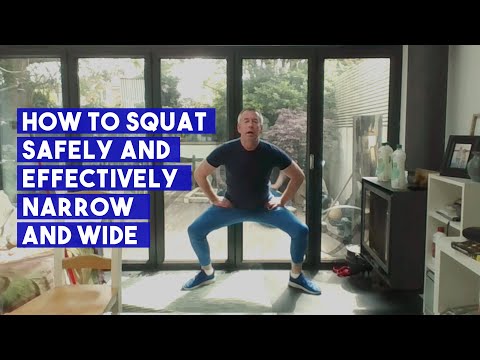
Narrow Squat Overview
The narrow squat is a bodyweight squat with a close stance. It works your quads, the muscles on the front of your thighs. It also works your glutes and hamstrings. Glutes are your butt muscles. Hamstrings are on the back of your thighs. You need no equipment. You just use your body and a bit of floor space. The narrow squat is great for beginners. The close stance puts more work on your quads. It builds leg strength and better balance. It also teaches good squat form. You can do it at home. It fits in a warm-up or a full leg workout.
What Is The Point of the Narrow Squat?
The narrow squat exercise targets your quads more than regular squats by keeping your feet closer together. It builds leg strength and helps fix muscle imbalances.
How To Do The Narrow Squat
- Stand tall with your feet about hip width apart or slightly narrower, toes pointing roughly straight ahead. A closer stance shifts more of the work onto your quads and demands a bit more ankle mobility.
- Set your posture before you move. Lift your chest, pull your shoulders back, and take a breath into your belly to brace your core like you are about to be nudged.
- Reach your arms out in front of you for balance, or fold them across your chest. This counterweight helps you sit back without tipping forward in a narrow stance.
- Begin the descent by pushing your hips back and bending your knees at the same time, as if slowly sitting into a low chair behind you. Keep your weight balanced over your heels and midfoot.
- Lower until your thighs are at least parallel to the floor, or as deep as you can go while keeping your heels planted and your back flat. Take about 2 to 3 seconds on the way down.
- Keep your knees tracking in line with your toes throughout. In a narrow stance the knees will travel forward over the feet, and that is fine as long as your heels stay down.
- Pause briefly at the bottom without bouncing or collapsing. You should feel your quads and glutes loaded and ready to drive.
- Push through your heels and stand back up, squeezing your glutes at the top and breathing out through the hardest part. Do not let your knees cave inward as you rise.
- Stand fully tall, reset your brace, and repeat. As a bodyweight beginner movement, aim for 12 to 20 controlled reps for 2 to 4 sets.
Narrow Squat Form Tips
- Keep your chest up and your back flat.
- Point your toes forward or just a little out.
- Keep your weight on your heels, not your toes.
- Push your hips back as you go down.
- Keep your knees in line with your feet.
- Lower slowly. Do not drop fast.
- Keep your core a little tight the whole time.
- Breathe in on the way down. Breathe out as you stand.
- Look straight ahead to help your balance.
Common Mistakes to Avoid for the Narrow Squat
- Letting the heels lift off the floor. When your weight rolls onto your toes you lose your base and put all the strain on your knees. Keep your heels planted, and if they pop up, work on ankle mobility or reduce depth for now.
- Caving the knees inward on the way up. Valgus collapse leaks power and stresses the knee joint over time. Cue your knees to track over your toes and imagine gently spreading the floor apart with your feet.
- Rounding the lower back at the bottom. A rounded spine under load, even bodyweight, is a common source of back irritation. Brace your core, keep a proud chest, and stop at the depth where your back stays flat.
- Rushing the reps with no control. Bouncing up and down turns the squat into a cardio drill and robs your muscles of tension. Lower for 2 to 3 seconds and stay in charge of the whole range.
- Not going deep enough. Quarter squats keep constant tension off the quads and glutes and build strength in only a tiny range. Aim for thighs at least parallel as long as your form holds.
- Letting the chest collapse forward. Folding at the hips turns a quad-focused squat into a stiff good morning and loads the lower back. Keep your torso as upright as your stance allows and lead with your chest.
- Placing the feet too close together. An extreme narrow stance can pinch the hips and make balance nearly impossible. Keep your feet around hip width or just inside it, not touching.
- Holding your breath the whole set or not bracing at all. No brace means no support for your spine, and passing out is a real risk if you hold too long. Breathe in and brace on the way down, then exhale as you drive up.
- Looking down at the floor. Dropping your head tends to round your upper back and pull you forward. Fix your eyes on a spot straight ahead and keep your neck neutral.
- Bouncing hard out of the bottom. Using a rebound to spring up skips the hardest part of the movement and can jar the knees. Own a controlled pause and drive up with muscle, not momentum.
- Ignoring progression because it is bodyweight. Doing the same easy sets forever means no more growth. Add reps, slow the tempo, or add a pause to keep challenging your legs over time.
Narrow Squat Workout Tips
- Use the narrow stance on purpose to bias the quads. Bringing your feet in shifts more demand onto the front of the thighs, which is great if quad development is your goal.
- Reach your arms forward as a counterbalance. Extending your arms lets you sit back and stay upright without tipping over, especially early on.
- Control the descent for 2 to 3 seconds. A slow lower keeps tension on the quads and teaches the balance and control this stance demands.
- Add a pause at the bottom on some sets. A one to two second hold kills the bounce and forces your legs to work from a dead stop.
- Work on ankle mobility if your heels lift. Better ankle range lets your knees travel forward safely and keeps you deep with your heels down.
- Squeeze your glutes hard at the top. Finishing hip extension trains the glutes and reinforces tall, strong standing posture.
- Progress by slowing the tempo before adding load. A five second descent makes bodyweight squats brutal without needing any equipment.
- Once bodyweight feels easy, hold a dumbbell or wear a pack. Small added load keeps you in a challenging rep range and drives new growth.
- Keep 12 to 20 reps for size and endurance. Higher reps suit a bodyweight movement and build real muscle when you push near failure.
- Use the mind-muscle connection with your quads. Think about your thighs driving you up rather than just standing, and the reps get far more productive.
- Film yourself from the side. Video reveals depth, heel lift, and forward collapse that you cannot feel while grinding through a set.
- Keep your knees tracking over your toes. Letting the knees follow the line of your feet keeps the joint happy and the load on the right muscles.
- Try tempo variations to keep it fresh. Slow negatives, pauses, and one and a half reps all add difficulty without any equipment.
- Brace your core on every rep. A tight midsection protects your spine and gives your legs a stable base to push from.
- Space your working sets with short rests for a real burn. Because these are lighter, 60 to 90 seconds of rest keeps the intensity high.
- Be consistent and patient. Bodyweight squats build a rock-solid foundation, and mastering them here pays off when you load up heavier variations later.








Questions & Comments
Be the first to ask a question about this exercise.