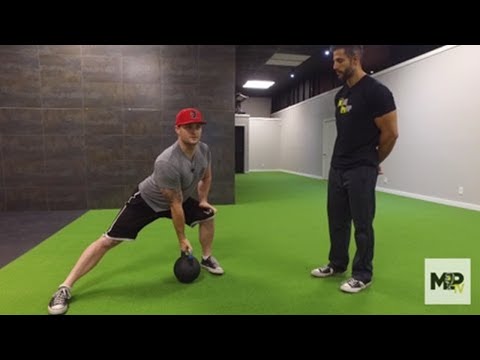
Kettlebell Lateral Lunge Overview
The kettlebell lateral lunge builds strong legs and hips. You step out wide to the side and sink into a lunge. It works your quads and glutes the most. Your quads are the front of your thighs. Your glutes are your butt muscles. It also works your inner thighs. You hold one kettlebell at your chest. Most leg moves go straight up and down. This one trains you side to side. That builds strength you use in sports and daily life. It also stretches and works your inner thighs. The kettlebell lateral lunge fits on leg day. Beginners can start with no weight. It builds balance and strong hips over time.
What Is The Point of the Kettlebell Lateral Lunge?
The kettlebell lateral lunge builds single-leg strength while targeting your quads and glutes. It also improves hip mobility and challenges your balance.
How To Do The Kettlebell Lateral Lunge
- Hold a kettlebell with both hands at chest level in a goblet position, cupping the sides of the handle. Stand tall with your feet about hip-width apart and your chest up.
- Brace your core and set your shoulders down and back. The kettlebell at your chest acts as a counterbalance, so let it help you sit back rather than pull you forward.
- Take a wide step out to the right side, keeping your left leg straight and both feet pointing forward. Plant your right foot flat and stable before you load it.
- Push your hips back and down as you bend your right knee, sinking into the lunge with your weight on your right heel and midfoot. Your left leg stays long and you should feel a stretch through its inner thigh.
- Lower until your right thigh is roughly parallel to the floor or as deep as your mobility allows with a flat back. Keep your right knee tracking over your foot, not caving inward.
- Keep your chest up and your back flat throughout, letting the kettlebell hang between your knees at the bottom. Do not round forward over the weight.
- Drive hard through your right heel to push yourself back up to standing, straightening the working leg. Squeeze the glute of the working side as you rise.
- Return to the tall start position with both feet together and reset your posture before the next rep. Move with control rather than bouncing side to side.
- Complete all your reps on one side, usually 8 to 12, then switch to lunge to the left so both legs get equal work.
Kettlebell Lateral Lunge Form Tips
- Keep your chest up and back flat. Do not hunch over the bell.
- Push your hips back as you lunge. Sit into your hip, not your knee.
- Keep the stepping foot flat. Drive up through your heel.
- Keep your other leg straight. Feel a stretch in your inner thigh.
- Point both feet forward. Do not let them turn out.
- Move slow and controlled. Balance needs a steady pace.
- Keep your core tight the whole time. This holds you steady.
- Keep your knee in line with your foot. Do not let it cave in.
- Breathe in as you lower. Breathe out as you stand.
Common Mistakes to Avoid for the Kettlebell Lateral Lunge
- Letting your working knee cave inward. When the knee collapses toward the midline it stresses the joint and shuts off the glutes. Push your knee out so it tracks over your foot the entire time.
- Rounding your back over the kettlebell. Folding forward through the spine puts your lower back at risk and takes tension off the legs. Keep your chest up and your back flat, and let your hips sit back rather than your torso tip down.
- Putting your weight on your toes. Loading the front of your foot makes you unstable and shifts strain to the knee. Sit back into your heel and midfoot so the glutes and quads drive the lunge.
- Not stepping wide enough. A short side step limits your depth and the stretch through your straight leg. Take a genuinely wide step so you can sink into a full lateral lunge.
- Bending the trailing leg. Letting the straight leg bend robs you of the adductor stretch that makes this move valuable. Keep the non-working leg long with the foot flat and pointing forward.
- Using too heavy a kettlebell. Overloading forces you to hunch and shortens your range. Pick a weight you can hold cleanly at your chest while keeping an upright torso and full depth.
- Bouncing out of the bottom. Using a rebound to spring back up cheats the working leg and can jar the knee. Descend under control and drive up with intent from a stable bottom position.
- Letting the kettlebell drift away from your body. Holding it out in front pulls you forward and strains your lower back. Keep it snug against your chest so it counterbalances you properly.
- Twisting your hips or feet during the lunge. Rotation instead of a clean side-to-side pattern loads the joints unevenly. Keep both feet pointing forward and your hips square as you move.
- Rushing through reps without resetting. Sloppy, fast reps degrade your form and balance quickly. Return fully to standing, reset your posture, and start each rep clean.
- Neglecting the weaker side. Favoring your stronger leg lets a real imbalance grow. Match your reps on both sides and let the weaker leg set the pace.
Kettlebell Lateral Lunge Workout Tips
- Use the goblet hold as a built-in counterbalance. Holding the kettlebell at your chest lets you sit back and down into a deeper, more upright lunge than you could manage empty-handed.
- Drive through the heel of the working leg. This keeps your weight back where the glutes and quads can work and protects the knee from taking the load.
- Push your knee out to track over your foot. Keeping the knee from caving builds strong, stable knees and keeps the glutes firing.
- The lateral lunge trains movement most people neglect. Side-to-side loading builds the adductors and glute stabilizers that forward-only exercises miss, which pays off for athletics and knee health.
- Take a genuinely wide step. A wide stance is what gives you the deep stretch through the inner thigh and the full range that makes this move effective.
- Match your reps and effort on both legs. Most people have a dominant side that quietly takes over, so even work keeps a visible imbalance from building.
- Program it as an accessory on lower-body days. Sets of 8 to 12 per leg build single-leg strength, mobility, and balance alongside your main squats and hinges.
- Move slowly and stay in control. This is as much a mobility and stability drill as a strength move, so quality reps beat rushed ones.
- Progress by adding weight or depth gradually. Once your form holds, grab a heavier bell or sink a little lower, but never at the cost of a flat back and tracking knee.
- Keep your torso upright and proud. An upright chest keeps the load on your legs and off your lower back.
- Use it to open up tight hips and groins. The lateral pattern stretches and strengthens the adductors, which loosens hips stiffened by too much sitting.
- Pair it with forward lunges and squats. Combining planes of movement builds legs that are strong and resilient from every angle.
- Reset fully between reps. Standing tall and squaring up before each rep keeps your mechanics clean and your balance solid.
- Film yourself from the front. Video quickly reveals a knee that caves or a back that rounds under fatigue.
- Start with your weaker leg. Leading with the weaker side and matching it on the strong side is a simple way to even out over time.
- Be patient and consistent. Single-leg strength and hip mobility build steadily, so keep the reps clean and progress will come.








Questions & Comments
Be the first to ask a question about this exercise.