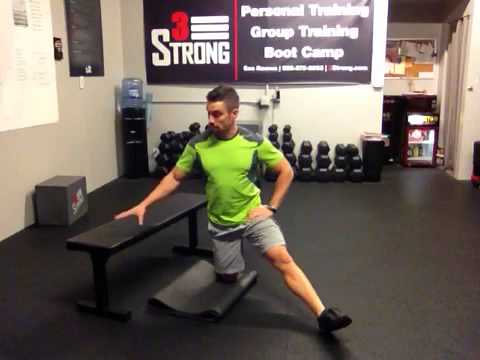
Half Kneeling Quad Stretch Overview
The half kneeling quad stretch stretches your quads. Those are the big muscles on the front of your thighs. It also stretches your hip flexors. Those are the muscles at the front of your hips. You need no equipment. You just use your body and some floor space. The half kneeling quad stretch keeps your legs loose and healthy. Tight quads and hips can pull on your back. This stretch helps ease that pull. It is great for beginners. Use it after a workout to cool down. It also feels good after sitting all day. Hold each side slow and calm.
What Is The Point of the Half Kneeling Quad Stretch?
The half kneeling quad stretch loosens tight quads and hip flexors. It fixes muscle tightness from sitting too much and improves hip mobility.
How To Do The Half Kneeling Quad Stretch
- Kneel down and set up in a half kneeling position with your right knee on the ground and your left foot planted flat in front of you. Use a pad or mat under the down knee for comfort.
- Stack your left knee roughly over your left ankle and set your feet about hip-width apart for a stable base. Keep your down knee, hip, and shoulder in a tall vertical line.
- Stand tall through your torso and brace your core gently. Tuck your tailbone slightly under so your lower back does not arch as you move.
- Squeeze the glute on your kneeling side to help tilt your pelvis and deepen the stretch through the front of that hip. This posterior tilt is what makes the stretch reach the hip flexor as well as the quad.
- Slowly push your hips forward while keeping your back knee planted and your torso upright. Move in small increments rather than lunging aggressively.
- Feel the stretch build along the front of your right thigh and the front of your hip. Ease into it to a point of gentle tension, never sharp pain.
- Hold the position and breathe slowly and deeply for about 30 seconds, letting the muscle relax a little more with each exhale. To deepen it further, you can reach back and hold your right foot to bend the knee.
- Ease out of the stretch, switch so your left knee is down, and repeat on the other side. Aim for two to three holds of about 30 seconds per leg.
Half Kneeling Quad Stretch Form Tips
- Keep your torso tall. Do not lean forward.
- Tuck your hips under a little. This deepens the stretch safely.
- Keep your back knee on the floor.
- Push your hips forward slowly and gently.
- Hold your core a little tight for balance.
- Breathe slow and deep the whole time.
- Feel a gentle pull, not sharp pain.
- Keep your front foot flat on the floor.
- Stay calm and still. Do not bounce.
Common Mistakes to Avoid for the Half Kneeling Quad Stretch
- Arching your lower back to push the hips forward. Letting the spine extend fakes the feeling of a stretch while actually cranking your lower back instead of the hip flexor. Tuck your tailbone under and brace lightly so the stretch reaches the front of the hip, not the lumbar spine.
- Leaning your torso forward as you move. Folding at the hips takes the tension off the front of the hip and turns the movement into a lean. Stay tall and vertical through your torso so the stretch lands on the quad and hip flexor where you want it.
- Bouncing in and out of the stretch. Ballistic bouncing can trigger the muscle to tighten up defensively and even cause small strains. Ease into a steady hold and let the tissue relax gradually with your breath rather than pulsing.
- Pushing to the point of sharp pain. Cranking hard past gentle tension can strain the muscle and makes you tense up rather than relax. Stretch only to a point of mild, tolerable tension and back off if it turns sharp.
- Letting your front knee cave inward or drift far past your toes. A collapsing or overloaded front knee is uncomfortable and unstable. Keep the front knee tracking over the foot and roughly stacked over the ankle for a solid base.
- Holding your breath through the stretch. Tensing up and holding your breath keeps the muscle from releasing and shortens how far you can ease into it. Breathe slowly and deeply and let each exhale relax you a little deeper.
- Not squeezing the glute on the kneeling side. Skipping the glute squeeze means you miss the pelvic tilt that lets the stretch reach the hip flexor. Gently fire the glute of the down leg to tuck the pelvis and deepen the stretch.
- Rushing the hold and cutting it short. A quick few seconds does not give the muscle time to relax and lengthen. Hold each side for around 30 seconds so the tissue actually settles into the new length.
- Only stretching one side. Doing your tighter side and skipping the other builds an uneven feel and can affect your posture and gait. Stretch both legs evenly and give the tighter side an extra round if needed.
- Kneeling on a hard surface with no padding. A bony knee grinding into the floor makes you tense and cuts the hold short. Put a pad or folded mat under the down knee so you can relax and hold the position comfortably.
- Doing this hard right before heavy lifting. A long static stretch right before a max effort can briefly dampen the muscle. Save the deep holds for after training or as their own mobility session, and use dynamic moves to warm up.
Half Kneeling Quad Stretch Workout Tips
- Use the glute squeeze to unlock the hip flexor. Firing the glute of your down leg tilts your pelvis under and lets the stretch reach the deep hip flexor, not just the surface of the quad.
- Stay tall and stack your joints. Keeping your down knee, hip, and shoulder in a vertical line puts your body in the strongest position to stretch the front of the hip safely.
- Ease in and hold rather than bounce. A slow, steady 30 second hold lets the tissue relax and lengthen, which bouncing simply cannot do.
- Breathe deeply and relax on each exhale. Your muscles release best when you are calm, so use slow breathing to sink a little deeper into the stretch over the hold.
- Reach back and hold your foot to progress. Once the basic stretch feels easy, grabbing your rear foot and bending the knee deepens the quad stretch noticeably.
- Program this after training or as recovery. Static stretching fits best post-workout or on its own, when your tissues are warm and you are not about to lift heavy.
- Keep the tension gentle and never sharp. Stretching should feel like a firm pull, not pain, and staying in the comfortable range actually lets you gain range faster over time.
- Use a pad under your down knee. Comfort matters here, since a bruised knee makes you tense and cuts the hold short, so protect the joint and relax into it.
- Address tight hip flexors if you sit a lot. Long hours seated shorten the hip flexors, and this stretch is a simple, effective way to open them back up.
- Stretch both sides evenly and often. Give each leg equal time and stretch a tighter side an extra round to even out how your hips feel and move.
- Pair it with glute activation work. Tight hip flexors often go with sleepy glutes, so combining this stretch with glute drills tends to improve how your hips work.
- Do a few rounds spread through the day if needed. Short, frequent holds can be more effective for stubborn tightness than one long grind, especially for desk-bound lifters.
- Use dynamic moves to warm up instead. Before lifting, favor leg swings and lunges to prime the hips, and save this deep hold for afterward.
- Keep the movement in the hips, not the low back. If you feel it in your lower back you are arching, so re-tuck your pelvis and stay tall to redirect the stretch.
- Track your range over time. Noticing that you can ease further forward week to week is real progress and a sign your hip mobility is improving.
- Be consistent, since mobility is built gradually. Flexibility responds to regular, patient practice, so make this a routine habit rather than an occasional fix.








Questions & Comments
Be the first to ask a question about this exercise.