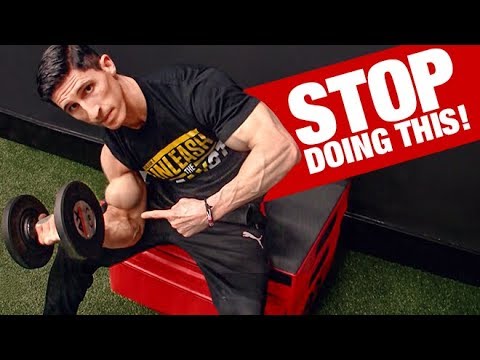
Concentration Cur Overview
The concentration curl is a seated move for your biceps. The biceps are the muscles on the front of your upper arm. You use one dumbbell and one arm at a time. You rest the back of your arm on your inner thigh. This locks your arm in place. It also works your forearm a little. The concentration curl is great for building a strong bicep peak. It is easy for beginners to learn. The seated setup stops you from swinging. This makes each rep strict and clean. Use it near the end of an arm workout. It is a great finisher after your bigger lifts.
What Is The Point of the Concentration Cur?
The concentration curl builds bigger biceps by isolating the muscle completely. It removes momentum and forces your biceps to do all the work for maximum growth.
How To Do The Concentration Cur
- Sit on the end of a flat bench with your feet planted wide and your torso leaned slightly forward. Hold a single dumbbell in one hand and let it hang between your legs. This position locks your arm in place so the biceps do the work.
- Brace the back of your working upper arm against the inside of your thigh, just above the knee. This is the whole point of the exercise. With the elbow pinned, you cannot swing or cheat, so every bit of tension lands on the biceps.
- Let the weight hang down with your arm nearly straight, keeping a slight bend so the joint stays protected. Take a breath and set your shoulder down, away from your ear.
- Curl the dumbbell up by contracting your biceps, not by heaving your shoulder. Keep the upper arm glued to your thigh the entire time and think about driving your pinky up toward your shoulder.
- Aim for a slow, deliberate lift of about two seconds. The elbow should be the only joint that moves, hinging like a door on a fixed frame.
- Squeeze hard at the top and hold that peak contraction for a full second. This is where the biceps peak really gets built, so do not rush past it.
- Lower the dumbbell under control over three seconds, resisting gravity the whole way. The eccentric, or lowering phase, is where a lot of growth happens, so do not just drop it.
- Return to the near-straight starting position, feel the stretch, and begin the next rep without letting the weight rest. Finish all your reps on one arm, then switch. Most lifters do best here in the 8 to 15 rep range.
Concentration Cur Form Tips
- Keep your upper arm still against your thigh. Only your forearm should move.
- Move slowly both up and down. Do not let the weight drop fast.
- Squeeze your biceps hard at the top. This builds the peak.
- Keep your wrist straight and firm. Do not let it bend back.
- Breathe out as you lift. Breathe in as you lower.
- Keep your back straight and chest up. Do not round over too far.
- Use a full range of motion. Straighten your arm at the bottom each rep.
- Keep your feet planted for a steady base.
- Do not swing your body. Let your biceps do the work.
Common Mistakes to Avoid for the Concentration Cur
- Letting the upper arm drift off your thigh. The whole value of this curl is the fixed elbow, and once your arm floats free you start swinging from the shoulder. Keep the back of the arm pressed hard into your inner thigh so the biceps has nowhere to hide.
- Using too much weight. Ego loading turns a clean, isolated curl into a jerky mess where momentum does the lifting. Drop the dumbbell size until you can move it smoothly with your elbow alone, then build up slowly with real reps.
- Rushing the lowering phase. Most people yank the weight up and then let it crash back down, throwing away the eccentric that builds so much of the arm. Fight gravity on the way down with a slow three-count and you will feel the difference within a week.
- Cutting the range of motion short. Stopping halfway up or not straightening the arm at the bottom robs the biceps of both its stretched and contracted positions. Go from a near-full stretch to a hard squeeze at the top on every single rep.
- Skipping the peak contraction. Blowing past the top without a pause means you miss the moment the biceps is working hardest. Hold the squeeze for a full second at the top and picture the muscle balling up under the skin.
- Twisting your torso to help the weight up. Rotating your body to sling the dumbbell recruits your back and shoulder and takes tension off the target. Stay still through the trunk and let only the forearm rise and fall.
- Flexing the wrist to curl. Bending at the wrist to fling the weight cheats the biceps and can strain the joint over time. Keep the wrist firm and neutral so the pull comes purely from the upper arm.
- Holding your breath through the set. Locking your breath spikes pressure and makes you dizzy on a small isolation move where it is not needed. Breathe out as you curl up and in as you lower for steady, controlled reps.
- Training only your dominant arm well. Because you work one side at a time, it is easy to grind harder on your strong arm and coast on the weak one. Match the reps and effort on both sides and let the weaker arm set the standard.
- Bouncing out of the bottom. Snapping the weight up from a dead hang uses the stretch reflex instead of muscle and invites a bicep tendon strain. Pause briefly at the bottom, then curl with intent from a controlled position.
- Shrugging the working shoulder up. When the weight gets heavy people raise the shoulder to assist, which pulls the trap into a bicep exercise. Keep the shoulder pressed down and locked so the arm stays the only mover.
Concentration Cur Workout Tips
- Treat this as your finisher, not your opener. The concentration curl shines at the end of an arm session when you want to fully isolate and pump the biceps after heavier compound pulls.
- Chase the mind-muscle connection here more than anywhere. Because the arm is braced and you are seated, you can pour all your focus into feeling the biceps contract, which is one of the most reliable ways to grow it.
- Use a slow three-second lowering phase on every rep. The eccentric portion drives a huge amount of growth, and this exercise is built for controlling it since you cannot use momentum.
- Supinate as you curl by turning your pinky up toward the ceiling. That extra rotation squeezes the biceps harder at the top and hits the peak of the muscle you see when you flex.
- Pause and squeeze for a full second at the top. This brief hold at peak contraction teaches the muscle to fire hard and adds quality to every rep without any extra weight.
- Keep the reps higher, roughly 8 to 15 per set. Small isolation moves respond better to moderate loads and controlled volume than to heavy grinding.
- Do your weaker arm first and let it set the rep count. Most people have a stronger side that quietly takes over on two-arm work, so single-arm curls are your chance to even things out.
- Film a set from the side once in a while. A quick phone video shows elbow drift and body swing far better than the lift feels in the moment.
- Try a slow four-second eccentric on your last set as a burnout. Fighting the weight down when you are already fatigued is a brutal but effective way to finish the biceps off.
- Do not let the weight rest at the bottom between reps. Keeping constant tension through the set is what makes the muscle burn and grow, so stop just short of a dead hang.
- Pair it with a stretch-focused move like an incline dumbbell curl. Combining a peak-contraction exercise with a stretched-position one hits the biceps from both ends of its range.
- Keep the shoulder pinned down throughout. A stable, depressed shoulder keeps the tension on the arm and protects the joint from creeping into the movement.
- Add weight only when your form stays perfect. Progressive overload matters, but on this move clean reps beat heavy ones every time, so earn each jump.
- Use a thumbless or full grip you find comfortable, but squeeze the handle hard. A tight grip sends a signal up the arm that helps the biceps contract more forcefully.
- Rest about 60 to 90 seconds between sets. That is enough to recover for quality reps without letting the pump fade completely.
- Be patient with the biceps peak. The shape of your arm is largely genetic, but consistent, focused curling over months builds the fullest muscle you can achieve.








Questions & Comments
Be the first to ask a question about this exercise.